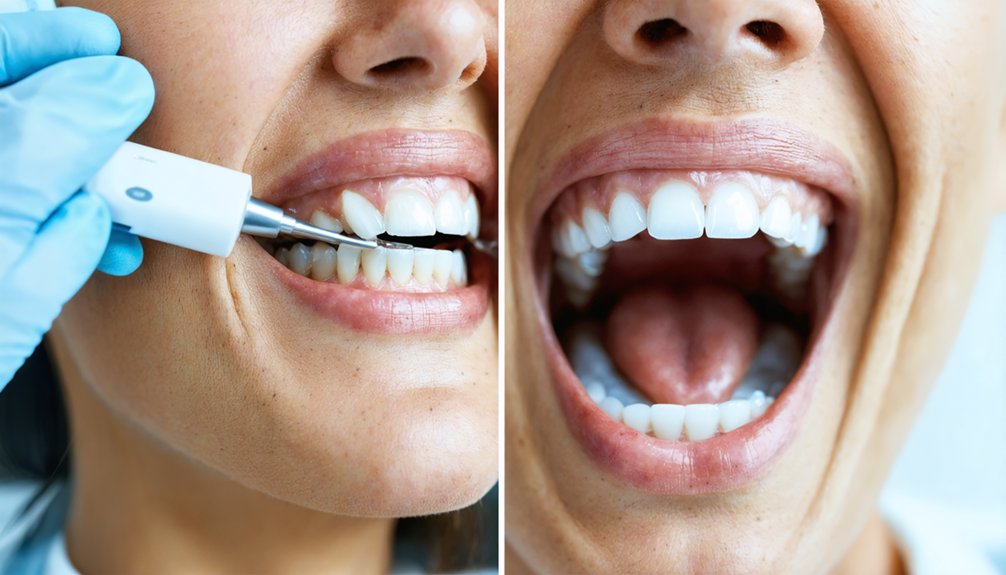
When comparing whitening strips to professional treatments, you’ll find significant differences in speed, cost, and effectiveness. Strips cost $20–$60 and improve teeth by 1–6 shades over two weeks, while professional treatments cost $300–$1,000 but deliver up to eight shades in a single visit. Professional results also last 1–3 years versus strips’ 3–6 months. Your ideal choice depends on your stain type, budget, and sensitivity tolerance—all factors worth examining closely.
Key Takeaways
- Professional whitening achieves up to 8 shades improvement in one visit, while strips deliver 1-6 shades over two weeks.
- Strips cost $20–$60 per box, whereas professional treatments range from $300–$1,000 but last significantly longer.
- Professional results last 1–3 years; strips fade within 3–6 months, requiring more frequent retreatment.
- Strips carry lower sensitivity risks, while professional treatments offer better precision and supervised gum protection.
- Strips suit mild, extrinsic stains; professional treatments better address deep, intrinsic stains from aging or medications.
Which Produces Better Results: Whitening Strips or Professional Treatment?
When comparing whitening outcomes, professional treatment consistently outperforms strips. Clinical evidence, including systematic reviews and meta-analyses, confirms that dentist-supervised whitening produces greater color change.
Professional whitening consistently outperforms strips, with clinical evidence confirming greater color change under dentist supervision.
In-office systems can deliver roughly eight shades of improvement in a single visit, while strips typically yield one to six shades over multiple sessions.
Treatment duration favors professional care if speed matters to you. Strips require approximately two weeks of daily 30-minute applications, totaling around seven hours.
Professional whitening is completed in one appointment lasting under an hour.
Cost comparison reveals a clear trade-off. Strips run $20–$60 per box, while professional treatment ranges from $300–$1,000.
However, professional results last one to three years versus three to six months for strips, reducing your long-term retreatment frequency.
How Much Does Each Whitening Option Actually Cost?
Here’s what controls your actual spend:
- Whitening strips require repurchase every 3–6 months, increasing annual costs.
- Dentist-provided take-home kits offer a middle ground at $100–$400, with stronger formulations than strips.
- In-office treatments last 1–3 years, reducing how often you’ll need retreatment.
You’re not just paying for the procedure—you’re paying for durability. When you calculate cost-per-month of maintained results, the price differences between options narrow considerably.
How Long Does Each Whitening Treatment Take?
If you choose whitening strips, you’ll commit to roughly 30 minutes of daily use over about two weeks, totaling approximately seven hours of cumulative treatment time.
Professional in-office whitening, by contrast, typically requires just one appointment lasting an hour or less.
Your schedule and patience for gradual results will largely determine which timeline works best for you.
Strip Treatment Time Requirements
Unlike professional whitening, which is typically completed in a single office visit lasting under an hour, whitening strips require daily 30-minute applications spread across roughly two weeks—totaling approximately seven hours of cumulative treatment time.
Unlike natural remedies or alternative options, strips use clinically measured peroxide concentrations, but their slower protocol reflects intentional limitations for unsupervised home use.
To manage your strip treatment schedule effectively, consider these structured expectations:
- Daily commitment: Apply strips consistently for 30 minutes each session without skipping days.
- Total duration: Plan for a 14-day protocol to complete the full treatment cycle.
- Cumulative time: Expect roughly seven total hours of active treatment across the two-week period.
This controlled, methodical approach suits those prioritizing gradual, self-managed whitening over speed.
Professional Whitening Visit Duration
Professional whitening compresses what strips require two weeks to accomplish into a single appointment lasting roughly 45 minutes to one hour. Your dentist applies a high-concentration peroxide gel, often activating it with a light source to accelerate the process. You leave with measurable results the same day.
That efficiency directly affects treatment scheduling. Instead of committing to 14 consecutive days of strip application, you block one controlled visit and move forward. When you factor cost comparison into your decision, the higher professional fee becomes more justifiable against the time investment strips demand.
If your schedule is unpredictable or you need results before a specific date, a single professional appointment gives you a defined, controllable timeline that over-the-counter protocols simply can’t match.
How Long Do Whitening Results Last?
When choosing between whitening strips and professional treatment, how long the results last is a key factor worth weighing carefully. Longevity differs considerably between both options, and your lifestyle habits directly control how long either result holds.
- Whitening strips typically last 3–6 months before noticeable fading occurs.
- Professional whitening can maintain results for 1–3 years with consistent maintenance.
- Diet impact from coffee, tea, wine, and tobacco accelerates fading in both cases.
Professional treatments last longer because stronger bleaching agents produce more complete stain reduction. Strips require more frequent reapplication, increasing your long-term cost.
If you want durable, predictable results with fewer repeat interventions, professional whitening gives you greater control over outcome and maintenance scheduling.
Which Option Is Safer for Teeth Sensitivity and Gum Health?
When weighing sensitivity risks, research shows that whitening strips actually carry a lower risk and intensity of tooth sensitivity than supervised at-home professional bleaching.
Professional treatments, however, offer stronger gum protection through precise gel placement controlled by a licensed dentist, reducing the likelihood of soft tissue irritation that improper strip application can cause.
Your safest choice ultimately depends on whether you prioritize minimizing sensitivity or ensuring supervised, controlled application that protects surrounding gum tissue.
Sensitivity Risks Compared
Both whitening strips and professional treatments carry sensitivity risks, but the evidence suggests they differ in meaningful ways.
A meta-analysis found that whitening strips produce lower sensitivity risk and intensity compared to supervised at-home bleaching. Here’s what you should know before choosing:
- Strips use milder peroxide concentrations, reducing nerve irritation but increasing exposure time.
- Professional treatments involve stronger agents that may trigger sharper sensitivity, though dental supervision allows immediate intervention.
- Natural whitening and alternative remedies carry fewer sensitivity risks but lack clinical evidence for meaningful color change.
If you prioritize control over sensitivity responses, strips offer a more gradual, self-managed approach.
If you want supervised risk management with faster results, professional treatment gives you trained oversight during application.
Gum Protection Methods
How your gums are protected during whitening depends largely on which method you choose. In a professional setting, your dentist applies a physical or chemical barrier to your gum tissue before gel application begins. This controlled approach minimizes gum irritation by keeping the bleaching agent precisely on the enamel surface. You’re not managing placement yourself, which reduces the risk of soft tissue contact.
With whitening strips, you control the fit and positioning. If the strip overlaps onto your gums, gel application effectively becomes unsupervised chemical exposure to soft tissue. Strips are designed with lower peroxide concentrations to offset this risk, but improper placement still causes gum irritation.
If gum protection is a priority, professional treatment gives you more reliable, verifiable control over where the bleaching agent contacts your mouth.
Supervision and Safety Levels
Gum protection is one piece of the broader safety picture, but sensitivity risk adds another layer worth examining carefully. Unlike alternative methods or home remedies, professional whitening gives you licensed oversight at every stage. Evidence clarifies the distinction:
- Sensitivity frequency is statistically lower with whitening strips than supervised at-home bleaching, per meta-analysis data.
- Gel concentration control is tighter under dental supervision, reducing unpredictable tissue exposure.
- Application accuracy is professionally managed, minimizing uneven results or irritation from incorrect strip placement.
You retain more control when a clinician monitors your treatment. Alternative methods and home remedies offer no such oversight, making strips the safer unsupervised choice—though professional supervision remains the highest-control option overall.
Are Whitening Strips or Professional Treatment Better for Your Stain Type?
Whether whitening strips or professional treatment will work better for you depends largely on what type of staining you’re dealing with. If your discoloration stems from diet considerations like coffee, tea, or wine, strips can effectively target those surface-level extrinsic stains. They function similarly to consistent home remedies, producing gradual improvement over roughly two weeks.
However, if your staining is intrinsic, caused by aging, medications, or deeper pigmentation, strips typically fall short. Professional treatment uses stronger peroxide concentrations that penetrate beyond surface enamel, making it the more appropriate choice for deeper discoloration.
Identify your stain type before committing to either option. Choosing the wrong method wastes time and money. Matching treatment strength to stain depth gives you the most controlled, predictable outcome.
Which Whitening Option Is Right for You?
Choosing the right whitening option comes down to four practical factors: cost, speed, stain depth, and how long you want results to last. Skip alternative methods and natural remedies—evidence doesn’t support them for meaningful color change. Instead, use these criteria to decide:
- Budget under $60 and mild surface stains: Whitening strips deliver 1–6 shades over two weeks with minimal oversight.
- Faster, deeper results: Professional treatment produces up to 8 shades in one visit and lasts 1–3 years.
- Sensitivity concerns: Strips carry a lower sensitivity risk than supervised bleaching protocols.
You’re in control of this decision. Match the method to your stain type, timeline, and budget—not marketing claims.
Frequently Asked Questions
Can Whitening Strips or Professional Treatments Work on Dental Crowns?
Neither whitening strips nor professional treatments can change your crown’s color due to dental crown limitations—artificial materials don’t respond to peroxide. You’ll find whitening strip effectiveness applies only to your natural surrounding teeth.
Does Teeth Whitening Affect Enamel Strength Over Time?
Studies show 78% of users report temporary sensitivity. Whitening doesn’t permanently weaken your enamel, but you’re increasing your sensitivity risk with overuse. Manage enamel erosion by following recommended protocols and spacing treatments appropriately.
How Soon After Whitening Can You Eat Normally Again?
You can typically resume normal eating within 24–48 hours post-whitening. Respect diet restrictions by avoiding staining foods initially. Monitor sensitivity concerns closely—if discomfort persists beyond 48 hours, consult your dentist before reintroducing temperature-extreme foods.
Can Pregnant Women Safely Use Whitening Strips at Home?
Brilliant timing for cosmetic experiments! You shouldn’t use whitening strips while pregnant. Current evidence doesn’t confirm their safety during pregnancy. Instead, explore home remedies and natural alternatives like baking soda. You’re in control—prioritize safety first.
Do Whitening Results Differ Between Upper and Lower Teeth?
Yes, your upper and lower teeth can respond differently due to variations in natural shade and enamel thickness. You’ll often notice upper teeth color brightens more visibly, as strips and gels contact them more evenly.
References
- https://www.reddit.com/r/beauty/comments/mhwitg/at_home_teeth_whitening_strips_40_bucks_vs/
- https://summitdentistryspokane.com/blog/why-you-should-get-professional-teeth-whitening-over-teeth-whitening-strips/
- https://nvorthodontics.com/teeth-whitening-strips-vs-professional-whitening-services/
- https://wewhiten.com/teeth-whitening-vs-whitening-strips/
- https://www.youtube.com/watch?v=S-TQeElIsAg
- https://www.lpdental.com/whitening-strips-professional-whitening/
- https://pubmed.ncbi.nlm.nih.gov/33215202/
- https://geodentalsa.com/professional-whitening-vs-whitening-strips-which-is-more-effective/
- https://linedentalaloha.com/blog/whitening-strips-vs-in-office-whitening
- https://www.copperfieldfamilydental.com/professional-teeth-whitening-vs-diy-strips-west-jordan/