Intrinsic stains form deep within your tooth’s dentin layer during development, making them structurally inseparable from the tooth itself. You’ll typically see gray, brown, white, or striped discoloration that standard whitening strips and professional cleanings simply can’t reach. Causes range from tetracycline exposure and dental fluorosis to trauma and genetic conditions. Effective treatment requires professional-grade bleaching, microabrasion, or restorative options like veneers or crowns — and there’s considerably more to understand before choosing your path forward.
Key Takeaways
- Intrinsic stains originate deep within the dentin layer, making them impossible to remove with standard cleaning or over-the-counter whitening products.
- Common causes include tetracycline antibiotics, excessive fluoride intake, physical trauma, root canal treatments, and genetic conditions like dentinogenesis imperfecta.
- Unlike extrinsic stains on enamel surfaces, intrinsic stains require intensive treatments such as professional bleaching or microabrasion for mild to moderate cases.
- Restorative options like veneers, dental bonding, and crowns effectively mask deep discoloration when bleaching proves insufficient.
- Long-term maintenance includes twice-daily brushing, flossing, limiting staining foods, and scheduling professional cleanings every six months.
What Are Intrinsic Stains and Why Are They Harder to Treat?
Unlike the surface-level discoloration that a routine polish can clear away, intrinsic stains originate deep within the dentin layer, making them structurally inseparable from the tooth itself.
These intrinsic stain characteristics — gray, brown, white, or striped patterns — typically develop during early childhood while the tooth is still forming, embedding discoloration beyond the reach of standard prophylactic methods.
Intrinsic stains form during tooth development — embedding discoloration too deep for standard prophylactic methods to reach.
That’s precisely where treatment challenges intensify. You can’t scale or polish away what lives inside the tooth structure.
Conventional whitening agents often fail to penetrate deeply enough to produce meaningful results, and aggressive bleaching can trigger sensitivity without delivering adequate correction.
Understanding the stain’s origin isn’t optional — it’s the foundation of any effective clinical strategy you’ll pursue moving forward.
Intrinsic vs. Extrinsic Stains: What’s the Visual Difference?
When you compare the two side by side, the visual distinction becomes clinically telling.
Extrinsic stains sit on the enamel surface — typically yellow or brown deposits from coffee, tobacco, or poor hygiene. They respond to professional cleaning and stain prevention protocols.
Intrinsic stains, however, originate within the dentin layer. You’ll recognize them by their gray, brown, white, or banded striped patterns that no amount of polishing removes. They’re embedded structurally, not superficially.
The difference matters because it directly shapes your aesthetic options.
Extrinsic cases allow conservative intervention. Intrinsic cases often demand bleaching, microabrasion, veneers, or crowns — depending on stain depth and cause.
Misidentifying one for the other wastes time and delays effective treatment. Accurate visual diagnosis is your first clinical advantage.
What Causes Intrinsic Stains Inside the Tooth?
Several factors can embed discoloration deep within your tooth’s dentin during its earliest stages of development.
If you took tetracycline antibiotics as a child or consumed fluoride-heavy well water, you may have introduced the most common chemical triggers for gray, brown, or white intrinsic staining.
Beyond medication and fluoride, physical trauma to a tooth, past root canal treatment, old amalgam restorations, or an inherited genetic condition can all initiate internal darkening that no surface polish will ever reach.
Childhood Medication And Fluoride
Tetracycline antibiotics and excessive fluoride intake rank among the most common culprits behind intrinsic staining, and both act during critical windows of early tooth development.
When administered during childhood, tetracycline binds directly to developing dentin, producing gray or brown discoloration that no surface treatment can reverse. Knowing this, you should ask your child’s physician about medication alternatives before accepting a tetracycline prescription.
Fluoride staining follows a similar developmental pattern.
Overexposure through fluoride sources like unregulated well water or excessive supplementation disrupts enamel mineralization, resulting in white spots or brown mottling characteristic of dental fluorosis.
You retain control by monitoring your child’s fluoride intake early—testing water supply levels and coordinating with your dentist to establish safe, precise consumption thresholds before visible damage occurs.
Trauma And Genetic Factors
Beyond medication and fluoride exposure, physical trauma and hereditary conditions introduce a separate and often overlooked pathway for intrinsic discoloration.
When you’ve experienced a blow to a tooth, the internal pulp can hemorrhage, releasing pigmented byproducts that permanently stain surrounding dentin. Past root canal treatment carries similar trauma implications, frequently resulting in progressive internal darkening that no surface treatment can reverse.
Genetic predisposition also shapes your tooth’s structural composition before it fully emerges.
Conditions like dentinogenesis imperfecta alter dentin formation at the cellular level, producing characteristic gray or brown discoloration embedded throughout the tooth.
Old amalgam restorations further compound the issue by leaching metallic pigments into adjacent dentin walls.
Recognizing these origins allows you to pursue targeted restorative solutions rather than ineffective surface-level interventions.
How Tetracycline and Fluorosis Create Permanent Discoloration
Among the most stubborn causes of intrinsic discoloration, tetracycline antibiotics and excessive fluoride ingestion chemically alter tooth structure during its developmental stage, producing stains that no polishing or scaling can touch.
Tetracycline effects occur when the antibiotic binds directly to calcium ions within developing dentin, creating gray or brown banding permanently locked inside the tooth matrix. The earlier the exposure, the deeper and more severe the discoloration becomes.
Tetracycline doesn’t stain teeth—it becomes part of them, locked inside the dentin where no polish can reach.
Fluorosis impact develops differently—excess fluoride disrupts enamel-forming cells, producing hypomineralized zones that appear as white spots, brown patches, or surface pitting.
Both conditions form during childhood, meaning you can’t reverse them through conventional hygiene. Understanding their distinct mechanisms allows your dental provider to select targeted treatments that actually address the stain’s origin rather than its surface.
Why Standard Whitening Products Won’t Fix Intrinsic Stains
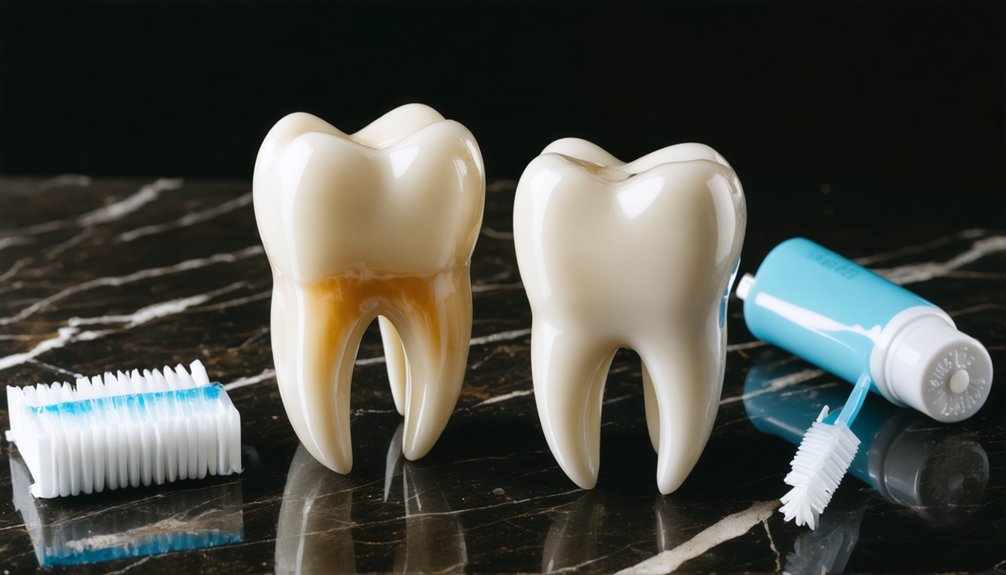
Knowing what creates these stains matters little if your treatment approach can’t reach them—and that’s exactly where standard whitening products fall short. Over-the-counter gels and strips work by oxidizing surface pigments, but intrinsic stains live within dentin—far beneath where these formulas penetrate.
This is one of the most persistent whitening misconceptions: that brighter means deeper. It doesn’t.
Even professional-grade peroxide must be applied strategically and for extended durations to affect internal discoloration. Standard protocols simply aren’t engineered for that depth. You can commit to stain prevention on the surface while simultaneously missing the structural source entirely.
Understanding this limitation shifts your focus where it belongs—toward clinically precise interventions like high-concentration in-office bleaching, microabrasion, or restorative solutions designed to address what whitening strips never could.
How Dentists Diagnose Intrinsic Stains Before Recommending Treatment
Before any treatment begins, your dentist must first distinguish intrinsic stains from surface deposits—a diagnostic step that shapes every clinical decision that follows.
Through precise diagnostic techniques, clinicians confirm whether discoloration originates within the dentin or merely sits on the enamel surface. Visual assessment alone isn’t sufficient; a structured evaluation is essential.
Your dentist will systematically examine:
- Medical and medication history — identifying tetracycline use or fluoride exposure during development
- Stain color and pattern — gray, brown, or banded appearances signal internal origin
- Response to professional cleaning — intrinsic stains persist after scaling and polishing
- Structural integrity — ruling out trauma or failed restorations causing internal darkening
This diagnostic precision guarantees you receive a targeted treatment protocol, not guesswork.
What Bleaching and Microabrasion Can Fix: and What They Can’t
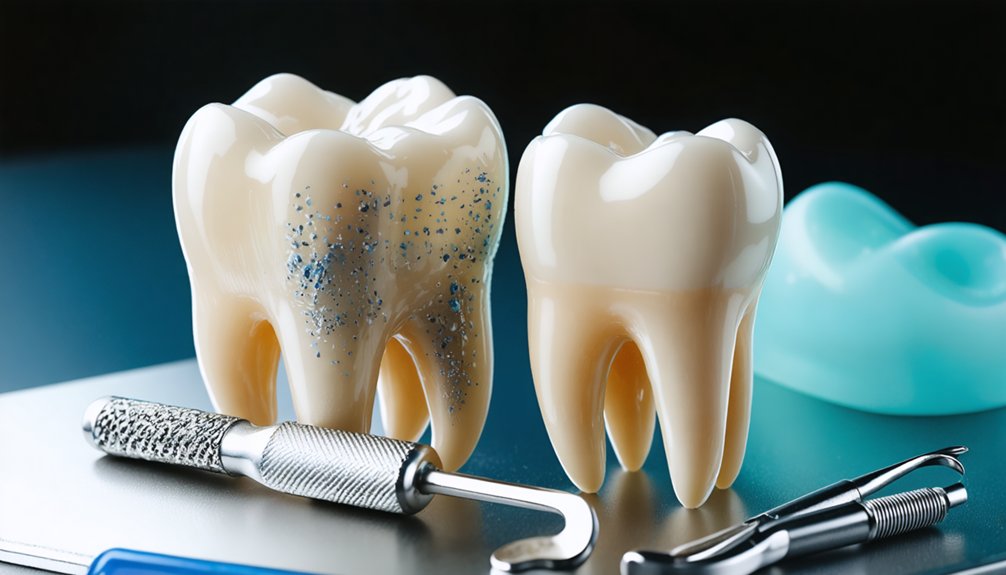
When your intrinsic stains stem from fluorosis or mild tetracycline exposure, bleaching and microabrasion can deliver meaningful results—reducing discoloration through high-concentration peroxide treatments or by removing microns of enamel to lighten surface-level pigmentation.
A stepwise bleaching protocol, sometimes extended up to a year, improves outcomes for moderate staining, while microabrasion works best when the discoloration remains shallow rather than deeply embedded in dentin.
However, you shouldn’t expect either method to fully resolve severe or resistant stains, where porcelain veneers, bonding, or crowns become the only reliable path to aesthetic correction.
Bleaching And Microabrasion Benefits
Bleaching and microabrasion each target intrinsic stains through distinct mechanisms, and understanding their limitations is just as important as recognizing their strengths.
Selecting the right approach requires evaluating stain depth, origin, and severity.
Bleaching techniques and microabrasion effectiveness are best understood through their documented outcomes:
- Bleaching reduces mild-to-moderate tetracycline discoloration using high-concentration peroxide applied over extended treatment periods.
- Microabrasion removes shallow fluorosis stains by eliminating microns of enamel, producing measurable surface clarity.
- Combined protocols—microabrasion followed by bleaching—deliver superior results for fluorosis cases with surface and subsurface involvement.
- A stepwise carbamide peroxide protocol, escalating from 10% to 20%, optimizes penetration without compromising enamel integrity.
You gain the most control by matching the correct modality to the stain’s clinical profile before committing to treatment.
Limitations Of These Treatments
Understanding what bleaching and microabrasion can realistically achieve is just as important as knowing how to apply them. Both treatments work best on mild to moderate stains — fluorosis responds well, but deep tetracycline discoloration often resists even extended bleaching protocols.
Setting accurate treatment expectations protects you from frustration and misguided investment. Bleaching can’t fully penetrate severely darkened dentin, and microabrasion removes only microns of enamel, limiting its effectiveness on deeply embedded stains.
Pushing beyond these boundaries risks sensitivity, enamel thinning, and diminishing returns. Patient motivation matters, but effort alone won’t overcome biological limits.
When conservative methods plateau, veneers, bonding, or crowns become the precise solution. Recognizing that threshold early keeps your treatment path efficient, controlled, and strategically sound.
Should You Get Veneers, Bonding, or a Crown for Intrinsic Stains?
If bleaching and microabrasion have failed to lift your intrinsic stains, restorative cosmetic options become the practical path forward—and choosing between veneers, bonding, and crowns depends on the stain’s severity, the tooth’s structural integrity, and your aesthetic goals.
Each option serves a distinct clinical purpose:
- Veneer considerations — Thin porcelain shells mask deep discoloration while preserving most natural tooth structure.
- Bonding advantages — Resin application costs less and requires minimal enamel removal, suiting mild cases.
- Crown durability — Full coverage crowns protect structurally compromised teeth while eliminating visible staining entirely.
- Treatment costs — Bonding ranks lowest, veneers mid-range, and crowns highest; your budget directly shapes your options.
Align your choice with both functional needs and aesthetic goals for lasting, confident results.
How Long Does Intrinsic Stain Treatment Actually Take?

Treatment timelines for intrinsic stain duration vary considerably depending on the stain’s origin, depth, and the method you and your dentist select.
Bleaching protocols for tetracycline-related staining demand patience—stain persistence means you’re often committing to extended sessions spanning six to twelve months before achieving measurable color matching results.
Fluorosis responds faster when microabrasion pairs with bleaching, compressing your timeline markedly.
If conservative approaches fail to meet your standard for treatment effectiveness, cosmetic enhancements like veneers or bonding deliver immediate, controlled outcomes.
Crowns take slightly longer due to fabrication requirements but offer structural precision alongside aesthetics.
Regardless of the method, long-term results depend on your maintenance strategies.
Consistent oral hygiene and periodic professional monitoring protect your investment and prevent new discoloration from undermining prior treatment gains.
Set realistic patient expectations early.
How to Keep Intrinsic Stain Treatments Looking Their Best Long-Term
Once your dentist completes your intrinsic stain treatment, protecting that investment requires consistent daily oral hygiene—brushing twice daily with a non-abrasive fluoride toothpaste and flossing to prevent surface deposits from compromising your results.
You’ll also want to schedule regular professional maintenance visits every six months, allowing your dental team to monitor the integrity of veneers, bonding, or bleaching outcomes before minor issues escalate.
Staying proactive with both home care and clinical check-ups guarantees your treated teeth retain their aesthetic clarity long-term.
Daily Oral Hygiene Habits
After investing time and resources into bleaching, microabrasion, veneers, or bonding, you’ll want daily habits that actively protect those results.
Dispelling whitening myths starts here — no rinse or over-the-counter strip maintains restorative work effectively. Precision matters more than product quantity.
- Brush twice daily using a non-abrasive fluoride toothpaste to protect enamel integrity without degrading bonding or veneer surfaces.
- Master flossing techniques by sliding gently along restorative margins to prevent stain-trapping plaque accumulation without dislodging edges.
- Limit chromogenic foods and beverages — coffee, red wine, and dark sauces accelerate surface staining on exposed natural tooth structure.
- Schedule professional cleanings every six months to remove deposits before they compromise treatment longevity.
Consistency in these four areas directly controls how well your results hold.
Regular Dental Maintenance Visits
Maintaining the results of bleaching, microabrasion, veneers, or bonding long-term depends heavily on how consistently you engage with professional dental care.
Schedule cleanings every six months to remove extrinsic buildup that can visually compromise your restorations or treated enamel. Your dentist will monitor existing intrinsic stains for progression and evaluate whether retreatment is necessary.
Preventive care appointments also allow early detection of new concerns before they escalate into structural or cosmetic complications. If you’ve invested in veneers or bonding, professional polishing protocols specific to those materials protect their surface integrity.
Consistent dental hygiene reinforced through clinical visits creates a controlled environment where your treatment outcomes remain predictable and stable.
Skipping appointments introduces variables that gradually erode the precision you’ve worked to achieve.
Frequently Asked Questions
Can Intrinsic Stains Worsen Over Time Without Any Treatment?
Yes, intrinsic stains can worsen without intervention. You’re allowing stain progression to deepen within your dentin, limiting future treatment options. Act decisively—conservative bleaching or restorative solutions become increasingly critical as discoloration intensifies over time.
Are Intrinsic Stains Hereditary and Passed Down Through Families?
Some intrinsic stains can be hereditary. If your genetic factors align with a family history of enamel defects or dentin irregularities, you’re likely inheriting those same structural vulnerabilities that cause internal discoloration.
Do Intrinsic Stains Affect the Structural Strength of Teeth?
Intrinsic stains don’t typically weaken your tooth structure themselves, but their stain causes—like trauma or decay—can compromise integrity. You’ll want to address underlying issues promptly to maintain both aesthetic appearance and long-term dental strength.
Can Children Receive Treatment for Intrinsic Stains Before Adulthood?
Yes, you can pursue pediatric dental options early, but dentists typically delay definitive treatment until adulthood. They’ll monitor tooth discoloration causes and may use conservative bleaching temporarily, reserving veneers or crowns until your teeth fully mature.
Does Dental Insurance Typically Cover Intrinsic Stain Treatment Costs?
Like maneuvering through a maze, dental coverage for intrinsic stains can be tricky. Insurance typically won’t cover cosmetic treatment options, so you’ll need to budget independently for bleaching, veneers, or bonding procedures.
References
- https://ijcrt.org/papers/IJCRT2501548.pdf
- https://dimensionsofdentalhygiene.com/article/how-to-treat-intrinsic-stain/
- https://jamesstewartdds.com/tooth-stains-intrinsic-vs-extrinsic/
- https://www.dentalcare.com/en-us/ce-courses/ce491/staining-types-and-causes
- https://www.apexxdental.com/resources/extrinsic-vs-intrinsic-teeth-stains/
- https://www.todaysrdh.com/dental-stain-hygienists-can-ascertain-source-help-increase-dental-patient-confidence/
- https://www.rwatsondds.com/blog/2018/08/08/intrinsic-vs-extrinsic-tooth-stains-192463/
- https://crest.com/en-us/oral-care-tips/teeth-stains/teeth-stains-causes-types-how-remove-teeth-stains
- https://www.double-white.com/blog/intrinsic-vs-extrinsic-stains-guide.html
- https://www.teethwhitening.london/blog/intrinsic-extrinsic-tooth-stains-difference