Tetracycline stains bind deep into dentin, making them far more resistant to whitening than surface discoloration. You’ll need professional-grade solutions like in-office bleaching, custom tray protocols, or deep bleaching combinations to see real results. Maintenance products, lifestyle adjustments, and veneers round out your full range of options when bleaching alone won’t cut it. Each approach targets a different severity level, and knowing which one fits your case makes all the difference.
Key Takeaways
- Professional in-office bleaching using high-concentration hydrogen peroxide gels with laser activation delivers visible results within 6-12 sessions for tetracycline stains.
- Custom tray bleaching with 10-15% carbamide peroxide applied nightly for 8-12 weeks can lighten stains by 2-4 value shades.
- Deep bleaching protocols combining in-office power bleaching with nightly home tray applications outperform individual whitening methods for severe stains.
- Porcelain or composite veneers effectively mask deep tetracycline chromatic bands when peroxide-based treatments fail to produce adequate results.
- Eliminating staining agents like coffee, tea, and tobacco while maintaining biannual professional cleanings preserves long-term whitening results.
What Makes Tetracycline Stains So Hard to Whiten?
Tetracycline stains resist conventional whitening because the antibiotic molecules bind directly to calcium ions within developing dentin, embedding chromogens deep beneath the enamel surface where topical bleaching agents struggle to penetrate.
Understanding tetracycline origins clarifies why standard treatments fail—exposure during tooth development permanently incorporates stain molecules into mineralized tissue, not merely onto it.
Tetracycline stains aren’t surface-level—they’re permanently locked into mineralized tissue formed during tooth development.
Stain characteristics vary by severity, ranging from uniform yellowing to banded gray-brown discoloration, directly influencing whitening challenges you’ll face.
Darker, banded stains demand extended bleaching protocols, often requiring months of consistent treatment rather than days.
Treatment considerations must account for stain depth, band location, and enamel thickness before selecting an intervention.
You’re not dealing with surface contamination—you’re addressing structurally embedded pigmentation requiring deliberate, methodical clinical strategy.
Professional In-Office Bleaching for Tetracycline Stains
When bleaching embedded tetracycline chromogens, professional in-office treatments deliver the concentrated penetration that over-the-counter products can’t match.
Your dentist applies high-concentration hydrogen peroxide gels—up to 35-40%—directly onto stained enamel, breaking stubborn chromogen bonds that lower-grade formulas simply can’t reach.
Laser or light-accelerated activation further accelerates stain molecule breakdown within 60-90 minutes per session.
The in-office advantages are clear: immediate visible results after each visit, precise application control, and professionally monitored sensitivity management.
Expect 6-12 sessions for meaningful lightening on severe staining.
Treatment costs reflect this clinical precision, making professional bleaching a deliberate investment rather than an impulse purchase.
Pairing in-office sessions with home tray maintenance prevents color rebound, protecting your results and maximizing the return on that investment.
Custom Tray Bleaching: The Most Predictable Home Method
When your dentist fabricates custom-fitted trays, they guarantee precise gel-to-tooth contact that eliminates uneven bleaching and minimizes gum exposure to carbamide peroxide.
You’ll apply a 10–15% carbamide peroxide gel nightly for 8–12 weeks, allowing the agent to penetrate tetracycline bonds at a controlled, sustained rate.
Consistent long-term use over 3–12 months can lighten stains by 2–4 value shades, making custom tray bleaching the most clinically reliable home-based strategy for intrinsic discoloration.
Tray Fit And Precision
Custom-fitted trays are the backbone of effective at-home tetracycline bleaching, and their precision directly determines how well the carbamide peroxide gel contacts your stained tooth surfaces. Ill-fitting trays allow gel to migrate onto gum tissue, reducing concentration at the stain site while increasing sensitivity risk.
Your dentist takes precise impressions to fabricate trays that conform exactly to your tooth contours, ensuring uniform gel distribution across every stained surface. Tray comfort isn’t incidental — it’s critical. Comfortable trays encourage consistent overnight wear, which tetracycline cases demand for weeks or months.
Mastering application technique matters equally. Load only a small gel drop per tooth compartment, seat the tray firmly, and wipe excess immediately. This precision maximizes peroxide contact time directly where deep stain penetration is needed most.
Long-Term Bleaching Results
Precision tray fit sets the stage, but the real measure of success is what happens over months of consistent overnight use. Tetracycline stains don’t respond to short-term protocols—they demand sustained chemical exposure.
With 10-15% carbamide peroxide applied nightly over 8-12 weeks, you’re driving peroxide deep into enamel layers where intrinsic bands actually reside.
The long-term benefits compound progressively. Clinical data confirms that continuous nightly application across three, six, or even twelve months can lighten stains by 2-4 value shades—results short-term treatments simply can’t replicate.
Treatment effectiveness depends entirely on your commitment to the protocol. You control the outcome. Skipping applications stalls progress and extends your timeline.
Maintain consistency, and you’ll achieve measurable, documented lightening even when complete stain elimination remains structurally impossible.
Deep Bleaching When Office and Home Treatment Both Fall Short
When neither in-office power bleaching nor extended home tray therapy fully resolves your tetracycline staining, deep bleaching combines both approaches to maximize penetration and lightening beyond what either method achieves alone.
You’ll begin with chairside power sessions to activate deep stain breakdown, then shift to nightly custom tray applications to sustain and build on those results.
Maintaining your outcome long-term requires accelerated maintenance protocols—periodic strip or chairside touch-ups—to prevent color regression and lock in the shades you’ve worked to achieve.
Combining Chairside And Home
Neither chairside power bleaching nor extended home tray therapy alone can fully address severe tetracycline staining—but combining both through deep bleaching protocols greatly improves outcomes.
This chairside synergy leverages high-concentration peroxide gels to penetrate deep enamel layers during in-office sessions, breaking stubborn tetracycline bonds that surface treatments can’t reach.
You then shift directly to home enhancement using custom-fitted trays with 10-15% carbamide peroxide, sustaining and amplifying the initial lightening achieved chairside.
Power bleaching acts as the catalyst; your nightly tray applications lock in results and push stain reduction further over weeks.
Clinical evidence confirms this combined approach outperforms either method independently, delivering measurable shade improvements across multiple treatment cycles while reducing color rebound through consistent, disciplined maintenance on your schedule.
Maintaining Results Long-Term
Even with deep bleaching protocols in place, sustaining your results demands a structured, long-term maintenance strategy—because tetracycline staining has a persistent tendency to rebound without consistent intervention.
Commit to nightly custom tray applications every few months as effective touch ups to counter color regression before it escalates. Incorporate low-concentration peroxide rinses daily and switch to high-fluoride whitening toothpaste to reinforce enamel integrity between professional sessions.
Eliminate staining agents—coffee, tea, tobacco—that accelerate pigment redeposition onto treated surfaces. Schedule periodic chairside power bleaching sessions to reset any visible rebound.
Long term maintenance isn’t optional with tetracycline cases; it’s the defining factor between sustained improvement and wasted clinical investment. You control the outcome by treating maintenance as a protocol, not an afterthought.
Whitening Strips as a Low-Cost Option for Tetracycline Stains
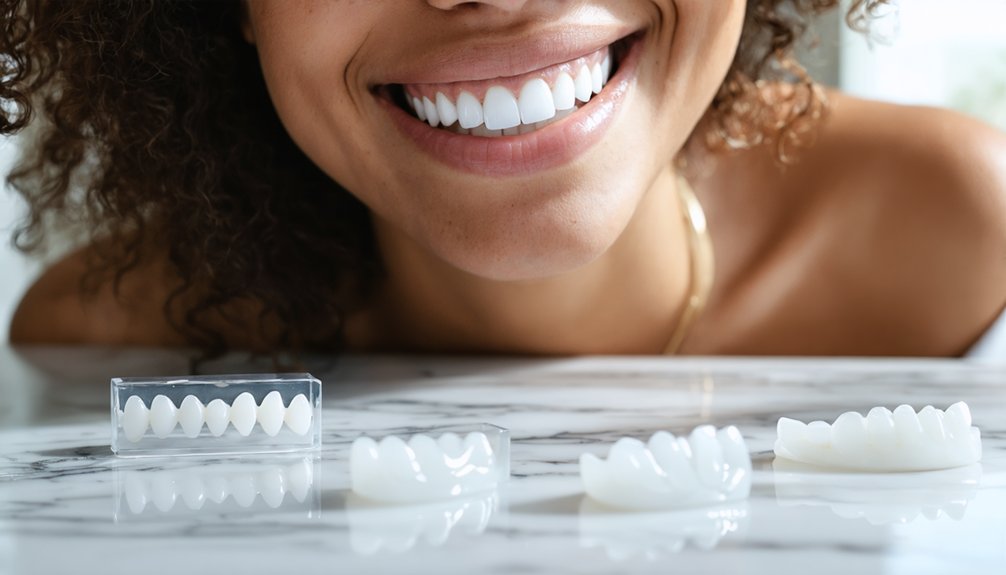
Although whitening strips won’t fully eliminate deep tetracycline bands, they’re a clinically viable, low-cost adjunct that can meaningfully support your overall bleaching protocol.
Clinical studies confirm 6.5% hydrogen peroxide strips match 15% carbamide peroxide tray whitening efficacy over three months, making their cost-effectiveness undeniable.
Maximize your results by understanding three key factors:
- Treatment Duration – Consistent daily use over 8–12 weeks delivers measurable shade improvement.
- Sensitivity Concerns – Lower-concentration formulas minimize enamel irritation during extended protocols.
- Ease of Use – Strips integrate seamlessly into maintenance routines between professional sessions.
Comparison reviews and user experiences consistently validate strips as reliable maintenance tools.
They won’t replace chairside power bleaching, but they’ll strategically extend and protect your whitening investment between professional treatments.
How Long Tetracycline Whitening Actually Takes by Treatment Type
When choosing a tetracycline whitening treatment, you need to understand that timelines vary dramatically depending on the method you select.
In-office power bleaching delivers visible results within a single 60-90 minute session, yet you’ll typically require 6-12 visits to achieve meaningful lightening of deep stains.
Treatment Timelines By Type
Understanding how long tetracycline whitening takes depends entirely on which treatment path you choose, since each method operates on a different mechanism and penetration depth.
Treatment duration directly influences your effectiveness comparison across options.
- In-Office Bleaching: Requires 6–12 sessions using 35–40% hydrogen peroxide, delivering immediate but incremental results per visit.
- Custom Tray Home Bleaching: Demands 8–12 weeks of nightly application, with ideal outcomes emerging at 3–12 months of consistent use.
- Deep Bleaching Protocol: Combines chairside activation with home maintenance, maximizing penetration while controlling color regression long-term.
Each timeline reflects the stain’s intrinsic depth, not surface-level discoloration.
You must commit to the full recommended duration—cutting treatment short guarantees incomplete results and color rebound.
Faster Vs. Longer Methods
Knowing the timeline for each treatment type sets the stage for a more practical question: which method actually gets you results faster, and what trade-offs come with that speed?
In-office bleaching delivers fast results—you’ll see visible lightening within your first session. However, tetracycline stains run deep, meaning those sessions must repeat 6–12 times before meaningful change holds.
You’re trading time-per-visit efficiency for a slower cumulative outcome.
Extended home tray bleaching demands patience, but gradual improvement over 3–12 months often outperforms rushed chairside treatments in final shade quality.
You control the pace and minimize sensitivity risks.
Combination protocols offer the strongest balance—chairside treatments accelerate early progress while home applications lock in lasting results.
If you want both speed and stability, deep bleaching isn’t optional; it’s the strategic choice.
Whitening Toothpastes and Rinses That Protect Your Results
After investing weeks or months into whitening tetracycline-stained teeth, you’ll want products that protect those hard-won results. Whitening toothpastes and rinses won’t eliminate deep intrinsic bands, but they’re essential maintenance tools that preserve your progress through targeted whitening ingredients and enamel protection.
Incorporate these three product strategies into your daily routine:
- Whitening toothpastes with gentle abrasives and high-fluoride formulas remove surface residues while strengthening enamel integrity.
- Low-concentration peroxide rinses (1-3%) deliver mild daily bleaching that combats color regression between professional sessions.
- Remineralizing rinses counteract prolonged bleaching agent exposure, maintaining enamel density and reducing sensitivity.
These adjunctive products don’t replace professional treatment—they extend it. Consistent daily use keeps your results stable and prevents preventable discoloration from reversing your investment.
When Tetracycline Bleaching Fails, Veneers Fill the Gap
Even after completing extended bleaching protocols, some tetracycline stains—particularly severe Grade III or IV banding—simply won’t respond to peroxide-based treatments.
When bleaching reaches its ceiling, veneers become your most reliable restorative solution.
Porcelain and composite veneer materials each offer distinct advantages.
Porcelain delivers superior opacity, masking deep chromatic bands without requiring aggressive tooth reduction.
Composite resin provides a less invasive, cost-effective alternative for localized discoloration.
Pre-cementation opaquing guarantees dark underlying dentin doesn’t compromise your final aesthetic outcome.
Veneer longevity depends heavily on material selection, occlusal forces, and your maintenance commitment.
Porcelain veneers typically last 10-20 years with proper care, while composite options require earlier replacement.
Choosing the right veneer system transforms untreatable staining into a controlled, predictable cosmetic result you can confidently depend on long-term.
Lifestyle Habits That Prevent Tetracycline Stains From Returning
Protecting your whitening results requires the same discipline as achieving them. Tetracycline stains are resistant, and without deliberate lifestyle changes, external factors accelerate regression.
You’ve invested significant time and resources—don’t surrender those gains to preventable habits.
Implement these three dietary adjustments and behavioral controls immediately:
- Eliminate staining consumables — Cut coffee, tea, red wine, and berries from your daily routine or rinse immediately after consumption.
- Quit tobacco entirely — Smoking reintroduces surface staining and undermines gum health supporting your restored teeth.
- Maintain professional cleaning schedules — Biannual cleanings remove plaque buildup that locks in discoloration before it penetrates deeper layers.
Pair these habits with low-concentration peroxide rinses nightly.
Consistency isn’t optional—it’s the mechanism that preserves everything you’ve worked to achieve.
How to Match the Right Tetracycline Treatment to Your Stain Severity
Not all tetracycline stains respond to the same treatment, and mismatching your protocol to your stain severity wastes time, money, and enamel integrity.
Tetracycline severity determines everything—your bleaching concentration, session frequency, and whether restorative intervention becomes necessary.
For mild to moderate banding, extended at-home carbamide peroxide trays worn nightly for 8-12 weeks deliver measurable improvement.
Moderate-to-severe cases demand combination deep bleaching protocols where chairside power sessions precede sustained home tray maintenance.
When treatment matching fails to achieve acceptable aesthetics despite prolonged bleaching, porcelain veneers or composite bonding provide definitive masking solutions.
You must assess stain grade before committing to any protocol.
Skipping this diagnostic step guarantees suboptimal outcomes.
Consult a cosmetic dentist who quantifies stain depth before recommending your individualized whitening strategy.
Frequently Asked Questions
Can Tetracycline Stains Affect Children’s Permanent Teeth After Antibiotic Exposure?
Tetracycline exposure absolutely can permanently stain your child’s developing permanent teeth. You’re gambling with their dental health if antibiotics are administered during tooth formation—consult your dentist immediately to explore safer antibiotic alternatives.
Does Dental Insurance Ever Cover Bleaching Treatments Specifically for Tetracycline Discoloration?
Most insurance policies won’t cover bleaching treatment options for tetracycline discoloration since they’re deemed cosmetic. You’ll need to explore flexible spending accounts or payment plans to take control of your whitening investment effectively.
Are Tetracycline Stains Hereditary or Exclusively Caused by Antibiotic Use?
Tetracycline stains aren’t hereditary — antibiotic effects exclusively cause them. Imagine a child treated for pneumonia at age six; genetic factors don’t trigger discoloration, but that antibiotic exposure permanently bonds pigments into your developing enamel.
Can Tetracycline Whitening Treatments Be Safely Performed During Pregnancy?
You shouldn’t pursue tetracycline whitening treatments during pregnancy due to serious safety concerns. Instead, you’ll want to explore treatment alternatives like enhanced oral hygiene and lifestyle modifications until after delivery to protect both you and your baby.
Do Tetracycline Stains Worsen Naturally With Age Without Any Treatment?
Yes, your tetracycline stains can worsen through age-related discoloration and natural stain progression. Without treatment, enamel thins, revealing darker dentin beneath, intensifying those bands. You’re losing ground daily—proactive whitening intervention keeps deterioration from compounding further.
References
- https://www.healthline.com/health/tetracycline-teeth
- https://pocketdentistry.com/whitening-treatments-for-tetracycline-discoloration/
- https://smilepath.nz/blogs/blog/teeth-whitening-for-tetracycline-teeth
- https://www.sciencedirect.com/science/article/abs/pii/S0300571217300982
- https://www.trysnow.com/blogs/news/how-to-whiten-teeth-damaged-by-tetracycline
- https://www.hilarispublisher.com/open-access/managing-tetracycline-staining-with-whiteningfocused-oral-hygiene-regimens.pdf
- https://www.korwhitening.com/see-kor-whitening-helped-tetracycline-patients/
- https://clubwhitesmile.com/how-to-safely-whiten-teeth-with-tetracycline-stains/
- https://static1.squarespace.com/static/5dc43d56f1a40f72ec167c68/t/5e29af530199a14a22960d4a/1579790171477/1777685010ADT_ManagementofTetracyclineDamagedTeeth_Nov08.pdf
- https://pubmed.ncbi.nlm.nih.gov/12666888/