Tetracycline stains are difficult to remove because they’re not on your teeth—they’re locked inside them. During tooth development, tetracycline binds with calcium to form stable complexes within dentin’s hydroxyapatite crystals, embedding the discoloration beneath your enamel where topical treatments can’t reach. Standard whitening agents only target surface chromogens, leaving dentin-bound stains untouched. Gray and brown tones resist oxidation longer than yellow stains, compounding the challenge. Understanding what’s actually happening inside your tooth structure explains everything.
Key Takeaways
- Tetracycline binds with calcium ions during tooth development, forming stable complexes permanently embedded within dentin’s crystalline structure beneath the enamel surface.
- Stain molecules are locked below the enamel surface, making them completely unreachable by topical whitening treatments or surface abrasives.
- Standard whitening agents cannot penetrate deeply enough to affect stains chemically bonded within dentin’s hydroxyapatite crystals.
- Gray and brown tetracycline stains resist oxidation longer than yellow tones, making them significantly harder to break down chemically.
- Aggressive bleaching only oxidizes enamel unevenly, potentially worsening appearance by increasing contrast between lightened enamel and dark underlying stains.
Why Tetracycline Stains Form Inside the Tooth, Not on It
When tetracycline enters the bloodstream during tooth development, it binds directly with calcium ions to form stable tetracycline-calcium orthophosphate complexes within the mineralizing dentin matrix.
This process embeds the compound beneath the enamel surface, producing intrinsic discoloration that no topical treatment can reach. The developmental impact is permanent because the stain integrates into the tooth’s structural foundation, not its outer layer.
Tetracycline staining isn’t surface-level — it’s permanently woven into the tooth’s structural foundation, unreachable by topical treatments.
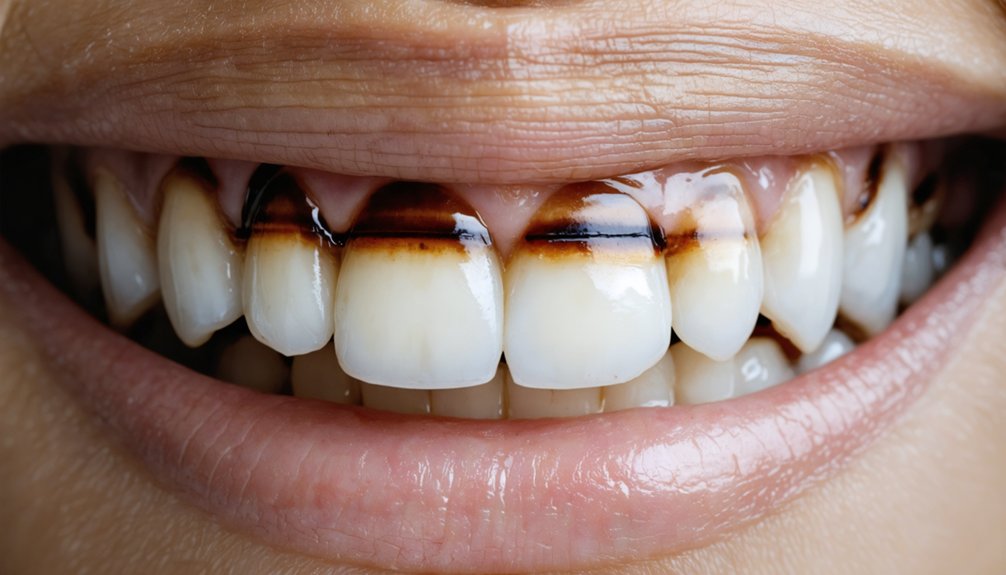
You’re dealing with a biochemical bond that forms during calcification, making the discoloration part of the dentin itself. Gray, brown, or bluish horizontal bands appear depending on when exposure occurred and for how long.
Since the staining originates below the enamel, surface abrasives, whitening strips, and standard bleaching agents fail to penetrate deeply enough to produce meaningful results.
Why Tetracycline Stains Penetrate Too Deep for Whitening to Reach
Because tetracycline binds tightly to the dentin matrix during mineralization, the stain doesn’t sit near the enamel surface where whitening agents operate—it’s embedded within the dentin’s crystalline structure at depths most bleaching compounds can’t penetrate.
Stain prevention requires early intervention; once mineralization completes, treatment alternatives become your only viable path.
Visualize what you’re working against:
- Stain molecules locked inside dentin columns, beyond enamel’s translucent outer shell
- Bleaching agents diffusing outward before reaching discolored dentin layers
- Horizontal pigment bands running through the tooth’s full structural depth
- Cervical regions resisting penetration due to dentin thickness increases
- Surface whitening revealing uneven enamel clarity while underlying stains remain unchanged
Standard whitening doesn’t fail because of application error—it fails because the chemistry physically can’t reach the compromised zone.
Why Dentin Makes Tetracycline Stains Impossible to Bleach Away
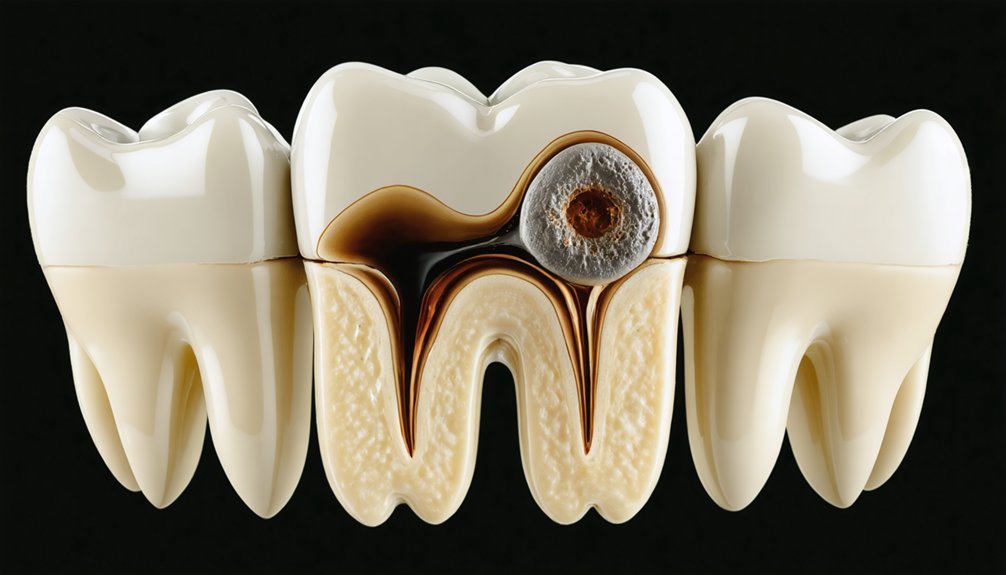
When tetracycline binds to calcium during tooth mineralization, it embeds itself into the dentin matrix at a molecular level, making it structurally inseparable from the tooth itself.
Bleaching agents work by oxidizing surface and near-surface chromogens, but they can’t penetrate deeply enough to reach dentin-bound tetracycline molecules sitting beneath the enamel layer.
This structural barrier means that even aggressive bleaching protocols oxidize the enamel above the stain rather than the stain itself, leaving the discoloration largely intact.
Dentin’s Deep Binding
Tetracycline binds irreversibly to hydroxyapatite crystals within dentin during the tooth’s mineralization phase, forming stable tetracycline-calcium orthophosphate complexes that embed beneath the enamel surface.
This dentin structure integration creates stain permanence that surface treatments can’t reverse.
- Tetracycline molecules penetrate below the enamel layer, locking into dentin’s mineral matrix.
- Stains appear as horizontal bands or uniform darkening throughout the tooth’s core.
- The cervical third contains thicker dentin, intensifying discoloration in that region.
- Bleaching agents oxidize surface pigments but can’t reach dentin-bound tetracycline complexes.
- Gray and brown shades resist even professional-grade whitening protocols.
You’re dealing with a molecular-level bond that conventional treatments weren’t designed to address.
Understanding this mechanism lets you make informed decisions about pursuing realistic, evidence-based solutions.
Bleaching’s Structural Limitations
Dentin’s molecular grip on tetracycline explains precisely why bleaching fails structurally, not just chemically. When you apply bleaching agents, they penetrate enamel but can’t reach tetracycline molecules embedded within dentin’s crystalline matrix. The stain sits below the treatment threshold.
Extended bleaching attempts introduce significant bleaching risks. Prolonged peroxide exposure degrades enamel’s structural integrity, accelerating erosion and increasing vulnerability to decay. You’re fundamentally damaging healthy tissue while the stain remains intact.
Severe gray or brown tetracycline bands respond minimally even after months of professional treatment. The cervical third—where dentin thickens near the gum line—resists penetration most aggressively.
You can’t bleach what you can’t reach. The chemistry is correct; the anatomy is the barrier.
Why Whitening Can Make Tetracycline Stains Look More Uneven
When you apply whitening agents to tetracycline-stained teeth, the enamel lightens unevenly because bleaching targets only the outer, less-pigmented zones while leaving the deeper, dentin-bound stain intact.
This differential response reveals previously masked banding patterns, making horizontal striations appear sharper and more pronounced than before treatment.
You can end up with a result that looks more visually disruptive than the original stain, as the contrast between lightened enamel and persistent dark bands intensifies.
Bleaching Reveals Hidden Bands
Bleaching often exposes banding patterns that weren’t visible before treatment began. One of the most common treatment misconceptions is that bleaching techniques lighten tetracycline stains uniformly. They don’t. Tetracycline deposits in horizontal striations during tooth development, and bleaching accelerates contrast between lighter enamel and darker dentin-bound bands.
What you’ll likely observe post-bleaching:
- Bright white zones appearing between darkened horizontal bands
- Gray or brown striations becoming sharper against lightened enamel
- Cervical thirds retaining deeper pigmentation than incisal edges
- Blotchy, uneven coloration replacing previously uniform discoloration
- Increased visual contrast making staining appear worse than pre-treatment
This contrast effect occurs because tetracycline binds tightly to dentin, resisting oxidation that bleaching agents achieve on surrounding enamel.
You’re not reversing the stain—you’re highlighting it.
Uneven Enamel Lightening Effects
The contrast problem extends beyond band visibility alone—enamel itself doesn’t lighten uniformly when exposed to bleaching agents, which compounds the visual irregularity you’re already dealing with.
Tetracycline-affected teeth exhibit inconsistent enamel color distribution, meaning bleaching agents penetrate and react at variable rates across the tooth surface. Thicker enamel regions lighten faster, while thinner cervical zones resist treatment, creating patchwork discoloration.
This uneven response directly alters light reflection patterns—areas that bleach successfully appear brighter and more translucent, while undertreated zones retain darker hues, amplifying contrast rather than reducing it.
You’re fundamentally making compliant zones visually compete against resistant ones.
Clinically, this outcome confirms that bleaching alone can’t standardize enamel response in tetracycline cases, particularly moderate-to-severe classifications requiring restorative intervention.
Why Bleaching Tetracycline Stains Takes So Long
Unlike surface stains that respond quickly to whitening agents, tetracycline stains bind deeply within the dentin structure, requiring extended treatment durations averaging 3–4 months and, in severe cases, up to 12 months.
Bleaching duration depends on stain severity, shade, and patient compliance throughout each session cycle.
- Stain molecules sit embedded below the enamel surface, far from topical agents.
- Bleaching agents must slowly diffuse through enamel to reach dentin-bound tetracycline.
- Gray and brown shades resist oxidation longer than yellow-toned discoloration.
- Missing sessions or inconsistent application resets measurable progress.
- KöR bleaching delivers the strongest non-invasive penetration over a structured 6-week protocol.
You’re working against a chemically bonded stain, not a film.
Consistent, disciplined application determines whether treatment produces meaningful results or stalls entirely.
Your Real Options for Treating Tetracycline Stains
Treating tetracycline stains requires matching the severity of your discoloration to the appropriate intervention, since no single option works across all cases.
Natural remedies and standard whitening fail against intrinsic dentin-bound stains, making professional treatments your most viable path forward.
For mild staining, KöR bleaching delivers the strongest non-invasive results over approximately six weeks.
Moderate cases may respond to extended professional bleaching spanning three to four months.
Severe gray or brown discoloration typically requires porcelain veneers, which demand 0.25–0.75mm of enamel reduction but deliver predictable, lasting coverage.
Dental bonding suits mild presentations but carries a shorter functional lifespan.
Crowns remain reserved for structurally compromised teeth.
Your stain severity, tooth structure, and compliance capacity should drive the clinical decision, not preference alone.
Frequently Asked Questions
Can Tetracycline Stains Worsen or Darken Further Over Time?
Yes, your tetracycline exposure can cause stains to darken over time. Long-term effects include deepening discoloration as light interacts with embedded molecules, making your dentin appear progressively grayer or more brown without intervention.
Are Tetracycline Stains on Baby Teeth Permanent if They Fall Out?
You don’t need to worry—tetracycline stains on baby teeth cause permanent discoloration, but since they fall out naturally, they don’t require dental treatments. Your permanent teeth, however, may still face staining risks during development.
Does Tetracycline Staining Affect All Teeth Equally or Just Some?
Tetracycline staining doesn’t affect all teeth equally. Teeth mineralizing during antibiotic exposure develop the worst tooth discoloration causes, creating banded patterns. Your dental treatment options vary based on which teeth absorbed the most tetracycline during calcification.
Can Tetracycline Stains Cause Tooth Sensitivity During Treatment?
Yes, you’ll likely experience tooth sensitivity during treatment options like bleaching, as it can cause enamel erosion, increasing nerve exposure. Managing your treatment intensity and duration helps you control tooth sensitivity effectively.
Are Children Today Still at Risk of Developing Tetracycline Stains?
Today, you’re at lower risk, as prescribing guidelines restrict tetracycline exposure in children under eight. However, you should still monitor your child’s dental health, since some regions and practitioners don’t always follow updated protocols consistently.
References
- https://www.okundentistry.com/blog/how-to-get-rid-of-tetracycline-stains-on-teeth
- https://azdentist.com/conditions/tetracycline-staining/
- https://pmc.ncbi.nlm.nih.gov/articles/PMC8845455/
- https://www.healthline.com/health/tetracycline-teeth
- https://myserenitydental.com/remove-tetracycline-stains-from-teeth/
- https://www.midbaydental.com/why-do-tetracycline-mutate-your-teeth-and-how-to-remove-it/
- https://dimensionsofdentalhygiene.com/article/what-can-be-done-to-improve-tetracycline-stained-teeth/
- https://www.stanleysmiles.com/blog/how-can-i-whiten-my-tetracycline-stains