Whitening medication stains requires a step-by-step approach because these stains penetrate beyond your enamel into the dentin, where standard over-the-counter products can’t reach. You’ll start with a professional cleaning, then work through whitening toothpaste, strips, and custom trays before considering in-office treatments like walking bleach for deep intrinsic stains. Each step builds on the last, and protecting your results afterward is just as critical. Keep going to find out exactly what works at each stage.
Key Takeaways
- Start with a professional cleaning to remove surface debris, ensuring whitening agents make direct contact with enamel for maximum effectiveness.
- Use whitening toothpaste for 4–8 weeks to address extrinsic stains before progressing to stronger treatments.
- Apply whitening strips daily for 14 days; transition to custom trays if results remain insufficient.
- For deep intrinsic stains, a dentist applies peroxide paste inside the tooth, repeating 3–5 times over 4–6 weeks.
- Maintain results by avoiding pigmented foods, brushing consistently, and scheduling retreatments every 6–18 months based on stain depth.
Why Medication Stains Resist Standard Whitening Treatments
Medication-related tooth discoloration resists standard whitening treatments because it often penetrates beyond the enamel surface and embeds within the dentin, where over-the-counter products can’t reliably reach.
Medication-related tooth discoloration embeds within the dentin—too deep for standard whitening products to reach.
Medication effects alter the tooth’s internal structure during formation or through prolonged exposure, making stain depth a critical factor in determining your treatment options.
Surface-level whitening toothpastes and strips target extrinsic stains only. When discoloration is intrinsic, those products make contact with the enamel but can’t penetrate deeply enough to break apart embedded pigmentation. You’re essentially treating the wrong layer.
Understanding stain depth before you start lets you avoid wasted time and money on products that won’t work.
A professional evaluation confirms whether your staining is surface-level or structural, and directs you toward a treatment path that can actually produce results.
Get a Professional Cleaning Before You Start Whitening
Once you know your staining type, a professional cleaning gives your whitening treatment the best possible starting surface. Plaque, tartar, and surface debris block whitening agents from contacting enamel directly, reducing their effectiveness before you’ve even started.
Schedule a dental health checkup and cleaning before beginning any cosmetic procedures. Your dentist will remove built-up deposits, identify any underlying issues that could interfere with treatment, and confirm your enamel is strong enough to proceed.
After your cleaning, begin brushing twice daily with a non-abrasive whitening toothpaste. This maintains the clean surface and starts reducing mild extrinsic staining over four to eight weeks.
A clean baseline isn’t optional — it’s the foundation that makes every subsequent whitening step more precise and effective.
What Whitening Toothpaste Actually Does for Medication Stains
Whitening toothpaste works by using mild abrasives and low-concentration peroxide compounds to lift surface staining from enamel — but it’s important to understand what that means for medication-related discoloration.
If your staining is extrinsic, whitening toothpaste can support meaningful stain removal from dental enamel over time. Expect roughly one to two shades of improvement across four to eight weeks with consistent twice-daily brushing.
Use a soft-bristled brush to protect dental enamel from abrasion while working through the stain.
However, if your medication staining is intrinsic — embedded within the dentin — toothpaste won’t reach it. In that case, you’ll need to move beyond toothpaste and use peroxide-based strips or custom trays.
Toothpaste is your baseline tool, not your complete solution.
How to Use Whitening Strips on Medication-Stained Teeth
If toothpaste alone isn’t lifting your medication stains, whitening strips are your next step — and they work best on extrinsic discoloration that toothpaste couldn’t fully address. Forget teeth whitening myths about natural remedies like charcoal or lemon juice doing the heavy lifting — strips use actual peroxide to penetrate surface stains.
Here’s how to use them correctly:
- Brush first, then wait — apply strips at least 30 minutes after brushing to reduce gum irritation
- Wear them 30–60 minutes daily for 14 days
- Remove and avoid staining foods for several hours after each session
- Wait 30–60 minutes before brushing after removal
Strips typically deliver 1–2 shades of improvement. For deeper medication staining, you’ll need to advance to custom trays.
When Custom Trays Are the Right Move for Medication Stains
When whitening strips aren’t cutting through moderate to stubborn medication stains, custom trays offer a stronger solution.
Custom tray systems use carbamide peroxide concentrations around 10–16%, considerably higher than what strips typically deliver.
With consistent use over one to four weeks, you can expect results of roughly four to eight shades lighter.
Tray Strength vs. Strips
Strips work well for light surface staining, but medication-related discoloration often runs deeper than strips can reach. Strips deliver lower peroxide concentrations against a flat surface, making them ineffective against staining embedded in dentin.
Custom trays give you more control. Your dentist fits the tray precisely to your teeth, ensuring the gel stays in consistent contact across every surface.
Among your tray options, carbamide peroxide gel concentrations typically range from 10–16%, markedly stronger than most strip formulas. That sustained contact at higher concentration is what allows the peroxide to penetrate beyond the enamel layer.
If strips haven’t produced meaningful results after two weeks, custom trays are the logical next step. They’re built for the kind of stubborn, medication-induced staining that surface-level products can’t reliably address.
Expected Whitening Results
Eliminate dietary stain sources—coffee, tea, and red wine—throughout the treatment window, since re-staining actively undermines peroxide’s work.
Don’t substitute alternative natural remedies like charcoal or oil pulling during this phase; they’re unproven against medication-based discoloration and can interfere with consistent results.
Follow your dentist’s tray schedule precisely, because skipping sessions extends the timeline and reduces overall shade improvement.
In-Office Whitening for Deep or Resistant Medication Stains
For medication stains that penetrate deep into the dentin, in-office whitening is often your most effective option. Your dentist applies high-concentration peroxide directly to your teeth, delivering results in a single 60–90 minute session. Expect roughly 4–8 shades of improvement per visit.
For resistant cases, your dentist may combine in-office treatment with custom take-home trays, producing 6–10 shades total. This combined protocol gives you greater control over your final outcome.
To protect your results, tighten your oral hygiene routine immediately after treatment. Brush twice daily and floss consistently.
Eliminate dietary triggers—coffee, tea, and red wine—for at least 24–48 hours post-treatment, when enamel remains most vulnerable to re-staining.
Periodic maintenance keeps results lasting longer.
Does Microabrasion Help With Medication-Induced Stains?
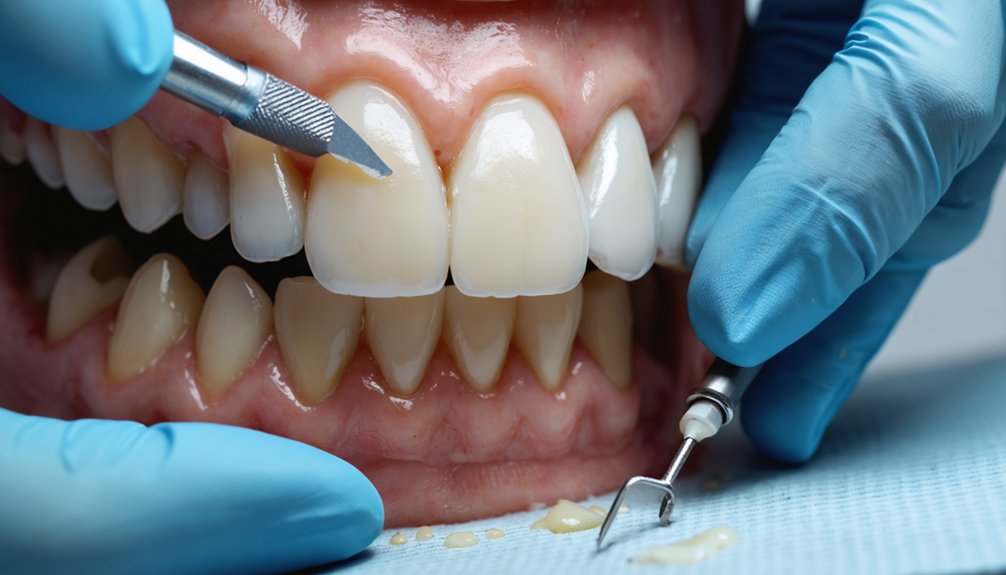
When surface stains resist standard whitening methods, microabrasion offers a targeted first step before deeper bleaching begins. This technique combines mild acid with an abrasive compound, using chemical exfoliation to remove a thin, stained enamel layer. You gain precise stain removal before committing to stronger bleaching agents.
Follow this controlled sequence:
- Your dentist applies the microabrasion compound directly to discolored enamel, working it across the surface to lift embedded pigment.
- You wait through a structured recovery period, allowing enamel to stabilize before bleaching starts.
- Your dentist then introduces peroxide-based bleaching, targeting any remaining deeper discoloration.
This stepwise approach gives you measurable progress at each stage, preventing unnecessary exposure to stronger treatments when a preparatory layer removal resolves part of the problem first.
What Is Walking Bleach and Who Actually Needs It?
Microabrasion clears the surface layer, but some medication stains sit deeper—inside the tooth itself—where no topical treatment reaches.
Walking bleach targets exactly that zone. Your dentist places a peroxide-based paste directly inside the tooth through a small access opening, seals it, and lets it work for three to seven days. You return to have it replaced—typically three to five times over four to six weeks—until the discoloration lifts.
You’ll need this technique if your staining is intrinsic, meaning it’s embedded in the dentin rather than sitting on enamel. Medication safety matters here because the paste concentration and placement require professional control.
Tooth sensitivity is a common side effect, so your dentist monitors progress carefully and adjusts the schedule based on your response.
How to Protect Your Results When Staining Comes From Medication
Keeping your results after medication-related whitening takes more deliberate effort than standard stain prevention, because the underlying medication may continue affecting tooth color over time. You’ll need to build consistent protective habits into your daily routine.
Dietary adjustments and oral hygiene form your defense system:
- Avoid coffee, tea, red wine, and dark sauces for 24–48 hours post-whitening, when enamel re-stains most aggressively.
- Rinse with water immediately after consuming pigmented foods or drinks, flushing stain compounds before they bond to enamel.
- Brush and floss twice daily, removing plaque biofilm that traps discoloration against tooth surfaces.
Schedule maintenance whitening every six months or annually. Because medication exposure may persist, periodic retreatment isn’t optional—it’s part of your long-term color management strategy.
How Often Do You Need to Retreat Medication-Related Stains?
How often you’ll need to retreat depends on the type of stain, the whitening method used, and how well you limit re-staining exposures.
Surface stains from medication tend to return faster than deeper ones respond to treatment, so your schedule won’t be one-size-fits-all.
Most maintenance plans call for retreatment every six months to a year, but your dentist will adjust that timeline based on how your teeth respond.
Retreatment Timing Factors
Once whitening results stabilize, retreatment timing depends on the depth of the original stain, the method used, and how well you protect your teeth afterward. Dietary influences and alternative natural remedies affect how long your results last.
- Surface stains from daily beverages return faster—expect retreatment every 6 months if you regularly consume coffee, tea, or red wine.
- Moderate stains treated with custom trays typically hold results 12 months before noticeable fading requires another cycle.
- Deep medication-induced stains addressed through in-office protocols may need retreatment after 12–18 months, depending on enamel integrity and daily habits.
Track your shade against a reference point after each treatment. This gives you precise control over when retreatment is actually necessary rather than guessing.
Maintenance Whitening Schedules
Maintaining your whitening results after medication-related staining requires a scheduled approach, not guesswork. Your retreatment timeline depends on stain analysis completed at routine dental hygiene visits, where a dentist can assess re-staining depth and progression before it becomes resistant.
Most people need maintenance whitening every six months to one year. If your medication staining was deeply intrinsic, schedule retreatment closer to the six-month mark.
For lighter extrinsic staining, annual touch-ups using custom trays at home may be sufficient.
Between sessions, brush twice daily, floss consistently, and rinse after consuming stain-causing foods or drinks. Avoid coffee, tea, and red wine during the 24–48 hours following any whitening session.
Structured maintenance prevents stain accumulation and reduces the intensity of retreatment needed each cycle.
Frequently Asked Questions
Can Medication Stains Return Even After Successful Whitening Treatment?
Yes, they can return. You’ll need to maintain stain removal techniques consistently, as dental remineralization doesn’t prevent re-staining. Limit dark foods, rinse after meals, and schedule maintenance whitening every six to twelve months.
Are Children’s Medication Stains Treated Differently Than Adult Stains?
Yes, pediatric dental care handles medication effects differently—you’ll find dentists avoid aggressive bleaching on children’s developing teeth, instead prioritizing monitoring, gentle cleaning, and delaying stronger whitening treatments until enamel fully matures.
Does Stopping the Medication Help Prevent Further Tooth Discoloration?
Discontinuing the source can pause further medication effects on your teeth. If you’ve stopped, you’re ahead in stain prevention—now focus on consistent brushing, avoiding dark foods, and pursuing professional whitening to address existing discoloration effectively.
Can Veneers or Crowns Be an Alternative if Whitening Fails Completely?
Yes, if whitening fails completely, you can explore veneers alternatives or crowns options. They’ll cover deeply stained teeth permanently, giving you full control over your smile’s appearance when bleaching doesn’t deliver results.
Is Tooth Sensitivity From Whitening Worse for Medication-Stained Teeth?
Up to 78% of whitening users report tooth sensitivity. Yes, you’ll likely experience more whitening discomfort with medication-stained teeth, since deeper intrinsic stains require stronger peroxide concentrations, intensifying tooth sensitivity beyond typical cases.
References
- https://dentalpedia.co/article/teeth-whitening-for-stained-teeth-from-medications.html
- https://cedardentalgroup.com/how-to-whiten-stained-teeth/
- https://www.facebook.com/groups/zerodonto/posts/10166315317545010/
- https://www.ada.org/resources/ada-library/oral-health-topics/whitening
- https://www.youtube.com/watch?v=qbUYI4CcW0E
- https://serenitydentalbloom.com/blog/how-to-remove-teeth-stains
- https://oralb.com/en-us/oral-health/life-stages/adults/how-to-use-whitening-strips-guide
- https://en.wikipedia.org/wiki/Tooth_whitening
- https://www.youtube.com/watch?v=gfVsgtD1mHY
- https://www.whirlpool.com/blog/washers-and-dryers/how-to-get-stains-out-of-white-clothes.html