Medication stains resist standard whitening treatments because they’re chemically embedded within your enamel and dentin during tooth development, not sitting on the surface where peroxide can easily reach them. Over-the-counter products contain only 3–10% hydrogen peroxide, which can’t penetrate deep enough to oxidize these intrinsic chromogens. Professional-grade agents reach 25–40% concentration, giving them the diffusion capacity to target embedded stains. Understanding exactly what you’re dealing with determines which treatment approach will actually work for your situation.
Key Takeaways
- Medication stains are intrinsic, embedding chemically within enamel and dentin during tooth development, unlike removable surface stains from food or tobacco.
- Standard OTC whitening products contain only 3–10% hydrogen peroxide, insufficient to penetrate enamel and reach deeply embedded chromogens.
- Professional-grade bleaching agents use 25–40% peroxide concentrations, effectively diffusing through enamel to oxidize medication-related stains in dentin.
- Custom-fitted trays and extended protocols ensure consistent gel contact, maximizing penetration needed for intrinsic stain treatment.
- Stain severity, depth, and specific medication type determine whether bleaching alone or restorative options like veneers are required.
What Makes Medication Stains Different From Regular Tooth Discoloration?
Unlike surface stains from coffee or tobacco, medication stains like those caused by tetracycline embed directly within the enamel and dentin during tooth development, making them intrinsic by nature.
These stain types form below the enamel surface, placing them beyond the reach of standard extrinsic treatment options like whitening toothpaste or over-the-counter strips.
You’re dealing with dark gray or brown banding that’s chemically integrated into your tooth structure—not simply deposited on top of it.
Antibiotics like doxycycline and antipsychotics produce similarly deep-seated discoloration that resists conventional surface-level approaches.
Understanding this distinction matters because it directly determines which treatment options are viable for your situation.
Without recognizing the intrinsic nature of these stains, you risk pursuing ineffective solutions that waste both time and resources.
Why Standard Whitening Products Cannot Fix Medication Stains?
When you reach for over-the-counter whitening strips or toothpaste, you’re applying agents that work exclusively on the tooth’s outer surface, leaving intrinsic medication stains completely untouched.
Standard products lack the chemical concentration needed to penetrate enamel and dentin, where tetracycline and similar compounds have permanently bonded during tooth development.
You can’t correct a structural, subsurface problem with a surface-level solution, which is why OTC whiteners consistently fail against medication-induced discoloration.
Surface-Only Treatment Limitations
Standard whitening products—including over-the-counter toothpastes, strips, and rinses—can’t address medication stains because they’re engineered exclusively for surface-level, extrinsic discoloration.
Understanding these stain characteristics helps you set realistic treatment expectations before investing in ineffective solutions.
These products fail for four evidence-based reasons:
- They lack sufficient peroxide concentration to penetrate enamel structure.
- Their contact time with tooth surfaces is clinically inadequate.
- Their formulations target deposited surface pigments, not embedded chromogens.
- They can’t reach dentin, where tetracycline and similar compounds integrate during development.
You’re fundamentally applying a surface solution to a structural problem.
No amount of consistent OTC use will reverse intrinsic discoloration caused by medication absorption into developing dental tissues.
Professional-grade intervention becomes the only clinically viable path forward.
Penetration Strength Inadequacy
The surface-level failure of OTC products connects directly to a more fundamental chemistry problem: peroxide concentration.
Standard whitening strips and toothpastes contain peroxide levels too low to overcome penetration barriers within calcified dental tissue. You’re dealing with stains embedded in dentin—not sitting on enamel—so inadequate concentration means the active agent never reaches the discoloration site.
Whitening efficacy depends directly on peroxide’s ability to diffuse through enamel and oxidize chromogens deep within dentin.
OTC formulations, typically containing 3–10% hydrogen peroxide, can’t sustain the diffusion gradient required for meaningful intrinsic stain disruption.
Professional-grade agents reach 25–40%, maintaining sufficient concentration gradients to penetrate calcified tissue.
Without that chemical strength, you’ll achieve shade lightening without actually addressing the medication-induced discoloration embedded below the enamel surface.
Which Medications Cause the Deepest and Most Resistant Staining?
Not all medication-induced stains are equal in severity or resistance to treatment. Understanding which drugs cause the deepest discoloration helps you make informed decisions about intervention.
The most resistant stains originate from:
- Tetracycline stains — antibiotics taken during tooth development embed gray or brown bands directly into dentin, making them exceptionally difficult to reverse.
- Doxycycline — produces similar deep-seated discoloration with comparable structural integration.
- Antipsychotic discoloration — antipsychotics generate brownish staining that standard whitening protocols consistently fail to eliminate.
- Iron supplements — direct enamel contact causes dark intrinsic discoloration resistant to surface-level treatments.
These medications compromise tooth structure at the developmental or prolonged-exposure level.
You’ll need professional assessment to determine whether bleaching, veneers, or bonding offers the most clinically appropriate solution.
How Professional Bleaching Reaches Medication Stains Below the Enamel?
When you undergo professional bleaching, high-concentration carbamide or hydrogen peroxide gels penetrate enamel and reach the dentin where medication stains like tetracycline have embedded.
Your dentist applies these professional-grade agents at strengths far exceeding over-the-counter products, enabling them to oxidize the chromogenic compounds locked within the tooth’s hard tissues.
Because intrinsic stains resist single-session treatment, you’ll typically require multiple appointments to achieve measurable, cumulative improvement in discoloration.
Peroxide Penetrates Enamel Deeply
Unlike over-the-counter strips or pastes, professional bleaching gels use high-concentration hydrogen peroxide or carbamide peroxide—typically ranging from 15% to 40%—that actively penetrates the enamel’s crystalline structure to reach discolored dentin beneath.
Peroxide efficacy depends on molecular size, concentration, and contact duration, all of which professional protocols optimize. Enamel absorption accelerates under controlled conditions, delivering oxidizing agents directly to embedded chromogens.
Key mechanisms driving deeper penetration include:
- High-concentration gradients forcing peroxide molecules through hydroxyapatite channels
- Extended application windows maximizing diffusion depth
- Accelerator light sources elevating oxidation rates within dentin
- Custom-fitted trays maintaining consistent gel-to-enamel contact
These combined factors allow professional-grade peroxide to systematically break down medication-derived pigments that surface treatments simply can’t access.
Professional Gels Target Intrinsic Stains
Because medication stains like tetracycline integrate directly into dentin during tooth development, they’re chemically bonded within the tooth’s mineralized matrix—far beyond what surface-level treatments can reach.
Professional-grade peroxide gels, typically carbamide or hydrogen peroxide at clinical concentrations, penetrate enamel tubules and diffuse into dentin, oxidizing embedded chromogens at their source.
Custom whitening solutions amplify this precision. Your dentist fabricates trays engineered to your arch anatomy, ensuring consistent gel contact and controlled exposure duration—variables that directly determine efficacy.
Professional treatment benefits extend beyond concentration alone; extended wear cycles and multiple sessions allow cumulative oxidation of deeply embedded pigmentation.
Over-the-counter alternatives simply can’t replicate this controlled, sustained penetration. For medication-induced intrinsic stains, professional intervention isn’t optional—it’s the only evidence-supported pathway to measurable improvement.
Multiple Sessions Improve Results
Reaching medication stains embedded in dentin requires cumulative chemical exposure—a single bleaching session rarely delivers sufficient oxidation depth.
You’ll need multiple sessions to achieve improved outcomes with tetracycline or antibiotic-induced discoloration. Each treatment incrementally oxidizes chromogenic molecules deeper within the tooth structure.
Follow this structured approach:
- Schedule professional bleaching every two to four weeks, allowing tissue recovery between sessions.
- Monitor shade progression using a standardized dental shade guide after each appointment.
- Supplement in-office treatments with custom tray applications using carbamide peroxide nightly.
- Reassess stain severity at three-month intervals to determine continued treatment necessity.
Consistent, controlled peroxide exposure across multiple sessions penetrates dentin progressively, maximizing oxidation of embedded pigments.
You’re managing a biochemical process—patience and protocol adherence directly determine your results.
When Does Professional Whitening Actually Work on Medication Stains?
When professional whitening works on medication stains depends largely on stain depth, severity, and the specific drug involved.
You’ll see the best outcomes when stain assessment confirms mild-to-moderate intrinsic discoloration rather than severe tetracycline banding. Early-stage antibiotic stains respond more favorably than those embedded deeply during critical tooth development phases.
Treatment duration considerably influences results. Extended protocols using professional-grade carbamide or hydrogen peroxide—delivered through custom trays over several weeks—penetrate enamel more effectively than single sessions.
Multiple applications allow peroxide agents to progressively diffuse into dentin, targeting discoloration at its source.
However, you must understand that severe gray or dark-banded tetracycline stains rarely achieve complete resolution through whitening alone.
In those cases, veneers or bonding become the clinically superior alternatives.
Are Veneers, Bonding, or Crowns Better Than Whitening for Medication Stains?
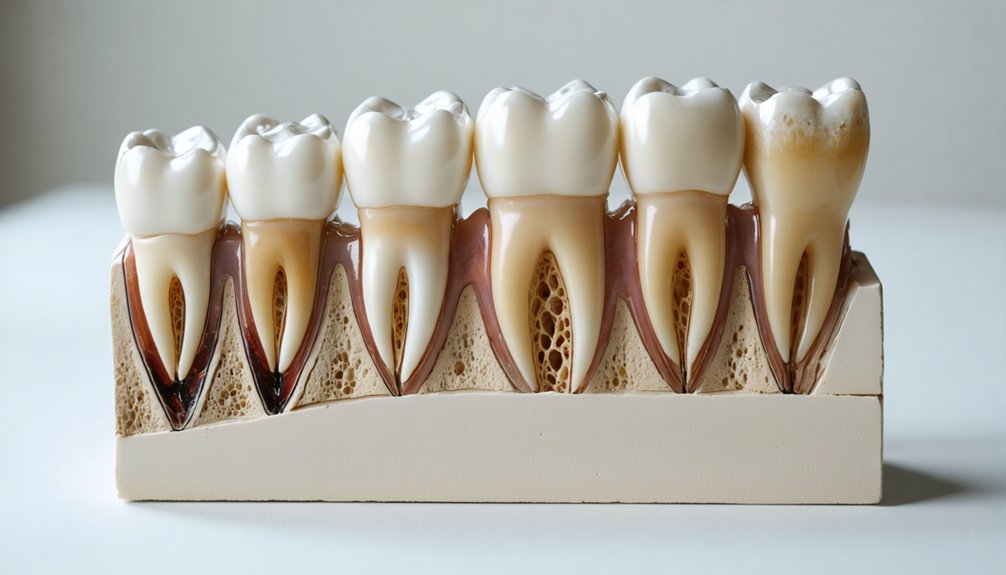
Whether veneers, bonding, or crowns outperform whitening depends on stain severity, tooth structure integrity, and your long-term restorative goals.
When tetracycline or antipsychotic staining resists bleaching protocols, restorative options deliver superior, predictable outcomes.
Evaluate each option systematically:
- Veneers — Veneer advantages include complete stain masking with precise shade control, ideal for moderate-to-severe intrinsic discoloration.
- Bonding — Bonding effectiveness suits mild-to-moderate staining, offering cost-efficient resin application without significant enamel reduction.
- Crowns — Reserved for structurally compromised teeth with extreme medication-induced staining requiring full coverage.
- Whitening — Appropriate only for lighter intrinsic stains where enamel integrity remains intact.
Consult your dentist to assess stain depth, remaining tooth structure, and functional requirements before committing to any irreversible restorative procedure.
What Your Dentist Needs to Know About Your Medications Before Whitening?
Once you’ve evaluated restorative options against whitening, your dentist’s ability to recommend the right protocol hinges on a complete medication history. Disclose every current and past medication, including tetracycline, doxycycline, antipsychotics, iron supplements, and chlorhexidine rinses.
Each compound produces distinct stain characteristics that directly shape your stain assessment and treatment sequencing.
Tetracycline taken during tooth development embeds within dentin, requiring extended professional-grade peroxide protocols or restorative intervention. Antipsychotics and antihistamines reduce salivary flow, compounding discoloration through secondary mechanisms.
Iron supplements demand immediate identification since direct enamel contact causes unique darkening patterns.
Your dentist cross-references your medication history against stain depth, distribution, and coloration to select an evidence-based approach, whether prolonged bleaching cycles, custom tray therapy, or alternative restorative treatment.
Which Habits Prevent Medication Stain Treatments From Fading Prematurely?
Preserving the results of professional whitening or restorative treatment requires consistent behavioral discipline, particularly after investing in protocols targeting deep medication stains.
Your prevention habits directly determine treatment longevity. Implement these evidence-based maintenance routines:
- Eliminate chromogenic agents — avoid coffee, tea, red wine, and tobacco within 48 hours post-treatment and minimize ongoing exposure.
- Rinse immediately — flush your mouth with water after consuming staining substances to reduce pigment adhesion time.
- Use professional-grade fluoride toothpaste — it reinforces enamel integrity, slowing re-staining progression.
- Schedule periodic touch-up sessions — dentist-supervised reapplication of whitening agents counteracts gradual discoloration recurrence.
Skipping these steps accelerates pigment reintegration into treated surfaces.
You’ve invested in correcting deep medication staining—disciplined adherence protects that outcome measurably.
Frequently Asked Questions
Can Medication Stains on Baby Teeth Affect Permanent Tooth Development Later?
Yes, medication stains on baby teeth can signal developmental concerns affecting tooth enamel in permanent teeth. You’ll want to consult pediatric dentistry early, as long-term effects on underlying structures require evidence-based intervention strategies.
Does Stopping the Staining Medication Improve Whitening Treatment Outcomes Significantly?
Stopping staining medications won’t markedly reverse existing intrinsic discoloration, but it prevents further embedding. You’ll find whitening effectiveness improves when no new staining agents compete, allowing professional-grade peroxide treatments to target established discoloration more precisely.
Are Medication Stains Covered by Dental Insurance as a Medical Necessity?
Think again—dental policies rarely cover medication types causing stains as medical necessities. You’ll typically find insurers classify whitening as cosmetic, so you must proactively document your medical history to pursue potential coverage exceptions.
How Long Do Professional Whitening Results Typically Last on Medication Stains?
Your whitening longevity on medication stains typically spans six to twelve months before touch-ups are needed. Due to stain persistence within dentin, you’ll require repeated professional sessions to maintain measurable improvement over time.
Can Medication Stains Return After Successful Professional Whitening Treatment Completion?
Yes, medication stains can return after professional whitening. Your stain recurrence depends on medication types you’re taking and whitening techniques used, as intrinsic discoloration often persists deep within enamel, requiring ongoing maintenance treatments.
References
- https://www.73smiles.com/does-whitening-help-medication-stains/
- https://primedentalbroward.com/blog/can-teeth-whitening-treat-discoloration-from-medications-and-genetics/
- https://www.thegalleryofsmiles.com/blog/are-teeth-whitening-treatments-effective-on-all-types-of-stains-cip119/
- https://www.rowlettdental.com/does-teeth-whitening-work-on-all-types-of-stains/
- https://fiddleheaddental.com/tetracycline-stains-fighting-back-for-a-brighter-whiter-smile/
- https://www.ada.org/resources/ada-library/oral-health-topics/whitening
- https://mydentisthub.com/medications-and-their-impact-on-the-success-of-teeth-whitening/
- https://smilefreshau.com.au/blogs/news/can-brown-teeth-be-white-again
- https://www.paulydentalgroup.com/are-your-medications-causing-teeth-stains-heres-what-to-do/
- https://southoakdental.com/cosmetic-dentist-in-oakville-why-teeth-dont-whiten/