Custom whitening trays outperform boil-and-bite trays in nearly every measurable category. They’re made from dental impressions, so they fit precisely, seal tightly, and deliver professional-strength gels directly to your teeth without leakage. Boil-and-bite trays are more affordable and work for mild surface stains, but they can’t match custom trays for deep, intrinsic discoloration. Your best choice depends on stain severity, budget, and how dramatic you want your results—and there’s plenty more to contemplate before deciding.
Key Takeaways
- Custom trays offer a precise fit extending 3mm past the gumline, ensuring uniform gel contact and superior whitening results compared to boil-and-bite trays.
- Custom trays use professional-strength gels that effectively target deep, intrinsic stains from tobacco and coffee, while boil-and-bite trays only address surface stains.
- Boil-and-bite trays are more affordable and accessible but deliver limited results, making them suitable only for mild stains on a tight budget.
- Custom trays minimize gum irritation and sensitivity through precise fitting, whereas boil-and-bite trays risk gel leakage and increased gum irritation due to imprecise molding.
- Custom trays provide faster, more dramatic whitening within 1-2 weeks, while boil-and-bite trays require longer treatment for comparably modest outcomes.
What Are Custom and Boil-and-Bite Whitening Trays?
When choosing a teeth-whitening tray, you’ll encounter two main options: custom trays and boil-and-bite trays.
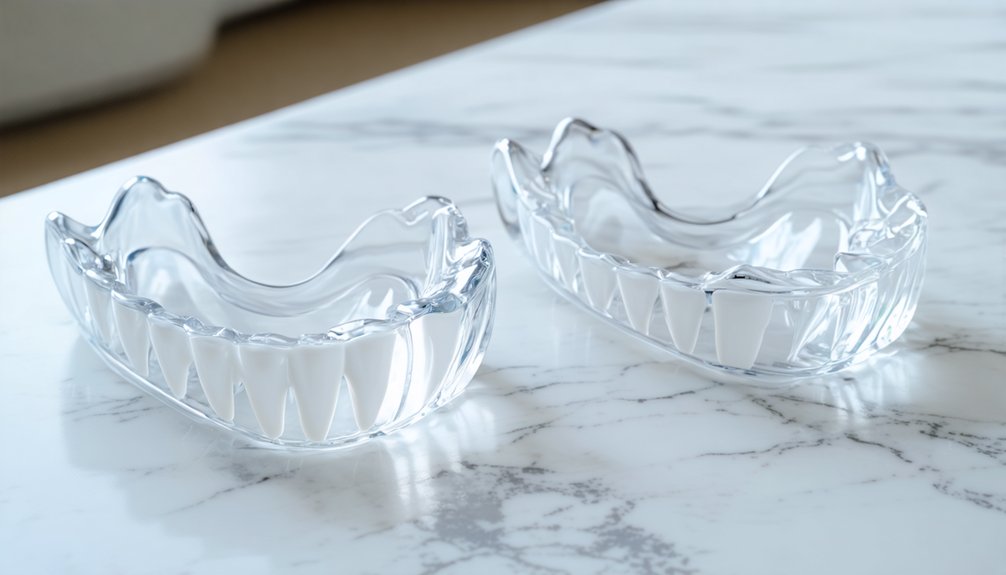
Custom trays are fabricated from dental impressions taken by your dentist, ensuring a precise fit with a tight gingival seal. They’re paired with professional-strength bleaching gels and worn daily for one to two weeks, delivering controlled, consistent results aligned with your user preferences.
Custom trays crafted from dental impressions deliver precise fits, professional-strength whitening, and consistent results tailored to your preferences.
Boil-and-bite trays use soft thermoplastic material you heat and mold at home, offering a semi-custom fit without a dental visit. They’re available over-the-counter and use medium-strength gels.
While more accessible, they require careful molding to avoid uneven pressure or gel leakage. Tray maintenance differs between options—custom trays demand gentle cleaning to prevent warping, while boil-and-bite trays follow standard at-home care protocols.
How Well Do These Trays Actually Fit?
When you choose custom trays, your dentist crafts them from precise dental impressions, ensuring a snug fit that extends 3mm past your gumline and creates a tight gingival seal.
Boil-and-bite trays offer a semi-custom fit since you mold them at home using heat, but they apply lower pressure—around 7–9 psi—which often produces uneven contact and potential gel leakage.
Your tray’s fit directly governs whitening outcomes, as a poorly sealed tray wastes gel, causes gum irritation, and delivers inconsistent results across tooth surfaces.
Custom Tray Fit Precision
Fit precision separates custom trays from every other whitening option on the market. Your dentist takes direct impressions of your teeth, then fabricates trays that extend exactly 3mm past your gumline, creating a tight gingival seal that locks gel against each tooth surface.
That custom tray comfort directly controls how uniformly the bleaching agent contacts enamel, eliminating the gaps and pooling common with generic alternatives.
Boil and bite convenience sacrifices that precision. You mold thermoplastic at home, but mouth pressure alone can’t replicate lab fabrication. The result is inconsistent contact, potential gel leakage onto soft tissue, and uneven whitening.
If you’re investing in a whitening system, the tray’s fit determines everything—from gel efficiency to sensitivity management. Custom trays give you that control; no other over-the-counter option does.
Boil-And-Bite Fit Quality
Boil-and-bite trays occupy the middle ground between generic strip systems and dentist-fabricated options, but understanding exactly where they land on the fit spectrum matters before you commit to one.
You heat the thermoplastic material, bite down, and mold it to your arch—creating a semi-custom shape. The result delivers better fit comfort than universal trays, yet it falls short of professional precision.
Your molding pressure, typically 7–9 psi from your bite, produces less adaptation than the vacuum or pressure-forming equipment dentists use. Poorly executed molding introduces hot spots, uneven gel contact, and potential leakage onto gum tissue.
The user experience depends heavily on your technique during that initial molding session, making careful execution essential for achieving consistent, predictable whitening contact across all tooth surfaces.
Fit Impact On Results
How well your whitening tray fits directly determines whether you achieve uniform bleaching or patchy, inconsistent results. A precise fit guarantees consistent gel-to-tooth contact, maximizing sealing effectiveness and preventing premature dilution from saliva intrusion.
Custom trays extend 3mm past your gumline, creating a tight seal that locks professional-strength gel against each tooth surface uniformly. This design eliminates dead zones where bleaching agents fail to penetrate, delivering predictable, even whitening.
Boil-and-bite trays compromise fit comfort and sealing effectiveness because mouth pressure alone can’t replicate dentist-fabricated precision. Uneven thermoplastic molding creates gaps, allowing gel migration onto gum tissue while reducing active contact with enamel.
If you’re targeting consistent, controlled results, fit quality isn’t a minor variable—it’s the foundational factor separating dramatic improvement from mediocre outcomes.
Which Tray Handles Tobacco, Coffee, and Deep Stains Better?
When stubborn stains from tobacco, coffee, or decades of natural aging penetrate beyond the enamel’s surface, the tray you choose determines whether you’ll see dramatic results or modest improvements.
Custom trays deliver superior whitening effectiveness against deep stains because they pair higher-concentration professional gels with a precise fit that keeps the bleaching agent in consistent contact with every tooth surface.
Custom trays win against deep stains by combining professional-strength gels with a fit that leaves no tooth surface untreated.
Tobacco stains and coffee stains are notoriously difficult to eliminate because they’re often intrinsic, meaning they’ve bonded within the dentin layer.
Boil-and-bite trays use medium-strength gels that address surface discoloration adequately but struggle against severe intrinsic discoloration.
If you’re dealing with deep stains from long-term tobacco or coffee use, custom trays aren’t just the better option—they’re the necessary one.
Whitening Power: Which Tray Gets Better Results?
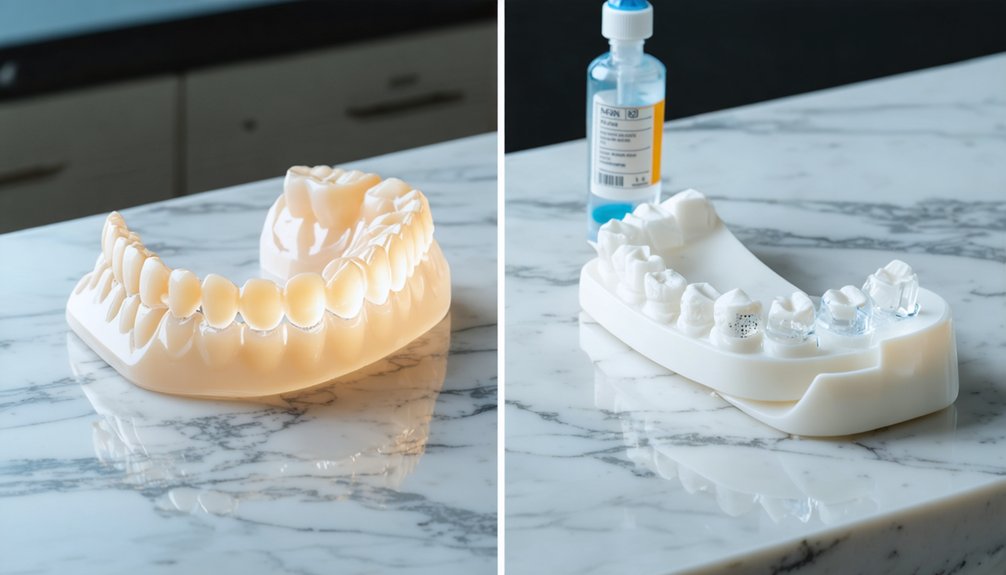
When comparing whitening power, custom trays outperform boil-and-bite options because they pair higher-concentration professional gels with a precise fit that maximizes gel-to-tooth contact.
You’ll find that boil-and-bite trays rely on medium-strength over-the-counter gels, which lack the potency to break down deeper, more resistant stains effectively.
Custom trays also deliver faster, more uniform results since their snug seal minimizes gel waste and guarantees consistent coverage across every tooth surface.
Gel Strength Comparison
Gel strength stands as one of the most decisive factors separating custom trays from boil-and-bite options.
Custom trays pair with professional-strength bleaching gels, featuring higher gel concentration differences that penetrate deeper, intrinsic stains from aging or tobacco exposure. You get supervised, targeted treatment that delivers measurable results faster.
Boil-and-bite trays typically use medium-strength gels, which limits their effectiveness against severe discoloration.
The trade-off, however, involves sensitivity levels. Higher-concentration professional gels may trigger tooth sensitivity in some users, while medium-strength formulas generally produce milder reactions.
Your choice depends on your stain severity and tolerance threshold.
If you’re managing deep discoloration and can handle stronger gels, custom trays give you a decisive advantage.
For surface stains with sensitivity concerns, boil-and-bite gels offer a measured alternative.
Stain Removal Effectiveness
Gel strength directly shapes how well each tray type removes stains, but the full picture of whitening effectiveness goes beyond concentration alone. Stain types matter greatly.
Custom trays excel at targeting intrinsic discoloration from aging, tobacco, and deep pigmentation because higher-concentration gels penetrate enamel more effectively under a sealed fit.
Boil-and-bite trays handle mild extrinsic stains reasonably well, though uneven contact limits their consistency.
Whitening duration also influences outcomes. Custom trays deliver dramatic, uniform results within one to two weeks because the snug fit maximizes gel-to-tooth contact while minimizing waste.
Boil-and-bite trays require longer treatment periods for comparable results, and you’ll likely encounter uneven whitening if the tray fit isn’t precise.
For severe staining, custom trays remain the superior clinical choice.
Speed Of Results
Boil-and-bite trays work more slowly due to weaker gel formulations and inconsistent contact.
Key speed factors include gel concentration, tray seal quality, and treatment consistency.
Poor tray adaptation creates gaps that reduce active whitening time per session.
If you’re targeting significant discoloration within a controlled timeframe, custom trays deliver faster, more predictable outcomes than boil-and-bite alternatives can reliably achieve.
How Much Does Each Whitening Tray Actually Cost?
When weighing your whitening options, cost plays a decisive role in the decision. Custom trays carry a higher upfront investment, but their long-term value justifies the expense. You’re paying for precision-fitted trays, professional-strength gels, and supervised results that last.
Custom trays cost more upfront, but precision fit, professional-strength gels, and lasting results make every dollar count.
Boil-and-bite trays sit in the mid-range, costing less than custom options but more than basic store-bought pre-filled strips. They balance affordability with semi-customization, making them a practical choice if budget is a primary cost factor.
Store-bought alternatives remain the cheapest, though their weaker formulations deliver limited results.
If you prioritize lasting, dramatic whitening, custom trays offer the strongest return on investment. If moderate improvement suits your goals, boil-and-bite trays provide a reasonable compromise between cost and effectiveness without requiring a dental visit.
Will Either Tray Hurt Your Gums or Cause Sensitivity?
Sensitivity and gum irritation are real concerns with any whitening tray, but the degree of risk depends heavily on fit and gel concentration.
Custom trays extend 3mm past your gumline, creating a tight seal that minimizes gel contact with soft tissue. Boil-and-bite trays carry higher gum irritation potential due to imprecise molding and possible leakage.
Key distinctions that affect your sensitivity levels:
- Custom trays use high-concentration professional gels, which can trigger tooth sensitivity but reduce gum exposure through snug fit.
- Boil-and-bite trays apply medium-strength gels but risk uneven gel distribution from poor pressure molding.
- Both options can cause sensitivity if worn beyond recommended durations.
Control your exposure by following manufacturer protocols precisely.
Custom vs Boil-and-Bite: Who Should Choose Which?
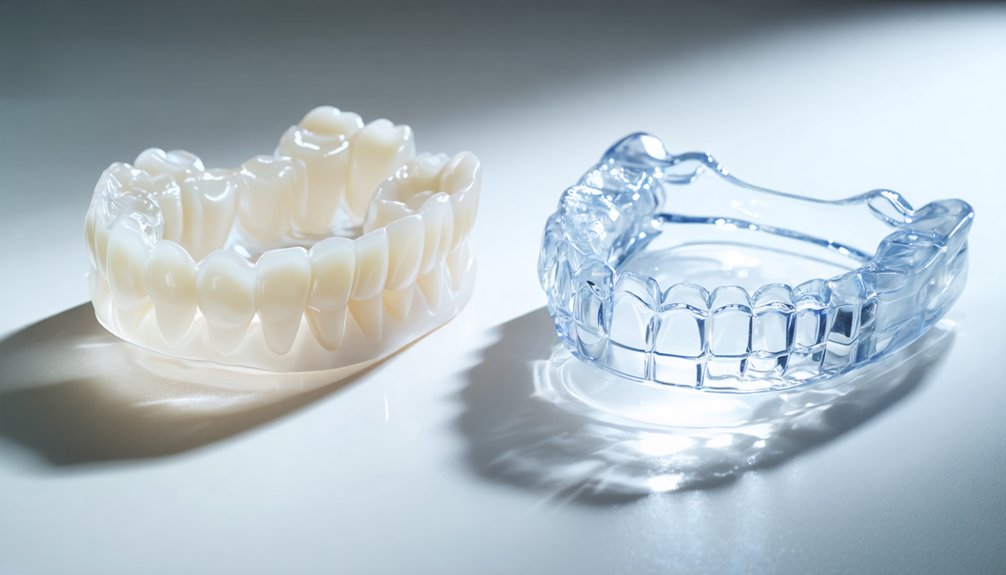
Knowing how each tray affects your gums and tooth sensitivity narrows down which option actually fits your situation.
If you’re dealing with intrinsic stains from aging or tobacco, custom tray benefits outweigh the upfront cost. You get higher gel concentrations, a snug gingival seal, and uniform whitening that boil-and-bite trays can’t reliably match.
If your stains are mild and your budget’s limited, boil-and-bite trays offer a reasonable middle ground. However, you’ll need to account for boil and bite drawbacks: uneven pressure, potential gel leakage, and bulkier fit that affects comfort and speech.
Choose custom trays if precision and results matter most. Choose boil-and-bite if cost is your primary constraint and your whitening needs are moderate.
Which Whitening Tray Should You Actually Choose?
Choosing between custom and boil-and-bite trays comes down to three measurable factors: stain severity, budget, and how much precision you need. User experiences consistently show that intrinsic stains from aging or tobacco respond better to custom trays with professional-strength gels.
Boil-and-bite trays suit moderate extrinsic discoloration when cost is a constraint.
Use this framework to decide:
- Severe stains or gum sensitivity: Choose custom trays for controlled gel concentration and a tight gingival seal.
- Moderate stains, limited budget: Boil-and-bite trays offer semi-custom fit without a dental visit.
- Tray maintenance priority: Custom trays resist warping longer with proper care, extending your investment.
Your results depend on matching the tray’s precision to your actual whitening demands.
Frequently Asked Questions
How Long Do Custom Whitening Trays Typically Last Before Needing Replacement?
Like a well-built tool, your custom trays can last one to two years. Longevity factors include proper care and material quality, so you’ll avoid hot water to prevent warping and maximize durability.
Can Boil-And-Bite Trays Be Reused Multiple Times After Initial Molding?
Yes, you can reuse boil-and-bite trays multiple times after the initial molding process, but tray comfort and fit will gradually degrade. Monitor for distortion, as repeated use compromises the thermoplastic’s structural integrity and whitening effectiveness.
Are Whitening Trays Safe to Use With Dental Crowns or Veneers?
Whitening trays won’t bleach crowns or veneers, so you’ll notice uneven color matching. Dental compatibility requires professional evaluation before use. Prioritize whitening safety by consulting your dentist to assess restorations and select appropriate gel concentrations accordingly.
How Should Whitening Trays Be Properly Stored When Not in Use?
Studies show improper storage reduces tray lifespan by 50%. After proper cleaning, store your trays in a ventilated case under controlled storage conditions—avoid heat above 140°F to prevent warping, ensuring they’re ready for consistent, effective whitening sessions.
Can Children or Teenagers Safely Use Either Type of Whitening Tray?
You shouldn’t use either tray type on children or teenagers without consulting a dentist first. Safety concerns and age recommendations suggest waiting until permanent teeth fully develop, as whitening agents can damage immature enamel and sensitive gum tissue.
References
- https://www.myidealdental.com/dental-resources/best-teeth-whitening-trays
- https://www.mydentistgrandprairie.com/blog/professional-take-home-kits-vs-store-bought/
- https://www.beverlyhillsladentist.com/blog/best-teeth-whitening-trays/
- https://dentistryonpark.com/blog/comparing-take-home-trays-vs-in-office-teeth-whitening/
- https://shopremi.com/blogs/night-mouth-guard-blog/custom-teeth-whitening-trays-cost
- https://dentalhealth.com/blogs/news/custom-fit-teeth-bleaching-trays
- https://gladiatorguards.com/custom-vs-boil-and-bite-stop-worrying-the-mouthguard-debate-is-over/
- https://www.smilebrilliant.com/articles/at-home-teeth-whitening-vs-dentist/