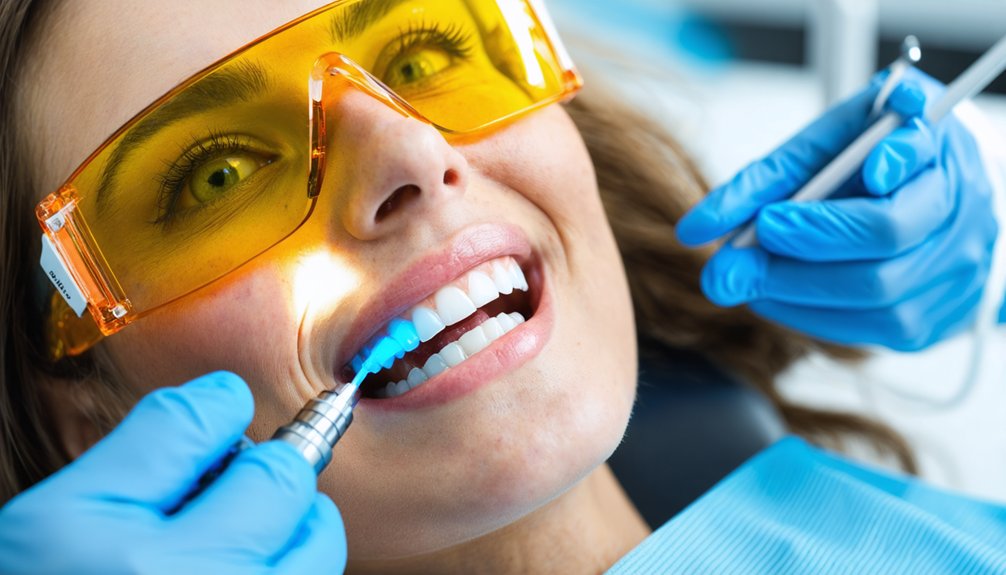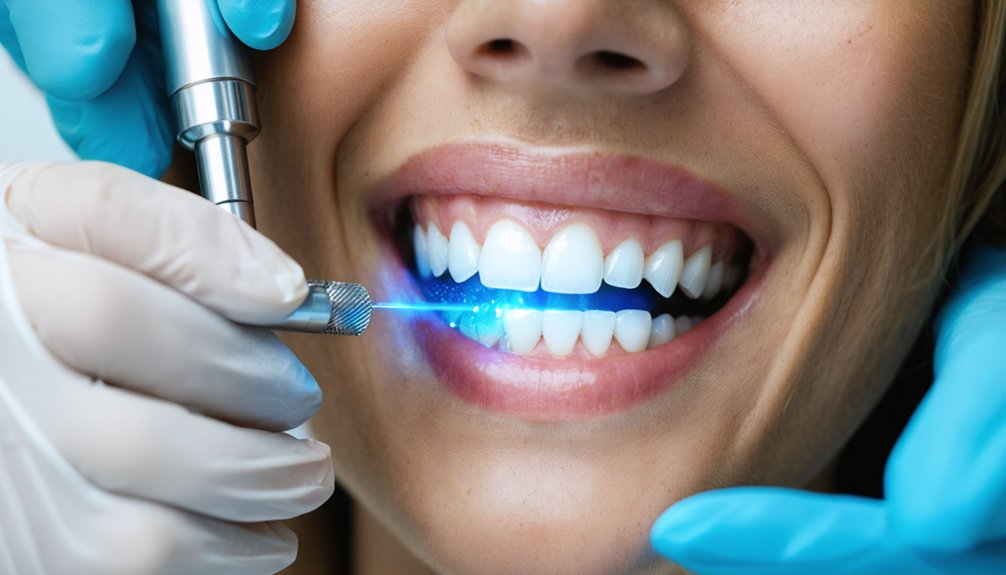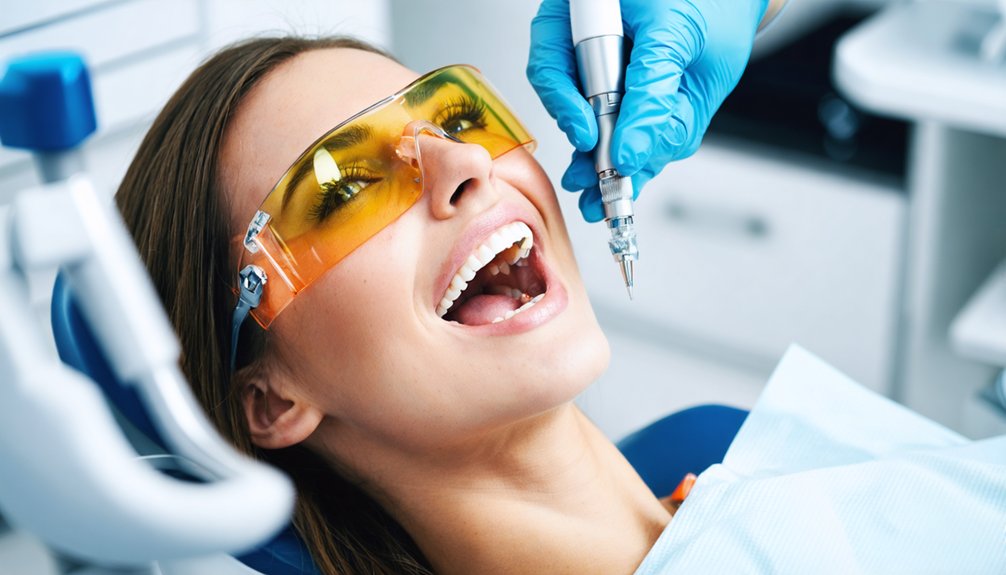
If you have sensitive teeth, standard whitening treatments can trigger real nerve pain, but laser whitening changes that equation entirely. Argon and diode lasers activate peroxide faster, cutting exposure time and reducing irritation at the source. Systems like Fotona’s TouchWhite and alternatives like Hismile’s PAP+ formula give you effective results without the post-treatment sting. Matching the right technology to your specific sensitivity level and stain type is where the real difference starts.
Key Takeaways
- Laser whitening minimizes uncontrolled peroxide penetration, reducing nerve irritation for sensitive teeth compared to standard over-the-counter whitening products.
- Argon lasers use 488 nm wavelengths to accelerate peroxide activation ten times faster, targeting surface stains while protecting surrounding tissue.
- Diode lasers operate at 660 nm, offering adjustable intensity to calibrate treatment based on individual sensitivity thresholds.
- The Fotona TouchWhite laser system uses non-thermal delivery to activate whitening agents without generating heat or triggering nerve hypersensitivity.
- Peroxide-free alternatives like PAP+ technology oxidize stain molecules directly through enamel, making them suitable for peroxide-intolerant patients.
Why Sensitive Teeth React Badly to Standard Whitening
When hydrogen peroxide penetrates your enamel, it doesn’t stop at surface stains — it reaches the dentin tubules beneath, triggering nerve irritation that causes sharp, lingering pain in sensitive teeth.
Understanding your sensitivity triggers matters because most over-the-counter products ignore dentin exposure entirely.
Knowing what triggers your sensitivity isn’t optional — most whitening products were never designed with your dentin in mind.
One of the most persistent whitening myths is that all whitening methods carry equal risk. They don’t. High-concentration peroxide formulas applied without professional oversight amplify pain because they penetrate deeper and faster than your nerves can tolerate.
If your enamel’s already compromised — through erosion, gum recession, or micro-cracks — standard treatments worsen the damage.
You’re not reacting abnormally. Your teeth are simply responding to chemical aggression that standard whitening products aren’t designed to control.
Smarter delivery systems exist, and they’re built specifically for you.
Why Laser Whitening Causes Less Sensitivity Than Bleaching
Laser whitening sidesteps the core problem bleaching creates: uncontrolled peroxide penetration.
Lasers activate lower peroxide concentrations precisely, reducing the sensitivity factors that trigger nerve irritation. You’re not flooding dentinal tubules with aggressive chemicals — you’re targeting chromogens directly through controlled laser efficiency.
Here’s why the mechanism works in your favor:
- Argon lasers absorb yellow pigments at 488 nm, accelerating peroxide action tenfold without excess chemical exposure.
- Diode lasers use 660 nm wavelengths, minimizing heat transfer to surrounding gum tissue.
- Shorter exposure times reduce cumulative peroxide contact, limiting tubule penetration.
- Professional adjustment lets clinicians calibrate intensity based on your specific sensitivity factors in real time.
You stay in control. The laser does the precision work bleaching simply can’t replicate.
Argon Laser Whitening Targets Surface Stains Without Irritation
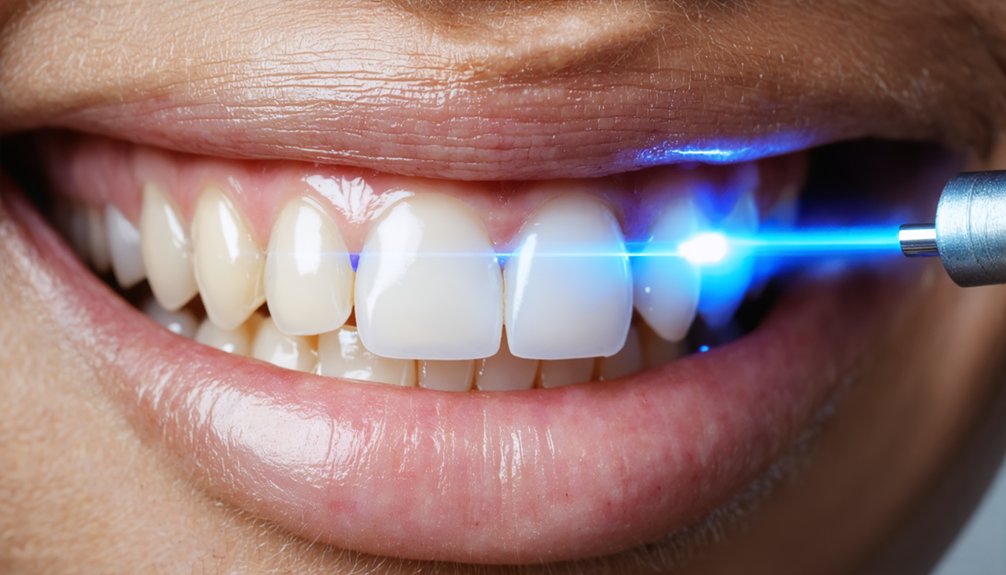
If you’re struggling with surface stains from food or tobacco, argon laser whitening delivers a targeted solution by emitting a precise 488 nm blue light wavelength that your enamel’s yellow pigments absorb directly.
This selective absorption accelerates peroxide activation up to ten times faster than conventional bleaching, so you achieve effective stain removal without exposing your sensitive enamel to prolonged chemical contact.
Because the argon laser’s energy interacts specifically with surface-level discoloration rather than penetrating deeper tissue, you experience considerably less gum and enamel irritation throughout the entire procedure.
Blue Light Penetrates Stains
Argon laser whitening targets surface-level stains by producing a 488 nm blue light wavelength that’s absorbed directly by yellow pigments in the enamel. This blue light effectiveness accelerates stain oxidation, amplifying peroxide activity up to ten times faster than standard methods.
You gain precise control over your whitening outcome through these key mechanisms:
- Selective absorption — blue light targets yellow pigments without affecting surrounding tissue
- Accelerated oxidation — peroxide activation intensifies, breaking down stain molecules rapidly
- Reduced thermal exposure — argon’s gentler output minimizes gum and enamel irritation
- Surface-specific targeting — ideal for food and tobacco stains without penetrating deeper layers
If you’re managing sensitivity while demanding measurable results, argon laser technology delivers a technically sound, controlled whitening solution.
Gentle On Sensitive Enamel
When sensitivity is your primary concern, argon laser whitening stands out as the gentler clinical choice. Its 488 nm blue wavelength targets yellow pigments directly, accelerating peroxide activation tenfold while minimizing thermal stress on surrounding tissue.
You’re not sacrificing results for comfort — you’re leveraging precision.
One persistent whitening myth suggests aggressive treatments deliver superior outcomes. Argon technology disproves that. By focusing energy on surface-level stains from food and tobacco, it protects enamel health rather than compromising it.
Unlike CO2 alternatives, argon reduces gum irritation without diminishing efficacy.
You maintain control throughout the process. Clinicians can calibrate exposure in real time, ensuring treatment stays within your sensitivity threshold.
For patients who’ve avoided whitening due to discomfort, argon laser redefines what’s clinically achievable.
Diode Laser Whitening Cuts Sensitivity in the Chair
Diode lasers cut in-chair sensitivity by using 660 nm red light that enamel absorbs efficiently, accelerating peroxide reactions without generating the heat that typically triggers nerve irritation. This precision gives you measurable treatment comfort throughout the procedure.
Key advantages you’re controlling with diode laser technology:
- Targeted wavelength absorption — 660 nm red light activates peroxide selectively, minimizing gum and pulp exposure.
- Accelerated reaction time — faster oxidation means shorter chair time, reducing cumulative sensitivity risk.
- Adjustable intensity — clinicians calibrate output specifically for your sensitivity threshold.
- Reduced hypersensitivity incidents — controlled exposure windows lower post-treatment nerve irritation considerably.
You’re not sacrificing results for comfort — diode laser protocols deliver both simultaneously.
TouchWhite Fotona Laser for Zero Post-Treatment Pain
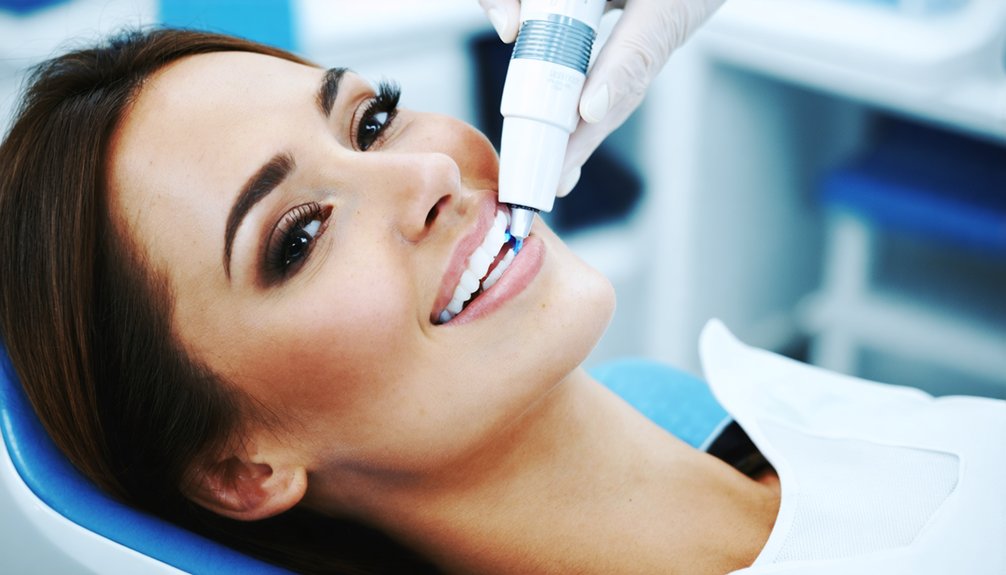
If you’ve struggled with post-treatment tooth pain after whitening, TouchWhite Fotona laser technology eliminates that concern entirely by using a non-invasive approach that’s exceptionally gentle on sensitive enamel.
The Fotona system targets discoloration without triggering the nerve hypersensitivity that conventional bleaching agents typically cause, so you leave the chair with zero residual discomfort.
Better still, you’ll walk out with a visibly brighter smile in a single office visit, making it one of the most efficient and patient-friendly professional whitening options available.
Fotona’s Pain-Free Mechanism
Fotona’s TouchWhite laser system redefines teeth whitening for sensitive patients by eliminating the root cause of post-treatment discomfort. Its Fotona mechanisms work non-invasively, bypassing nerve stimulation entirely.
You get pain free whitening through precise laser calibration that targets stains without compromising enamel integrity.
Here’s how the system controls your experience:
- Non-thermal delivery — The laser activates whitening agents without generating heat that triggers nerve responses.
- Selective chromophore targeting — Energy absorbs into discolored molecules exclusively, leaving surrounding tissue undisturbed.
- Zero peroxide overexposure — Controlled application prevents chemical penetration beyond the stain layer.
- Single-session efficiency — One visit delivers measurable brightness, reducing cumulative exposure risk entirely.
You maintain complete control over outcomes while the technology handles precision—no sensitivity tradeoffs required.
Immediate Whitening Results
The instant brightness you achieve reflects a controlled, non-invasive process engineered for predictability.
Fotona’s wavelength penetrates enamel efficiently without thermal damage, so the whitening you see leaving the chair is stable and consistent.
For patients who need outcomes on their terms—without compromising tooth sensitivity—TouchWhite eliminates the trade-off between effectiveness and comfort.
You gain full control over your schedule while the laser does the precise, targeted work.
MAXULTRA Whitening When Standard Treatments Stop Working
When standard whitening treatments fail to address complex or stubborn discoloration, MAXULTRA Whitening steps in as a hybrid solution combining an at-home kit with an in-office laser session. Its maxultra effectiveness directly targets discoloration challenges that conventional methods can’t resolve.
Here’s what makes MAXULTRA your strategic advantage:
- Hybrid precision — controlled at-home application prepares enamel before professional laser treatment amplifies results.
- ULTRA T variant — specifically engineered for tougher, deeper stains resistant to standard peroxide treatments.
- Sensitivity management — controlled application protocols minimize hypersensitivity throughout the entire process.
- Non-invasive methodology — laser sessions work without aggressive chemical concentrations, protecting enamel integrity.
You’re not surrendering to difficult stains. You’re deploying a clinically structured, two-phase system designed to overcome exactly what simpler treatments couldn’t.
Hismile LED Whitening: A Laser-Free Option for Peroxide Sensitivity
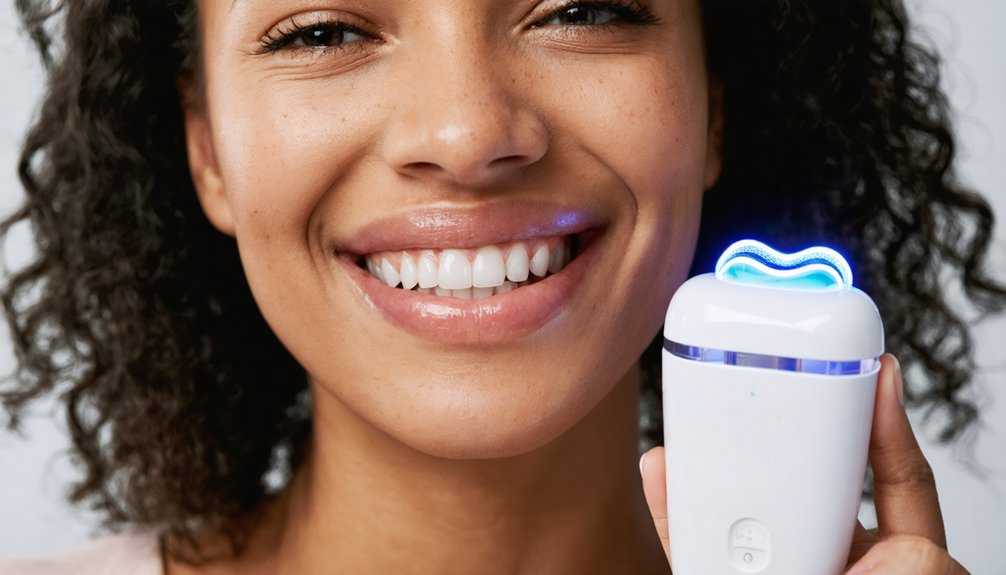
For patients who can’t tolerate peroxide-based formulas, Hismile’s LED whitening kit delivers a clinically viable alternative built around PAP+ (phthalimidoperoxycaproic acid) technology.
Unlike conventional bleaching agents, PAP+ effectiveness stems from its ability to oxidize stain molecules directly through enamel without triggering nerve sensitivity. You’re getting meaningful stain reduction without compromising enamel safety or enduring post-treatment discomfort.
The LED technology accelerates this reaction by activating PAP+ compounds precisely, shortening treatment duration while maintaining gentle application standards.
As a home whitening system, it puts the process entirely in your hands—you control timing, frequency, and intensity.
Hismile benefits extend beyond comfort; you’re choosing a sensitivity solution that doesn’t force trade-offs between results and pain management, making it a legitimate clinical choice for peroxide-intolerant patients.
Snow LED Kit Whitens Up to Eight Shades Safely
If you’re looking for a structured at-home whitening system designed with sensitivity in mind, the Snow LED Kit delivers results of up to eight shades whiter in 21 days through its patented LED mouthpiece technology.
You’ll apply the whitening serum using the included wands, then activate the LED mouthpiece for 9–30 minutes daily, accelerating the whitening process without generating the heat that typically triggers discomfort.
The kit also includes a desensitizing serum, giving you a targeted solution to counteract any residual sensitivity throughout your treatment cycle.
Patented LED Mouthpiece Technology
Three key components make the Snow LED Kit a standout solution for sensitive teeth: its patented LED mouthpiece, desensitizing serum, and whitening wands. The mouthpiece design delivers controlled light exposure, accelerating whitening while minimizing discomfort.
Here’s what the patented technology delivers:
- Wavelength precision – Targets stained enamel without generating harmful heat
- Hands-free application – Mouthpiece design guarantees consistent, full-coverage light distribution
- Desensitizing integration – Serum works simultaneously to protect vulnerable enamel
- Flexible sessions – You control treatment duration between 9–30 minutes daily
You’re not sacrificing comfort for results. The system’s engineering gives you measurable outcomes—up to eight shades whiter in 21 days—while maintaining complete sensitivity management throughout every session.
Desensitizing Serum Included
While most whitening systems force you to choose between results and comfort, the Snow LED Kit’s included desensitizing serum eliminates that compromise entirely.
You’re getting a clinically intentional addition that directly counteracts post-treatment sensitivity before it starts. The serum’s desensitizing benefits work by reinforcing enamel integrity during active whitening cycles, giving you control over how aggressively you pursue shade improvement.
Unlike systems that treat sensitivity as an afterthought, Snow integrates serum effectiveness directly into its protocol. You apply it alongside the whitening wands, meaning both processes run concurrently rather than consecutively.
This synchronized approach lets you achieve up to eight shades of improvement over 21 days without sacrificing your comfort threshold. You’re not managing damage afterward—you’re preventing it throughout.
In-Office Laser Beats At-Home Kits for Severe Sensitivity
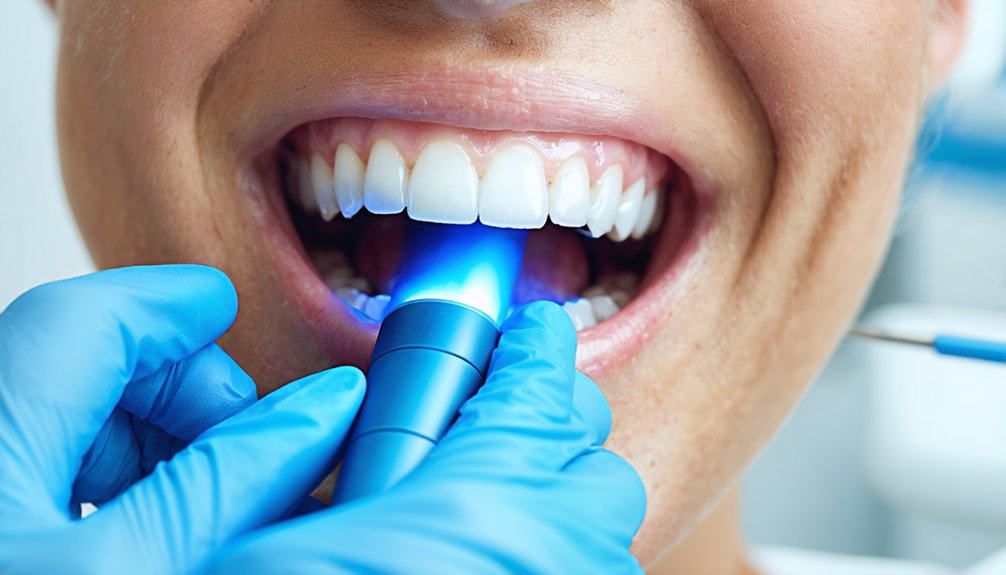
When severe tooth sensitivity‘s the concern, in-office laser treatments deliver a clear advantage over at-home kits. You gain precise control over laser effectiveness and treatment duration, minimizing discomfort that at-home kits can’t manage as reliably.
Consider these critical advantages:
- Calibrated intensity — Professionals adjust argon or diode lasers to your exact sensitivity threshold.
- Accelerated peroxide activation — Lasers increase whitening speed tenfold, reducing prolonged enamel exposure.
- Immediate monitoring — Clinicians detect sensitivity signals and adjust parameters in real time.
- Single-session results — Fotona laser technology delivers visible whitening without repeated applications that compound sensitivity risks.
At-home kits lack this precision. You’re managing concentration and timing independently, increasing sensitivity exposure.
For severe cases, professional laser treatment isn’t optional — it’s the strategically superior choice.
Match Your Stain Type and Sensitivity Level to the Right Treatment
Matching your stain type and sensitivity level to the right treatment eliminates guesswork and reduces unnecessary discomfort.
Stain classification drives treatment customization — surface stains from food or tobacco respond well to Argon laser therapy, while deeper discoloration requires the hybrid MAXULTRAWhitening approach or Fotona-based TouchWhite sessions.
If you experience chronic sensitivity, prioritize peroxide-free options like HismileKit’s PAP+ formula or Snow’s desensitizing serum system.
For moderate sensitivity with stubborn stains, diode LED acceleration shortens peroxide exposure while delivering measurable results.
You control outcomes by aligning stain origin, depth, and your sensitivity threshold with the appropriate protocol.
Skipping this matching process forces you into treatments that either underperform or aggravate discomfort — both outcomes you can strategically avoid.
Frequently Asked Questions
How Long Do Laser Whitening Results Typically Last for Sensitive Teeth?
Results typically last 1–3 years. With proper sensitivity management and advanced laser technology, you’ll maintain your whitened smile longer by avoiding staining foods and scheduling annual touch-ups to preserve those shades you’ve gained.
Can Laser Whitening Worsen Existing Gum Disease or Recession?
Yes, laser whitening can worsen existing gum disease or recession. You must prioritize your gum health before pursuing any treatment options. Argon lasers offer gentler application, but you’ll need professional clearance to protect compromised gum tissue effectively.
Does Dental Insurance Ever Cover Laser Whitening for Sensitive Patients?
Like chasing shadows, insurance coverage for laser whitening remains elusive—most plans won’t cover it since it’s cosmetic. You’ll need to explore flexible spending accounts or financing to fund your treatment options effectively.
How Many Laser Whitening Sessions Are Needed for Optimal Results?
You’ll typically need one to three sessions for ideal results, though patient experiences vary based on stain severity. Combining home remedies like desensitizing serums enhances outcomes, giving you greater control over your whitening journey efficiently.
Are There Age Restrictions for Laser Whitening Treatments on Sensitive Teeth?
Age considerations affect your treatment eligibility considerably. You’ll typically need to be 18+ for laser whitening, as developing teeth demand careful caution. Consult your dentist to confirm you’re cleared for safe, sensitivity-conscious laser treatment.
References
- https://aspiredw.com/blog/best-teeth-whitening-for-sensitive-teeth/
- https://springhavendental.com/blog/teeth-whitening-for-sensitive-teeth/
- https://www.mylifesmiles.com/teeth-whitening-clinic/what-are-the-best-laser-teeth-whitening-methods
- https://ivorywhitening.com/laser-teeth-whitening-for-sensitive-teeth/
- https://calistogadentalgroup.com/laser-dentistry-for-teeth-whitening-a-guide-to-a-brighter-smile/
- https://maidentistry.com/blog/whitening-sensitive-teeth-exploring-options-for-pain-free-results/
- https://pmc.ncbi.nlm.nih.gov/articles/PMC5410669/
- https://www.healthline.com/health/dental-and-oral-health/laser-teeth-whitening