Teeth whitening requires multiple sessions because peroxide agents can only penetrate and oxidize stain compounds layer by layer—your enamel absorbs the gel gradually, so one session can’t reach every embedded stain. Deeper discoloration, like stains from tetracycline or aging, resists quick removal and needs repeated treatment cycles. Your starting shade, enamel porosity, and sensitivity also dictate how many sessions you’ll need. Keep going to uncover exactly what’s driving your specific whitening timeline.
Key Takeaways
- Peroxide agents oxidize stains incrementally, targeting successive layers with each session rather than removing all discoloration at once.
- Deeper, intrinsic stains from aging or tetracycline resist quick removal and require repeated whitening cycles to fully neutralize.
- Enamel absorbs whitening gel gradually, limiting how much stain can be safely removed within a single treatment session.
- Recovery intervals between sessions allow enamel and pulp to stabilize, preventing sensitivity and long-term structural damage.
- Lifestyle factors like coffee, tea, and tobacco accelerate stain depth, increasing the total number of sessions required.
The Science Behind How Whitening Removes Stains
Teeth whitening works by pushing peroxide-based agents—either hydrogen peroxide or carbamide peroxide—deep into your enamel, where they break apart the molecular bonds holding stain compounds in place.
The whitening gel doesn’t clear all discoloration in a single pass. Instead, it targets successive stain layers, oxidizing each one incrementally. That’s why one session rarely delivers your target shade—the chemistry itself is cumulative by nature.
Your enamel absorbs the gel at a controlled rate, and your gum health plays a direct role in how safely and consistently that exposure can continue. Irritated or compromised gum tissue limits treatment intensity and duration.
Understanding this process lets you set realistic expectations and take deliberate control over your whitening timeline rather than hoping a single appointment produces the result you want.
Why One Session Rarely Removes Deep Discoloration
When you expose your teeth to a whitening agent, the peroxide penetrates enamel gradually, breaking down stain compounds layer by layer rather than all at once.
Deep discoloration resists a single session because stain molecules embed themselves within the enamel’s microscopic structure over months or years, making them slow to oxidize and clear.
Each successive treatment builds on the last, progressively lightening deeper stain layers until your teeth reach the target shade.
Stain Layers Resist Quickly
Because stain compounds don’t accumulate on a single surface layer, a single whitening session can’t realistically clear all discoloration at once. Stains penetrate progressively deeper into enamel, exploiting enamel porosity to anchor pigment compounds well beneath the surface. Whitening agents must work through each successive layer, which takes repeated exposure rather than one concentrated treatment.
Saliva effects also complicate single-session results. Saliva dilutes peroxide agents during treatment, reducing their penetration depth and limiting chemical reach. Each session you complete breaks down another layer of embedded stain, building cumulatively on previous results.
Attempting to accelerate this process in one sitting risks sensitivity and enamel damage without guaranteeing superior outcomes. Understanding this layered resistance helps you set realistic expectations and commit to the structured treatment schedule that actually delivers measurable, lasting shade improvement.
Enamel Absorbs Stains Deeply
Enamel’s porous microstructure actively draws stain compounds inward, allowing pigment molecules from coffee, tea, wine, and tobacco to migrate beyond the surface and embed within deeper structural layers. Enamel porosity determines how aggressively these compounds penetrate, and rougher surface texture accelerates absorption by expanding the contact area between pigment and enamel.
Once stains establish themselves at deeper structural levels, a single whitening session can’t reach or neutralize all discoloration simultaneously. Peroxide agents work incrementally, penetrating successive layers rather than clearing embedded pigment in one cycle.
You’re fundamentally reversing a gradual accumulation process, which demands a proportional treatment response. Each session dismantles another layer of established staining, progressively restoring brightness.
Recognizing this mechanism helps you set realistic expectations and commit to the full treatment protocol needed for meaningful, lasting results.
Gradual Whitening Builds Results
Stain depth explains why whitening demands repetition rather than a single concentrated effort. Each session penetrates successive stain layers, building cumulative results rather than clearing all discoloration at once. You’re fundamentally training the peroxide chemistry to work progressively deeper into compromised enamel.
Attempting maximum whitening in one appointment increases sensitivity risks and doesn’t guarantee better outcomes.
Patient compliance directly determines how efficiently you reach your target shade. Skipping scheduled sessions or ignoring post-treatment care stalls progress and forces additional cycles, raising cost considerations unnecessarily.
Spacing treatments correctly allows enamel to stabilize between oxidative exposures, protecting structural integrity while sustaining forward momentum.
Understanding this gradual mechanism shifts your expectations productively. You’re not waiting for results—you’re systematically directing a biochemical process toward a precise, controllable outcome.
Why Your Stain Type Changes the Session Count
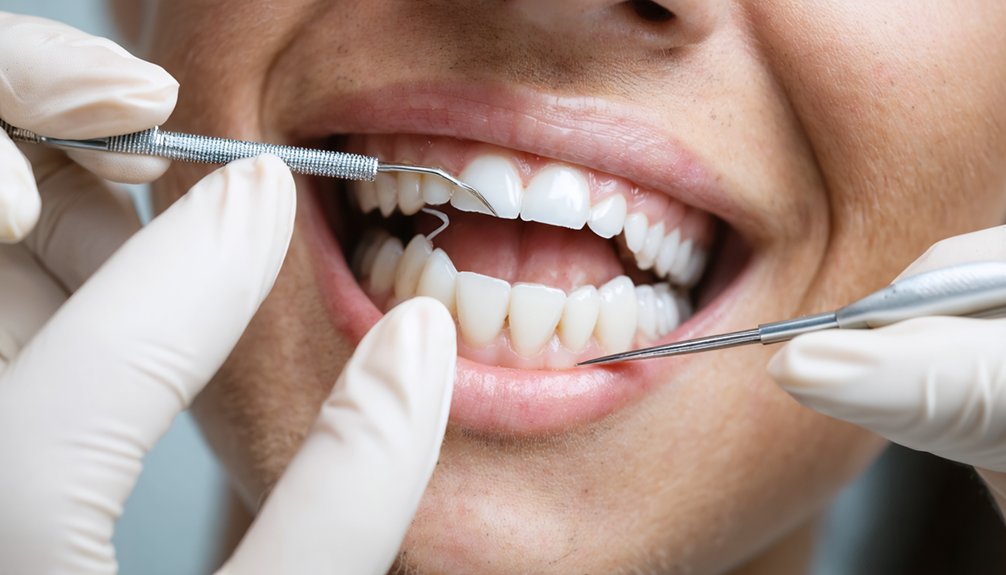
The type of stain affecting your teeth directly determines how many whitening sessions you’ll need to reach your target shade. Extrinsic stains—those sitting on your enamel’s surface from coffee, tea, or tobacco—typically respond faster and require fewer treatments than intrinsic stains embedded within the tooth structure itself.
When staining penetrates deeper layers, each session lifts only a portion of the discoloration, making multiple cycles necessary to build toward a satisfactory result.
Extrinsic Versus Intrinsic Stains
Whether your teeth respond to whitening in one session or six often comes down to a single factor: where your stain lives.
Extrinsic stains sit on enamel’s surface and typically clear faster, lowering your cost considerations. Intrinsic stains penetrate the tooth’s inner structure, demanding more sessions and potentially pushing you toward alternative treatments like veneers or bonding.
Here’s what controls your session count:
- Stain location — Surface stains respond immediately; internal stains require cumulative peroxide penetration.
- Stain origin — Tetracycline and aging-related discoloration resist whitening far more than coffee or tea staining.
- Stain depth — Deeper layers lighten gradually, meaning each session builds on the last rather than delivering instant results.
Knowing your stain type lets you plan treatment with precision and realistic expectations.
Stain Depth Affects Sessions
How deep your stain sits within the tooth structure directly determines how many whitening sessions you’ll need. Surface-level extrinsic stains respond faster because peroxide agents reach them quickly through enamel permeability.
Intrinsic stains embedded within dentin resist treatment and require repeated cycles to progressively break down stain compounds layer by layer.
Your dietary habits accelerate stain depth. Consistent coffee, tea, or wine consumption drives chromogens deeper into enamel over time, compounding treatment difficulty.
Tetracycline and aging-related discoloration penetrate even further, demanding the most sessions.
Each whitening cycle exposes successive stain layers rather than eliminating all discoloration simultaneously.
Understanding this cumulative mechanism gives you strategic control—you can accurately anticipate your session count based on stain origin, depth, and how aggressively you’ve managed contributing lifestyle factors.
Why Your Starting Shade Changes Everything
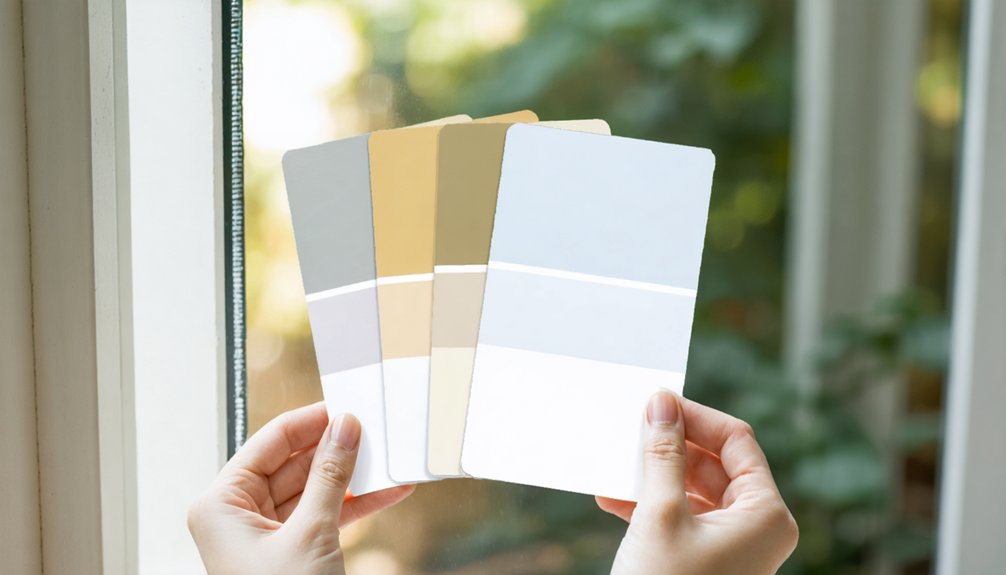
Your starting tooth shade is potentially the single most influential variable in determining how many whitening sessions you’ll need. Darker baselines demand more treatment cycles because stain compounds are more deeply established within your enamel structure.
Your starting tooth shade is the most powerful variable controlling how many whitening sessions stand between you and results.
Diet impact accelerates discoloration over time, while enamel health determines how effectively whitening agents can penetrate and break down those compounds.
Here’s what your starting shade directly controls:
- Session volume — darker teeth require more cumulative whitening cycles to reach a target shade.
- Visible progress per session — heavy baseline discoloration limits noticeable shade change after a single treatment.
- Treatment timeline — long-standing discoloration extends your overall whitening schedule substantially.
Understanding your baseline puts you in control of setting realistic expectations and committing to the right number of sessions.
Why Sensitivity Affects How Many Sessions You Can Do
Starting shade determines how many sessions you need, but sensitivity determines how fast you can get through them. If you experience tooth sensitivity, your dentist will space treatments weeks apart, giving your enamel and pulp time to stabilize between oxidative exposures. Rushing that timeline doesn’t accelerate results — it increases discomfort and risks enamel damage.
Thinner enamel amplifies sensitivity responses, which directly caps how much whitening can be safely delivered per session. If you’re also considering dental veneers, managing tooth sensitivity beforehand becomes even more critical, since veneer placement requires stable enamel conditions.
You control your outcome by respecting recovery intervals, not by compressing them. Strategic spacing lets each session build on the last while keeping the process safe and clinically sustainable.
Lifestyle Habits That Slow Down Your Teeth Whitening Results
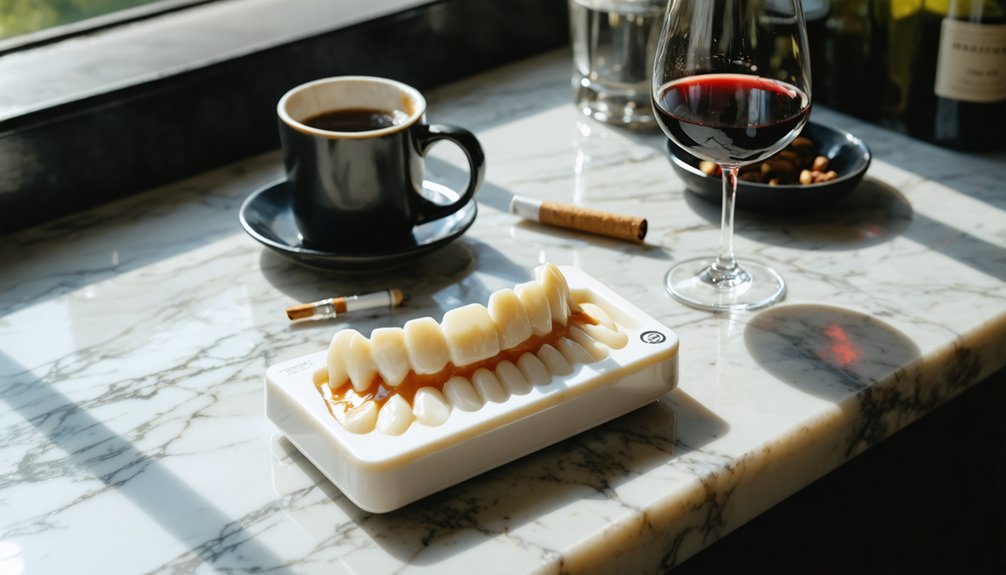
Even after completing multiple whitening sessions, your daily habits can quietly erode those results before you’ve reached your target shade. Your dietary habits and oral hygiene practices directly control how fast stains rebuild between treatments.
Three lifestyle factors that slow your progress:
- Consuming staining agents — Coffee, tea, red wine, and tobacco redeposit pigment onto enamel after every session, forcing your whitening to work against an active stain cycle.
- Neglecting oral hygiene — Plaque accumulation creates a surface layer that blocks whitening agents from penetrating efficiently, reducing each session’s effectiveness.
- Inconsistent maintenance — Skipping touch-up treatments while continuing stain-causing habits accelerates regression, meaning you’ll need more corrective sessions overall.
You control these variables. Adjusting them directly shortens your total treatment timeline.
How Many Sessions Is Too Many : and When to Stop
Controlling your lifestyle habits reduces unnecessary sessions, but at some point you also need to recognize when adding more treatments stops producing meaningful results. Once your teeth plateau at a consistent shade across two consecutive sessions, continuing offers diminishing returns.
Sensitivity that worsens after each treatment signals that your enamel needs recovery time, not another application. Cost considerations also matter — stacking professional or DIY sessions without measurable shade progression wastes money and risks overexposure to peroxide.
Professional vs. DIY approaches both carry this risk, though professional oversight gives you objective shade-measurement tools to confirm actual progress. Stop when your target shade is reached, when sensitivity becomes persistent, or when two sessions produce no visible change.
Chasing brightness beyond your enamel’s capacity causes damage, not improvement.
Frequently Asked Questions
Can Teeth Whitening Results Look Uneven Across Different Teeth?
Like a mosaic coming together piece by piece, yes, your results can look uneven. Dental stains and tooth discoloration vary per tooth, so you’ll notice differences until multiple sessions gradually harmonize your overall brightness.
Do Whitening Results Last Longer With Professional Treatments Than At-Home Kits?
Professional treatments do last longer, giving you stronger shade consistency with fewer touch-ups. At-home kits require higher treatment frequency to maintain results. You’ll achieve more durable, controlled whitening outcomes by choosing professional-grade peroxide concentrations over consumer alternatives.
Will Existing Crowns or Fillings Affect My Overall Whitening Outcome?
Yes, your dental restorations won’t whiten like natural teeth, creating a color mismatch. Crowns and fillings stay their original shade, so you’ll need to factor this into your whitening plan for consistent results.
Does Genetics Influence How Bright My Teeth Can Ultimately Become?
Yes, genetic factors directly influence your natural tooth shade and set the upper limit of how bright you can achieve. They determine enamel thickness and baseline color, meaning you’ll need tailored sessions to maximize your individual whitening potential.
Can Poor Oral Hygiene Reduce How Effective Each Whitening Session Is?
Yes, poor oral hygiene directly reduces your whitening results. Plaque buildup blocks peroxide from penetrating enamel evenly, while diet impact compounds staining. Prioritize dental health before each session—you’ll maximize effectiveness and maintain control over your whitening outcomes.
References
- https://www.willowrundental.net/blog/2025/07/12/how-many-teeth-whitening-sessions/
- https://www.reddit.com/r/askdentists/comments/1katl31/is_is_okay_to_get_multiple_inoffice_whitening/
- https://smilesofchandler.com/understanding-zoom-teeth-whitening-sessions/
- https://www.lakeoconeedental.com/blog/how-many-teeth-whitening-sessions-will-i-need/
- https://www.teethwhitening.london/blog/is-it-normal-to-need-multiple-whitening-cycles
- https://www.northjacksonvillecompletedentistry.com/blog/teeth-whitening-how-many/
- https://rx360.in/dental-health/is-one-session-enough-for-teeth-whitening/
- https://dentalecostsmile.com/laser-teeth-whitening/
- https://cosmeticsurgerytips.com/cosmetics/how-many-teeth-whitening-sessions-do-i-need/