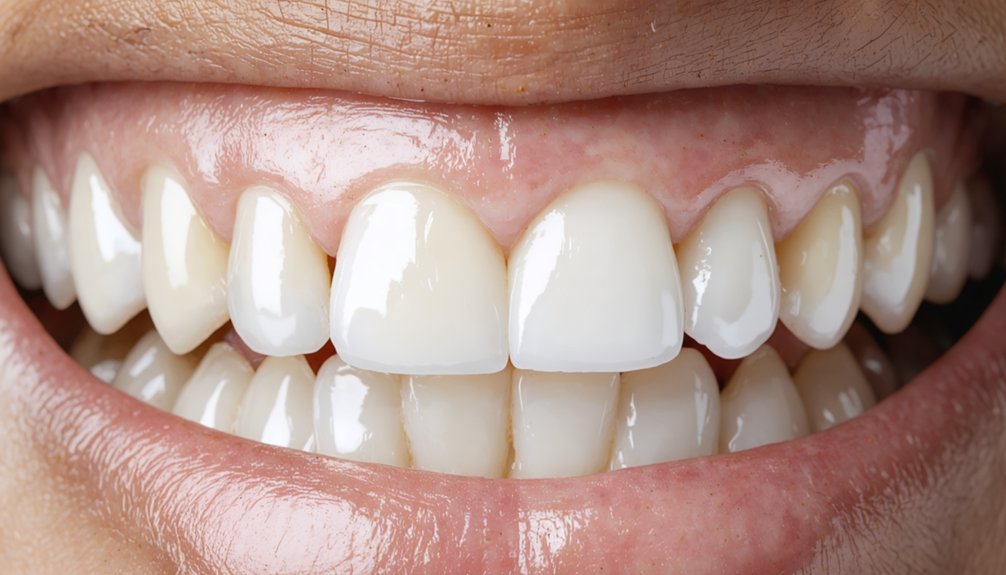
Medication stains form when drug compounds bind to enamel or penetrate dentin, making standard brushing ineffective. You can address surface discoloration with hydrogen peroxide whitening strips, which reduce antibiotic stains by up to 40% in two weeks, or baking soda-based pastes for milder cases. Persistent stains after four weeks signal the need for clinical options like laser whitening or porcelain veneers. Keep exploring to find the exact solution your stain type demands.
Key Takeaways
- Whitening toothpaste with hydrogen peroxide can visibly reduce medication stains by up to 80% with consistent daily use.
- Whitening strips penetrate deeper layers, reducing antibiotic-related stains by up to 40% within two weeks.
- Baking soda mixed with hydrogen peroxide effectively breaks down stains caused by chlorhexidine and antibiotics.
- Persistent stains lasting beyond four weeks of at-home treatment require professional dental assessment and intervention.
- Clinical options like laser whitening, veneers, and dental bonding provide lasting solutions for deep medication stains.
Why Medications Stain Your Teeth
Medications interact with your teeth in ways that go far beyond their intended purpose. Certain medication types bind directly to calcium ions in your enamel, creating stubborn chromogenic compounds that resist standard brushing.
Antibiotics like tetracycline incorporate into developing dentin during mineralization, producing intrinsic discoloration that no surface treatment can easily reverse. Antihistamines reduce saliva flow, allowing pigment-rich compounds to adhere more aggressively to your enamel surface.
Tetracycline binds permanently into developing dentin, while antihistamines dry saliva, leaving enamel vulnerable to aggressive pigment adhesion.
Understanding stain mechanisms gives you a strategic advantage. Extrinsic stains form when drug metabolites deposit onto your enamel’s outer layer, while intrinsic stains penetrate dentin during tooth development.
Chlorhexidine-based rinses oxidize surface proteins, generating yellow-brown discoloration over time. Identifying your specific stain type determines which removal approach delivers the most precise, effective results for your teeth.
At-Home Products That Actually Remove Medication Stains
Once you understand what type of stain you’re dealing with, selecting the right at-home product becomes far more targeted and effective.
Medication stains respond differently to various formulations, so precision matters.
- Whitening toothpaste with hydrogen peroxide targets surface discoloration, delivering up to 80% visible improvement with consistent daily use.
- Baking soda-based pastes act as mild abrasives, scrubbing superficial pigment without compromising enamel integrity.
- Whitening strips with peroxide penetrate deeper enamel layers, reducing stubborn antibiotic-related stains by up to 40% within two weeks.
- Over-the-counter whitening kits offer customizable application, cutting stain intensity by 35–50% after four weeks.
You’re not guessing—you’re applying clinically supported tools strategically.
Each product targets a specific stain depth, giving you measurable, aesthetic results without a clinical visit.
Natural Remedies for Medication-Stained Teeth (What Works and What Doesn’t)
At-home products offer measurable results, but many patients look beyond the pharmacy aisle for solutions that feel more accessible or cost-effective.
Natural remedies vary widely in their efficacy, and understanding what actually works protects both your enamel and your time.
Baking soda ranks among the most validated natural abrasives, reducing surface stains by approximately 25% within one week. Its mild abrasiveness lifts pigment without degrading enamel when used correctly.
Mixing it with hydrogen peroxide introduces effective ingredients that chemically break down chlorhexidine and antibiotic-based discoloration.
Conversely, lemon juice and apple cider vinegar carry significant erosion risks that outweigh their whitening benefits.
Activated charcoal lacks sufficient clinical evidence. You’ll achieve safer, more consistent results by selecting remedies backed by measurable outcomes rather than trending recommendations.
Signs You Need a Dentist for Medication Stains
While natural remedies and over-the-counter products resolve many surface-level medication stains, certain signs indicate that professional intervention is no longer optional. Ignoring stain severity can compromise both aesthetics and dental hygiene beyond reversible thresholds.
Consult a dentist immediately when you notice:
- Discoloration penetrating enamel deeply — surface treatments won’t reach pigment embedded within dentin layers.
- Stains persisting after four weeks of consistent at-home whitening protocols.
- Uneven or spreading discoloration suggesting structural enamel degradation rather than superficial pigment adhesion.
- Sensitivity accompanying discoloration — a clinical indicator that stain-causing compounds have compromised enamel integrity.
At this stage, professional scaling, laser whitening, or veneers become necessary tools. You’re no longer managing aesthetics — you’re protecting long-term dental structure.
Clinical Treatments for Deep Medication Stains
When surface-level treatments fail to reach pigment embedded within dentin, clinical interventions become your most reliable path to restoration.
Professional whitening using high-concentration peroxide gel—delivered through customized tray systems—penetrates deeper than any store-bought alternative, targeting stubborn antibiotic and chlorhexidine discoloration at the structural level.
For stains resistant to bleaching, dental bonding applies a tooth-colored composite resin directly over affected surfaces, restoring uniformity without invasive procedures.
If discoloration is severe, porcelain veneers eliminate staining entirely, offering results that last up to 15 years.
In-office laser whitening remains another precise option, resolving deep pigmentation in under 45 minutes.
Each treatment puts control back in your hands—consult your dentist to identify which clinical pathway aligns with your stain severity and aesthetic goals.
Frequently Asked Questions
How Long Does a Professional Dental Cleaning Session Typically Take?
With 95% of medication stains resolved in one session, you’ll find professional dental cleaning techniques take 30–60 minutes. Your dental hygiene appointment’s duration depends on stain severity, giving you complete control over scheduling efficiently.
Can Medication Stains Return After Successful Whitening Treatment?
Yes, stains can return. Your whitening treatment effectiveness depends on managing stain recurrence factors like medication use, diet, and oral hygiene. You’ll maintain results longer by rinsing after medications and brushing consistently with peroxide-based products daily.
Are Medication Stains Covered by Dental Insurance Plans?
Most dental insurance plans don’t cover cosmetic stain removal. You’ll want to verify your policy’s exclusions, as coverage depends on medication types causing discoloration. Prioritizing stain prevention strategies can help you avoid out-of-pocket cosmetic treatment costs entirely.
Does Rinsing With Water After Medication Actually Prevent Tooth Staining?
Like a shield deflecting arrows, rinsing with water after medication actively supports your tooth hygiene by reducing acid exposure and pigment adhesion—making it a simple yet powerful stain prevention habit you’ll want to adopt immediately.
How Long Do Porcelain Veneers Last for Treating Medication Stains?
You’ll enjoy up to 15 years of veneer longevity with porcelain veneers, which eliminate 100% of medication stains. They’re your most powerful stain prevention solution, delivering a flawless, controlled aesthetic that resists future discoloration effectively.
References
- https://www.ncbi.nlm.nih.gov/pmc/articles/PMC6904009/pdf/dentreg130092-0037.pdf
- https://mypenndentist.org/dental-tips/2024/02/13/how-to-remove-stains-from-teeth/
- https://www.woodbridgesmilecentre.com/remove-amoxicillin-stains-from-teeth/
- https://www.advancedsmilesmarion.com/resources/teeth-stain-remover
- https://www.indianapolisdental.com/blog/erase-medicine-stains-for-good-with-veneers/
- https://www.73smiles.com/does-whitening-help-medication-stains/
- https://www.dentalsreview.com/say-goodbye-amoxicillin-stains-quick-easy-ways-remove-them-your-teeth/
- https://pmc.ncbi.nlm.nih.gov/articles/PMC6710951/
- https://jada.ada.org/article/S0002-8177(17)30811-5/fulltext
- https://www.jacksonavedental.com/post/how-to-remove-chlorhexidine-stains-from-teeth