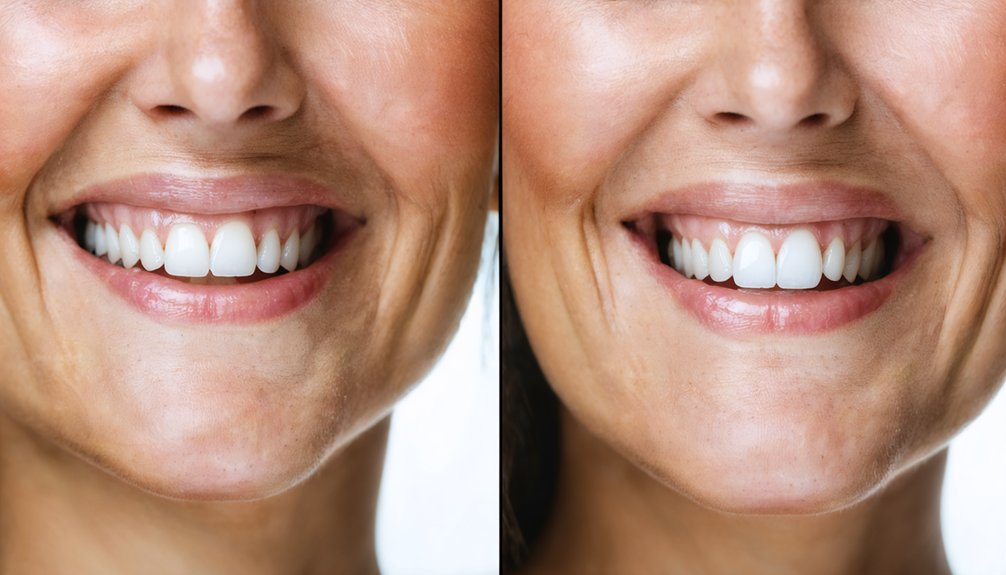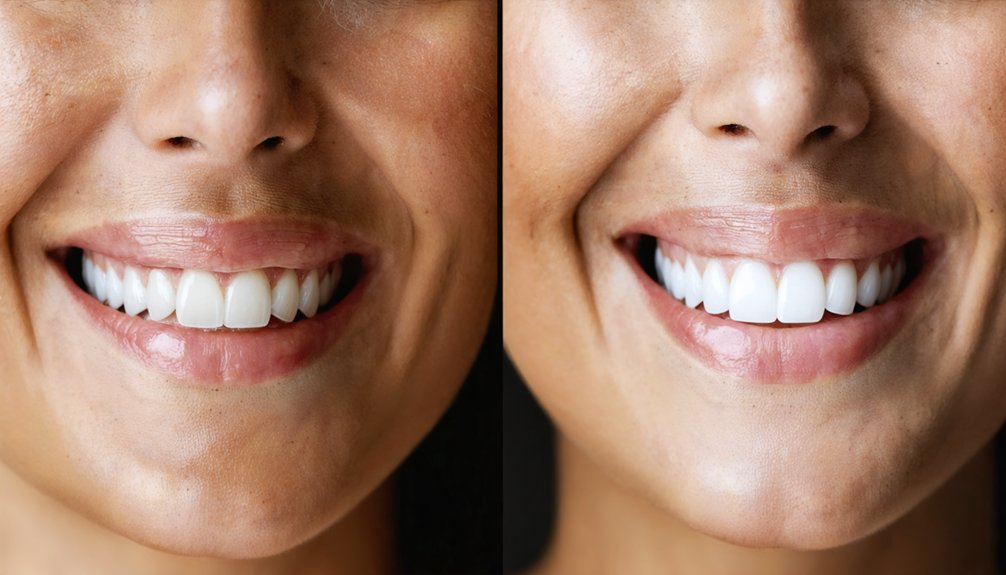
For aging teeth, your best treatment depends on where the discoloration starts. If you’ve got extrinsic stains from coffee, wine, or tobacco sitting on intact enamel, whitening can lift your shade six to eight levels. But if enamel erosion has exposed darker dentin, or you’re dealing with intrinsic discoloration, structural damage, or sensitivity, whitening won’t help—veneers will. Keep exploring to find out exactly which option fits your situation.
Key Takeaways
- Whitening effectively removes extrinsic surface stains from coffee, tea, and tobacco, lifting six to eight shades when enamel remains intact.
- Aging teeth with enamel erosion exposing darker dentin require veneers, as bleaching cannot reverse intrinsic discoloration or structural damage.
- Whitening results fade within 12–24 months, while porcelain veneers last 15–20 years, resisting staining from common beverages and tobacco.
- Veneers correct chips, cracks, misalignment, and wear in addition to discoloration, offering functional restoration whitening cannot provide.
- Despite higher upfront costs, veneers offer better long-term value for aging teeth with structural issues or intrinsic staining.
Extrinsic vs. Intrinsic Staining: Why the Difference Determines Your Treatment
Intrinsic staining is fundamentally different. It originates within the dentin, often because enamel erosion has thinned your protective outer layer, exposing the naturally darker tissue beneath.
No bleaching agent reverses that structural reality. You’re not dealing with surface particles—you’re dealing with exposed anatomy.
Tooth sensitivity frequently signals this erosion threshold, warning you that your enamel’s compromised. At that point, whitening doesn’t just underperform—it can actively worsen your condition.
Understanding which category applies to your teeth isn’t optional. It’s the clinical foundation of every treatment decision that follows.
Which Type of Aging Yellowing Actually Responds to Whitening
If your yellowing comes from decades of coffee, tea, wine, or tobacco staining, professional whitening can lift your tooth color by six to eight shades because the peroxide oxidizes those extrinsic chromogenic molecules directly on the enamel surface.
You’ll see the strongest response when your enamel remains structurally intact and the discoloration hasn’t penetrated beyond the surface layer.
However, if your aging teeth show yellowing from enamel thinning that exposes the darker dentin underneath, whitening can’t reach or alter that intrinsic discoloration, making it the wrong clinical choice.
Extrinsic Stain Origins
Extrinsic stains accumulate on the outer enamel surface through years of exposure to chromogenic compounds found in coffee, tea, red wine, and tobacco, and these surface-bound discolorations respond predictably to peroxide-based bleaching.
The oxidative reaction breaks apart stain molecules embedded within the pellicle layer, restoring your natural enamel brightness without altering tooth structure.
However, you should assess two clinical variables before proceeding. Gum recession exposes cementum, which absorbs stains differently than enamel and won’t respond uniformly to whitening agents.
Tooth sensitivity, particularly in patients with worn enamel or exposed dentin, may intensify during treatment and limit peroxide concentration tolerance.
If your yellowing originates purely from decades of dietary and lifestyle exposure on structurally intact enamel, professional whitening delivers measurable, predictable results.
Whitening Shade Response
Not all aging-related yellowing responds equally to peroxide bleaching, and understanding this distinction determines whether whitening delivers the transformation you’re expecting or falls short entirely.
Surface stains from coffee, tea, and tobacco oxidize predictably under peroxide, producing measurable shade lifts of six to eight levels in a single session. However, yellowing driven by enamel thickness reduction exposes underlying dentin, which bleaching agents can’t structurally alter. You’re targeting pigment molecules, not replacing lost mineral tissue.
Additionally, reduced enamel thickness amplifies tooth sensitivity during treatment, making aggressive bleaching protocols clinically unsuitable for some aging patients. If your yellowing originates from intrinsic dentin exposure rather than extrinsic accumulation, whitening won’t achieve your target shade, and continuing to pursue it only increases discomfort without proportional aesthetic return.
Dentin Exposure Limits
Aging yellows teeth through two distinct pathways, and only one of them responds to peroxide bleaching. Extrinsic staining from decades of coffee, wine, and tobacco accumulates on enamel surfaces — peroxide oxidizes those chromogenic molecules effectively.
However, if your yellowing stems from enamel thickness loss, you’re facing intrinsic dentin exposure, and bleaching won’t reverse that. As enamel thins with age, the darker underlying dentin becomes structurally visible, not just surface-stained. No concentration of hydrogen peroxide corrects that optical reality.
You’ll also experience heightened tooth sensitivity during whitening attempts because compromised enamel transmits chemical irritants directly to pulp tissue. Before committing to whitening, your dentist must clinically assess your enamel thickness.
Thin enamel with visible dentin exposure indicates veneers, not bleaching, as your correct clinical pathway.
What Veneers Fix That Whitening Can Never Address
When whitening reaches its chemical limit, veneers step in to correct what bleaching agents can’t touch. If your teeth carry chips, cracks, or wear patterns from decades of use, whitening won’t rebuild lost structure—veneers physically restore shape and surface integrity in a single bonded application.
They also block intrinsic stains like tetracycline banding and dentin exposure while simultaneously correcting minor misalignment and proportion, giving you an all-encompassing aesthetic result that no bleaching protocol can replicate.
Structural Damage Repair
Whitening can brighten your teeth, but it can’t rebuild them. If you’re dealing with chips, cracks, or worn edges from decades of use, bleaching agents offer zero structural correction. You’re applying chemistry to a compromised surface and expecting architectural results.
Veneers physically reconstruct the visible tooth surface. They restore lost shape, close gaps, and reinforce areas weakened by enamel erosion—damage that bleaching actually worsens by increasing tooth sensitivity in already-thinned enamel.
When your enamel degrades, peroxide penetrates deeper, amplifying nerve exposure rather than correcting the underlying problem.
Veneers give you control over outcomes that whitening simply can’t deliver. You’re not masking damage—you’re replacing the surface with a durable, precisely engineered shell designed to perform for 15 to 20 years.
Intrinsic Stain Coverage
Structural damage is one category where whitening fails you—but there’s another failure mode that’s even more absolute: intrinsic staining. When discoloration originates beneath the enamel—from tetracycline banding, fluorosis, or dentin darkening caused by enamel thinning—bleaching agents can’t reach it.
You’re oxidizing surface molecules while the actual problem sits deeper. Worse, whitening can heighten tooth sensitivity and paradoxically make fluorosis spots more conspicuous by lightening surrounding enamel.
Veneers bypass this entirely. They don’t attempt chemical penetration—they cover. Enamel preservation becomes part of the clinical calculus, since minimal enamel reduction is required during preparation, but the payoff is complete masking of discoloration regardless of its origin or depth.
If your staining is intrinsic, whitening isn’t a solution. It’s a detour.
Shape And Alignment
Bleaching agents oxidize chromogenic molecules—that’s the entirety of what whitening does. It can’t close gaps, reconstruct chipped edges, or correct uneven proportions. If your aging teeth show structural wear alongside discoloration, whitening delivers incomplete results.
Veneers physically reshape your smile’s architecture. Porcelain shells correct misalignment, lengthen worn edges, close diastemas, and standardize irregular contours—simultaneously. You’re not managing one cosmetic variable; you’re controlling all of them in a single treatment plan.
Clinically, your dentist evaluates gum health before bonding veneers, ensuring the gingival margin supports long-term stability. Tooth sensitivity is monitored during enamel preparation, with minimal reduction protocols preserving underlying dentin.
Whitening addresses surface chemistry. Veneers address surface geometry. For aging teeth requiring structural rehabilitation, the distinction determines whether your outcome is partial or complete.
Whitening vs. Veneers for Aging Teeth: Which Results Last Longer?
When you’re weighing long-term value, the durability gap between whitening and veneers is significant. Professional whitening results fade within 12 to 24 months, requiring touch-ups every 12 to 18 months to maintain shade. If you experience tooth sensitivity, repeated bleaching cycles can aggravate enamel and pulpal tissue over time.
Veneers, by contrast, deliver color stability lasting 15 to 20 years with consistent dental hygiene and routine professional maintenance. Porcelain resists staining from coffee, wine, and tobacco far more effectively than natural enamel post-bleaching. You won’t need retreatment for a decade or more.
If longevity and predictability matter to you, veneers offer a structurally superior, longer-lasting solution. Whitening suits short-term goals; veneers are built for permanent transformation.
The Real Cost Difference Between Whitening and Veneers for Aging Teeth
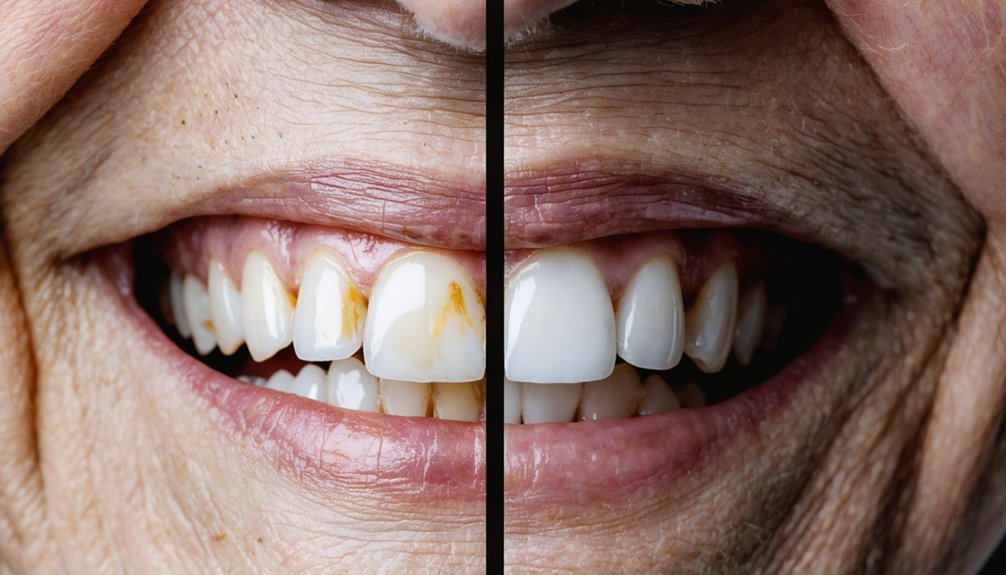
Cost shapes nearly every cosmetic dental decision, and the price gap between whitening and veneers is substantial. Understanding the cost comparison helps you allocate resources strategically based on treatment longevity and clinical need.
Key figures to guide your decision:
- Professional whitening costs $650–$795 total and requires touch-ups every 12–18 months.
- Porcelain veneers run $950–$2,500 per tooth but deliver 15–20 years of color stability.
- Composite veneers offer a middle option at $200–$1,500 per tooth with a 5–8 year lifespan.
- Whitening’s lower entry cost increases over time through repeated retreatment expenses.
When you factor treatment longevity into the cost comparison, veneers frequently deliver superior long-term value despite the higher upfront investment.
When Whitening Is the Right Call for Aging Teeth
Whitening earns its place as the smarter clinical choice when your primary concern is mild to moderate extrinsic discoloration on structurally sound teeth. If your yellowing stems from decades of dietary habits—coffee, tea, red wine, or tobacco—oxidative bleaching agents target those chromogenic molecules directly. You’re not masking the problem; you’re chemically eliminating it.
Professional in-office systems lift your shade by six to eight levels within a single appointment, delivering measurable results without irreversible enamel alteration.
If your oral hygiene is consistent and your enamel remains intact without chips, cracks, or significant wear, whitening gives you precise, controlled correction at a fraction of veneer costs.
It’s the clinically appropriate intervention when the issue is superficial, not structural.
When Veneers Are the Smarter Investment for Aging Teeth
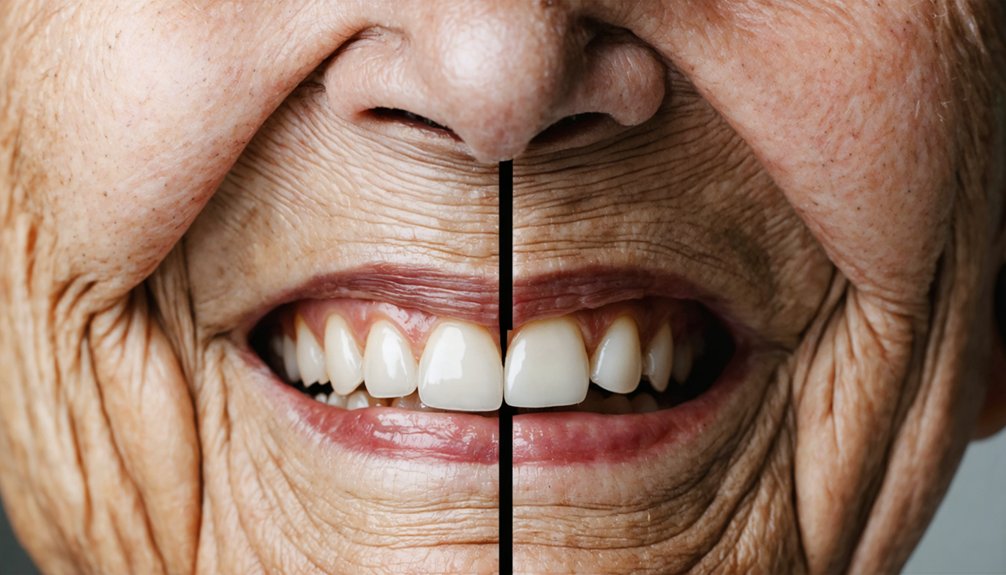
Veneers become the clinically superior choice the moment your aging teeth present with intrinsic discoloration, structural damage, or both simultaneously. When enamel erosion has exposed dentin, bleaching agents can’t reverse that structural deficit—they’ll only trigger tooth sensitivity without delivering meaningful color correction.
Veneers deliver precise control over four critical variables:
- Color depth – masking intrinsic stains bleach can’t penetrate
- Structural integrity – concealing chips, cracks, and wear patterns
- Shape correction – restoring proportion lost through decades of enamel erosion
- Long-term stability – porcelain resists staining for 15 to 20 years
If your teeth show fluorosis, tetracycline banding, or significant surface degradation, veneers aren’t an indulgence—they’re the clinically logical, cost-efficient solution per decade of aesthetic performance.
Frequently Asked Questions
Can Aging Teeth Be Whitened if They Have Existing Dental Crowns?
Yes, you can whiten your aging teeth, but whitening won’t change your crowns’ color since they don’t respond to peroxide. Crown compatibility issues may create uneven results, as whitening only affects natural color.
Does Teeth Whitening Cause Increased Sensitivity in Older Patients?
Yes, you’ll likely experience heightened sensitivity, as bleaching effects penetrate thinning tooth enamel more aggressively in older patients. Managing concentration levels and treatment duration lets you control discomfort while achieving your desired whitening outcome effectively.
Are Veneers Safe for Seniors With Gum Recession or Periodontal Issues?
Over 70% of seniors have periodontal issues—veneers aren’t always safe for you then. Your gum health must be stabilized first, as active recession compromises veneer longevity by destabilizing the bonding margin and risking failure.
Can Whitening or Veneers Be Combined With Orthodontic Treatment for Aging Teeth?
Yes, you can combine orthodontic alignment with whitening or veneers. Complete orthodontics first, then apply cosmetic improvements. This sequencing guarantees your veneers fit correctly and whitening targets properly positioned teeth for ideal, controlled aesthetic outcomes.
How Does Overall Health or Medications Affect Whitening Results in Older Adults?
Your systemic health and medication interactions directly affect whitening outcomes. Certain drugs cause intrinsic staining that bleaching can’t reverse. You’ll achieve better control by disclosing all medications to your dentist before committing to any whitening protocol.
References
- https://www.mapleridgedentistry.ca/blog/veneers-vs-whitening-what-gives-better-results/
- https://www.yourdentistryguide.com/whitening-vs-veneers/
- https://sapphiredentistrykaty.com/blog/veneers-vs-teeth-whitening-katy-tx/
- https://www.boulderdental.com/porcelain-veneers-vs-teeth-whitening-pros-cons/
- https://coliseumdentalwc.com/veneers-vs-whitening-which-option-matches-your-smile-needs/
- https://www.rayforddental.com/veneers-vs-teeth-whitening-which-option-is-best-for-your-smile-in-spring-tx
- https://ariadentalcare.com/blog/teeth-whitening-vs-veneers-which-smile-upgrade-is-right-for-you/
- https://www.asodontologiadigital.cl/en/blog/carillas-vs-blanqueamiento
- https://www.denstudio.co.uk/veneers-or-whitening
- https://www.rictadvanceddentistry.com/teeth-whitening-vs-veneers-which-option-is-best-for-you/