Your daily dental hygiene routine is your strongest defense against coffee stains. Tannins in coffee bind directly to enamel, accumulating in microscopic pores over time. Brushing twice daily with fluoride toothpaste disrupts this staining cycle, while rinsing with water immediately after coffee limits tannin contact time. Flossing clears residue from interproximal spaces that brushing misses. Professional cleanings and whitening strategies add another layer of protection—and each plays a distinct role worth understanding.
Key Takeaways
- Brushing twice daily with fluoride toothpaste dislodges surface stains before tannins penetrate enamel, disrupting the staining cycle and supporting remineralization.
- Rinsing with water immediately after coffee removes loose tannins and shortens their contact time with enamel surfaces.
- Whitening toothpaste contains detergents that break down organic coffee compounds, while flossing removes residue from interproximal spaces.
- Waiting 30 minutes before brushing after coffee allows saliva to neutralize acids, preventing micro-abrasions on temporarily softened enamel.
- Professional dental cleaning removes hardened calculus, eliminates subgingival stains, and smooths enamel surfaces that home brushing cannot adequately address.
How Coffee Actually Stains Your Teeth
Coffee contains tannins—polyphenolic compounds that bind directly to enamel surfaces and accumulate over time. During coffee brewing, these compounds concentrate depending on method and duration, meaning darker, longer-brewed varieties deliver higher tannin loads to your teeth.
Darker brews mean heavier tannin loads—and heavier tannin loads mean deeper, more stubborn stains on your enamel.
Once tannins contact enamel, they adhere to the microscopic pores and irregularities on your tooth surface. Plaque buildup accelerates this process by creating a sticky substrate that traps staining molecules more effectively.
Acidity compounds the problem—coffee temporarily softens enamel, making it more vulnerable to tannin penetration. Without consistent stain prevention strategies, these deposits darken progressively and become increasingly resistant to routine cleaning.
Understanding this mechanism gives you a precise target: reduce tannin contact time, protect enamel integrity, and disrupt plaque accumulation before stains establish themselves permanently.
Why Daily Brushing Is Your First Line of Defense Against Coffee Stains
Knowing how tannins bind to enamel and exploit plaque buildup points directly to your most accessible countermeasure: daily mechanical cleaning. Plaque provides the primary surface where oral bacteria colonize and tannins anchor, so eliminating that substrate disrupts the staining cycle at its source.
Brushing twice daily with fluoride toothpaste mechanically dislodges surface stains before they penetrate enamel pores, while fluoride actively supports remineralization to guard against enamel erosion. Whitening toothpaste adds mild detergents that break down organic coffee compounds further.
Daily flossing clears interproximal spaces where coffee residue lodges undisturbed. Together, these habits don’t just manage cosmetic discoloration—they address the structural and microbial conditions that make staining possible.
Consistent execution gives you direct, evidence-backed control over your enamel’s long-term appearance and integrity.
The Right Time to Brush After Drinking Coffee
While brushing immediately after coffee feels intuitive, it’s one of the most damaging habits for your enamel. Coffee brewing produces an acidic beverage that temporarily softens your enamel upon contact.
Brushing during this vulnerable window spreads micro-abrasions across softened tooth structure, accelerating erosion rather than preventing it.
Dentists recommend waiting 30 minutes after your last sip before picking up your toothbrush. This delay supports enamel remineralization, allowing saliva to neutralize residual acids and restore surface hardness.
During this window, rinse with water to remove loose tannins without mechanical risk.
Controlling when you brush is as critical as how often you brush. Timing your hygiene routine correctly protects your enamel while still effectively removing coffee residues before stains penetrate deeper tooth layers.
Why Rinsing Right After Coffee Prevents Stains From Setting
When you rinse with water immediately after drinking coffee, you remove loose tannins before they bind to enamel surfaces.
Swishing water acts as a mechanical rinse that washes away residual staining compounds still suspended in your saliva.
This simple habit dilutes coffee residue and shortens the duration of tannin contact with your teeth, reducing your overall staining risk.
Immediate Rinsing Removes Tannins
Rinsing with water immediately after drinking coffee mechanically displaces loose tannins before they bond to enamel surfaces. Each coffee bean contains concentrated polyphenols that begin adhering to enamel within minutes of contact. By swishing water promptly, you interrupt that adhesion cycle before it progresses into deeper staining.
Water rinsing also dilutes residual acidity, reducing the risk of enamel erosion that follows prolonged acid exposure. You’re not brushing yet — that comes 30 minutes later — but you’re actively controlling tannin contact time right now.
Incorporating mouthwash strengthens this defense by chemically disrupting organic residues water alone can’t fully remove. Adding xylitol gum stimulates saliva flow, giving you a natural flushing mechanism between rinses. Consistency with this step directly limits cumulative stain development.
Water Dilutes Coffee Residue
Water’s role extends beyond simple rinsing — it actively dilutes the polyphenol concentration sitting against your enamel surface after each sip of coffee. Regardless of your coffee brewing method, every cup delivers tannins that bind to enamel within minutes of contact. Drinking water between sips interrupts that binding cycle before stains set.
You’re also supporting enamel remineralization when you rinse promptly. Water neutralizes residual acidity, restoring your oral pH toward a level where minerals can redeposit onto softened enamel. This limits both structural erosion and surface discoloration simultaneously.
The strategy is straightforward: keep water accessible during every coffee session, swish deliberately after finishing your cup, and don’t allow tannins prolonged, uninterrupted contact with your teeth. Consistency here produces measurable long-term results.
Simple Dietary Tweaks That Reduce Coffee Staining
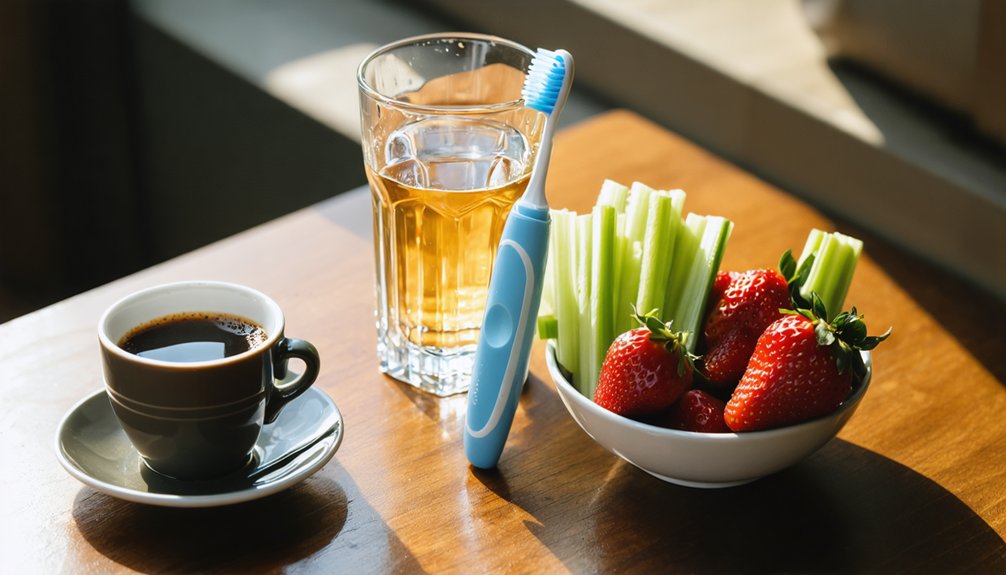
You can reduce coffee’s staining potential by adding milk or cream, which dilutes the polyphenol concentration responsible for tannin adhesion on enamel.
When you drink cold coffee through a straw, you bypass direct contact with your front teeth, considerably limiting the surface area exposed to staining compounds.
These two straightforward adjustments work alongside your daily hygiene routine to reduce cumulative stain buildup without requiring you to eliminate coffee entirely.
Milk Reduces Staining Polyphenols
Adding milk or cream to your coffee is one of the simplest dietary modifications you can make to reduce tannin-related staining. Milk proteins bind to polyphenols during coffee brewing, reducing the concentration of free tannins that contact your enamel. This binding effect directly lowers staining potential before enamel demineralization even becomes a concern.
Three imagery-driven reasons to add milk to your coffee:
- Picture tannin molecules being intercepted mid-liquid before they ever reach your tooth surface.
- Visualize a diluted, lighter-colored beverage making less chromogenic contact with porous enamel.
- Imagine your enamel maintaining its integrity rather than absorbing concentrated polyphenol compounds.
This single habit requires no additional products, appointments, or routines—just a deliberate choice made at the moment you prepare your cup.
Straws Minimize Tooth Exposure
Using a reusable straw when drinking cold coffee bypasses direct tannin contact with your front teeth entirely. Tannin chemistry explains why this works: polyphenols in coffee bind to enamel proteins on contact, initiating the staining cascade at the point of exposure.
By redirecting liquid past your anterior teeth, you eliminate that initial binding opportunity.
Coffee brewing method also influences stain risk. Cold brew concentrates tannins differently than hot extraction, making straw use particularly strategic for cold-format beverages where sipping duration tends to increase.
You won’t eliminate all exposure, since coffee still contacts posterior teeth, but you’ll considerably reduce cumulative tannin adhesion on the most visible surfaces.
Pair straw use with rinsing afterward to further limit polyphenol retention across all tooth surfaces.
What a Professional Cleaning Removes That Brushing Leaves Behind
Even with diligent twice-daily brushing, you can’t fully eliminate the hardened deposits and subgingival stains that accumulate over time. Dental plaque mineralizes into calculus that bristles can’t dislodge, and enamel erosion becomes visible only after professional evaluation reveals what home care misses.
A hygienist addresses three critical targets:
- Calculus deposits — hardened tartar bonded below the gumline that traps coffee tannins deep within tooth structure
- Subgingival stains — pigmented residues lodged beneath the gumline where brushing never reaches
- Roughened enamel surfaces — professionally polished smooth to reduce future tannin adhesion
Scheduling biannual cleanings gives you measurable control over stain accumulation that daily hygiene alone can’t provide.
Professional intervention isn’t optional maintenance — it’s a necessary component of any evidence-based stain prevention strategy.
Do Whitening Products Actually Remove Coffee Stains?
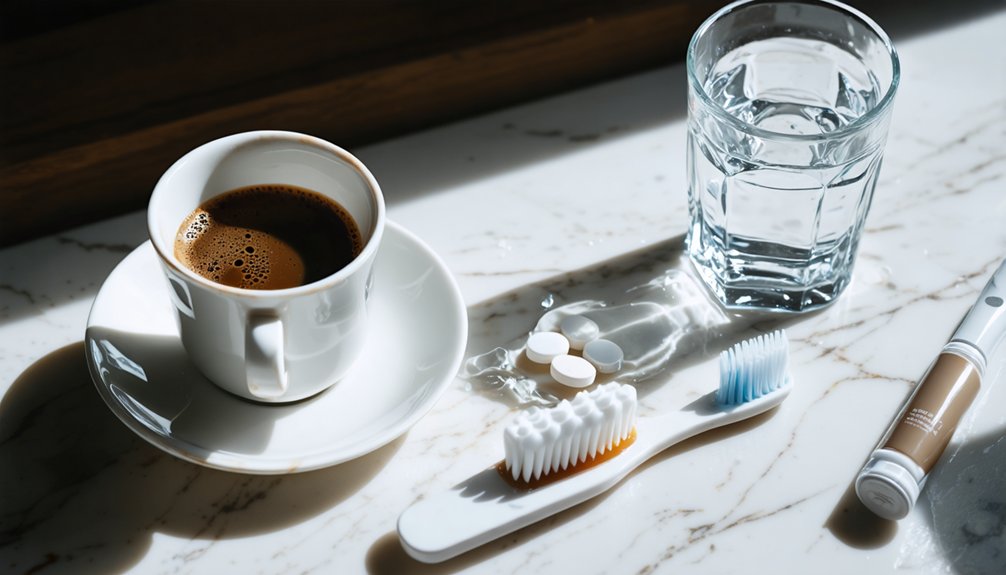
When coffee stains penetrate beyond the enamel surface, daily brushing won’t reach them — but whitening products can. Peroxide-based gels oxidize the organic molecules responsible for discoloration, breaking down stains that mechanical cleaning leaves behind.
Coffee temperature matters here — hot beverages expand enamel pores, allowing tannins to embed deeper into tooth structure. This makes whitening intervention more necessary over time.
Enamel pH also influences product effectiveness. When your mouth remains acidic after coffee consumption, whitening agents work against a compromised surface. You’ll get better results by rinsing first, then applying whitening treatments after enamel pH stabilizes.
Consult your dentist before starting any whitening regimen to confirm enamel integrity. Combining periodic whitening with consistent daily hygiene gives you the most reliable control over accumulated coffee staining.
How to Keep Coffee Stains Away After Whitening
Whitening clears accumulated stains, but without a maintenance strategy, coffee will re-stain treated enamel within weeks. Your coffee brewing habits and post-whitening care directly determine how long results last. Three evidence-based actions protect your investment:
- Rinse immediately after every cup — swishing water removes loose tannins before they penetrate freshly treated enamel pores.
- Delay brushing 30 minutes — coffee acidity temporarily softens enamel, and brushing before remineralization occurs causes micro-abrasions that accelerate future staining.
- Schedule biannual professional polishing — hygienists smooth enamel surfaces, reducing tannin adherence and catching erosion early.
Incorporating milk into your coffee brewing reduces polyphenol concentration, further protecting whitened teeth.
Consistent daily hygiene combined with these targeted habits keeps re-staining controlled long-term.
Frequently Asked Questions
Can Coffee Stains on Teeth Affect Overall Gum Health Long Term?
Coffee stains don’t directly harm your gums, but they’re linked to dental plaque buildup, which can. Tooth enamel erosion from coffee’s acidity compounds gum vulnerability. You’ve got to maintain rigorous hygiene to prevent long-term periodontal consequences.
Does the Temperature of Coffee Influence How Deeply Tannins Penetrate Enamel?
Hot coffee increases enamel porosity, accelerating tannin absorption deeper into tooth structure. You’ll reduce penetration risk by rinsing immediately with water and waiting 30 minutes before brushing, protecting softened enamel from compounding stain-related damage.
Are Certain Tooth Types or Shapes More Vulnerable to Coffee Staining?
Your front teeth practically magnetize coffee stains. Dental morphology dictates that flatter, broader tooth enamel surfaces accumulate tannins faster, so you’ll want to prioritize mechanical cleaning and rinsing strategies targeting those highly exposed anterior teeth specifically.
Can Genetics Determine How Easily Your Teeth Absorb Coffee Stains?
Yes, your genetic predisposition directly influences your enamel strength, affecting how easily coffee stains absorb. If you’ve inherited thinner or more porous enamel, you’ll need stricter daily hygiene routines to actively prevent accelerated tannin penetration.
Does Drinking Decaf Coffee Reduce Staining Risk Compared to Regular Coffee?
Don’t be fooled—decaf benefits don’t extend to stain prevention. Decaf still contains tannins that bind to enamel. You’ll need consistent mechanical cleaning and rinsing strategies regardless of your coffee type to maintain effective stain prevention.
References
- https://dentalreviewed.com/blog/how-to-prevent-coffee-and-tea-stains
- https://www.healthline.com/health/dental-and-oral-health/what-does-coffee-do-to-your-teeth
- https://www.thehealthy.com/dental/coffee-stains-teeth/
- https://www.goodrx.com/conditions/dental-care/remove-coffee-stains-teeth
- https://www.health.com/is-coffee-bad-for-your-teeth-7488391
- https://www.smileteam.com.au/blog/coffee-stains-how-to-prevent-getting-them-on-your-teeth/
- https://dentalstudio.sg/blog/oral-care/how-to-prevent-teeth-stains-from-coffee/
- https://fuquayvarinadentists.com/blog/5-tips-to-avoid-coffee-stains-on-teeth
- https://www.philips.co.uk/c-e/oral-health-care-blog/teeth-whitening/coffee-stained-teeth-four-tips
- https://www.rioranchodentalassociates.com/10-simple-ways-to-avoid-teeth-stains-from-coffee/