Hydrogen peroxide mouthwash can safely whiten your teeth when you use concentrations below 3% and follow controlled usage guidelines. It works by releasing free oxygen radicals that break down stain molecules in your enamel without mechanical abrasion. You’ll typically see measurable results after 60 to 90 days of consistent use. Side effects like sensitivity and soft tissue irritation are possible but manageable. The details on concentration, risks, and proper technique are all worth knowing before you start.
Key Takeaways
- Hydrogen peroxide mouthwash is generally safe at concentrations below 3%, with European regulations capping mouthrinses at 0.1%.
- It whitens teeth by releasing free oxygen radicals that break down stain molecules without mechanically abrading enamel.
- Common side effects include tooth sensitivity, soft tissue irritation, and temporary taste loss, which resolve upon discontinuation.
- Limit use to weekly applications, never swallow the solution, and rinse thoroughly with plain water afterward.
- Those with crowns, gum sensitivity, or active oral irritation should avoid use and consult a dentist first.
How Does Hydrogen Peroxide Whiten Teeth?
Hydrogen peroxide whitens teeth through a straightforward chemical process: it releases free oxygen radicals that penetrate the enamel and break apart the molecular bonds of chromogenic compounds responsible for tooth discoloration.
These radicals oxidize stain molecules accumulated from food, beverages, and tobacco, effectively lightening tooth color without mechanically abrading enamel surfaces.
When used as a mouthwash for teeth whitening, you’ll typically see measurable color changes after 60 to 90 days of consistent use. The whitening effect is real, though it’s less pronounced than what you’d achieve with 10% carbamide peroxide bleaching gels.
Incorporating hydrogen peroxide into your oral hygiene routine offers a low-intervention approach to managing surface discoloration, provided you use appropriate concentrations and follow established usage guidelines precisely.
What Concentration of Hydrogen Peroxide Is Actually Safe?
Knowing that hydrogen peroxide whitens teeth is only part of the picture—understanding which concentrations are actually safe determines whether you’re making a sound clinical choice.
For daily consumer use, European regulations cap hydrogen peroxide in mouthrinses at 0.1%. The American Dental Association sets hydrogen peroxide safety thresholds below 3% for unsupervised weekly applications.
Products ranging from 0.1% to 6% carry increasing risk and require professional supervision—this isn’t optional guidance, it’s a clinical requirement. Anything exceeding 6% isn’t considered safe for unsupervised use at all.
Consumer guidelines consistently recommend diluting 3% solutions with at least two parts water before oral use. Your concentration choice directly governs your risk exposure, so selecting the lowest effective dose remains the most defensible clinical strategy.
How Well Does Hydrogen Peroxide Mouthwash Really Work?
If you’re considering hydrogen peroxide mouthwash for whitening, you should expect gradual results rather than rapid transformation, with clinically relevant color changes typically appearing after 60 to 90 days of consistent use.
Research confirms that peroxide-based mouthrinses do whiten teeth, though their efficacy falls short of conventional at-home bleaching gels containing 10% carbamide peroxide.
The encouraging news is that once you achieve results, studies show color improvements can be maintained for up to two years without significant degradation.
Whitening Timeline And Results
Most users of hydrogen peroxide mouthwash won’t see noticeable whitening results until 60 to 90 days of consistent use, based on clinical evidence from peroxide-based mouthrinse studies.
Your whitening frequency and application methods directly influence how quickly detectable color changes occur.
Researchers measure results using ΔE values, which quantify color shifts objectively.
Studies confirm that peroxide mouthrinses do produce relevant whitening, though their efficacy remains lower than 10% carbamide peroxide at-home bleaching gels.
You’re trading speed for convenience when choosing a mouthrinse over a gel.
The encouraging finding is durability.
Clinical outcomes from mouthrinse use maintained their whitening effect for up to two years without degradation, meaning your results won’t rapidly reverse if you’ve completed a full treatment cycle.
Comparing Bleaching Product Effectiveness
When choosing between whitening products, the evidence places hydrogen peroxide mouthwash below 10% carbamide peroxide at-home bleaching gels regarding measurable color change.
Whitening product comparisons consistently show that mouthrinses produce modest ΔE values, while bleaching gels deliver faster, more pronounced results. Effectiveness evaluations also confirm that no significant color difference exists among competing hydrogen peroxide mouthwash brands, meaning premium pricing rarely translates to superior outcomes.
If you’re prioritizing visible, clinically significant whitening, mouthwash alone won’t meet that standard. It functions better as a maintenance tool or adjunct rather than a primary whitening intervention.
Understanding these distinctions lets you allocate your efforts strategically—selecting mouthwash when gradual improvement suffices, or advancing to professionally monitored gel-based treatments when you need measurable, documented results within a defined timeframe.
Long-Term Color Retention
Once hydrogen peroxide mouthwash produces visible whitening, how well does that color actually hold? Clinical evidence suggests the long-term benefits are measurable and durable when you use the product consistently.
Research confirms color maintenance remains stable for up to two years without significant degradation. Here’s what the data shows:
- Whitening results achieved after 60–90 days of consistent use persist through long-term follow-up monitoring.
- No meaningful color regression was detected at the two-year mark in clinical studies.
- Peroxide-based mouthrinses maintain outcomes without requiring aggressive retreatment cycles.
- Adverse effects during extended use remain rare and mild, supporting sustained color maintenance protocols.
You retain stronger control over results by maintaining consistent application habits rather than relying on periodic intensive treatments.
How Long Before Hydrogen Peroxide Mouthwash Works?
If you use hydrogen peroxide mouthwash consistently, you can expect to notice measurable color changes between 60 and 90 days of regular use.
Your results may vary based on factors like the concentration of hydrogen peroxide, the severity of your existing stains, and how frequently you rinse.
Intrinsic stains, heavily discolored teeth, and irregular use will all slow your whitening progress compared to surface stains treated with a disciplined daily routine.
Expected Timeline For Results
Unlike fast-acting bleaching gels, hydrogen peroxide mouthwash delivers gradual results that you won’t notice overnight.
Clinical evidence shows meaningful color change requires consistent whitening frequency over an extended period. User experiences align with research confirming results emerge slowly but reliably.
Here’s what the evidence-based timeline looks like:
- Days 1–30: No visible color change; peroxide begins penetrating surface stains
- Days 31–60: Subtle brightening may become detectable under controlled lighting
- Days 61–90: Clinically relevant color changes (ΔE) become measurable and visible
- Months 3–24: Results stabilize and maintain without significant degradation when use continues
You won’t achieve the same speed as 10% carbamide peroxide gels, but consistent daily rinsing produces sustained, documented whitening over time.
Factors Affecting Whitening Speed
Several variables directly influence how quickly hydrogen peroxide mouthwash produces visible whitening, and understanding them helps you set realistic expectations. Your baseline tooth shade matters greatly—heavily stained teeth may respond slower initially, yet ultimately show more dramatic improvement.
Peroxide concentration directly governs whitening effectiveness; higher concentrations within safe limits accelerate results. Consistency of use remains critical, as clinical evidence confirms color changes emerge between 60 and 90 days of regular application.
Your dietary habits affect outcomes substantially. Continued consumption of staining agents like coffee, tea, or red wine counteracts progress.
Individual biological factors, including enamel porosity and saliva composition, create variable user experiences across populations. Pre-existing dental restorations won’t respond to peroxide, potentially creating uneven results that require professional evaluation before beginning treatment.
Does Hydrogen Peroxide Mouthwash Damage Enamel Over Time?
Enamel damage from hydrogen peroxide mouthwash depends largely on concentration, frequency of use, and duration of exposure.
Enamel erosion becomes a measurable risk when hydrogen peroxide concentration exceeds recommended thresholds or when you use products longer than indicated.
Protect your enamel by following these evidence-based guidelines:
- Stay within safe limits — keep hydrogen peroxide concentration at or below 3% for unsupervised use
- Dilute appropriately — mix 3% hydrogen peroxide with at least 2 parts water before rinsing
- Avoid prolonged use — even low concentrations carry cumulative erosion risk with extended daily application
- Consult your dentist — existing crowns, veneers, or gum sensitivity require professional evaluation before you begin any peroxide-based regimen
Who Should Avoid Hydrogen Peroxide Mouthwash?
Certain individuals face elevated risks when using hydrogen peroxide mouthwash, and identifying whether you fall into one of these groups is essential before starting any whitening regimen.
Hydrogen peroxide risks are considerably higher if you have crowns, veneers, or existing restorations, as peroxide exposure can degrade materials and alter their appearance.
If you experience gum sensitivity or active oral tissue irritation, hydrogen peroxide can worsen these conditions.
Children and adolescents must avoid unsupervised use entirely without professional guidance.
User precautions also extend to individuals prone to accidental ingestion, since even small amounts can trigger nausea and gastrointestinal distress.
If you’re pregnant or managing systemic health conditions, consult your dentist before introducing any peroxide-based product into your oral care routine.
The Most Common Side Effects to Watch For
When you use hydrogen peroxide mouthwash, the most frequently reported side effects you’ll encounter are tooth sensitivity and oral soft tissue irritation.
You may also notice mouth dryness or a temporary loss of taste, particularly with consistent daily use.
These effects are typically transient, resolving once you discontinue use, but you should monitor their severity and adjust concentration or frequency accordingly.
Tooth Sensitivity Issues
Tooth sensitivity is the most frequently reported side effect of hydrogen peroxide mouthwash use, accounting for the largest share of oral cavity complaints among users.
Effective sensitivity management begins with recognizing your triggers and adjusting accordingly. For enamel protection and symptom control, follow these evidence-based steps:
- Reduce frequency — limit use to every other day if sensitivity develops
- Lower concentration — switch to formulas at or below 1.5% hydrogen peroxide
- Shorten exposure time — don’t exceed manufacturer-recommended rinsing durations
- Use desensitizing toothpaste — apply potassium nitrate or fluoride formulas between whitening sessions
Sensitivity typically resolves after you stop use. If discomfort persists beyond 72 hours, consult your dentist before continuing any peroxide-based whitening regimen.
Soft Tissue Irritation
Beyond sensitivity, soft tissue irritation stands as another commonly reported complaint among hydrogen peroxide mouthwash users. Your gingival tissue, oral mucosa, and inner cheeks are particularly vulnerable to peroxide-induced inflammation, especially at higher concentrations or with excessive use frequency.
Reported oral discomfort includes burning sensations, mucosal whitening, dryness, and temporary loss of taste. These soft tissue effects account for a significant portion of the 58% of adverse symptoms localized to the oral cavity.
Fortunately, irritation typically resolves after you discontinue use. You can reduce this risk by staying within concentrations below 3.5%, diluting solutions before rinsing, and avoiding prolonged contact with soft tissue.
If irritation persists beyond cessation, consulting a dental professional is strongly advised.
Taste And Dryness Effects
Have you noticed a metallic aftertaste or persistent mouth dryness after rinsing with hydrogen peroxide? These effects are documented adverse reactions tied to oxidative activity in your oral tissues.
Hydrogen peroxide can disrupt taste perception and reduce salivary function temporarily.
Watch for these specific effects:
- Altered taste perception — metallic or chemical aftertaste persisting 30–60 minutes post-rinse
- Mouth dryness — reduced salivary flow affecting comfort and mucosal protection
- Loss of taste acuity — diminished ability to detect flavors during active use periods
- Symptom escalation — increased dryness and taste disturbance correlating with higher concentrations or frequency
These effects typically resolve after cessation.
If taste perception impairment or mouth dryness persists beyond 48 hours, discontinue use and consult your dentist immediately.
How to Use Hydrogen Peroxide Mouthwash Safely
Using hydrogen peroxide mouthwash safely starts with choosing the right concentration—products shouldn’t exceed 3% for over-the-counter use, and you should dilute 3% solutions with at least two parts water before rinsing to reduce enamel damage risk.
Follow manufacturer directions precisely, and limit use to weekly applications rather than daily sessions. These application techniques minimize cumulative enamel exposure and lower your risk of sensitivity or mucosal irritation.
Limit hydrogen peroxide mouthwash to weekly use to protect enamel and reduce sensitivity risk.
Key safety precautions include never swallowing the solution; even small amounts can trigger nausea and gastrointestinal distress. Rinse thoroughly with plain water afterward.
If you have crowns, veneers, or gum sensitivity, consult a dentist before starting. Children and adolescents require professional guidance.
Discontinue use immediately if you experience persistent sensitivity, tissue irritation, or discomfort, and seek dental evaluation promptly.
How Hydrogen Peroxide Mouthwash Compares to Whitening Strips and Gels
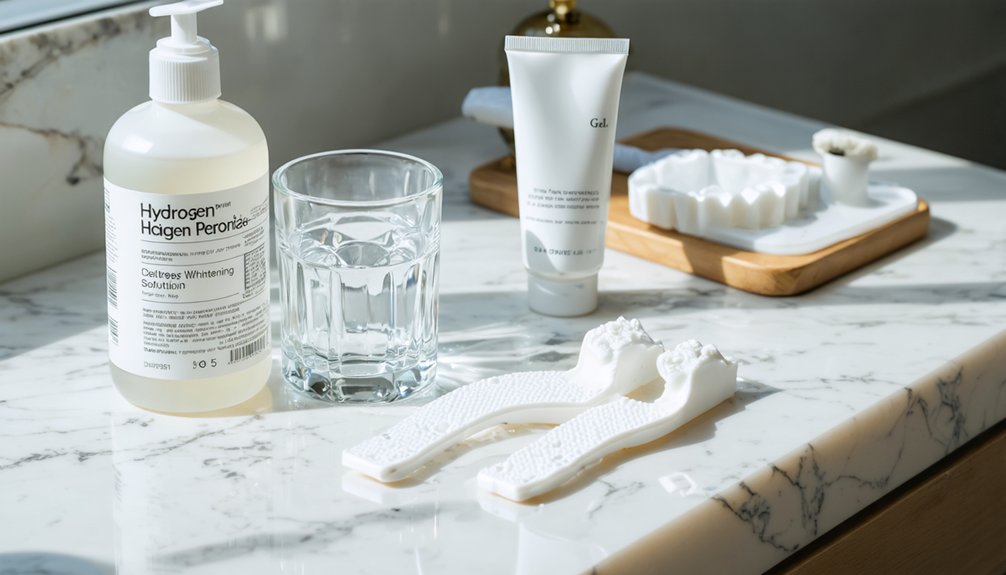
When comparing hydrogen peroxide mouthwash to whitening strips and gels, the evidence clearly favors conventional at-home bleaching products for speed and magnitude of color change.
Whitening effectiveness comparison data shows mouthwash requires 60–90 days for measurable results, while 10% carbamide peroxide gels deliver faster, more significant outcomes.
Product safety reviews confirm mouthwash carries fewer risks but trades efficacy for tolerability.
Key distinctions to guide your decision:
- Speed: Gels and strips produce visible whitening faster than mouthwash
- Magnitude: Carbamide peroxide gels achieve greater color change (ΔE)
- Safety profile: Mouthwash at low concentrations causes fewer adverse effects
- Maintenance: Mouthwash effectively sustains results achieved through stronger bleaching methods
Use mouthwash strategically as a maintenance tool, not a primary whitening intervention.
When to See a Dentist Instead
Certain clinical situations make professional dental evaluation essential before or instead of using hydrogen peroxide mouthwash. If you have crowns, veneers, or existing restorations, peroxide can degrade materials or cause uneven coloring.
Gum sensitivity, active cavities, or mucosal irritation also require assessment before you begin any whitening regimen.
Schedule dental check ups if you notice persistent tooth sensitivity, gum inflammation, or white patches during use—these signal that you should stop immediately and seek clinical guidance.
Your oral hygiene baseline also matters; whitening products won’t compensate for underlying bacterial buildup or periodontal issues.
Products containing 0.1% to 6% hydrogen peroxide legally require professional supervision. If you’re unsure about your concentration or application method, consult your dentist before proceeding.
Frequently Asked Questions
Can Hydrogen Peroxide Mouthwash Interact With Prescription Medications or Antibiotics?
Current evidence doesn’t confirm direct interactions, but you should consult your dentist or pharmacist about medication safety before use. Antibiotics can affect your oral health, potentially altering how hydrogen peroxide mouthwash performs or irritates tissues.
Is Hydrogen Peroxide Mouthwash Safe to Use During Pregnancy or Breastfeeding?
You should avoid hydrogen peroxide mouthwash during pregnancy or breastfeeding, as no established safety guidelines exist for these groups. Consult your dentist, follow professional advice, and explore alternative mouthwashes proven safer for your condition.
Can Hydrogen Peroxide Mouthwash Help Treat or Prevent Bad Breath Long-Term?
Hydrogen peroxide mouthwash can temporarily reduce bad breath-causing bacteria, but it’s not a proven long-term effects solution. For sustained oral hygiene, you’ll need consistent brushing, flossing, and professional dental evaluations alongside any peroxide-based rinse.
Does Hydrogen Peroxide Mouthwash Affect Taste Perception Permanently Over Time?
Hydrogen peroxide mouthwash doesn’t permanently affect taste perception. You may experience temporary taste sensitivity and flavor alterations during use, but evidence confirms these effects resolve once you discontinue the mouthwash, leaving no lasting damage.
Are Store-Brand Hydrogen Peroxide Mouthwashes as Effective as Name-Brand Products?
Yes, you’ll find store brand effectiveness matches name brand comparison results. Clinical studies show no significant color change differences among hydrogen peroxide mouthwash products tested, so you don’t need to overspend for equivalent whitening outcomes.
References
- https://pubmed.ncbi.nlm.nih.gov/23846062/
- https://www.nature.com/articles/4813423
- https://www.medicalnewstoday.com/articles/326148
- https://www.wdfdental.com/blog/hydrogen-peroxide-in-mouthwash-helpful-or-harmful-for-your-smile/
- https://www.healthline.com/health/hydrogen-peroxide-teeth-whitening
- https://ec.europa.eu/health/opinions/en/tooth-whiteners/index.htm
- https://ec.europa.eu/health/ph_risk/committees/04_sccp/docs/sccp_o_022.pdf
- https://ec.europa.eu/health/scientific_committees/opinions_layman/en/tooth-whiteners/l-3/6-tooth-whitening-side-effects.htm
- https://www.dawsondental.ca/site/blog/2025/08/07/is-hydrogen-peroxide-mouthwash-safe-to-use
- https://pmc.ncbi.nlm.nih.gov/articles/PMC4534617/