You can safely whiten your teeth at home by choosing kits with 6% or less hydrogen peroxide or opting for PAP-based formulas, which whiten without breaking down enamel. Look for products that include remineralizing agents like hydroxyapatite or fluoride to restore minerals between sessions. Avoid charcoal-based products, acidic compounds, and anything exceeding 10% peroxide. Sticking to FDA or Health Canada-compliant brands reduces your risk considerably. There’s much more to know before you pick a kit.
Key Takeaways
- Kits with 6% or less hydrogen peroxide or carbamide peroxide are considered enamel-safe for home use.
- PAP-based whitening kits offer a peroxide-free alternative that whitens teeth without causing enamel breakdown.
- Look for kits containing hydroxyapatite or fluoride, which help restore and protect enamel during whitening.
- Avoid products containing charcoal, acidic compounds, or unregulated peroxide levels exceeding 10%.
- Choose dentist-verified brands that meet FDA or Health Canada standards and have undergone clinical testing.
The Ingredients That Make a Whitening Kit Enamel-Safe
Not all whitening kits are created equal, and the ingredients inside determine whether a product protects or damages your enamel.
When evaluating whitening ingredients, prioritize formulations containing 6% or less hydrogen peroxide or carbamide peroxide that converts to 1%–3% active peroxide. These concentrations deliver results without compromising enamel integrity.
Effective whitening starts with safe concentrations—6% or less hydrogen peroxide to protect enamel while still delivering results.
PAP-based (phthalimidoperoxycaproic acid) kits offer a peroxide-free alternative clinically shown to whiten without structural damage.
For maximum enamel protection, look for kits that include remineralizing agents like hydroxyapatite or fluoride, which actively restore minerals lost during treatment.
Avoid products featuring unregulated peroxide levels, charcoal, or acidic compounds like citric acid, as these erode rather than protect enamel.
Verifying that a product meets FDA or Health Canada standards gives you a reliable baseline for safety.
How Peroxide Levels Affect Enamel: and Where the Line Is
Peroxide concentration is the single most important variable determining whether a whitening kit helps or harms your enamel. For peroxide safety and enamel protection, know these thresholds:
- 3%–6% hydrogen peroxide: safe for home use, minimal sensitivity risk
- Up to 10%: still within regulated limits, but monitor for irritation
- Above 10%: restricted to professional settings for good reason
- 21 tested online products exceeded 10× the legal 0.1% limit
- Some kits contained 300× the permissible amount, causing irreversible erosion
You’re in control when you verify concentration before purchasing.
Clinical evidence confirms that staying within the 3%–10% range produces effective whitening without permanent structural damage.
Anything beyond that shifts the risk-benefit ratio sharply against you.
What Peroxide Concentration Is Actually Safe for Home Use?
When it comes to home whitening, the safe range is well-established: hydrogen peroxide concentrations between 3% and 10% are clinically supported for over-the-counter use.
Store-bought strips typically fall between 3% and 6%, while carbamide peroxide gels convert to roughly 1%–3% active hydrogen peroxide, making them gentler options for sensitive teeth.
Safe application means staying within these verified thresholds. Anything exceeding 10% is restricted to professional dental settings for good reason — higher concentrations increase the risk of enamel breakdown and gum irritation.
Higher concentrations exist for a reason — exceeding 10% hydrogen peroxide puts your enamel and gum health at serious risk.
Consumer awareness is your first line of defense. Many online kits contain unregulated peroxide levels that far exceed legal limits.
Always verify the peroxide percentage before purchasing, and choose products that comply with FDA or Health Canada guidelines.
Which Whitening Kit Types Protect Enamel Best?
Choosing the right kit type makes a measurable difference in how well your enamel holds up during treatment. Consumer education is your first line of defense—knowing which formulations are clinically verified directly impacts whitening effectiveness and long-term enamel integrity.
These kit types offer the strongest enamel protection:
- Low-peroxide kits (≤6% hydrogen peroxide): Ideal for sensitive teeth with minimized erosion risk
- PAP-based kits: Peroxide-free formulations that whiten without triggering enamel breakdown
- LED-accelerated systems: Lower peroxide concentrations activated more efficiently, reducing chemical exposure
- Remineralizing gel kits: Restore lost minerals and counteract post-whitening sensitivity
- Dentist-verified brands (Lumineux, Aligner32): Clinically tested formulations with confirmed safety profiles
Match your kit choice to your enamel’s current condition and always verify ingredient concentrations before purchasing.
The Best Enamel-Safe Home Whitening Kits Right Now
Knowing which kit types protect enamel is only half the equation—you also need to know which specific products actually deliver on those standards.
Skip home remedies entirely—vinegar, lemon juice, and charcoal lack evidence and accelerate enamel erosion. Instead, prioritize clinically verified options.
Lumineux uses a certified non-toxic, peroxide-free formula that whitens without sensitivity.
Aligner32 offers PAP-based strips designed specifically to protect enamel integrity.
Lumix combines LED acceleration with low-peroxide concentrations, allowing effective whitening at safer exposure levels.
Each of these brands has undergone clinical testing and aligns with dentist-recommended formulation standards.
You’re not guessing—you’re selecting products backed by evidence. Confirm that any kit you choose stays within the 6% hydrogen peroxide threshold or uses a proven peroxide-free alternative.
How to Spot Dangerous Whitening Products Before You Buy
Not all whitening kits on the market meet legal safety standards—and buying the wrong one can permanently damage your enamel. Consumer awareness is your first defense. Whitening myths often obscure real risks, so knowing what to look for protects your teeth before purchase.
Watch for these red flags:
- Hydrogen peroxide exceeding 10% in any home-use product
- No ingredient list, concentration disclosures, or regulatory approval markings
- Claims of instant or dramatic results—classic whitening myths
- Products sold exclusively through unverified online marketplaces without third-party testing
- Missing manufacturer contact information or no usage instructions
Research confirms that 21 tested products exceeded ten times the legal peroxide threshold.
You’re responsible for verifying what you apply to your teeth. Check labels, cross-reference regulatory databases, and prioritize clinically verified formulations.
DIY and Natural Whitening Methods That Damage Enamel
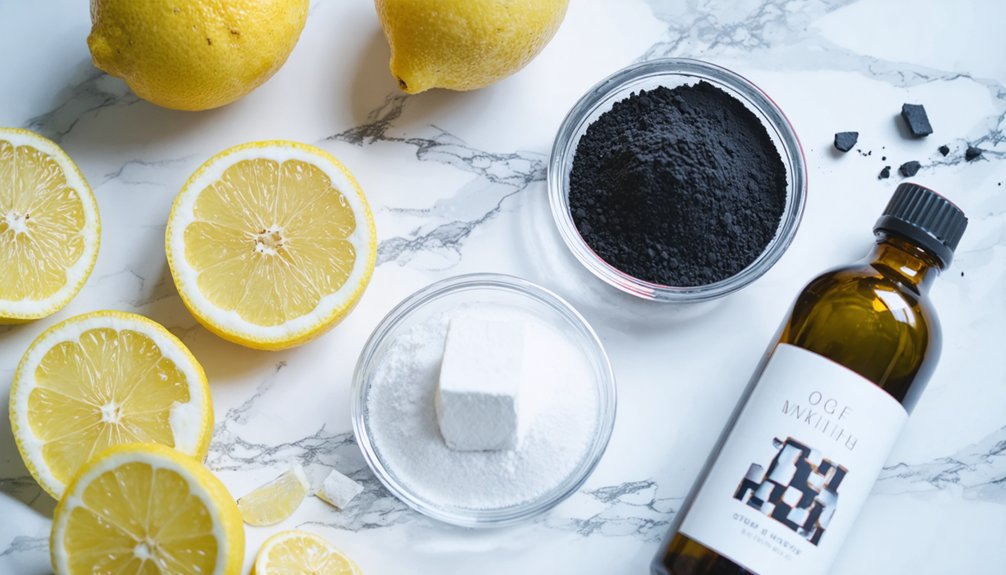
Many popular DIY whitening methods carry real risks that you should understand before trying them at home.
Charcoal-based products physically abrade enamel without clinical evidence of safe or effective whitening, while acidic remedies like lemon juice and vinegar chemically erode your tooth surface over time.
Even baking soda, often considered a mild option, can wear down enamel with repeated unbuffered use.
Charcoal Abrasion Risks
While peroxide-based whitening products carry measurable safety thresholds, charcoal-based alternatives lack any credible clinical evidence supporting their safety or efficacy. Charcoal safety claims are largely marketing-driven. The abrasion effects on enamel are well-documented and irreversible.
Here’s what you need to know:
- Activated charcoal is physically abrasive, mechanically stripping enamel with repeated use.
- No peer-reviewed studies confirm charcoal whitening is safe or effective.
- Enamel doesn’t regenerate—once it’s gone, it’s gone.
- Charcoal particles can embed in gum tissue, causing chronic irritation.
- Regulatory bodies haven’t approved charcoal-based products for dental whitening.
You’re not gaining control by choosing charcoal—you’re gambling with permanent dental structure. Stick to clinically verified, concentration-regulated whitening systems that give you measurable, safe outcomes.
Acidic Home Remedies
Charcoal isn’t the only unregulated whitening method that causes irreversible enamel damage—acidic home remedies carry an equally serious risk profile, and the chemistry behind that damage is straightforward.
When you apply acidic alternatives like lemon juice or vinegar to your teeth, their low pH directly demineralizes enamel through chemical erosion—not mechanical abrasion. This distinction matters: enamel erosion from acid is irreversible because your body can’t regenerate lost enamel structure.
Lemon juice registers around pH 2, and vinegar isn’t far behind. Repeated exposure dissolves the calcium-phosphate matrix that gives enamel its hardness.
No clinical evidence supports these methods as effective whitening agents, and the structural cost outweighs any perceived benefit. If you want control over your results, eliminate acidic home remedies entirely from your whitening protocol.
Baking Soda Enamel Wear
Baking soda sits in a gray zone that most DIY whitening guides fail to clarify honestly. Its mild abrasivity explains its baking soda effectiveness for surface stain removal, but repeated unbuffered use mechanically wears enamel over time.
Key risks you should recognize:
- Abrasion accumulates with each use, thinning enamel permanently
- It lacks remineralizing agents to offset structural loss
- It doesn’t address intrinsic staining, only surface debris
- Unbuffered application increases sensitivity risk considerably
- No clinical evidence supports it as a long-term whitening solution
Safer baking soda alternatives include PAP-based kits and low-peroxide formulations verified through clinical testing. These options deliver measurable whitening without mechanical degradation.
If you’re using baking soda regularly, you’re trading short-term results for long-term enamel vulnerability.
How to Use Whitening Kits Without Damaging Your Enamel
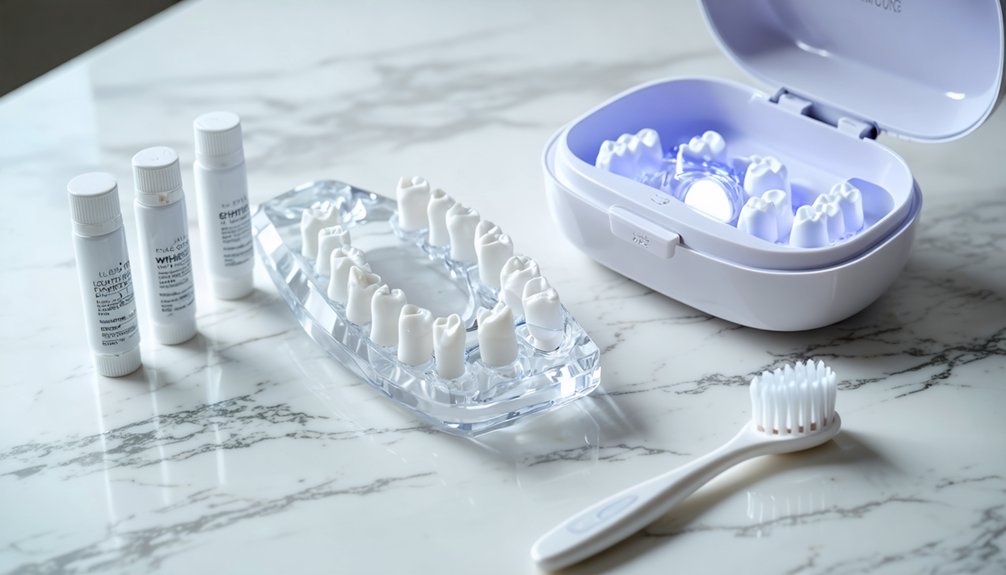
When using a home whitening kit, you must follow the manufacturer’s instructions exactly—extending treatment time won’t accelerate results and can compromise enamel integrity.
Clinical evidence confirms that proper use prevents permanent damage, while deviation from recommended protocols increases the risk of erosion and sensitivity.
You should also allow at least 48 hours between sessions, giving your enamel adequate time to recover from the oxidative stress of peroxide exposure.
Follow Manufacturer Instructions Carefully
One of the most critical steps in protecting your enamel during at-home whitening is following manufacturer instructions exactly as written.
Extending treatment time doesn’t improve results—it increases sensitivity and compromises ingredient safety. Clinical evidence confirms that proper use prevents permanent enamel damage.
Follow these evidence-based guidelines:
- Don’t exceed recommended wear time—longer exposure accelerates enamel breakdown
- Maintain the advised frequency—allow at least 48 hours between sessions for recovery
- Use only the provided amount of gel—excess product increases gum contact and irritation
- Store products correctly—improper storage degrades active ingredients unpredictably
- Stop immediately if pain or white spots appear—consult a dentist before continuing
You control the outcome. Deviating from instructions shifts whitening from a safe cosmetic process into a measurable risk.
Allow Enamel Recovery Time
Following instructions sets the foundation, but even perfect execution requires built-in recovery time between sessions. Whitening frequency directly impacts enamel integrity.
When you apply treatments too close together, you prevent enamel from rehydrating and remineralizing, increasing cumulative stress on tooth structure. Clinical evidence supports waiting at least 48 hours between sessions.
This window restores enamel hydration and allows mineral uptake to partially reverse microstructural changes caused by peroxide exposure. You’re not slowing results—you’re protecting the substrate that makes lasting whiteness possible.
Using fluoride toothpaste during recovery periods accelerates remineralization and reduces sensitivity.
Avoid acidic foods for 24–48 hours post-treatment, as compromised enamel is especially vulnerable to chemical erosion. Strategic pacing gives you control over outcomes without sacrificing structural integrity.
What to Do If Whitening Causes Pain or Sensitivity
Tooth sensitivity and mild discomfort during or after whitening are common, but they shouldn’t be ignored or pushed through. Effective pain management and sensitivity relief require deliberate action.
If whitening causes pain or heightened sensitivity, take these steps immediately:
- Stop treatment and allow at least 48 hours before resuming
- Switch to fluoride toothpaste to support enamel remineralization and reduce nerve exposure
- Avoid acidic foods and drinks—citrus, soda, and vinegar—for 24–48 hours post-treatment
- Apply a desensitizing gel if included in your kit, or purchase one separately
- Consult your dentist if pain persists, white spots appear, or gum stinging occurs
Pushing through discomfort risks cumulative enamel stress.
Your body’s response is data—use it to adjust your approach, not ignore it.
Are At-Home Whitening Kits Actually Regulated?
When you shop for whitening kits, regulatory bodies like the U.S. FDA and Health Canada are actively overseeing these products, capping over-the-counter hydrogen peroxide at 10% and requiring compliant safety labeling.
You should know, however, that legal limits don’t always reflect what’s actually on store shelves or online marketplaces, where enforcement actions have repeatedly uncovered products containing peroxide levels far exceeding legal thresholds.
Staying informed about these regulations helps you identify compliant products and avoid unregulated sellers whose kits can pose serious risks to your enamel.
Regulatory Bodies Overseeing Whitening
Although at-home whitening kits are widely available, they’re not operating in a regulatory vacuum. Multiple agencies enforce regulatory compliance and product labeling standards you should verify before purchasing:
- Health Canada confirms home-use whitening products are safe when directions are carefully followed.
- U.S. FDA permits over-the-counter hydrogen peroxide up to 10%, requiring strict safety labeling.
- Concentrations exceeding 10% are restricted exclusively to professional dental settings.
- Enforcement actions actively target unregulated online sellers exceeding legal peroxide thresholds.
- Marketing claims frequently overstate effectiveness, pressuring consumers into misuse.
You hold the advantage when you cross-reference a product’s ingredient list against these regulatory standards.
If a kit lacks transparent labeling or exceeds jurisdiction-specific peroxide limits, that’s a clear signal to walk away.
Legal Peroxide Limits Explained
Peroxide limits for at-home whitening kits vary by jurisdiction, but the regulatory frameworks governing them are more concrete than most consumers realize.
In the U.S., the FDA permits hydrogen peroxide concentrations up to 10% in over-the-counter products. Health Canada enforces similar thresholds, capping home-use formulations to protect against enamel damage and gum irritation.
Concentrations exceeding 10% carry serious legal implications and are restricted to professional dental settings only. Consumer awareness matters here: 21 tested products exceeded ten times the legal 0.1% threshold, and some online kits contained over 100 times the permitted limit.
You need to verify that any kit you purchase complies with your region’s regulatory standards before use. Non-compliant products aren’t just illegal—they’re genuinely hazardous to your enamel.
Enforcement Against Unregulated Sellers
Regulatory frameworks exist on paper, but enforcement against unregulated online sellers remains inconsistent and difficult to execute. You can’t assume every product you find online meets regulatory compliance standards. Authorities have acted, but gaps persist:
- Six dangerous online kits contained over 100 times the legal hydrogen peroxide limit.
- 21 tested products exceeded 10 times the permitted 0.1% threshold.
- Enforcement actions have targeted unregulated sellers distributing illegally concentrated formulas.
- Marketing claims routinely overstate effectiveness, pushing you toward misuse.
- Online safety risks escalate when products lack verified ingredient disclosure.
The FDA and Health Canada have clear mandates, but cross-border e-commerce complicates jurisdiction.
You’re responsible for verifying that any kit you purchase complies with legal peroxide limits before it contacts your enamel.
Frequently Asked Questions
Can Teeth Whitening Kits Safely Interact With Dental Implants or Veneers?
Whitening compatibility with dental restorations isn’t guaranteed—peroxide won’t whiten veneers or implants, and aggressive bleaching can chemically alter their surfaces. You should consult your dentist before applying any whitening kit near existing dental restoration work.
How Long Do Enamel-Safe Whitening Results Typically Last Before Fading?
Your results typically last 3–6 months before fading. You’ll maintain enamel durability by controlling whitening frequency—retreating only when necessary, avoiding acidic foods, and using fluoride toothpaste to sustain brightness without compromising enamel integrity.
Is Teeth Whitening Safe to Use During Pregnancy or Breastfeeding?
While whitening feels tempting, you should avoid it during pregnancy or breastfeeding due to unresolved safety concerns. Instead, you can explore alternative methods like PAP-based kits, which carry no peroxide-related risks to you or your baby.
Can Children or Teenagers Safely Use Enamel-Friendly Home Whitening Kits?
You shouldn’t let children use home whitening kits, as youth dental health requires caution—developing enamel is more vulnerable. Follow whitening safety guidelines and consult a dentist before considering any treatment for teenagers.
Does Teeth Whitening Affect the Color of Existing Dental Fillings or Crowns?
Your smile’s companions won’t follow along — whitening won’t alter filling color or crown longevity. You’re changing only natural enamel. Aggressive bleaching can, however, chemically compromise existing restorations, so consult your dentist before proceeding.
References
- https://mountaintowndental.com/home-whitening-kits-are-safe-and-effective-if-used-the-right-way/
- https://sacramentodentistry.com/blog/are-store-bought-whitening-kits-safe-for-enamel/
- https://www.medindia.net/news/healthinfocus/home-teeth-whitening-kits-are-they-safe-201987-1.htm
- https://aligner32.com/blogs/blog/are-whitening-kits-safe
- https://www.scotsman.com/health/at-home-teeth-whitening-kits-dentist-dangers-4832433
- https://shopismile.com/products/deluxe-home-teeth-whitening-system
- https://www.amazon.com/Lumineux-Teeth-Whitening-Strips-Treatments-Enamel-Safe/dp/B093TSRPQM
- https://kaufmandentistry.com/2025/04/10/which-at-home-whitening-treatments-are-worth-it/
- https://www.amazon.com/Enamel-Safe-Teeth-Whitening/s?k=Enamel+Safe+Teeth+Whitening
- https://www.youtube.com/watch?v=WsgJlPpxi-0