Whitening sensitivity happens when peroxide penetrates your enamel and stimulates pulpal nerve endings, lowering their firing threshold and triggering sharp, transient pain. Potassium nitrate counteracts this by raising your nerve cells’ resting membrane potential, which suppresses depolarization and makes those endings far less reactive to chemical and thermal stimuli. At 5%, it penetrates dentin within 10 to 30 minutes without compromising your whitening results. There’s considerably more to understand about how this works in practice.
Key Takeaways
- Potassium nitrate penetrates enamel and dentin within 10–30 minutes, raising resting membrane potential and suppressing nerve depolarization.
- It reduces nerve hyperactivity triggered by whitening agents, lowering the sharp, transient pain commonly associated with bleaching treatments.
- At 5% concentration, potassium nitrate effectively reduces sensitivity without interfering with the whitening chemistry or compromising results.
- Combined with fluoride, it strengthens enamel and reduces dentinal permeability, enhancing overall whitening safety and treatment completion rates.
- Applying 5% potassium nitrate gel 30 minutes before bleaching proactively calms nerve activity before peroxide penetration begins.
What Actually Causes Whitening Sensitivity?
When you apply a whitening agent to your teeth, hydrogen peroxide penetrates enamel and dentin rapidly, reaching the pulp tissue and stimulating intradental nerve endings. This penetration triggers sharp, transient pain by depolarizing nerve membranes within dentinal tubules.
Tooth sensitivity during whitening isn’t random — it’s a direct physiological response to oxidative agents contacting pulpal nerves.
Whitening agents accelerate this nerve activation by increasing membrane excitability, lowering the threshold required for nerve fibers to fire. Thermal stimuli then amplify the response, producing the characteristic sharp discomfort you experience mid-treatment.
Higher peroxide concentrations intensify this effect, which is why in-office bleaching protocols generate more acute sensitivity than at-home formulations.
Understanding this mechanism gives you a precise target for intervention before sensitivity disrupts your whitening protocol.
How Potassium Nitrate Calms Dental Nerve Endings
Potassium nitrate works against this nerve activation mechanism directly. When you apply it, potassium ions penetrate intact enamel and dentin, reaching intradental nerve endings within 10 to 30 minutes.
There, potassium ion effects raise the resting membrane potential of nerve fibers, suppressing depolarization. Your nerve endings can’t fire as easily, meaning thermal and chemical stimuli from bleaching agents no longer trigger sharp pain responses.
These nerve desensitization mechanisms don’t interfere with whitening chemistry. The potassium ions simply block transmission along dental nerve pathways, preventing pain signals from reaching your brain.
Experimental data confirms that 5% potassium nitrate reduces nerve hyperactivity by directly altering membrane potential. You retain full whitening efficacy while the neural response to peroxide-induced pulpal irritation stays clinically suppressed throughout your treatment.
How Fast Potassium Nitrate Reaches the Tooth Pulp
When you apply potassium nitrate to your teeth, it penetrates intact enamel and dentin within 10 to 30 minutes, reaching the pulp cavity before whitening agents can provoke nerve irritation.
Spectrophotometric studies confirm this rapid transit, validating that external application delivers the agent to its target site in under half an hour.
Your absorption rate, however, depends on the agent’s concentration, formulation viscosity, and any proprietary constituents that may either facilitate or impede diffusion through dental tubules.
Penetration Timeline Through Enamel
One of the more clinically relevant properties of potassium nitrate is how quickly it penetrates dental tissues to reach the pulp. Studies confirm it moves through intact tooth structure within 10 to 30 minutes, leveraging enamel permeability to access nerve endings before bleaching agents provoke irritation.
Key penetration factors include:
- Concentration: Higher concentrations accelerate diffusion through enamel and dentin layers
- Viscosity: Formulation thickness influences how efficiently the agent contacts tooth structure
- Delivery method: Custom tray applications optimize contact time and penetration depth
- Baseline enamel permeability: Individual variation affects absorption rate and pulpal reach
Spectrophotometric studies validate this timeline, confirming pulpal presence within 30 minutes of external application.
You’re effectively pre-treating your nerve endings before sensitivity has any opportunity to develop.
Factors Affecting Absorption Speed
Understanding *why* potassium nitrate reaches the pulp within that 10–30 minute window requires examining the variables that govern its absorption rate. Several influencing factors determine how efficiently the compound penetrates enamel and dentin.
Concentration is primary—5% formulations demonstrate ideal absorption rate without diminishing returns seen at higher concentrations. Viscosity matters too; thicker gels may slow diffusion through dentinal tubules, while thinner solutions move more readily.
Proprietary carrier constituents within commercial formulations also modify penetration speed. Delivery method plays a measurable role—custom tray applications maintain consistent tissue contact, maximizing uptake compared to passive surface exposure.
Additionally, pre-existing dentin exposure accelerates transit considerably, as tubule access becomes more direct. Understanding these variables lets you select formulations and delivery systems that enhance desensitization before bleaching begins.
Does Potassium Nitrate Weaken Whitening Results?
A common concern among patients considering potassium nitrate-containing whitening formulas is whether the desensitizing agent compromises color outcomes. Evidence confirms it doesn’t. Potassium nitrate targets nerve membranes, not chromophores, leaving whitening efficacy fully intact while supporting effective desensitization strategies.
Key clinical findings support this conclusion:
- 5% potassium nitrate combined with fluoride produces no statistically significant reduction in whitening outcomes compared to standard bleaching agents.
- 10% carbamide peroxide formulas containing potassium nitrate deliver equivalent shade improvements to control gels.
- Low-peroxide systems achieve 3–4 shade improvements while reducing sensitivity by 60–70%.
- Potassium nitrate carries no bleaching activity, meaning it neither accelerates nor inhibits peroxide-driven oxidation.
You can pursue complete treatment cycles without sacrificing results. The compound protects your comfort, not your color potential.
Why 5% Potassium Nitrate Is the Optimal Concentration
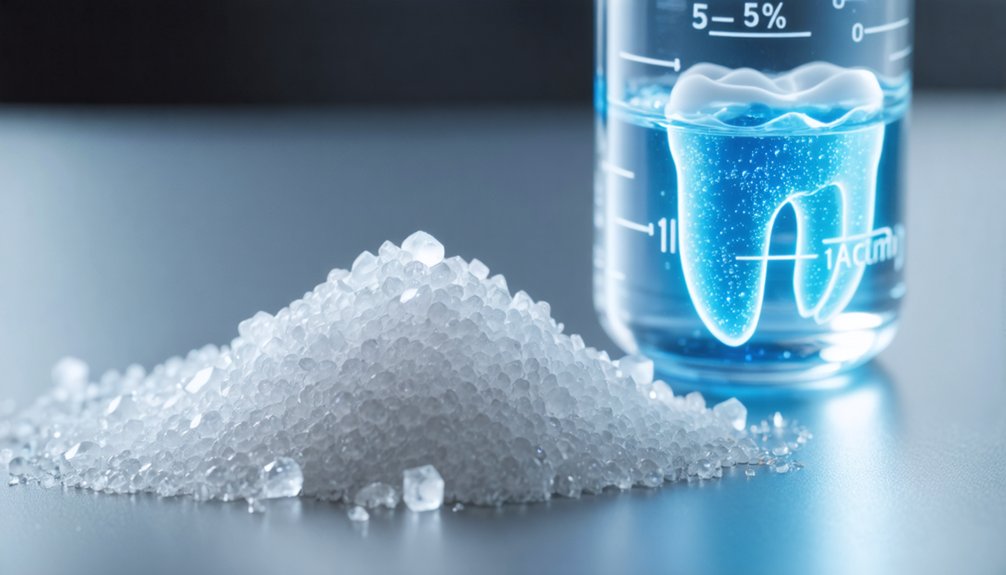
When selecting a potassium nitrate formulation, you’ll find that 5% concentration consistently delivers ideal desensitization across clinical trials.
Research confirms that this concentration effectively raises nerve firing thresholds and reduces sensitivity incidence by 60–70%, without compromising whitening outcomes.
Increasing the concentration beyond 5% yields no additional therapeutic benefit, making higher-percentage formulations unnecessary and clinically unsupported.
Optimal Efficacy at 5
Research consistently points to 5% as the threshold concentration at which potassium nitrate delivers its most reliable desensitizing effect.
Clinical evidence confirms this concentration enhances sensitivity management without compromising whitening outcomes. Higher concentrations don’t improve dental comfort or reduce sensitivity risk further—they simply exceed what nerve membranes require for effective suppression.
Key findings supporting 5% as the evidence-based standard:
- Meta-analyses of 23 RCTs confirm 5% formulations markedly outperform placebo in reducing dentinal hypersensitivity.
- Concentrations above 5% show no additional benefit in sensitivity reduction trials.
- 5% potassium nitrate reduces whitening-related sensitivity incidence by up to 62%.
- Ideal nerve membrane suppression occurs at this concentration, blocking pain signal transmission efficiently.
You’re not guessing with 5%—you’re applying a concentration validated by structured clinical research.
Higher Concentrations Show No Benefit
While 5% stands as the evidence-based benchmark, a natural question follows: does increasing the concentration push desensitization further? Research answers that clearly: no.
Randomized trials testing 10% potassium nitrate applied prior to in-office bleaching found no significant reduction in whitening sensitivity risk or intensity compared to controls. Higher concentrations don’t amplify the nerve-suppressing mechanism—they simply exceed what’s pharmacologically necessary to saturate the desensitization pathway.
Your decision-making should reflect this data. Selecting a higher-concentration formulation won’t strengthen your protection; it introduces unnecessary variables without measurable clinical return.
The 5% threshold achieves full therapeutic effect because it’s sufficient to raise nerve depolarization thresholds within dentinal tubules. Exceeding that concentration adds nothing functionally while potentially complicating formulation stability and delivery consistency.
How Potassium Nitrate and Fluoride Work Together
Combining potassium nitrate with fluoride creates a dual-action approach that addresses whitening sensitivity through complementary mechanisms. Together, they enhance whitening safety without compromising color outcomes.
Key benefits of fluoride synergy with potassium nitrate include:
- Nerve suppression: Potassium ions calm nerve hyperactivity by raising depolarization thresholds.
- Tubule occlusion: Fluoride strengthens enamel and reduces dentinal permeability, limiting pulpal irritant exposure.
- Preserved efficacy: Clinical trials confirm the combination doesn’t reduce whitening effectiveness.
- Reduced discontinuation: Patients experience fewer sensitivity episodes, completing full treatment cycles.
Tray-delivered 5% potassium nitrate-fluoride gel markedly reduces sensitivity associated with nightguard essential bleaching.
You’re fundamentally protecting your nerve endings while bleaching agents work unimpeded. The combination blocks pain signals without interfering with peroxide penetration or shade improvement.
When Potassium Nitrate Falls Short
Despite its efficacy in at-home settings, potassium nitrate doesn’t perform uniformly across all whitening protocols. Understanding potassium nitrate limitations helps you make informed decisions about your treatment approach.
Research confirms that 10% potassium nitrate applied before in-office bleaching doesn’t greatly reduce sensitivity risk or intensity. High-concentration hydrogen peroxide, typically used in clinical settings, appears to override the nerve-calming effects potassium nitrate provides.
Even at 10% concentration, potassium nitrate cannot withstand the nerve-overriding power of high-concentration hydrogen peroxide.
Studies also show no meaningful difference in whitening sensitivity thresholds between patients using 5% potassium nitrate dentifrice and control groups during high-concentration bleaching sessions.
Optimal desensitization occurs specifically at 5% concentration during low-to-moderate peroxide protocols. If you’re pursuing in-office, high-concentration bleaching, potassium nitrate alone won’t adequately protect you, and you’ll need to discuss additional sensitivity management strategies with your clinician.
How to Whiten Safely When Your Teeth Are Sensitive
Sensitive teeth don’t disqualify you from whitening—they require a more deliberate protocol. You can pursue whitening options effectively by controlling concentration, timing, and desensitization sequencing.
- Apply 5% potassium nitrate gel in a custom tray 30 minutes before each bleaching session to allow full pulpal penetration.
- Select low-peroxide formulas (6–10% hydrogen peroxide) paired with potassium nitrate to reduce sensitivity incidence by 60–70%.
- Use fluoride alongside potassium nitrate to reinforce enamel without compromising whitening efficacy.
- Avoid high-concentration in-office bleaching if sensitivity is severe, as it negates potassium nitrate’s protective mechanism.
This structured approach lets you complete treatment without interruption.
Sensitive teeth respond predictably when you apply evidence-based sequencing—potassium nitrate suppresses nerve depolarization, fluoride strengthens enamel, and low-peroxide agents deliver measurable shade improvement safely.
Frequently Asked Questions
Can Children Safely Use Potassium Nitrate-Containing Whitening Products at Home?
You shouldn’t use potassium nitrate dosage guidelines established for adults when treating children. Children’s dental safety requires professional supervision, as current evidence-based protocols don’t support unsupervised home whitening with potassium nitrate for pediatric patients.
How Long Does Potassium Nitrate Desensitization Last After Stopping Whitening Treatment?
With 60-70% sensitivity reduction, potassium nitrate duration typically extends several days post-treatment. You’ll maintain whitening product effectiveness benefits while nerve membranes gradually return to baseline excitability, though resuming use quickly restores desensitization if sensitivity recurs.
Is Potassium Nitrate Safe for People With Sensitive Gums or Oral Sores?
If you’ve got sensitive gums or oral sores, you should consult your dentist before applying potassium nitrate, as it’s not clinically validated for compromised gum health or oral hygiene conditions involving active mucosal lesions.
Can Potassium Nitrate Be Used Alongside Dental Bonding or Veneers?
“Better safe than sorry” — you can use potassium nitrate benefits alongside dental aesthetics like bonding or veneers, as it targets natural tooth nerve endings only, leaving restorations unaffected while actively managing surrounding dentinal hypersensitivity.
Does a History of Root Canals Affect How Potassium Nitrate Works?
Your root canal effects on potassium nitrate efficacy are minimal—since treated teeth lack essential pulp nerves, you won’t experience sensitivity there, but surrounding natural teeth still benefit fully from desensitization.
References
- https://dentaltestlab.com/en/potassium-nitrate-in-oral-care/
- https://pubmed.ncbi.nlm.nih.gov/12066670/
- https://www.sciencedirect.com/science/article/abs/pii/S1532338220300105
- https://www.xmmouthguard.com/blog/what-ingredients-in-a-teeth-whitening-kit-make-it-safe-for-sensitive-teeth
- https://pubmed.ncbi.nlm.nih.gov/34617663/
- https://www.sciencedirect.com/science/article/abs/pii/S0300571215000834
- https://rosedentalnashua.com/best-teeth-whitening-options-for-sensitive-teeth/
- https://theivory.dental/dentist-news/treating-tooth-sensitivity
- https://repositorio.usp.br/item/003237833
- https://www.cda-adc.ca/jcda/vol-71/issue-11/829.pdf