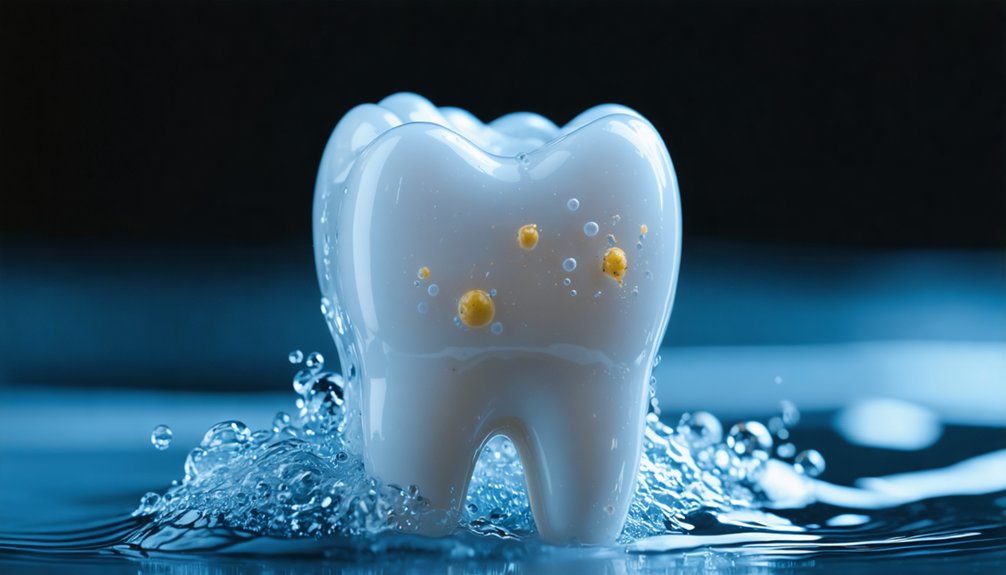
When hydrogen peroxide contacts your teeth, it releases reactive oxygen molecules that target chromophores — the compounds responsible for discoloration. These molecules break apart the chemical bonds holding stains to your enamel, converting pigmented compounds into smaller, soluble fragments that fade or wash away entirely. It even penetrates enamel’s microscopic pores to address subsurface stains. Understanding exactly how this process works at each stage reveals why concentration, timing, and technique matter so much.
Key Takeaways
- Hydrogen peroxide releases reactive oxygen molecules that break chemical bonds in chromophores, converting pigmented compounds into smaller, soluble fragments.
- It penetrates enamel’s microscopic pores, reaching subsurface dentin to oxidize deeply embedded chromophores directly.
- Extrinsic stains from coffee, tea, and tobacco are effectively dissolved through targeted chromophore bond disruption.
- The oxidation process transforms dark, pigmented compounds into colorless, soluble particles that are easily removed.
- Concentration levels determine effectiveness, with 3%–10% suitable for safe home whitening and stain removal.
What Makes Hydrogen Peroxide Effective on Tooth Stains?
Hydrogen peroxide works through three core chemical actions that make it uniquely effective at eliminating tooth stains. Its mechanism targets chromophores—the molecular structures responsible for visible discoloration—by releasing reactive oxygen molecules that break their chemical bonds.
Hydrogen peroxide targets chromophores directly, releasing reactive oxygen that dismantles the molecular bonds behind visible tooth discoloration.
This oxidation process converts large, pigmented compounds into smaller, soluble fragments your body easily clears away.
The benefits extend beyond surface-level results. Hydrogen peroxide penetrates enamel’s microscopic pores, reaching intrinsic stains embedded within the dentin layer.
You’re not just addressing what’s visible; you’re treating discoloration at its source.
Regarding safety, concentrations between 3% and 10% deliver clinically proven effects without compromising enamel integrity.
Understanding this balance gives you precise control over your whitening outcomes, ensuring both aesthetic improvement and long-term dental health.
How Does Hydrogen Peroxide Penetrate Enamel to Reach Deep Stains?
Enamel’s microscopic pore network is what makes deep whitening possible. Your enamel composition isn’t solid — it’s a crystalline lattice threaded with submicroscopic channels.
Hydrogen peroxide molecules are small enough to exploit these pathways, moving efficiently toward the dentin layer where stubborn stain structure embeds itself.
Here’s how the penetration sequence works:
- Surface entry — Hydrogen peroxide contacts enamel pores immediately upon application.
- Inward migration — Molecules travel through the crystalline matrix toward subsurface dentin.
- Deep oxidation — Reactive oxygen targets embedded chromophores within the stain structure itself.
This isn’t surface-level cleaning. You’re accessing discoloration at its source — compounds that brushing simply can’t reach.
That’s what separates genuine whitening from superficial polish.
Which Stains Hydrogen Peroxide Removes and Which It Can’t
Not every stain responds to oxidation the same way. Hydrogen peroxide excels against extrinsic stain types — coffee, tea, tobacco, wine, and food dye deposits that accumulate on and just beneath enamel surfaces.
Its free radicals break apart chromophore bonds efficiently, delivering measurable whitening where surface discoloration dominates.
However, you’ll encounter clear removal limitations with intrinsic stains. Tetracycline antibiotic discoloration, fluorosis banding, developmental defects, and trauma-induced darkening originate within dentin structure itself.
Hydrogen peroxide can partially address mild intrinsic cases through prolonged treatment, but deep antibiotic staining or structural discoloration often resists standard oxidation protocols entirely.
Understanding this distinction lets you set precise expectations. If your discoloration stems from lifestyle habits, hydrogen peroxide delivers results.
If it’s structural, professional intervention beyond standard peroxide treatment becomes necessary.
What Hydrogen Peroxide Concentration Is Safe to Use at Home?
Concentration determines both how effectively peroxide whitens and how safely it interacts with your enamel and soft tissues. Staying within proven ranges protects your results and your health.
The right concentration protects both your results and your health — precision matters as much as the product itself.
Safe home-use concentrations follow a clear hierarchy:
- 3% — Pharmacy-grade hydrogen peroxide; suitable for diluted rinses with minimal sensitivity risk.
- 3%–6% — The recommended range for whitening trays and strips, balancing efficacy with manageable safety precautions.
- Up to 10% — The accepted ceiling for over-the-counter products; exceeding this demands professional supervision and precise application techniques.
Higher concentrations accelerate oxidation but amplify gum irritation, enamel dehydration, and pulp sensitivity.
You retain control by matching concentration to your sensitivity threshold, treatment frequency, and desired shade outcome.
How Much Whitening Does Hydrogen Peroxide Actually Deliver?
Hydrogen peroxide delivers measurable, scientifically validated whitening—typically between 3 and 8 shade improvements on the VITA shade scale, depending on your baseline discoloration, concentration used, and treatment duration.
Surface stain removal happens rapidly, often within days, as the oxidation process dismantles chromophore bonds near the enamel surface.
Deeper intrinsic discoloration requires longer exposure, allowing peroxide to penetrate dentin and break down embedded compounds.
You’ll see the most dramatic results when targeting coffee, tea, tobacco, and wine residues—stains with high chromophore density respond aggressively to oxidation.
Consistency matters: interrupted treatment cycles reduce cumulative effectiveness.
At clinically appropriate concentrations, you control the outcome by managing application frequency and duration, translating direct chemical action into predictable, aesthetic results without unnecessary procedural complexity.
When Hydrogen Peroxide Isn’t Enough and You Need a Dentist
While hydrogen peroxide handles most extrinsic stains effectively, certain discoloration types fall outside its chemical reach.
Intrinsic staining from tetracycline antibiotics, fluorosis, or trauma penetrates dentin at a molecular level that over-the-counter concentrations can’t address. When you’ve completed consistent at-home treatment without meaningful results, it’s time to explore dentist alternatives.
Professional treatments offer three escalating solutions:
- In-office bleaching — 25–40% hydrogen peroxide activated by light or heat, delivering accelerated oxidation beyond home-use thresholds.
- Microabrasion — mechanical enamel refinishing that removes superficial fluorosis and calcification marks.
- Porcelain veneers — permanent cosmetic resurfacing for tetracycline or trauma-based discoloration that no bleaching agent can chemically reverse.
Recognizing hydrogen peroxide’s limitations isn’t defeat — it’s precision-driven decision-making about your aesthetic outcome.
Frequently Asked Questions
Can Hydrogen Peroxide Damage Existing Dental Crowns, Veneers, or Fillings?
Hydrogen peroxide can devastatingly compromise your restorations! It won’t bleach crowns or veneers, but you’ll risk crown sensitivity and veneer integrity through chemical degradation, potentially weakening composite fillings and disrupting bonding agents over repeated exposure.
How Long Should You Wait Between Hydrogen Peroxide Whitening Treatments?
You should wait 48–72 hours between hydrogen peroxide whitening treatments to optimize stain removal without over-sensitizing enamel. Spacing your treatment frequency allows tissues to recover while maintaining controlled, progressive results you’ll visibly appreciate.
Is Hydrogen Peroxide Tooth Whitening Safe During Pregnancy or Breastfeeding?
You shouldn’t use hydrogen peroxide tooth whitening during pregnancy or breastfeeding. Health guidelines recommend avoiding it due to unknown risks. Tooth sensitivity may worsen, and your body’s heightened state makes postponing treatments the safest, most controlled choice.
Can Children or Teenagers Safely Use Hydrogen Peroxide for Teeth Whitening?
Like an unfinished canvas, developing enamel needs protection. You shouldn’t use hydrogen peroxide whitening until 18—safety guidelines consistently restrict age recommendations, as concentrations between 3%-10% risk permanent sensitivity in still-maturing dental structures.
Does Rinsing Frequency Affect How Well Hydrogen Peroxide Removes Stains?
Yes, rinsing frequency directly impacts your stain removal results. You’ll maximize efficacy by rinsing twice daily—consistent rinsing techniques guarantee hydrogen peroxide maintains prolonged contact with chromophores, accelerating oxidation and delivering measurably brighter, more controlled whitening outcomes.
References
- https://www.gentledental.com/resources/articles/hydrogen-peroxide-teeth-whitening
- https://www.teethwhitening.london/blog/hydrogen-peroxide-penetrates-enamel-breaks-down-stains
- https://www.youtube.com/watch?v=6iJpKUPtMBw
- https://www.youtube.com/watch?v=GOhpOWrWpuo
- https://beyonddentalcare.com/does-hydrogen-peroxide-whiten-teeth/
- https://www.primarydental.com/dental-care/does-hydrogen-peroxide-whiten-teeth/
- https://akdenizdental.com/hydrogen-peroxide-for-teeth-whitening
- https://www.hicksdentalgroup.com/whiten-teeth-with-hydrogen-peroxide/
- https://www.nature.com/articles/s41598-023-43201-y
- https://www.smile-by-design.ca/news/is-it-safe-to-rinse-with-hydrogen-peroxide-dentist-approved-guide/