Tetracycline stains are chemically bound within your dentin, making them far more resistant than surface discoloration. Your best at-home option is 10% carbamide peroxide in custom trays, worn nightly for three to six months. Whitening strips won’t cut it for moderate to severe cases. If you see no improvement after six weeks, in-office power whitening, veneers, or composite bonding may be your answer. Keep going to discover which technique matches your specific situation.
Key Takeaways
- Custom tray bleaching with 10% carbamide peroxide worn nightly for 3–6 months is the most reliable at-home treatment for tetracycline stains.
- Whitening strips are ineffective against intrinsic tetracycline discoloration and should not replace professional-grade tray delivery systems.
- In-office power whitening targets deep intrinsic stains more effectively when home treatments show no improvement after 6 weeks.
- Porcelain veneers offer complete, predictable coverage for severe discoloration, lasting 10–20 years with proper care.
- Composite bonding provides a less invasive alternative, layering resin over stains but requiring touch-ups every 5–7 years.
Why Tetracycline Stains Resist Whitening Treatments
Tetracycline stains resist whitening because the discoloration is intrinsic, meaning it’s chemically bound within the dentin matrix rather than sitting on the enamel surface. This tetracycline resistance makes standard whitening protocols largely ineffective when used short-term.
The oxidizing agents in peroxide-based gels must penetrate through enamel and reach deeply embedded chromogens within dentin—a slow, demanding process.
These whitening challenges explain why over-the-counter products consistently underperform on tetracycline-affected teeth. The stain’s severity, depth, and banding pattern directly influence how your teeth respond to treatment.
Gray or dark brown banding proves particularly stubborn, often requiring extended professional protocols spanning months.
Understanding this resistance helps you set realistic expectations and choose interventions with enough potency and duration to produce measurable results.
Can 10% Carbamide Peroxide Bleach Tetracycline Stains at Home?
If you’re managing tetracycline staining at home, 10% carbamide peroxide delivered through custom non-scalloped trays offers the strongest balance of effectiveness and tolerability.
You’ll typically wear the trays nightly for 3 to 6 months, with most patients reaching maximum whiteness around the 3 to 4 month mark.
While you won’t achieve complete stain elimination in most cases, this protocol consistently produces noticeable lightening with fewer sensitivity issues than higher-concentration alternatives.
Home Tray Protocol Effectiveness
Although tetracycline stains rank among the most resistant forms of tooth discoloration, extended at-home bleaching with 10% carbamide peroxide can produce meaningful results when you commit to consistent, long-term tray use.
Non-scalloped trays deliver this concentration effectively, maximizing home tray benefits while minimizing gum irritation and sensitivity compared to higher-strength alternatives.
You’ll typically need three to six months of nightly wear to achieve noticeable lightening, with some cases requiring up to twelve months.
Patient compliance drives outcomes more than any other variable—skipping sessions or stopping early considerably reduces effectiveness.
Because 10% carbamide peroxide balances tolerability with performance, you’re more likely to maintain the routine long enough to see real improvement, making it the preferred concentration for managing tetracycline discoloration at home.
Treatment Duration And Outcomes
Treatment duration with 10% carbamide peroxide varies considerably based on stain severity, but you should expect a minimum commitment of three to four months for mild cases and up to six months or longer for moderate to severe discoloration.
Setting realistic treatment expectations is critical—even after twelve months of nightly use, complete color restoration isn’t guaranteed. Stain persistence, particularly with banded or deep intrinsic tetracycline discoloration, often limits achievable outcomes to noticeable improvement rather than full elimination.
You’ll typically see gradual lightening, with the most significant changes occurring between months two and four. If results plateau despite consistent tray use, altering to combination therapy or cosmetic restoration becomes the logical next step for achieving your target aesthetic outcome.
How Long Does Whitening Tetracycline Teeth Actually Take?
How long whitening tetracycline-stained teeth takes depends heavily on stain severity and depth. Surface stains typically respond within two weeks, but tetracycline staining requires three to six months of consistent treatment.
In severe cases, you may need up to twelve months of nightly tray use before reaching maximum whiteness—and even then, complete color restoration isn’t guaranteed.
Setting realistic treatment expectations upfront keeps you focused and prevents premature abandonment. Patient compliance directly determines your results; skipping sessions extends your timeline and compromises outcomes.
You’re working against deeply embedded chromogens, so consistency isn’t optional—it’s the deciding factor. Most patients achieve noticeable improvement rather than total elimination.
Stain depth ultimately controls how far whitening takes you, making professional evaluation essential before committing to any protocol.
Do Whitening Strips Work on Tetracycline-Stained Teeth?
While nightly tray protocols demand months of commitment, you might wonder whether a simpler option like whitening strips can deliver comparable results.
Research shows that 6.5% hydrogen peroxide strips match 10% carbamide peroxide trays in whitening efficacy over three months for mild staining. However, their stain removal capability falls short against intrinsic tetracycline discoloration.
The peroxide concentration in over-the-counter strips isn’t high enough to penetrate the deep structural staining tetracycline leaves behind. You’ll see modest improvement with mild yellow or gray surface staining, but moderate to severe banding requires stronger intervention.
Combining strips with a home power whitening system may enhance results for milder cases, but professional-grade tray delivery remains your most reliable option for meaningful, lasting improvement.
What Signs Mean You Need In-Office Power Whitening for Tetracycline Stains?
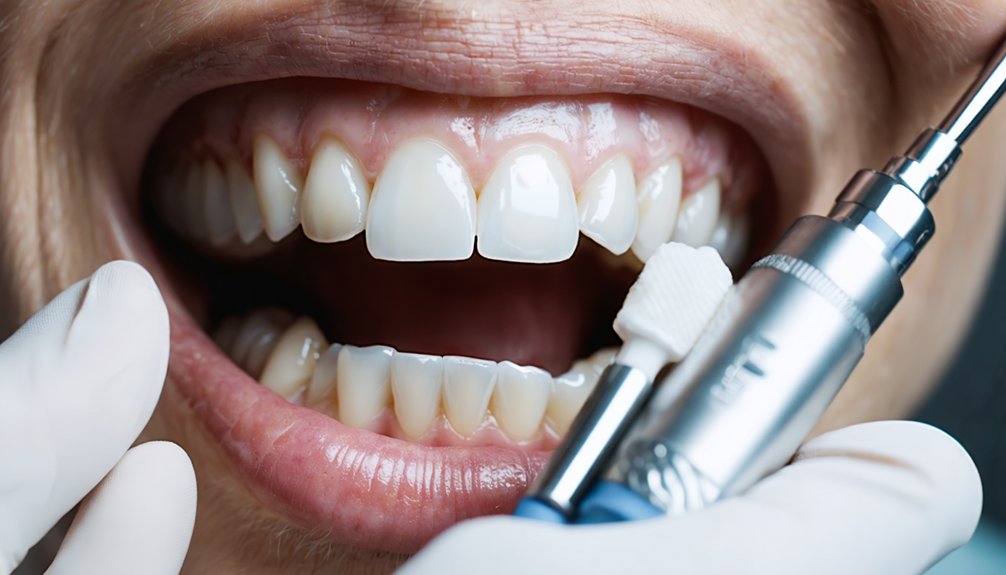
Recognizing when at-home bleaching has hit its ceiling helps you decide whether in-office power whitening is the next step. Specific treatment indications signal that stronger intervention is necessary.
At-home bleaching has a ceiling — knowing when you’ve reached it is the first step toward real results.
Schedule a professional assessment if you notice:
- Dark gray banding across multiple tooth zones that hasn’t shifted after 3 months of nightly tray use
- Severe brown discoloration resistant to 10% carbamide peroxide after consistent application
- Uneven stain distribution where certain teeth remain notably darker than others
- No measurable lightening after 6 weeks of compliant home whitening
- Deep intrinsic staining visible beneath the enamel surface
KöR Whitening’s refrigerated gels and laser-activated protocols target what home systems can’t reach.
Without professional intervention, you risk prolonged treatment with diminishing returns.
When Veneers or Bonding Outperform Bleaching for Tetracycline Stains
When bleaching fails to produce acceptable results after months of consistent treatment, veneers or composite bonding become your most reliable path to a uniform, aesthetically pleasing smile.
Porcelain veneers cover the tooth’s front surface entirely, masking dark gray bands or severe brown discoloration that peroxide agents can’t adequately address.
Composite bonding offers a less invasive alternative, layering resin directly over stained enamel to conceal moderate discoloration at a lower cost than veneers.
Bleaching Limitations Explained
Bleaching delivers measurable results for mild to moderate tetracycline staining, but it hits a hard ceiling when stains penetrate deep into the dentin or appear as dark gray bands across the tooth structure. Stain permanence at that depth limits bleaching effectiveness regardless of concentration or duration.
Recognize these specific scenarios where bleaching falls short:
- Dark gray banding resists even 12 months of nightly carbamide peroxide application
- Severe brown discoloration rarely achieves complete color restoration through whitening alone
- Deep intrinsic stains embedded in dentin don’t respond to surface-level peroxide penetration
- Extended protocols spanning 6 months may yield only marginal improvement
- Over-the-counter products lack sufficient concentration to address moderate to severe cases
When these conditions apply, veneers or composite bonding give you predictable, complete coverage that bleaching simply can’t deliver.
Veneers Versus Bonding
Once bleaching reaches its ceiling with severe tetracycline staining, porcelain veneers and composite bonding become your most reliable paths to predictable, complete coverage.
Veneers mask dark gray bands and deep brown discoloration that prolonged bleaching can’t eliminate. Their veneer longevity—often 10 to 20 years with proper care—makes them a sound long-term investment when whitening fails to deliver acceptable results.
Composite bonding offers a less invasive alternative, layering tooth-colored resin directly over stained surfaces. While bonding durability typically ranges from 5 to 7 years before requiring touch-ups, it preserves more natural tooth structure than veneers.
Your dentist evaluates stain severity, tooth condition, and your aesthetic goals to determine which restoration gives you the most controlled, lasting outcome.
Frequently Asked Questions
Can Children or Teenagers Safely Undergo Tetracycline Stain Whitening Treatments?
You shouldn’t pursue whitening treatments before age 18, as developing teeth aren’t ready for peroxide exposure. Consult your dentist about treatment age guidelines and safe alternatives like composite bonding to manage tetracycline staining effectively.
Does Dental Insurance Ever Cover Whitening Treatments for Tetracycline-Stained Teeth?
Most dental insurance policies don’t cover whitening treatment options, even for tetracycline stains. You’ll typically need to pay out-of-pocket, so explore flexible spending accounts or payment plans to manage your costs effectively.
Can Tetracycline Staining Reappear After Successful Whitening or Cosmetic Restoration?
Tetracycline stain reoccurrence is unlikely after cosmetic restoration, but whitening duration affects long-term results. You’ll need periodic maintenance to preserve brightness, as intrinsic stains can gradually resurface without consistent bleaching or protective restorative coverage.
Are Certain Teeth More Resistant to Tetracycline Whitening Than Others?
Yes, your back teeth often show more resistance due to higher stain severity and thicker enamel. You’ll notice tooth color varies across your mouth, so targeting stubborn areas with extended protocols maximizes your whitening outcomes.
How Does Tetracycline Staining Affect Overall Tooth Sensitivity During Treatment?
Tetracycline’s deep staining mechanisms make your teeth more reactive to peroxide treatments, increasing sensitivity risk. You’ll manage sensitivity effectively by choosing 10% carbamide peroxide, which minimizes irritation while still penetrating stubborn intrinsic stains during extended treatment.
References
- https://pocketdentistry.com/whitening-treatments-for-tetracycline-discoloration/
- https://www.taylorfrancis.com/chapters/edit/10.1201/9781315365503-13/whitening-treatments-tetracycline-discoloration-linda-greenwall-bruce-matis
- http://www.vanhaywood.com/uploads/articlespage/2018 Tetracycline Bleaching.pdf
- https://vegassmilesuite.com/how-to-whiten-teeth-with-tetracycline-stains/
- https://smilepath.nz/blogs/blog/teeth-whitening-for-tetracycline-teeth
- https://pmc.ncbi.nlm.nih.gov/articles/PMC2741196/
- http://vanhaywood.com/uploads/articlespage/tetradebondngvb.pdf
- https://www.healthline.com/health/tetracycline-teeth
- https://www.sciencedirect.com/science/article/abs/pii/S0300571217300982
- https://pubmed.ncbi.nlm.nih.gov/12666888/