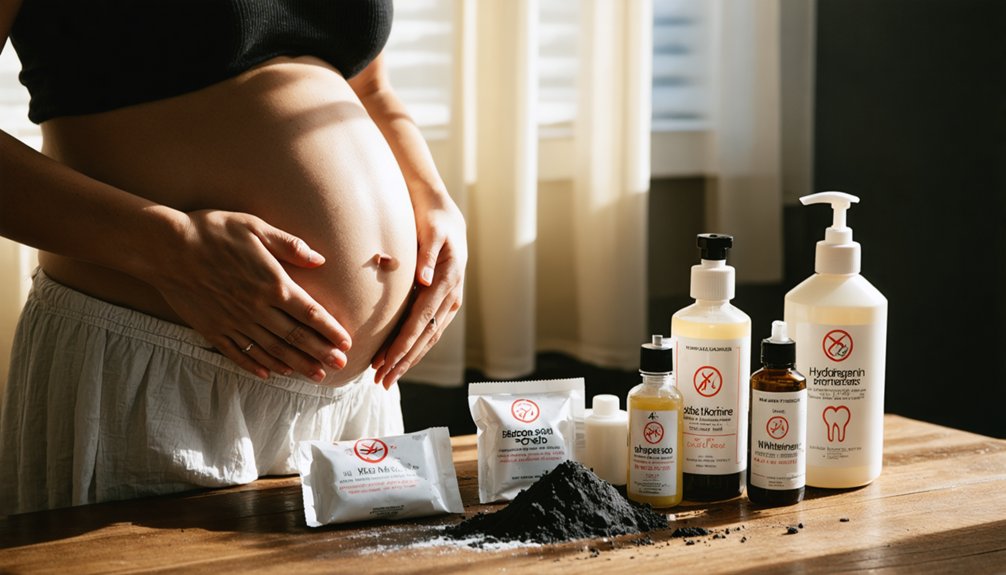
If you’re pregnant, you should postpone teeth whitening until after delivery. No whitening procedure is completely risk-free, and neither the ADA nor the FDA has established safety guidelines for whitening during pregnancy. Hydrogen peroxide can absorb through your gums into your bloodstream, and hormonal changes make your gum tissue more permeable. With no controlled studies confirming fetal safety, caution is your best protection—and there’s much more you need to know before making any decisions.
Key Takeaways
- Most dentists recommend postponing teeth whitening during pregnancy due to elective nature and incomplete safety data from clinical research.
- Hydrogen peroxide in whitening products absorbs through gums into the bloodstream, posing potential risks heightened by increased gum permeability during pregnancy.
- Neither professional nor OTC whitening treatments have confirmed safety during pregnancy; ADA-approved whitening toothpaste offers a safer alternative.
- Watch for warning signs like gum sensitivity, inflammation, bleeding, or systemic symptoms such as nausea after any whitening attempt.
- Consult a dental professional before considering any whitening treatment; prioritize maternal and fetal safety over cosmetic concerns.
Is Teeth Whitening Safe During Pregnancy?
Although teeth whitening is a common cosmetic procedure, its safety during pregnancy remains uncertain due to a significant lack of clinical research. Neither the ADA nor the FDA has established specific safety guidelines for whitening products during pregnancy, leaving you without definitive answers.
Hydrogen peroxide, the primary bleaching agent, can absorb through your gums and potentially reach your developing baby. Since no targeted studies have confirmed safety during pregnancy, most dentists and obstetricians advise postponing these cosmetic procedures until after delivery.
Maintaining strong dental hygiene remains essential throughout pregnancy, but whitening isn’t medically necessary. The professional consensus is straightforward: when credible safety data doesn’t exist, you’re better off waiting.
Protecting your baby’s development outweighs any cosmetic benefit whitening provides.
Why Dentists Recommend Waiting Until After You Give Birth
Most dentists recommend that you postpone teeth whitening until after delivery, as the professional consensus prioritizes caution when research data remains insufficient.
Hydrogen peroxide, the primary bleaching agent, can absorb through your gums and enter your bloodstream, creating a small but unquantified risk to your developing baby.
Since whitening is elective rather than medically necessary, waiting is the most defensible clinical choice.
Professional Consensus on Waiting
When it comes to teeth whitening during pregnancy, dental and medical professionals share a unified stance: wait until after you give birth. Neither the ADA nor the FDA has established safety guidelines for these cosmetic procedures during pregnancy, leaving critical data gaps.
Three core reasons drive this professional consensus:
- Hydrogen peroxide absorbs through your gums, creating unquantified fetal exposure risk.
- No controlled studies confirm whitening’s safety during pregnancy or lactation.
- Whitening carries no medical necessity, making caution the rational default.
Your dental hygiene doesn’t require bleaching agents to remain effective. Professionals consistently advise that when evidence is absent, postponement is the responsible choice.
You maintain full control by prioritizing proven-safe oral care practices until after delivery.
Chemical Risks During Pregnancy
Teeth whitening products expose your body to chemicals that don’t stay localized in your mouth. Hydrogen peroxide, the primary bleaching agent, penetrates dental enamel and absorbs through gum tissue, entering your bloodstream. From there, it can potentially reach your developing baby.
Pregnancy already increases oral sensitivity, making your gums more permeable and reactive to chemical exposure. This heightened absorption means bleaching agents may enter circulation more readily than they’d outside of pregnancy.
No research has confirmed these chemicals are safe for fetal development, yet no studies have proven complete safety either. That data gap itself is the risk.
Since whitening is elective, not medically necessary, most dentists recommend you eliminate that uncertainty entirely by waiting until after delivery.
How Whitening Chemicals Affect Your Body During Pregnancy
During pregnancy, your body absorbs chemicals differently, and whitening agents like hydrogen peroxide can pass through your gum tissue and enter your bloodstream. Hormonal influence effects alter how your body processes these compounds, increasing absorption unpredictability. Dental enzyme interactions may also shift, affecting how peroxide breaks down in your oral tissues.
Three key physiological concerns worth understanding:
- Increased gum permeability — Elevated estrogen softens gum tissue, allowing deeper chemical penetration.
- Altered metabolic processing — Your liver enzymes function differently during pregnancy, potentially slowing chemical clearance.
- Reduced buffering capacity — Hormonal shifts can change saliva composition, weakening your mouth’s natural protective response.
These changes don’t confirm harm, but they do confirm unpredictability. Controlling your exposure now means avoiding unnecessary variables while research remains insufficient.
What Does the Research Actually Show About Hydrogen Peroxide?
When you apply whitening products, hydrogen peroxide absorbs through your gums and enters your bloodstream, raising legitimate concerns about fetal exposure.
Researchers haven’t conducted pregnancy-specific studies to confirm whether this absorption causes harm to your developing baby.
You’re left steering a gap in the evidence—no data conclusively proves it’s dangerous, but none confirms it’s safe either.
Peroxide Absorption Through Gums
How much hydrogen peroxide actually absorbs through your gums—and what that means for your pregnancy—isn’t fully understood. Gum absorption occurs, but the extent of chemical penetration into your bloodstream remains poorly quantified. Here’s what current evidence does suggest:
- Absorption is confirmed — Hydrogen peroxide penetrates gum tissue rather than staying localized on enamel surfaces.
- Systemic reach is unclear — Whether absorbed concentrations enter your bloodstream at levels meaningful to fetal development hasn’t been adequately studied.
- Higher concentrations increase risk — Professional treatments use stronger peroxide formulas, amplifying potential chemical penetration compared to over-the-counter options.
Without definitive safety data, you can’t confidently assess your exposure risk.
Until research clarifies these gaps, avoiding peroxide-based whitening gives you the most control over what enters your body during pregnancy.
Limited Pregnancy-Specific Studies
Although hydrogen peroxide is one of the most widely used bleaching agents in dentistry, researchers haven’t conducted controlled studies examining its effects on pregnant women or developing fetuses. This gap in data means you’re making decisions about cosmetic procedures without the safety benchmarks that typically guide clinical recommendations.
Current dental hygiene guidelines don’t prohibit whitening outright, but they reflect a critical truth: absence of evidence isn’t evidence of absence. No study confirms harm, yet none confirms safety either. The FDA and ADA both acknowledge this research void, leaving practitioners unable to establish definitive thresholds for safe peroxide exposure during pregnancy.
Until pregnancy-specific trials exist, you’re operating in uncertainty. The prudent clinical position is postponement, prioritizing your baby’s development over an elective cosmetic outcome.
Unproven Safety And Risks
Hydrogen peroxide sits at the center of this uncertainty, and understanding what research actually shows helps clarify why clinicians remain cautious. Absorption through gum tissue is documented, yet pregnancy-specific data on fetal impact remains absent. Here’s what you’re actually working with:
- No confirmed harm exists, but absence of evidence isn’t evidence of safety.
- No pregnancy trials have tested whitening ingredients directly, leaving risk profiles undefined.
- Safer alternatives exist, including diet modifications that reduce staining foods and herbal remedies like salt water rinses that support gum health without chemical exposure.
You can’t make a fully informed decision when the data gap is this significant. Clinicians recommend postponement precisely because you deserve certainty, not assumptions, when protecting your developing baby.
Is Professional Whitening More Risky Than Over-the-Counter Products?
When comparing professional whitening to over-the-counter options during pregnancy, the key distinction lies in peroxide concentration and application time.
Professional cosmetic procedures use significantly higher peroxide concentrations with prolonged gum contact, increasing absorption risk. Over-the-counter strips contain lower concentrations, reducing but not eliminating exposure concerns.
Neither option carries confirmed safety data during pregnancy, so both warrant caution.
However, professionals typically advise stronger opposition to clinical treatments due to their intensified chemical delivery.
Maintaining dental hygiene through safer alternatives, such as ADA-approved whitening toothpaste, gives you meaningful control without unnecessary risk.
If you’re considering any whitening method, consult your dentist and obstetrician first.
The difference in risk profile between options is a degree of caution, not a green light for either choice.
Safe Ways to Brighten Your Smile Without Bleaching Chemicals
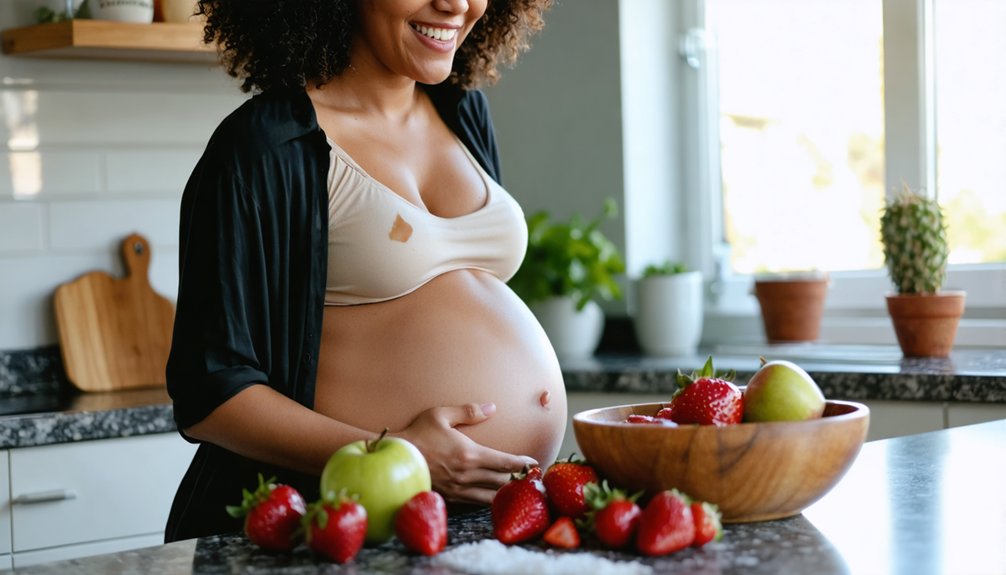
Since bleaching chemicals present unresolved safety questions during pregnancy, safer alternatives can help you maintain a brighter smile without the associated risks. Avoiding cosmetic dental procedures involving peroxide doesn’t mean accepting a dull smile. You can take control through evidence-supported, pregnancy-safe methods:
- Use ADA-approved whitening toothpaste — These rely on mild abrasives rather than bleaching agents, effectively reducing surface stains without chemical absorption risks.
- Brush twice daily with fluoride toothpaste — A concentration of 1,350–1,500ppm supports enamel health while minimizing discoloration.
- Reduce staining foods and drinks — Limiting coffee, tea, and sugary beverages preserves your natural tooth color.
Alternative natural remedies, like salt water rinses, also reduce pregnancy-related gum inflammation, supporting overall oral brightness safely and without unnecessary chemical exposure.
Is Whitening Toothpaste Safe to Use During Pregnancy?
If you’re looking for a whitening option during pregnancy, whitening toothpaste is generally considered safer than bleaching treatments because it relies on mild abrasives rather than chemical bleaching agents.
The ADA recommends selecting a whitening toothpaste bearing its seal of acceptance, as these products meet established safety and efficacy standards.
You should still consult your dentist before use, since not all whitening toothpastes are formulated identically, and some may contain ingredients that warrant closer scrutiny during pregnancy.
Whitening Toothpaste Safety Profile
Whitening toothpastes rely on mild abrasives rather than bleaching chemicals, making them a generally safer option than professional treatments or peroxide-based strips during pregnancy. Unlike invasive cosmetic procedures, they minimize chemical absorption through gum tissue.
If you’re prioritizing safety, here’s what to evaluate:
- Choose ADA-approved products — Select whitening toothpaste bearing the ADA seal, confirming it meets established safety standards.
- Use fluoride formulations — Toothpastes containing 1,350–1,500ppm fluoride support enamel health while reducing surface stains naturally.
- Avoid peroxide-containing formulas — Some whitening toothpastes include low-level bleaching agents; read labels carefully.
While natural remedies like salt-water rinses complement your routine, whitening toothpaste remains your most controlled, low-risk option.
Always confirm product choices with your dentist before use.
ADA-Recommended Safer Alternatives
Beyond evaluating ingredient labels, you’ll want to know which alternatives carry the strongest safety backing during pregnancy. The ADA recommends whitening toothpaste bearing its seal of acceptance as the most defensible option for maintaining brightness while pregnant. Unlike professional cosmetic procedures, these formulations rely on mild abrasives rather than concentrated bleaching agents, reducing systemic absorption risks.
Separating dental myths from evidence matters here. Many patients assume all whitening methods carry equivalent risk profiles—they don’t. Brushing twice daily with fluoride toothpaste containing 1,350 to 1,500ppm fluoride supports enamel integrity and minimizes surface staining without chemical bleaching.
Reducing sugary foods further preserves natural tooth color. These conservative, ADA-aligned strategies give you meaningful control over your oral appearance without compromising the precautionary standards your pregnancy warrants.
Is Teeth Whitening Safe While Breastfeeding?

Once you’ve delivered, the question of teeth whitening safety doesn’t automatically resolve itself if you’re nursing. Current evidence indicates chemicals used to bleach enamel don’t affect breast milk, yet professional consensus still urges caution.
To maintain control over your oral health routines and minimize unnecessary exposure, consider these evidence-based priorities:
- Postpone bleaching treatments until breastfeeding concludes, aligning with standard professional recommendations.
- Use ADA-approved whitening toothpaste as a safer alternative that supports daily oral health routines without chemical absorption risks.
- Apply dietary considerations by reducing stain-causing foods and beverages to preserve natural tooth brightness.
Consult your dentist before resuming any whitening protocol. Without conclusive safety data specific to lactation, the cautious approach remains your strongest evidence-based option.
Warning Signs to Watch for If You’ve Whitened Your Teeth While Pregnant
If you’ve whitened your teeth during pregnancy, monitoring for warning signs is essential given the lack of established safety data. Discontinue use immediately if you notice increased gum sensitivity, irritation, or inflammation, as pregnancy already heightens gum vulnerability.
Report any unusual bleeding, swelling, or persistent discomfort to both your dentist and obstetrician without delay.
Beyond oral hygiene concerns, watch for nausea or gastrointestinal symptoms following treatment, which may indicate chemical ingestion. Review your dietary habits to eliminate acidic or staining foods that could compound sensitivity post-whitening.
If you experience any systemic symptoms—dizziness, unusual fatigue, or oral tissue changes—seek prompt medical evaluation. Document when symptoms began relative to whitening exposure, as this information supports accurate clinical assessment and guides your care team’s recommendations.
Questions to Ask Your Dentist About Whitening During Pregnancy
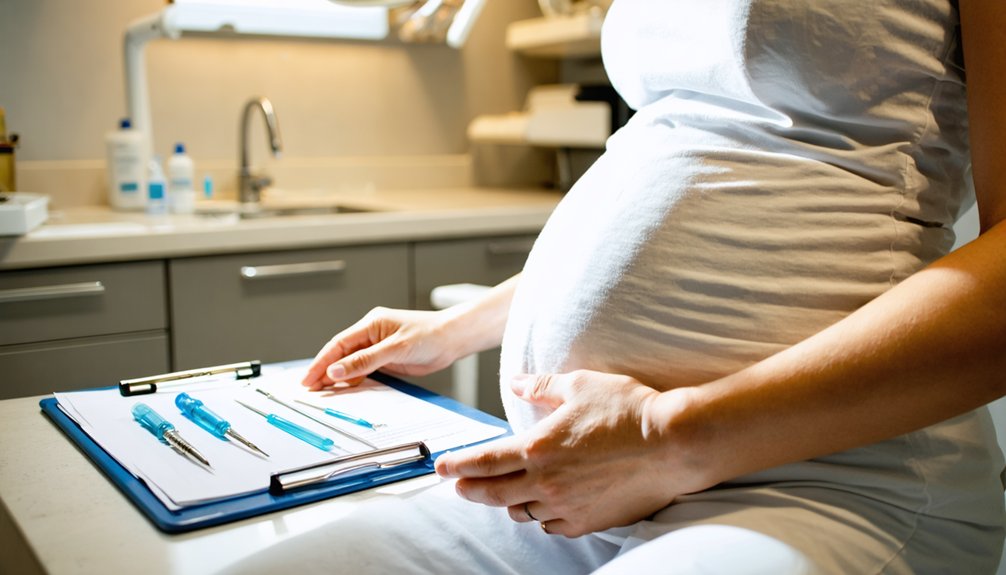
Knowing which warning signs to monitor is only part of informed decision-making—you also need direct, targeted conversations with your dental provider. Before pursuing any cosmetic procedures, come prepared with specific questions that put you in control of your care.
Monitoring warning signs matters—but direct, prepared conversations with your dental provider are equally essential to informed decision-making.
- What’s your clinical stance on hydrogen peroxide absorption risks during my trimester?
- Are there dental hygiene alternatives that maintain enamel brightness without bleaching agents?
- Which ingredients in over-the-counter products require the closest monitoring given my health history?
Your dentist can’t reference definitive safety studies—because they don’t exist—but they can assess your individual risk profile.
Document their responses, consult your obstetrician afterward, and make decisions based on consolidated professional input rather than assumptions.
Informed caution remains your strongest protective strategy.
Frequently Asked Questions
Can Teeth Whitening Affect Fertility or Conception Attempts Before Pregnancy?
No direct evidence links teeth whitening to fertility issues, but you should consult your doctor before conception attempts. Monitor dental sensitivity closely, as whitening efficacy varies, and chemical absorption remains inadequately studied in preconception contexts.
Does Pregnancy Itself Naturally Change or Discolor the Color of Teeth?
Yes, pregnancy can naturally alter your tooth enamel, contributing to oral discoloration. Hormonal shifts, increased estrogen, and heightened gum sensitivity may cause teeth to appear darker, making consistent oral hygiene essential for maintaining control over your dental health.
Are Whitening Procedures Safe During the First Trimester Versus Third Trimester?
Neither trimester’s deemed safe for whitening procedures. Dental safety concerns persist throughout pregnancy, as research remains insufficient. You should avoid cosmetic concerns like bleaching entirely and consult your dentist before considering any whitening treatment.
Can Stress From Avoiding Whitening Negatively Impact Pregnancy Outcomes?
Skipping whitening won’t harm you, but unmanaged stress can. Hormonal fluctuations already heighten dental sensitivity, so you’re better off channeling that energy into safe alternatives, protecting both your emotional wellbeing and your baby’s development effectively.
Do Pregnancy Vitamins or Supplements Interact With Whitening Product Ingredients?
No clear evidence confirms that pregnancy vitamins interact with whitening formulations, but you shouldn’t assume safety. Dental sensitivity may increase due to supplements affecting gum tissue, so consult your dentist before combining any whitening treatments with prenatal regimens.
References
- https://www.mdsgdentistry.com/can-you-use-teeth-whitening-strips-while-pregnant/
- https://mothertobaby.org/baby-blog/whitening-teeth-during-pregnancy-or-breastfeeding-lets-bite-into-the-subject/
- https://nvdentists.com/pregnancy-safe-teeth-whitening/
- https://www.thebump.com/a/whiten-teeth-pregnancy
- https://www.estrellamountaindentistry.com/blogs/is-teeth-bleaching-safe-during-pregnancy/
- https://kidshealth.org/en/parents/tooth-whitening-pregnancy.html
- https://americanpregnancy.org/pregnancy/dental-work-and-pregnancy/
- https://www.regencysquaredental.com/is-teeth-whitening-safe-for-pregnant-women/
- https://www.which.co.uk/news/article/can-i-whiten-my-teeth-while-pregnant-afHyT3E0ZGpU