Home remedies can’t remove tetracycline stains because these discolorations are locked inside your dentin, not sitting on the surface. Baking soda, oil pulling, and fruit-based applications may brighten surface clarity for mild yellowing, but they can’t penetrate deep enough to reverse intrinsic discoloration. Used carefully and consistently, they work best as maintenance tools rather than primary solutions. Severe banding and gray staining require professional intervention. Keep exploring to understand exactly which options match your stain severity.
Key Takeaways
- Baking soda and hydrogen peroxide paste can mildly reduce surface yellowing through controlled abrasion but cannot penetrate dentin-level tetracycline stains.
- Oil pulling combined with fruit-based applications may help manage moderate banding, offering subtle surface-level improvements with consistent use.
- Acidic remedies like lemon juice risk accelerating enamel erosion, increasing sensitivity and vulnerability to further staining if misused.
- Limit acidic or abrasive treatments to once weekly, avoiding layering multiple methods in one session to prevent enamel damage.
- Home remedies serve as maintenance tools only; severe gray or banded stains require professional treatments like KöR whitening or veneers.
Why Tetracycline Stains Are So Hard to Remove
Tetracycline stains are among the most stubborn discolorations in dentistry because they don’t form on the surface — they’re locked deep within the dentin, the mineralized tissue beneath your enamel.
Understanding tetracycline origins matters when you’re choosing a treatment strategy. The antibiotic binds to calcium ions during tooth development, embedding itself permanently into your dentin’s crystalline structure.
This intrinsic discoloration isn’t something you can scrub away or dissolve with acidic compounds. Exposure typically occurred during childhood or in utero before the 1980s, producing yellow, gray, or banded staining that sits well below what surface treatments can reach.
Because the discoloration lives inside your tooth rather than on it, home remedies face a fundamental structural barrier — one you need to understand before investing time in any whitening approach.
Can Home Remedies Actually Help With Tetracycline Stains?
Given how deeply tetracycline stains are embedded in dentin, it’s fair to ask whether home remedies have any role at all — and the honest answer is limited but not zero.
Home remedy effectiveness depends entirely on your stain severity and realistic expectations. These methods won’t penetrate dentin or reverse intrinsic discoloration, but they can refine surface clarity, reduce plaque buildup, and create a cleaner baseline before professional intervention.
Home remedies won’t reverse tetracycline staining — but they can refine surface clarity and build a cleaner baseline.
When evaluating your stain treatment options, understand that home approaches work best as maintenance tools, not primary solutions.
You’re managing surface conditions, not structural pigmentation. If your staining is mild or banded, consistent use of targeted home methods may yield subtle visual improvement — enough to matter aesthetically, but never a substitute for professional-grade care.
How to Match Each Home Remedy to Your Tetracycline Stain Severity
Matching a remedy to your stain severity is the difference between strategic maintenance and wasted effort.
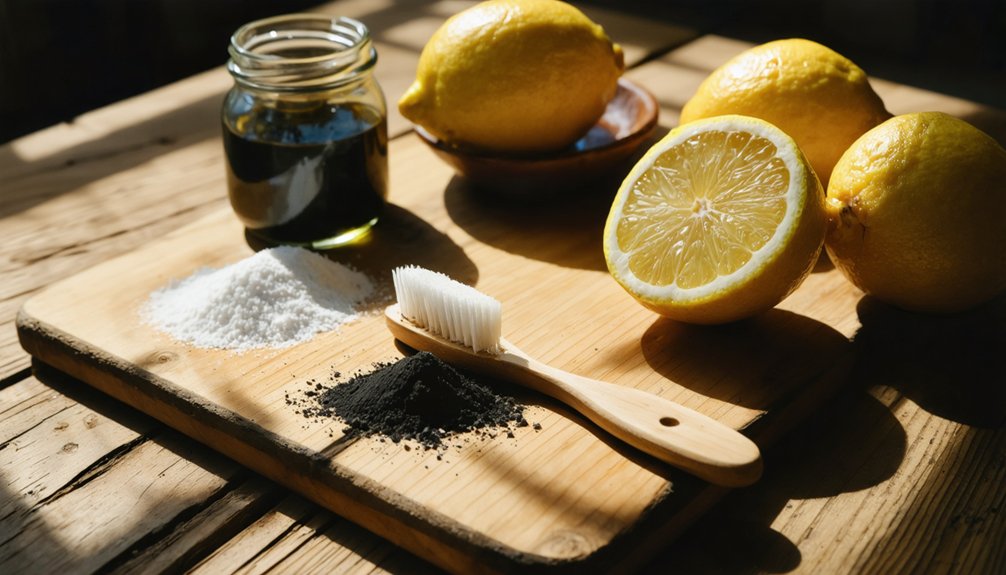
For mild, surface-level yellowing, baking soda with hydrogen peroxide offers controlled abrasion without compromising enamel care. Use it two to three times weekly, monitoring sensitivity closely.
For moderate banding, layer oil pulling with fruit-based applications. Coconut oil reduces bacterial load while malic acid targets residual discoloration. Alternate methods rather than stacking them daily.
For deep gray or dentin-embedded stains, home remedies won’t deliver meaningful results. That’s where tetracycline prevention strategies intersect with professional intervention — veneers or KoR whitening address what topical applications can’t reach.
Know your stain classification before committing to any protocol. Precision matters more than persistence when managing tetracycline discoloration at home.
Baking Soda and Hydrogen Peroxide: Limited Relief for Tetracycline Stains
When you combine baking soda with hydrogen peroxide into a paste and brush for one to two minutes, two to three times weekly, you’ll address surface-level plaque and minor discoloration with mild abrasive action.
However, hydrogen peroxide’s bleaching capacity doesn’t penetrate deeply enough to reach tetracycline staining embedded within dentin, limiting its cosmetic effectiveness on moderate to severe cases.
You can expect marginal brightening at best, making this approach a supplementary measure rather than a reliable solution for intrinsic stain correction.
Baking Soda Paste Application
Baking soda combined with hydrogen peroxide forms one of the most accessible whitening pastes you can prepare at home, yet its effectiveness against tetracycline stains remains fundamentally limited.
The baking soda benefits center on its mild abrasive properties, which break down surface plaque and superficial discoloration efficiently.
For paste application, mix baking soda with hydrogen peroxide until you achieve a consistent, spreadable texture. Brush gently for one to two minutes, two to three times weekly.
You’re addressing only the outermost enamel layer, not the dentin where tetracycline pigmentation resides. Overuse risks enamel erosion and increased sensitivity without delivering meaningful stain reduction.
Treat this method as a supplementary hygiene measure rather than a corrective solution for intrinsic discoloration requiring professional-grade intervention.
Hydrogen Peroxide Bleaching Limits
Although hydrogen peroxide strengthens the whitening action of baking soda paste, it can’t penetrate deeply enough to address tetracycline’s intrinsic dentin staining.
Your bleaching effectiveness remains confined to enamel-level discoloration, leaving embedded pigmentation untouched beneath the surface.
Higher peroxide concentration doesn’t resolve this limitation—it only amplifies sensitivity and enamel erosion risks without delivering proportional results.
Over-the-counter formulas typically contain 3–10% hydrogen peroxide, which falls considerably short of the clinical-grade concentrations required for any meaningful impact on dentin.
You’re working against a structural barrier that surface-level chemistry simply can’t overcome.
Recognize this boundary before investing time in repeated applications.
If you’re pursuing visible change beyond minor brightening, professional-grade interventions like KöR whitening or veneers offer the precision and depth this condition demands.
What Oil Pulling Can and Can’t Do for Tetracycline Stains
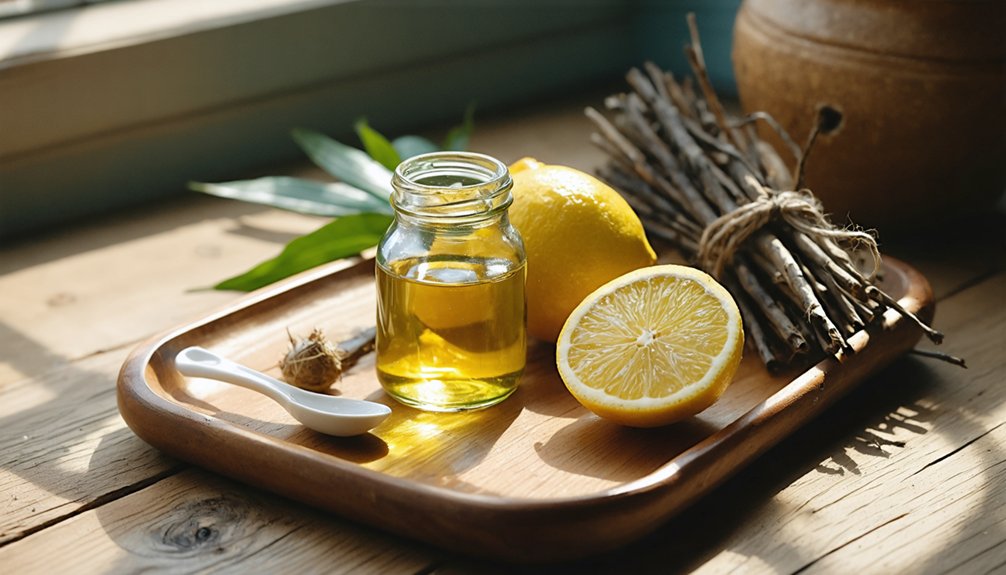
Oil pulling is an Ayurvedic practice where you swish a tablespoon of coconut or sesame oil through your teeth for 15 to 20 minutes, drawing out bacteria and reducing plaque buildup that contributes to surface staining.
Its oil pulling effectiveness lies strictly in oral health benefits—not dentin penetration.
Here’s what you can realistically expect:
- It reduces surface plaque that amplifies the appearance of existing discoloration
- It supports a cleaner oral environment, minimizing secondary staining agents
- It won’t penetrate dentin, meaning tetracycline’s intrinsic banding remains completely unaffected
Spit into the trash, rinse thoroughly, then brush.
Combined with other methods, oil pulling refines your overall results.
However, for embedded tetracycline stains, professional intervention remains your most precise, controlled solution.
Fruit-Based Remedies for the Lightest Tetracycline Stain Cases
Fruit-based remedies occupy a similarly limited but slightly more targeted lane than oil pulling for the lightest tetracycline stain cases.
You’re working primarily with malic acid from strawberries and citric effects from orange peel — both delivering mild surface-level oxidation that addresses superficial discoloration only. The fruit benefits here are real but narrow: mash one strawberry with baking soda, apply for three to five minutes weekly, or rub orange peel’s inner white layer across teeth for one to two minutes.
Malic acid from strawberries and citric compounds from orange peel tackle surface discoloration only — real benefits, narrowly delivered.
Banana peel offers potassium and magnesium for gentle polishing. However, you must restrict acidic applications to once weekly — enamel erosion compounds quickly with overuse.
For anything beyond the faintest tetracycline banding, these methods won’t penetrate dentin where the staining actually lives.
Overuse, Acid Damage, and Other Home Remedy Mistakes to Avoid
When you overuse acidic home remedies like lemon juice, strawberry, or orange peel, you accelerate enamel erosion and compromise the structural integrity of your teeth.
Thinning enamel exposes the underlying dentin, making your teeth hypersensitive to temperature, pressure, and sweet foods.
You’ll also find that weakened enamel becomes more porous, paradoxically increasing your teeth’s vulnerability to future staining rather than reducing it.
Enamel Erosion Risks
Though natural remedies offer a gentler path to a brighter smile, misusing them can silently compromise your enamel—the tooth’s irreplaceable protective layer.
Without deliberate enamel protection strategies, acidic agents like lemon juice and overused abrasives gradually thin this barrier, leaving teeth hypersensitive and structurally vulnerable.
Unlike dentin, enamel doesn’t regenerate—making enamel restoration techniques largely preventative rather than corrective. Once it’s gone, it’s gone.
Protect your enamel by avoiding these critical mistakes:
- Applying acidic remedies more than once weekly, accelerating mineral loss
- Brushing immediately after acidic applications, when enamel is temporarily softened
- Using multiple abrasive methods simultaneously, compounding wear beyond safe thresholds
Control your whitening approach with precision—strategic timing, measured frequency, and professional consultation guarantee you’re brightening your smile without silently dismantling it.
Overuse Causes Sensitivity
Enamel erosion and tooth sensitivity share the same root cause: overuse. When you apply acidic agents like lemon juice, strawberries, or even baking soda too frequently, you’re stripping enamel faster than it can recover. The result isn’t whitening — it’s exposure of the underlying dentin, which amplifies thermal and tactile sensitivity markedly.
Effective sensitivity management starts with strict frequency control. Limit acidic applications to once weekly, and never layer multiple abrasive or acidic methods within the same session. Enamel protection requires intentional recovery time between treatments.
You’re also not accelerating results by increasing applications — you’re compounding damage. For tetracycline stains specifically, overuse won’t penetrate intrinsic discoloration anyway.
Precision and restraint yield better outcomes than aggressive repetition ever will.
When Home Remedies for Tetracycline Stains Fall Short
Tetracycline stains present a unique challenge because the discoloration forms intrinsically within the dentin—far beyond the reach of any surface-level treatment.
Understanding home remedy effectiveness helps you make smarter decisions before investing time in stain removal techniques that won’t deliver results.
Here’s when you need to reconsider your approach:
- Banding or gray discoloration persists after consistent weeks of treatment
- Surface abrasives cause sensitivity without visibly lifting embedded pigmentation
- Multiple methods combined still produce no measurable improvement
At this point, professional intervention becomes necessary.
Veneers, KoR whitening, or composite bonding directly address dentin-level staining that home methods simply can’t penetrate.
You deserve accurate expectations—redirect your efforts toward solutions that match the actual severity of your condition.
Professional Treatments That Actually Work on Deep Tetracycline Stains
When home remedies reach their limit, professional treatments pick up where they leave off—targeting the dentin layer directly rather than the tooth’s surface. Your treatment options expand considerably once you step into a clinical setting.
KöR whitening uses refrigerated, high-concentration peroxide gels applied through custom trays overnight, penetrating deeply enough to oxidize embedded tetracycline pigments.
For severe banding, porcelain veneers offer complete aesthetic control, masking discoloration with precision-crafted, color-matched restorations. Composite bonding presents a more conservative alternative when only partial coverage is needed.
In any effectiveness comparison, professional interventions consistently outperform home methods for intrinsic stains—not because home approaches fail entirely, but because dentin-level discoloration demands clinical-grade chemistry and controlled application that no pantry ingredient can replicate.
Frequently Asked Questions
Can Tetracycline Stains Return After Successful Professional Whitening Treatment?
Ironically, yes—tetracycline stains can return. You’ll need consistent stain prevention habits to maintain your results. Combine professional whitening techniques with ADA-approved toothpaste and avoid stain-causing foods to keep your smile brilliantly controlled.
Are Tetracycline Stains Hereditary or Only Caused by Antibiotic Exposure?
Tetracycline stains aren’t hereditary—they’re exclusively caused by antibiotic exposure during tooth development. Genetic factors don’t trigger this discoloration. You’re only at risk if you’ve taken tetracycline antibiotics during critical developmental years, giving you full preventive control.
Does Dental Insurance Typically Cover Tetracycline Stain Removal Procedures?
Your dental insurance won’t typically cover tetracycline stain removal, as it’s deemed cosmetic. You’ll need to explore procedure options like veneers or KoR whitening independently, so understanding your insurance coverage limitations helps you plan financially with confidence.
At What Age Can Children Safely Begin Tetracycline Stain Treatments?
Like a developing blueprint, your child’s smile needs protection first — avoid tetracycline exposure entirely during childhood dental care. You shouldn’t pursue stain treatments until permanent teeth fully erupt, typically around age 12-14.
Can Tetracycline Stains Affect the Structural Integrity of Teeth Over Time?
Tetracycline stains don’t directly compromise your tooth enamel’s structural integrity, but long term effects from aggressive whitening attempts can weaken it. You’ll want professional guidance to protect both aesthetics and durability effectively.
References
- https://smilelabny.com/remove-brown-stains-teeth-naturally/
- https://bethanyfamilydental.com/remove-tetracycline-stains-with-cosmetic-dentistry/
- https://drchrisamott.com/natural-ways-to-remove-brown-tooth-stains/
- https://www.mydentaloffice.com/10-home-remedies-for-whiter-teeth-that-actually-work/
- https://www.trysnow.com/blogs/news/tetracycline-teeth-staining-in-adults
- https://www.scrippsdentalcare.com/cosmetic-dentistry/how-can-i-get-rid-of-tetracycline-stains/
- https://www.healthline.com/health/tetracycline-teeth
- https://www.stanleysmiles.com/blog/how-can-i-whiten-my-tetracycline-stains