Tetracycline stains are embedded deep within your dentin, which means most DIY whitening solutions won’t touch them. Over-the-counter strips, natural remedies, and store-bought peroxide kits lack the concentration needed to penetrate beneath your enamel’s surface. For mild cases, whitening strips or custom trays with high-concentration gels can produce gradual results. Severe discoloration may require professional-grade overnight whitening systems or restorative options like veneers. Keep scrolling to find out which approach matches your specific situation.
Key Takeaways
- Tetracycline stains are embedded in dentin, making them resistant to most DIY whitening methods that only affect surface enamel.
- Over-the-counter whitening strips may offer subtle lightening for mild cases but cannot address deep banding or gray-brown discoloration.
- Store-bought peroxide kits lack the concentration needed to penetrate stained dentin effectively for meaningful results.
- Natural remedies and abrasive DIY treatments risk enamel erosion without improving the underlying intrinsic discoloration.
- Custom trays with high-concentration gels remain the most effective at-home option, offering gradual improvement over several months.
Why DIY Whitening Doesn’t Work on Tetracycline Stains
Tetracycline stains form deep within the dentin layer, where the antibiotic binds to calcium during tooth development and becomes permanently embedded beneath the enamel surface.
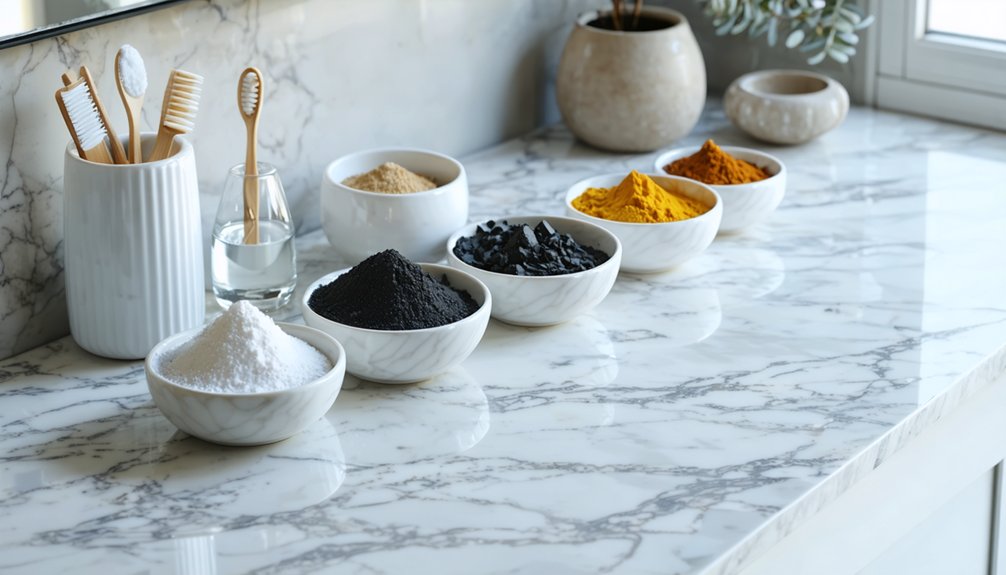
Because the discoloration originates below the enamel, DIY whitening methods can’t reach the source. Over-the-counter strips and natural remedies like baking soda or activated charcoal only interact with surface enamel, leaving intrinsic stains completely untouched.
DIY whitening can’t fix what it can’t reach — tetracycline stains live below the enamel surface.
Worse, abrasive natural remedies accelerate enamel erosion, compromising structural integrity without delivering any real improvement.
Even store-bought peroxide kits lack the concentration and contact time required to penetrate dentin.
You’re not dealing with surface buildup — you’re dealing with a structural discoloration embedded in the tooth itself.
Standard DIY approaches are chemically insufficient for this specific condition.
Whitening Strips for Mild Tetracycline Discoloration
While standard DIY whitening methods fall short across the board, whitening strips occupy a narrow exception for the mildest cases of tetracycline discoloration.
Stain assessment is critical before committing to this approach — strips only deliver measurable whitening effectiveness against uniform, light-yellow superficial discoloration, not banding or gray-brown intrinsic pigmentation.
Applied daily for 30 minutes, peroxide-coated strips penetrate minimally into enamel, producing gradual, partial lightening over several weeks.
You won’t achieve dramatic results, but for genuinely mild cases, you may notice subtle improvement in overall brightness.
Understand the ceiling here: strips don’t reach dentin, where tetracycline binds calcium during development.
If your discoloration involves visible banding or darker hues, strips won’t move the needle — and you’ll need to escalate to professional-grade intervention.
Custom Trays With High-Concentration Gels for Deeper Stains
When whitening strips reach their limit, custom trays with high-concentration peroxide gels become the next viable at-home option for deeper tetracycline staining.
Custom tray benefits include a precise fit that holds gel directly against enamel, maximizing high concentration effectiveness where strips can’t reach.
Key advantages of this approach:
- Targeted delivery: Fitted trays minimize gel dilution from saliva
- Higher peroxide levels: Prescription-grade gels penetrate deeper into stained dentin
- Controlled exposure: You manage wear duration to reduce sensitivity risk
- Gradual improvement: Consistent daily use over several months yields measurable lightening
You’ll see partial improvement in mild-to-moderate cases, though severe banding typically resists full correction.
This method remains your strongest DIY option before escalating to professional clinical intervention.
How Overnight Whitening Tackles Stubborn Tetracycline Stains
Overnight whitening represents a significant step up from standard custom tray protocols, giving stubborn tetracycline stains the extended contact time they actually require.
Because stain persistence is the defining challenge with tetracycline discoloration, brief daytime sessions simply can’t penetrate dentin deeply enough to produce meaningful change.
The KöR Whitening system addresses this directly. You’ll wear refrigerated, high-concentration peroxide trays for six to eight hours nightly over six weeks.
KöR Whitening trays, worn six to eight hours nightly for six weeks, deliver the extended contact time tetracycline stains demand.
The extended exposure allows peroxide molecules to diffuse through enamel into stained dentin, breaking chromogen bonds that shorter sessions leave intact.
Overnight results aren’t immediate—you’ll notice gradual lightening across weeks, not days.
Yellow and brown tones respond most predictably, while gray-green banding diminishes rather than disappears entirely.
Lifelong maintenance trays preserve your progress.
When to Switch to Veneers or Bonding for Tetracycline Stains
Prolonged bleaching protocols like KöR can produce meaningful improvement, but they’ve a ceiling—particularly with severe gray or banded tetracycline staining that resists even months of overnight peroxide exposure.
When whitening plateaus, restorative intervention becomes the evidence-based next step.
Consider switching when you observe:
- Gray or dark banding that survives six-plus weeks of bleaching
- Composite bonding suits mild-moderate cases, though bonding longevity typically spans five to seven years before staining or chipping requires replacement
- Porcelain veneer options provide durable, translucent coverage requiring 0.25–0.75mm enamel reduction, including sub-gingival margins to eliminate dark halos
- Crowns when structural compromise accompanies severe discoloration
You’re not surrendering control by choosing veneers or bonding—you’re selecting the tool calibrated for your stain’s actual severity.
Frequently Asked Questions
Can Tetracycline Stains Worsen Over Time Without Any Whitening Treatment?
Like shadows deepening at dusk, yes, your tetracycline stains can worsen over time. You’ll notice increased stain progression as dentin darkens, reinforcing treatment urgency—you shouldn’t delay pursuing effective whitening interventions to maintain control over discoloration.
Are Tetracycline Stains Hereditary or Only Caused by Antibiotic Exposure?
Tetracycline stains aren’t hereditary; they’re exclusively caused by antibiotic history during tooth development. Your genetic factors don’t predispose you to them—only direct tetracycline exposure during enamel and dentin formation triggers these intrinsic discolorations.
Does Teeth Whitening for Tetracycline Stains Affect Surrounding Gum Tissue?
Whitening gels can irritate gum tissue if they contact it directly. You’ll protect your gum health by using well-fitted trays and following whitening safety protocols, minimizing exposure and reducing the risk of inflammation or sensitivity.
Can Children With Tetracycline Stains Undergo Any Safe Whitening Methods?
You shouldn’t pursue safe whitening for tetracycline stains in children, as developing teeth remain highly sensitive. Prioritizing children’s dental health means waiting until adulthood before considering professional bleaching protocols like KöR or composite bonding interventions.
How Do Dentists Officially Diagnose and Grade Tetracycline Stain Severity?
Dentists use diagnostic criteria and staining classification systems to grade your tetracycline stains by examining discoloration depth, color intensity, and banding patterns, categorizing severity from mild uniform yellowing to severe dark gray or brown bands.
References
- https://myserenitydental.com/remove-tetracycline-stains-from-teeth/
- https://smilepath.nz/blogs/blog/teeth-whitening-for-tetracycline-teeth
- https://www.mydrdennis.com/blog/cheap-fix-for-tetracycline-stains/
- https://azdentist.com/conditions/tetracycline-staining/
- https://vegassmilesuite.com/how-to-whiten-teeth-with-tetracycline-stains/
- https://www.trysnow.com/blogs/news/tetracycline-teeth-staining-in-adults
- https://www.stanleysmiles.com/blog/how-can-i-whiten-my-tetracycline-stains
- https://www.smilesofchesterton.com/blog/solutions-for-tetracycline-stained-teeth/