Tetracycline stains bond deep inside your dentin, so you’ll need solutions that go beyond standard whitening. Your dentist’s top options include extended-wear whitening systems like KöR or Opalescence, dental bonding for residual dark bands, porcelain veneers for severe discoloration, and crowns when structural integrity is also compromised. The right choice depends on your stain’s depth, severity, and your goals. Each solution works differently — and knowing which fits your case makes all the difference.
Key Takeaways
- Extended whitening protocols like KöR and Opalescence use refrigerated gels and peroxide trays to gradually lighten mild-to-moderate tetracycline stains.
- Dental bonding applies tooth-colored composite resin over stubborn dark bands, offering a less invasive cosmetic correction after whitening.
- Porcelain veneers mask severe stains by bonding ultra-thin custom shells to tooth fronts, lasting 10–20 years with proper care.
- Crowns encase entire teeth, addressing both deep discoloration and structural damage using natural-looking materials like zirconia or lithium disilicate.
- Dentists classify stains as mild, moderate, or severe to match treatment intensity, patient goals, and budget appropriately.
Why Tetracycline Stains Resist Even Professional Whitening
Because tetracycline molecules bond directly to the calcium in developing dentin, they’re locked deep within the tooth’s structure—far beyond the reach of standard whitening agents that only penetrate enamel.
Tetracycline bonds to dentin at a molecular level—standard whitening agents simply cannot reach that deep.
This tetracycline resistance explains why over-the-counter strips and even basic professional treatments consistently fall short.
The whitening challenges intensify depending on when you were exposed to the antibiotic, how long you took it, and the dosage.
Gray and brown banding patterns—particularly common with doxycycline—oxidize poorly, making peroxide less effective at breaking down the embedded chromogens.
Your results also vary by stain depth: superficial discoloration responds better than stains anchored within the dentin matrix.
Understanding this distinction lets you approach treatment with realistic expectations and choose solutions actually designed for your specific stain severity.
How Dentists Decide Which Treatment Your Stain Actually Needs
When you visit a dental professional for tetracycline staining, they’ll first assess your stain’s severity, location, and depth before recommending any treatment path.
Mild, diffuse staining typically responds well to extended whitening protocols like KöR or Opalescence, while moderate-to-severe banding often requires cosmetic restorations such as veneers or crowns.
Your dentist matches the treatment intensity directly to what your stains actually demand, avoiding both under-treatment and unnecessary intervention.
Assessing Stain Severity First
Before your dentist recommends a single treatment, they’ll assess exactly how deep and severe your tetracycline staining runs—because that assessment is what separates a successful outcome from a frustrating one.
Stain classification follows a graded scale—mild, moderate, or severe—based on color intensity, band distribution, and enamel depth. Your staining’s grade directly shapes your treatment timeline.
Mild cases typically respond to extended whitening protocols like KöR or Opalescence over several weeks. Moderate staining may require combined in-office and at-home approaches spanning months. Severe gray or brown banding, particularly non-responsive to peroxide, often points immediately toward veneers or crowns.
Understanding where your stains fall on that scale gives you clarity and control—you’ll know exactly what’s ahead before committing to any protocol.
Matching Treatment To Needs
Once your stain severity is graded, your dentist maps that classification directly to the most effective treatment pathway. Your stain characteristics—depth, color distribution, and band intensity—determine which treatment options realistically deliver results.
Mild diffuse staining typically responds to KöR or Opalescence protocols, leveraging extended peroxide exposure to lift intrinsic discoloration gradually.
Moderate banding may combine whitening with targeted dental bonding, addressing residual dark zones without unnecessary restorative work.
Severe gray or brown bands, particularly those penetrating deep dentin, rarely respond to bleaching alone—porcelain veneers or crowns become the predictable solution.
Your dentist isn’t guessing; they’re matching clinical evidence to your specific presentation.
Understanding this decision framework empowers you to ask precise questions and commit confidently to a treatment plan designed around your actual smile.
KöR vs. Opalescence: Which Works Better for Tetracycline Stains?
Both KöR and Opalescence offer compelling whitening protocols for tetracycline stains, but they differ markedly in how they deliver results.
KöR effectiveness stems from refrigerated gels and extended-wear trays, giving you deeper peroxide penetration over six to eight weeks. It’s the stronger choice for diffuse, moderate staining with impressive long-term results.
Opalescence efficacy relies on 10% peroxide trays combined with monthly in-office Boost treatments, making its treatment protocols more flexible for patient preferences around scheduling and cost considerations.
It’s a solid option if you want measurable progress without the intensity of KöR’s commitment.
When comparing stain comparison outcomes, KöR typically outperforms for stubborn cases, while Opalescence suits mild to moderate stains.
Your dentist can align these whitening techniques precisely with your goals and budget.
When to Add Bonding After Tetracycline Stain Whitening
Even after a successful whitening course, some residual darker bands or cervical shadow areas simply won’t lift further—and that’s precisely when dental bonding earns its place.
Your dentist applies tooth-colored composite resin directly over those stubborn zones, sculpting it to blend seamlessly with your newly brightened enamel.
Composite resin is sculpted directly over stubborn zones, blending seamlessly with your newly brightened enamel.
Bonding techniques vary—some target isolated cervical margins, others address broader mid-tooth banding—so your provider tailors placement based on where staining persists.
It’s less invasive than veneers and delivers immediate cosmetic correction.
For post whitening care, you’ll maintain those bonded surfaces by avoiding stain-causing foods and scheduling periodic polishing appointments.
Because composite can discolor over time, disciplined upkeep protects your investment.
Used strategically, bonding transforms a near-perfect result into a truly complete, confident smile.
Porcelain Veneers for Severe Tetracycline Stain Cases
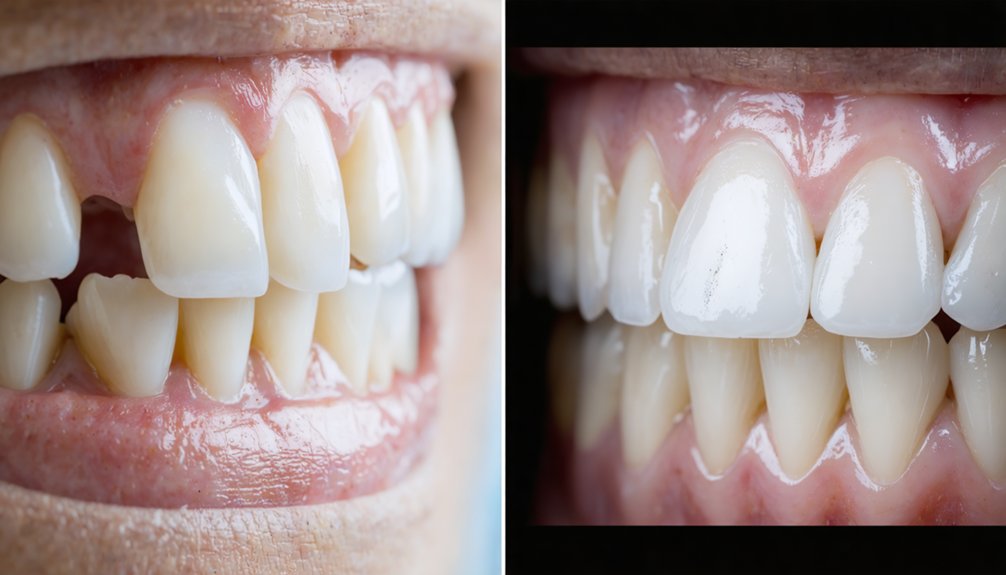
When whitening falls short against severe gray or brown tetracycline bands, porcelain veneers offer you a permanent, predictable solution by bonding ultra-thin shells directly to your tooth fronts.
Your dentist custom-crafts each veneer to match your desired shade and shape, effectively masking even the most stubborn discoloration across multiple affected teeth.
If your stains haven’t responded to extended whitening protocols, veneers eliminate the guesswork and deliver consistent, lasting aesthetic results.
Masking Severe Stains Permanently
For severe tetracycline staining that resists even the most aggressive whitening protocols, porcelain veneers offer the most predictable and permanent solution available.
When stain longevity has left deep gray or brown bands unresponsive to chemical treatment, ultra-thin porcelain shells bonded directly to your tooth fronts completely mask the discoloration beneath.
Your dentist custom-designs each veneer to match your desired shade and shape, giving you full control over your final aesthetic outcome.
Treatment longevity is a defining advantage here — properly placed veneers can last 10 to 20 years with routine care.
Unlike whitening, veneers don’t require repeated sessions or maintenance cycles.
They’re the standard recommendation when multiple anterior teeth carry severe intrinsic staining that cosmetic whitening simply can’t overcome predictably.
Custom Shade And Shape
Porcelain veneers give you complete control over two variables that matter most in severe tetracycline cases: shade and shape. You’re not accepting a compromise—you’re designing an outcome.
Through custom color options, your dentist matches each veneer to your desired brightness level, eliminating the gray or brown banding that whitening can’t fully address.
Personalized fitting guarantees each shell aligns precisely with your tooth’s natural contours, creating seamless integration across your smile. You choose the length, symmetry, and surface texture.
The porcelain mimics enamel’s light-reflecting properties, so results look natural rather than artificial. Because every detail is predetermined before bonding, you’re eliminating unpredictability entirely.
For severe tetracycline staining, that level of customization isn’t a luxury—it’s the functional reason veneers outperform every other available option.
When Whitening Falls Short
Customization gives veneers their edge in design—but it’s the clinical reality of severe tetracycline staining that makes them a necessity rather than a preference.
When stain persistence extends deep into dentin, whitening limitations become undeniable. Peroxide-based systems can’t reliably penetrate gray or brown banding at that depth, leaving you with incomplete results despite months of effort.
Porcelain veneers bypass this entirely. Your dentist bonds ultra-thin shells directly to the front surfaces of affected teeth, physically masking discoloration that no bleaching protocol can resolve.
You’re not waiting on gradual improvement—you’re choosing a permanent, predictable outcome. For non-responsive severe cases, veneers aren’t a cosmetic upgrade; they’re the clinically appropriate choice that finally gives you full control over your smile’s appearance.
When Tetracycline Stains Are Severe Enough to Need Crowns
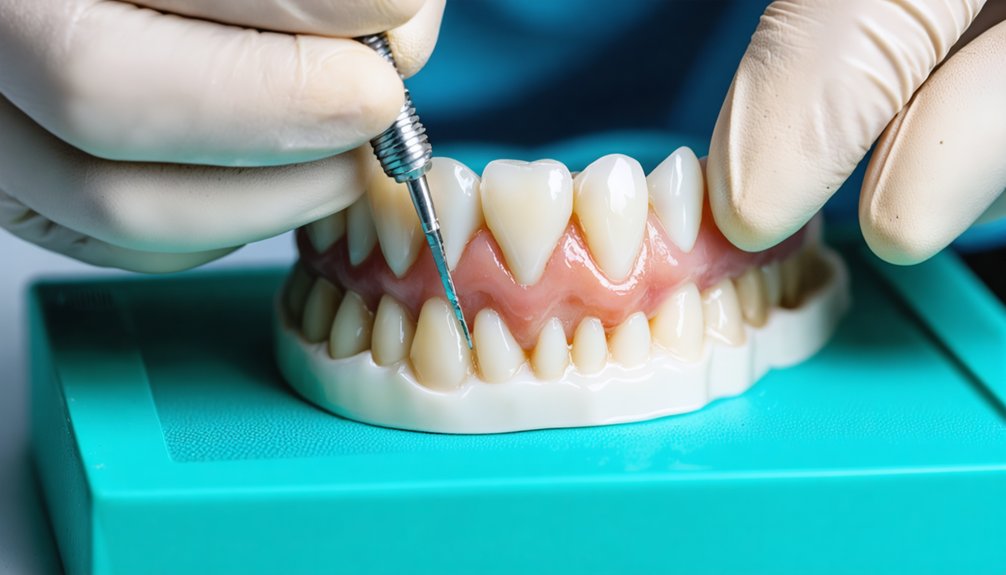
When tetracycline staining runs deep enough to compromise both the color and structural integrity of a tooth, crowns become the most predictable path to a lasting, natural-looking result.
Unlike veneers, crowns encase the entire tooth, giving your dentist full control over shade, contour, and protection.
Crown materials like zirconia and lithium disilicate offer exceptional strength while mimicking natural translucency—critical for blending seamlessly with surrounding teeth.
Crown longevity typically spans 10–15 years with proper care, making them a worthwhile investment when severe gray or brown banding resists every whitening protocol.
Your dentist may combine crowns with whitening on adjacent teeth to achieve a cohesive result across your smile.
This coordinated approach guarantees you’re not just masking damage—you’re rebuilding confidence with precision.
Questions Your Dentist Will Ask to Choose the Right Treatment
Before your dentist recommends a single treatment, they’ll ask targeted questions to map out exactly where your stains originate, how deep they run, and how your teeth have responded to any prior whitening attempts.
Expect questions about your antibiotic exposure timeline, dosage duration, and your age when treatment occurred — all critical variables shaping your treatment options.
Your dentist will also assess patient preferences around commitment level, budget, and aesthetic goals.
Do you want gradual improvement through extended whitening protocols, or immediate transformation through veneers? Are certain teeth more visually prominent to you?
These answers directly influence whether KöR, Opalescence, bonding, or porcelain restorations become your primary path.
You’re not just a passive recipient here — your input actively drives the clinical decision.
Frequently Asked Questions
Can Tetracycline Stains Reappear After Successful Professional Whitening Treatment?
Like a shadow that fades but never fully disappears, tetracycline stains won’t reappear, but stain recurrence factors like diet and habits can dull your results. Maintain whitening treatment effectiveness with touch-ups to keep you’re smile brilliant.
Are Tetracycline Stain Treatments Typically Covered by Dental Insurance Plans?
Dental insurance coverage typically won’t include tetracycline stain treatment options, as they’re considered cosmetic. You’ll want to explore financing plans to take control of achieving your desired aesthetic results confidently.
How Long Do Porcelain Veneers Last on Tetracycline-Stained Teeth?
Your veneers can last a lifetime of brilliance! Porcelain veneer longevity typically reaches 10-20 years on tetracycline-stained teeth. Stain severity doesn’t affect durability—you’ll maintain stunning results with proper care and regular professional check-ups.
Can Children With Tetracycline Stains Receive Professional Whitening Treatments Safely?
You shouldn’t pursue professional whitening for children, as whitening age guidelines restrict treatments until adulthood. Prioritizing child dental health means waiting until teeth fully develop before exploring safe, effective tetracycline stain removal options.
Does Tetracycline Staining Affect Overall Tooth Strength or Structural Integrity?
Tetracycline staining doesn’t compromise your tooth’s structural integrity. It’s purely a cosmetic concern tied to tooth discoloration causes. Your enamel health concerns remain intact, so you’re in control—focusing treatment purely on achieving your ideal aesthetic outcome.
References
- https://vegassmilesuite.com/how-to-whiten-teeth-with-tetracycline-stains/
- https://myserenitydental.com/remove-tetracycline-stains-from-teeth/
- https://blog.ultradent.com/transforming-tetracycline-stains-with-opalescence-whitening
- https://www.korwhitening.com/see-kor-whitening-helped-tetracycline-patients/
- https://bethanyfamilydental.com/remove-tetracycline-stains-with-cosmetic-dentistry/
- https://www.mydrdennis.com/blog/cheap-fix-for-tetracycline-stains/
- https://cosmetic-dentistry.com/blog/teeth-whitening-brands-improve-tetracycline-stains-look-better.html
- https://pmc.ncbi.nlm.nih.gov/articles/PMC2741196/
- https://www.healthline.com/health/tetracycline-teeth