Higher peroxide concentrations whiten faster because they release more free radicals per unit of time, accelerating the breakdown of carbon bonds in stain compounds. When you apply a higher percentage gel, the oxidation reaction intensifies quickly, driving reactive oxygen molecules deeper into enamel at a faster rate. However, effectiveness plateaus above 18% hydrogen peroxide, meaning faster doesn’t always mean better. The full story behind concentration, contact time, and safety is more nuanced than you’d expect.
Key Takeaways
- Higher concentrations release more free radicals, accelerating the breakdown of carbon bonds responsible for tooth discoloration.
- Peroxide penetrates enamel and dentin more rapidly at concentrations above 18%, speeding up the whitening process.
- 35% hydrogen peroxide can achieve 6–8 shades of whitening within just 15–30 minutes under professional supervision.
- More reactive oxygen molecules become available at higher concentrations, increasing the rate of stain compound oxidation.
- Despite faster initial results, effectiveness plateaus above 18% hydrogen peroxide, producing diminishing returns at higher concentrations.
Does Higher Concentration Always Mean Faster Whitening?
When it comes to tooth whitening, higher peroxide concentrations don’t always translate to faster or better results. Concentration misconceptions are among the most persistent whitening myths you’ll encounter.
Research confirms that concentrations above 18% hydrogen peroxide show no additional effectiveness gains—you’re not getting proportionally greater results by pushing higher. In fact, 6% hydrogen peroxide applied over extended sessions whitens deeper than 35% used briefly.
Similarly, 10-16% carbamide peroxide outperforms 37% after one week of use. What drives results isn’t solely concentration—it’s contact time, formulation chemistry, and delivery method.
You need to understand that higher percentages accelerate initial reaction speed but don’t guarantee superior outcomes. Controlling application duration and selecting the right agent gives you more predictable, measurable whitening performance.
How Oxidation Breaks Down Tooth Stains by Concentration Level
When peroxide contacts your tooth surface, it releases reactive oxygen molecules that target and break apart the carbon bonds in colored stain compounds, effectively decolorizing them.
Your concentration level directly controls the speed of this oxidation cascade—higher percentages generate more free radicals per unit time, accelerating stain breakdown but not necessarily deepening it.
At concentrations above 18%, the peroxide penetrates both enamel and dentin more rapidly, though extended application time at lower concentrations can achieve comparable or greater depth of whitening.
Oxidation Targets Stain Compounds
Oxidation breaks down tooth stains by targeting chromophore molecules — the colored organic compounds embedded in enamel and dentin. During the oxidation process, peroxide releases reactive oxygen species that attack the carbon double bonds within these chromophores.
Once those bonds break, the molecules lose their ability to absorb visible light, eliminating color at the molecular level.
Higher concentrations deliver more reactive oxygen simultaneously, accelerating stain removal across a broader molecular surface.
You’re not just speeding up a reaction — you’re increasing the volume of oxidative agents available to neutralize stain compounds before they can redeposit.
This precision matters: controlling concentration lets you dictate how aggressively oxidation targets deeply embedded pigments, particularly in dentin, where chromophores resist surface-level treatments.
Concentration Affects Reaction Speed
Concentration doesn’t just determine how much oxidation occurs — it controls how fast. Reaction kinetics respond directly to peroxide levels — higher concentrations drive faster radical release, accelerating stain breakdown at the molecular level.
Hydrogen peroxide acts within 30–60 minutes, while carbamide peroxide releases only 50% of its oxidative power within two hours, dispersing the remainder over eight hours.
You’ll hit concentration thresholds where effectiveness plateaus. Above 18% hydrogen peroxide, additional concentration gains yield diminishing returns in whitening performance.
What actually deepens results is contact time, not higher dosing. A 6% hydrogen peroxide applied over extended sessions outperforms a 35% gel in penetration depth.
Understanding these kinetics lets you optimize your protocol — matching concentration, exposure time, and delivery method to your target outcome.
Enamel Penetration By Percentage
Enamel penetration depth shifts markedly depending on the peroxide percentage you’re using and how long it stays in contact with the tooth surface. Higher concentrations penetrate enamel thickness faster, reaching dentin in a single session, but extended contact time ultimately drives greater penetration depth than concentration alone.
A 6% hydrogen peroxide application over two weeks achieves deeper oxidation than a 35% gel used briefly. Reactive oxygen molecules diffuse through enamel thickness more completely when exposure duration increases. You’ll get faster surface-level results with 35% concentrations, but deeper chromophore breakdown requires sustained contact at lower percentages.
Controlling both variables—concentration and time—lets you precisely target stain compounds at specific structural layers without unnecessarily compromising enamel integrity through prolonged high-dose exposure.
Hydrogen Peroxide vs. Carbamide Peroxide: Which Whitens Faster?
When choosing between hydrogen peroxide and carbamide peroxide, speed of action is determined by each agent’s chemical release profile. Hydrogen peroxide acts instantly, releasing its full oxidative power within 30–60 minutes, making it the faster option for short whitening duration protocols.
Hydrogen peroxide releases its full oxidative power within 30–60 minutes, making it the fastest-acting whitening agent available.
Carbamide peroxide, by contrast, releases only 50% of its active hydrogen peroxide within two hours, with the remainder dispersing over eight hours.
However, these peroxide types perform differently across timelines. A 10% carbamide peroxide application, though slower initially, equates to 3.6% hydrogen peroxide in sustained delivery, outperforming 37% hydrogen peroxide after one week of use.
If you prioritize immediate results, hydrogen peroxide wins. If you’re targeting deeper, cumulative whitening, carbamide peroxide’s extended-release profile gives you a measurable long-term advantage.
How Light and Heat Speed Up Peroxide Whitening
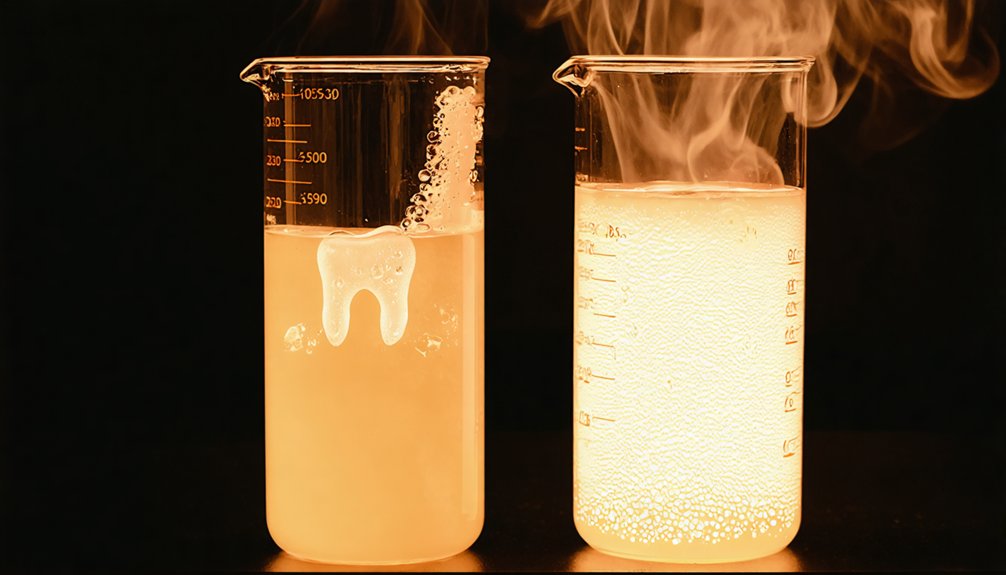
Beyond chemistry alone, light and heat activation fundamentally alter how quickly peroxide breaks down into reactive oxygen molecules.
When you apply light activation to gels ranging from 16% to 44% concentration, you accelerate the decomposition rate, driving oxidation deeper into enamel within a compressed timeframe.
Laser systems specifically amplify high-concentration bleach reactions, shortening session duration without sacrificing whitening depth.
Heat application works similarly by energizing hydrogen peroxide molecules, reducing the contact time you’d otherwise need to achieve equivalent results.
Professional heat technology paired with peroxide formulations lets you control treatment intensity precisely.
Both methods give you measurable efficiency gains—faster reactive oxygen release, reduced chair time, and more predictable shade outcomes—making them essential variables when optimizing your whitening protocol beyond concentration alone.
Is Higher Concentration Whitening Actually Safe?
When you use hydrogen peroxide concentrations up to 40%, you can do so safely in a professional clinical setting, provided your dentist applies strict isolation protocols like a dental dam to protect soft tissues.
The ADA establishes specific concentration thresholds and application guidelines that govern both in-office and at-home whitening products, ensuring you stay within evidence-based safety margins.
You’ll find that shorter high-concentration exposures carry less risk than prolonged low-dose applications, making professional supervision critical when working with formulations above 18% hydrogen peroxide.
Professional Setting Safety Protocols
Although higher peroxide concentrations raise legitimate safety concerns, professional protocols directly mitigate those risks through controlled application methods.
When you undergo in-office treatment, clinicians apply dental dams to isolate gingival tissue, preventing chemical burns from 35–40% hydrogen peroxide formulations. These safety measures guarantee precise gel placement exclusively on enamel surfaces.
Professional standards require monitoring exposure durations, typically limiting high-concentration contact to 15–30 minutes per session. You benefit from trained oversight that immediately addresses sensitivity responses.
Clinicians neutralize active peroxide upon session completion, halting oxidation before tissue damage occurs.
Light-activation systems further reduce necessary contact time, minimizing cumulative exposure.
Combined with ADA-compliant concentration guidelines, professional environments convert potentially hazardous formulations into controlled, predictable whitening protocols that prioritize both efficacy and tissue integrity.
ADA Concentration Guidelines
The ADA’s concentration guidelines directly answer whether higher-concentration whitening is safe by establishing formulation-specific thresholds tied to clinical evidence.
ADA recommendations separate professional and over-the-counter applications by concentration limits that reflect risk-to-efficacy ratios. You can use up to 40% hydrogen peroxide professionally with proper isolation protocols, including dental dam placement and soft tissue protection.
Over-the-counter formulations fall under considerably lower thresholds, restricting consumer access to higher-reactivity agents. These limits aren’t arbitrary—they’re anchored in oxidative exposure data measuring enamel integrity and pulpal response.
When you operate within ADA-defined concentration limits, you’re leveraging the highest clinically validated efficacy without exceeding documented safety margins.
Exceeding those thresholds without professional oversight introduces sensitivity risk and potential enamel degradation that no whitening outcome justifies.
What Peroxide Concentration Should You Use for Your Goals?
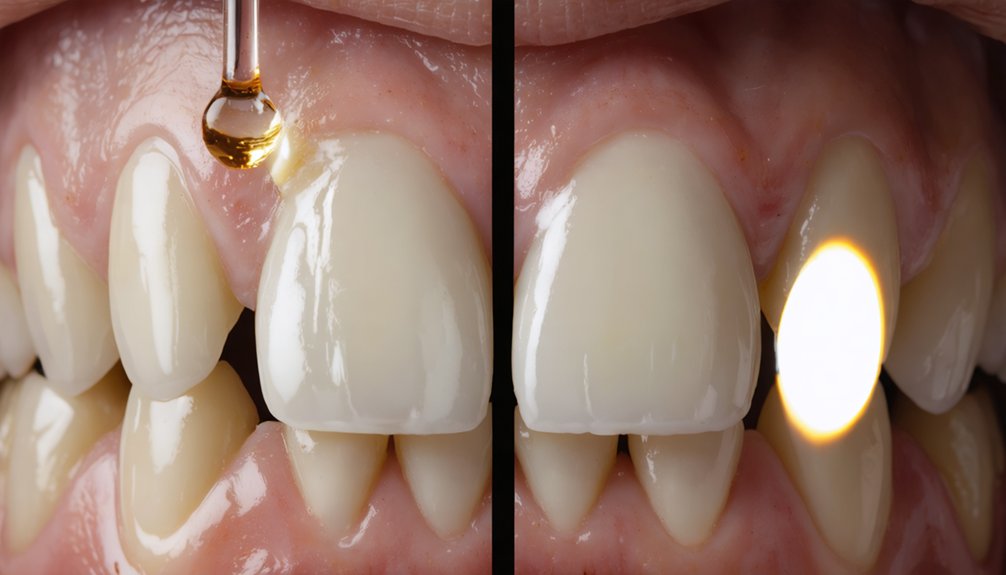
Choosing the right peroxide concentration depends entirely on your whitening timeline, sensitivity threshold, and desired shade outcome.
Peroxide concentration selection hinges on three factors: your timeline, sensitivity tolerance, and target shade result.
For rapid results, 35% hydrogen peroxide delivers 6-8 shades in 15-30 minutes under professional supervision. If your whitening goals prioritize gradual improvement with minimal sensitivity, 10-16% carbamide peroxide outperforms higher concentrations after one week of consistent use.
Your peroxide choices should also factor in application duration—longer sessions with lower concentrations penetrate enamel more deeply than brief high-concentration exposures.
For express in-office whitening, 25% hydrogen peroxide balances speed with patient tolerance effectively.
At-home users benefit most from 6% hydrogen peroxide over two weeks, surpassing single 40% in-office sessions in cumulative effectiveness.
Match concentration to your specific clinical outcome, not merely to treatment speed.
Frequently Asked Questions
Can Higher Peroxide Concentrations Permanently Damage Tooth Enamel Over Time?
Yes, you can damage enamel permanently with misuse. Prioritize sensitivity mitigation by limiting exposure time. Professional-grade enamel restoration protocols and ADA-approved concentrations let you control outcomes, preventing structural degradation while achieving effective, lasting whitening results safely.
How Soon Does Tooth Color Relapse After High-Concentration Whitening Treatments?
After high-concentration whitening, you’ll notice color relapse beginning within weeks. High-concentration formulations accelerate reversal due to shorter treatment duration, so managing tooth sensitivity and scheduling maintenance sessions lets you control long-term results effectively.
Does Carbamide Peroxide Cause Less Sensitivity Than Hydrogen Peroxide at Equivalent Strengths?
Yes, carbamide peroxide’s slower release reduces your sensitivity risk compared to hydrogen peroxide at equivalent strengths. In this sensitivity comparison, you’ll find its gradual breakdown optimizes peroxide effectiveness while minimizing nerve irritation, giving you greater formulation control.
Can Lower Peroxide Concentrations Achieve the Same Shade Improvement as Higher Ones?
Yes, you can achieve equivalent shade improvement with lower concentrations by extending application time. Lower concentration whitening mechanisms compensate through prolonged oxidation exposure, as concentration effects show 6% hydrogen peroxide outperforms 35% with extended contact.
How Many Whitening Sessions Are Needed Before Results Become Visibly Noticeable?
Like flipping a switch, you’ll notice visible results after just one session with 35% hydrogen peroxide. Your whitening frequency determines depth—lower concentrations need multiple sessions, but you’re achieving ΔE* >13.0 within one week regardless.
References
- https://pmc.ncbi.nlm.nih.gov/articles/PMC3894761/
- https://www.laserglowspa.com/blogs/news/teeth-whitening-gel-strength-guide
- https://gloscience.com/blogs/blog/what-is-carbamide-peroxide
- https://www.medicalnewstoday.com/articles/326148
- https://www.youtube.com/watch?v=ExAqwfUk36A
- https://www.gentledental.com/resources/articles/hydrogen-peroxide-teeth-whitening
- https://www.healthline.com/health/hydrogen-peroxide-teeth-whitening
- https://www.atlanticdentalcare.net/our-blog/what-is-the-best-way-to-whiten-teeth
- https://pmc.ncbi.nlm.nih.gov/articles/PMC9961799/