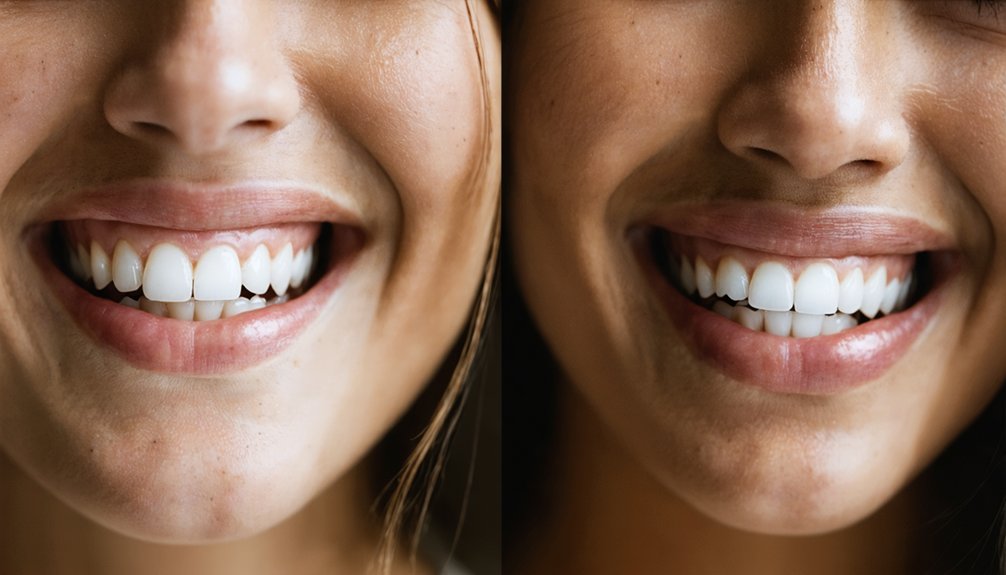
You can boost your confidence markedly by choosing the right teeth whitening technique for your needs. Whitening agents like hydrogen peroxide break down stain-causing molecules, lifting discoloration from your enamel and dentin layers. Whether you opt for professional in-office treatments, custom trays, or natural remedies like baking soda, each method delivers measurable results. Whiter teeth reduce social anxiety, sharpen your first impressions, and can even make you appear years younger. The details ahead will change how you approach your smile entirely.
Key Takeaways
- Teeth whitening reduces social anxiety and boosts confidence by improving self-image perception, making personal and professional interactions noticeably easier.
- In-office whitening treatments using concentrated hydrogen peroxide deliver immediate results within 30 to 60 minutes for maximum confidence impact.
- At-home options like whitening strips and custom trays offer flexible, cost-effective solutions for gradually enhancing smile aesthetics.
- Whiter teeth can make a person appear up to five years younger, commanding positive first impressions and social leverage.
- Maintaining whitening results requires consistent brushing, professional cleanings, touch-up treatments, and avoiding tobacco and stain-causing foods.
How Teeth Whitening Agents Actually Work
When it comes to teeth whitening, the chemistry behind it’s surprisingly straightforward. Whitening agents like hydrogen peroxide and carbamide peroxide penetrate your enamel and trigger chemical reactions that break down the molecular bonds causing discoloration.
During oxidation, oxygen molecules release and lift stain particles directly from your enamel and dentin layers.
You control the intensity of results by choosing between in-office treatments, which use higher peroxide concentrations for dramatic single-session changes, or at-home products that rely on lower concentrations requiring consistent application over several weeks.
Understanding these chemical reactions puts you in command of your whitening journey. You’re not guessing — you’re making informed decisions about concentration levels, application times, and treatment methods that align precisely with the results you want to achieve.
In-Office Whitening Treatments Worth the Cost
Once you understand how whitening chemistry works, the logical next step is putting that chemistry to work under professional supervision for maximum impact.
In-office techniques deliver concentrated hydrogen peroxide solutions—applied for 30 to 60 minutes—producing dramatic shade changes in a single session.
Laser whitening accelerates peroxide activation using light energy, compressing weeks of at-home effort into one controlled appointment.
Power bleaching offers comparable speed with high-concentration peroxide formulations.
Treatment costs average around $600, but consider what you’re purchasing: precision application, gum protection through professional barrier gels, and clinically verified results.
The $600 price tag buys precision, protection, and clinically verified results—not just whiter teeth.
You’re not paying for convenience alone—you’re investing in a controlled environment where concentration levels and exposure times are calibrated specifically for your enamel.
That level of control justifies the cost entirely.
Natural Whitening Remedies That Actually Deliver
Not every effective whitening solution requires a dentist’s chair or a prescription-strength gel. Natural ingredients like baking soda, hydrogen peroxide, and activated charcoal deliver effective results when you apply them correctly. A 2017 JADA review confirmed baking soda’s efficacy as a mild abrasive, and combining it with diluted hydrogen peroxide enhances stain removal through targeted application methods.
However, safety concerns matter. Lemon juice and apple cider vinegar risk enamel erosion with repeated use, and long-term effects from improper application can outweigh short-term gains. User experiences consistently show that disciplined, sparing use produces better outcomes than aggressive daily treatments.
Cost comparisons favor these remedies considerably over professional procedures. Ingredient analysis confirms that when used correctly, these accessible options give you measurable whitening control without compromising structural integrity.
Best At-Home Teeth Whitening Options Ranked
When it comes to at-home whitening, you’ve got three primary options worth considering: whitening strips, custom trays, and natural remedies.
Whitening strips offer a flexible, peroxide-coated solution you can apply daily, while custom trays filled with professional-grade gel deliver more targeted, effective results.
If you prefer a chemical-free route, natural alternatives like baking soda or activated charcoal can reduce surface stains, though they’re less potent than peroxide-based treatments.
Whitening Strips Explained
Whitening strips rank among the most accessible and effective at-home options you’ll find on the market today. These flexible plastic strips carry a thin peroxide-based gel layer that adheres directly to your enamel, targeting discoloration at the molecular level for measurable whitening effectiveness.
Your application techniques determine your results. Press each strip firmly against your teeth, ensuring full contact across the enamel surface while avoiding overlap onto your gums. Most strips require daily sessions lasting 30 minutes over one to two weeks. Consistent adherence to the schedule drives oxidation deeper into stain particles, accelerating visible improvements.
You control your outcome by choosing strips with higher peroxide concentrations and following manufacturer guidelines precisely. Skipping sessions weakens cumulative results, so treat each application as a non-negotiable step in your whitening protocol.
Custom Tray Benefits
Custom trays deliver a level of precision that no over-the-counter strip or prefilled tray can match. Your dentist takes an exact mold of your teeth, ensuring the whitening gel contacts every surface evenly without pooling or gaps.
That precision fit eliminates uneven results and minimizes gum exposure to peroxide, reducing irritation considerably.
You’ll fill the custom tray with professional-grade gel and wear it on your schedule, giving you full control over treatment intensity and timing.
That custom tray convenience means you’re not locked into rigid prefilled designs that compromise contact quality.
The gel concentration in dentist-provided trays also exceeds what retail products offer, accelerating visible results.
If you’re serious about achieving consistent, lasting whiteness, custom trays represent the most targeted and effective at-home investment available.
Natural Remedy Options
Natural remedies occupy a unique space in teeth whitening because they’re accessible, affordable, and free of the synthetic chemicals found in commercial products. You can harness simple ingredients to gradually lift surface stains while maintaining control over what contacts your enamel.
- Baking soda acts as a mild abrasive, gently scrubbing away discoloration without aggressive chemical intervention.
- Activated charcoal binds directly to stain molecules, pulling impurities from your enamel’s surface during each application.
- Diluted hydrogen peroxide penetrates surface deposits but requires careful dilution to prevent tissue irritation.
- Apple cider vinegar, while effective against stains, demands sparing use to avoid irreversible enamel erosion.
Use these options strategically, not impulsively. Overuse converts a beneficial routine into a damaging one, undermining the results you’re working to achieve.
Which Method Fits Your Budget and Sensitivity?
Choosing the right whitening method ultimately comes down to two critical factors: your budget and your tooth sensitivity.
If you’re working within tight budget considerations, over-the-counter strips or whitening toothpaste deliver measurable results at minimal cost. Custom trays with professional-grade gel offer a mid-range investment with stronger outcomes. In-office treatments run approximately $600 but produce dramatic, immediate results.
Sensitivity levels directly determine which concentration of peroxide you can tolerate. If you experience heightened sensitivity, lower-concentration at-home products applied gradually are your safest option. Higher peroxide concentrations used in professional settings work faster but may intensify discomfort.
You control the outcome by matching method intensity to your physiological tolerance. Assess both variables honestly before committing, and you’ll select a whitening strategy that delivers results without unnecessary setbacks.
The Confidence Benefits of a Whiter Smile

When you achieve a brighter smile, you’re directly investing in your self-esteem, as studies consistently link whiter teeth to measurable increases in confidence.
You’ll find that social anxiety decreases notably, allowing you to engage more freely in both personal and professional interactions without self-consciousness.
Beyond social ease, a whiter smile can make you appear up to five years younger, restoring a youthful aesthetic that reinforces your overall quality of life.
Smiling Boosts Self-Esteem
Confidence is one of the most immediate rewards of a whiter smile, and the research behind it’s compelling. Smile psychology confirms that your self image perception shifts measurably when you eliminate visible discoloration. You’re not imagining the difference—clinical data backs it.
- You appear up to five years younger, instantly reshaping how others perceive you.
- Your anxiety in social settings drops, letting you engage conversations without hesitation.
- You project authority in professional interactions, influencing outcomes before you speak.
- Your overall quality of life improves as dental aesthetics align with your self-expectations.
These aren’t passive outcomes. You control your smile, and by extension, you control the confidence you bring into every room.
Whitening isn’t vanity—it’s a strategic investment in your personal presence.
Social Anxiety Decreases
Beyond self-esteem, whitening directly targets a specific psychological barrier—social anxiety. Clinical data confirms that improved dental aesthetics measurably reduce self-consciousness during social interactions.
When you’re confident in your smile, you stop filtering yourself—you speak more freely, engage more directly, and project authority rather than uncertainty.
Anxiety reduction isn’t incidental here; it’s a documented psychological outcome. Studies show individuals with whiter teeth experience considerably less apprehension in professional and personal settings.
You’re no longer preoccupied with how others perceive your smile, which frees your cognitive focus for actual communication.
That shift in mental bandwidth is powerful. Whitening doesn’t just change how others see you—it changes how you operate within every interaction, giving you measurable control over your social confidence.
Youthful Appearance Restored
A brighter smile doesn’t just improve aesthetics—research shows it can make you appear up to five years younger. Your smile transformation directly influences how others perceive your age and energy.
Reclaim that youthful glow by understanding exactly what whitening achieves:
- Reduced visual aging: Whiter teeth counteract the dullness that accumulates over years of dietary staining.
- Sharper facial contrast: Bright teeth draw attention upward, minimizing the appearance of fine lines.
- Renewed vibrancy: A luminous smile signals health and energy, qualities strongly associated with youth.
- Commanding first impressions: People unconsciously associate white teeth with energy, giving you immediate social leverage.
You control how age presents itself.
Strategic whitening doesn’t merely clean—it actively repositions your appearance, restoring confidence you’d assumed was permanently lost to time.
How to Make Your Teeth Whitening Results Last Longer
Once you’ve achieved your desired level of whiteness, maintaining those results requires consistent, deliberate habits.
Your teeth maintenance routine should include brushing twice daily with fluoride toothpaste and scheduling regular professional cleanings.
Control your whitening frequency by applying touch-up treatments every six months to two years, depending on your lifestyle habits.
Actively eliminate stain-causing culprits like coffee, red wine, and berries from your daily intake, or rinse immediately after consuming them.
Stain-causing foods like coffee and red wine are your smile’s worst enemies—eliminate them or rinse immediately after.
You should also avoid tobacco products, which accelerate discoloration greatly.
When you commit to these targeted behaviors, you extend your results well beyond the average timeframe.
Every deliberate choice you make directly determines how long your brighter smile remains visible, giving you complete control over your dental aesthetics.
Frequently Asked Questions
Can Teeth Whitening Affect Existing Dental Crowns, Veneers, or Fillings?
Over 60% of restorations don’t respond to whitening agents. Teeth whitening won’t change your crowns or veneers, creating shade mismatches. You’ll need veneer maintenance and monitor crown sensitivity, since whitening only affects natural enamel.
At What Age Is Teeth Whitening Considered Safe for Teenagers?
You should wait until age 14-16 before considering teenage suitability for whitening methods, as enamel’s still developing earlier. Consult your dentist to identify safe, controlled options that protect your maturing teeth effectively.
How Does Pregnancy Affect the Safety of Teeth Whitening Treatments?
During your delicate journey, you should avoid teeth whitening treatments entirely. Pregnancy precautions demand it—hormonal changes heighten sensitivity, and peroxide chemicals may pose unverified risks to your developing baby. Consult your dentist before proceeding.
Can Certain Medications Cause Teeth Discoloration That Whitening Cannot Fix?
Yes, certain medication types can cause deep intrinsic discoloration causes that whitening can’t fix. Tetracycline antibiotics and antihypertensives embed stains within dentin, requiring veneers or bonding to restore your smile’s brightness effectively.
Does Teeth Whitening Have Any Long-Term Effects on Enamel Strength?
Overusing whitening treatments can cause enamel erosion, weakening your teeth’s protective layer. You’ll safeguard your enamel’s strength by controlling whitening frequency, spacing sessions appropriately, and using dentist-recommended concentrations to achieve lasting brightness without compromising structural integrity.
References
- https://pmc.ncbi.nlm.nih.gov/articles/PMC12330114/
- https://www.myvalleyviewdental.com/can-teeth-whitening-improve-self-confidence/
- https://dentalcarefree.com/blogs/Teeth-Whitening-Treatments–A-Pathway-to-Higher-Self-Esteem.html
- https://www.grandcentraldentistry.com/say-cheese-how-teeth-whitening-can-boost-your-confidence-and-self-esteem/
- https://www.aarp.org/health/conditions-treatments/teeth-whitening/
- https://thebeautyholic.com/how-teeth-whitening-can-give-your-confidence-a-kick/
- https://montgomeryparkdentalcare.com/dentist/brighten-your-smile-boost-your-confidence-the-psychological-power-of-teeth-whitening/
- https://www.lavaansmile.com/blog/investing-in-your-confidence
- https://www.drsilmansmilespa.com/how-white-teeth-can-make-you-feel-more-confident-every-day
- https://www.addentistry.com/uncategorized/how-teeth-whitening-can-boost-your-confidence-and-oral-health/