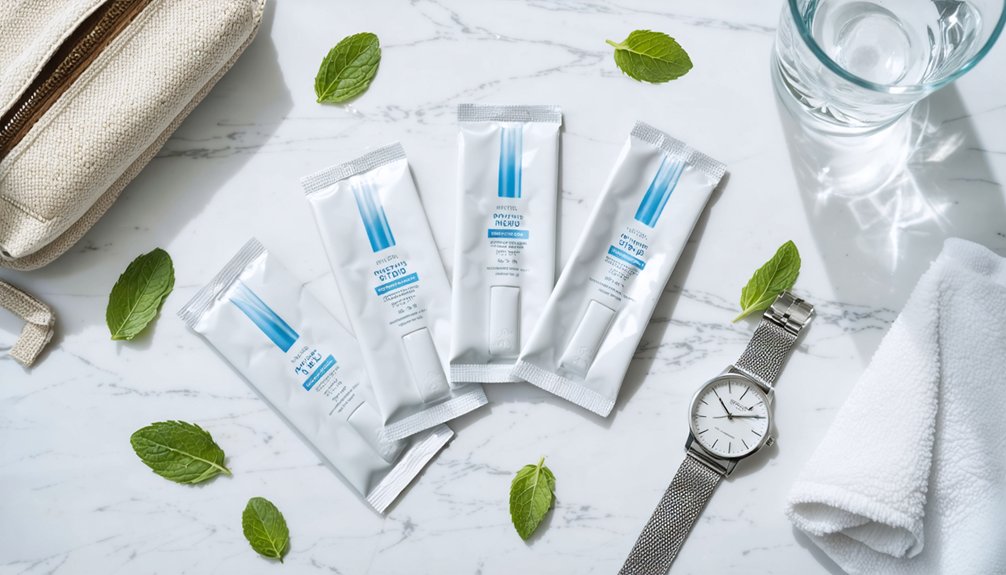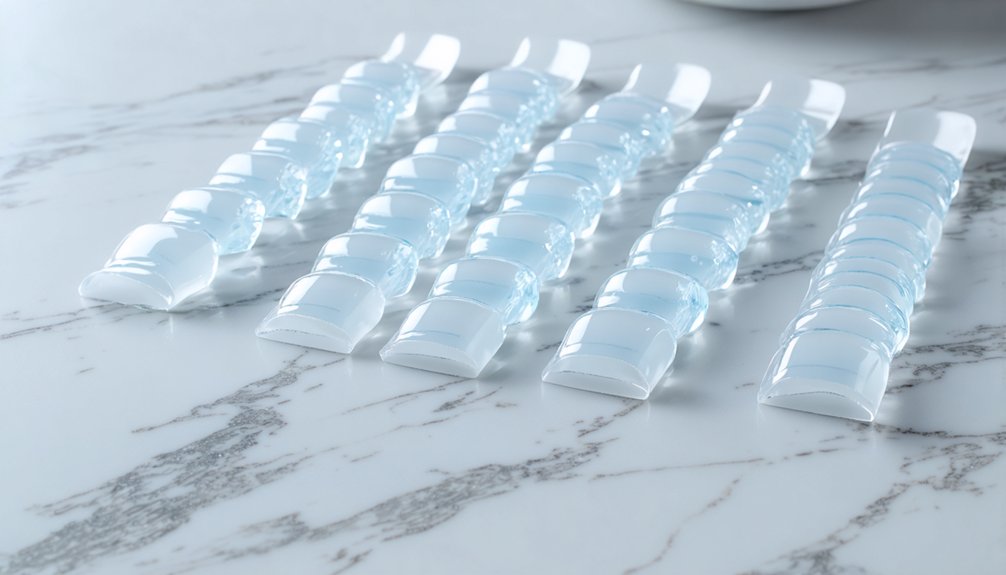
For stubborn teeth stains, you’ll need peroxide-based strips that penetrate beyond surface enamel to oxidize embedded chromogens at the dentin level. Lumineux leads as the #1 dentist-approved option, while Crest 3DWhitestrips deliver deep intrinsic stain removal. LED-accelerated kits enhance bleaching efficacy, and sensitive formulas like Rembrandt reduce nerve irritation without sacrificing results. Proper application technique and supplementary tools like whitening pens and hydrogen peroxide floss close the coverage gaps strips alone can’t reach. The full breakdown ahead covers everything you need.
Key Takeaways
- Crest 3DWhitestrips effectively target deep intrinsic stains by delivering hydrogen peroxide or carbamide peroxide directly into dentin.
- LED whitening kits, like Crest 3D Professional Express, accelerate peroxide penetration for faster removal of stubborn stains.
- Lumineux is the #1 dentist-approved whitening strip on Amazon, combining natural oils with active whitening agents.
- Auraglow features nano-hydroxyapatite for simultaneous whitening and enamel remineralization, ideal for frequent users managing recurring stains.
- Sensitive users should choose lower-peroxide formulas like Rembrandt 1 Week Whitening Kit, containing potassium nitrate for nerve desensitization.
Lumineux: Best Overall Whitening Strip for Stubborn Stains
Lumineux holds the #1 spot among dentist-approved whitening strips on Amazon in 2025, making it the strongest at-home option for stubborn stains. Unlike competitors relying solely on harsh peroxides, Lumineux integrates natural remedies like coconut oil and sage oil alongside its active whitening agents, reducing irritation while targeting discoloration effectively.
Your dietary habits directly influence treatment outcomes. Coffee, tea, and wine accelerate stain accumulation, so pairing Lumineux with disciplined consumption timing maximizes your results.
Apply strips with firm fingernail pressure between teeth to ensure full contact with stained surfaces. Keep coverage within visible tooth boundaries to prevent gum sensitivity.
For sustained whitening, combine Lumineux with whitening mouthwash and hydrogen peroxide-dipped floss to address interproximal staining that strips alone can’t fully penetrate.
Crest 3DWhitestrips: Top Pick for Intrinsic Stains
While Lumineux addresses surface-level discoloration effectively, intrinsic stains—those embedded within the dentin layer—demand a more targeted clinical approach, and that’s where Crest 3DWhitestrips outperforms standard brushing alone.
Unlike natural remedies or alternative treatments, which lack penetrating agents, Crest 3DWhitestrips delivers hydrogen peroxide or carbamide peroxide directly to compromised enamel, breaking down chromogens at the dentin level.
Crest 3DWhitestrips penetrates where natural remedies cannot, delivering peroxide directly to break down deep chromogens.
You’ll achieve ideal results by pressing the strip firmly between teeth using a fingernail, ensuring the bleaching gel contacts stained surfaces fully.
Keep coverage within visible tooth boundaries—extending onto gum tissue triggers sensitivity.
For maintenance, apply once monthly alongside nightly flossing and biannual professional cleanings.
This protocol gives you measurable, reproducible whitening outcomes that no natural remedy or alternative treatment can consistently replicate.
Crest 3D Professional Express: Best LED Whitening Kit
If you’re targeting stubborn intrinsic stains, the Crest 3D Whitestrips Professional Express White + Whitening Light Dental Whitening Kit ranks as the top LED light whitening product for 2026.
The included LED light accelerates the hydrogen peroxide bleaching gel’s penetration, enhancing its efficacy against deep discoloration beyond what standard strips achieve.
You’ll apply the strips for 30 minutes daily over four consecutive days, then maintain results with monthly applications paired with nightly flossing.
LED Light Whitening Benefits
Adding an LED light component to your whitening routine delivers measurably faster results, and the Crest 3D Whitestrips Professional Express White + Whitening Light Dental Whitening Kit stands as the top-ranked LED whitening kit for 2026.
The LED technology accelerates peroxide activation, intensifying the bleaching reaction against stubborn intrinsic stains that standard strips address more slowly. You’re fundamentally compressing treatment time without sacrificing efficacy.
The whitening benefits extend beyond surface discoloration, targeting deeper chromogenic compounds embedded within enamel.
Pairing the light device with hydrogen peroxide-infused strips creates a dual-action mechanism that outperforms strips alone.
For maximum precision, guarantee full strip adhesion before activating the light, keep coverage within visible tooth boundaries, and maintain consistent daily application intervals to sustain controlled, cumulative results.
Stubborn Intrinsic Stain Removal
Intrinsic stains penetrate beyond the enamel surface, embedding chromogenic compounds within the dentin layer that standard brushing can’t reach. Unlike extrinsic discoloration addressed through diet adjustments or natural remedies like oil pulling, intrinsic staining requires targeted peroxide-based intervention.
Crest 3DWhitestrips delivers carbamide or hydrogen peroxide directly against the tooth surface, diffusing bleaching agents through enamel into dentin to oxidize embedded chromogens at their source. You need consistent application—strips conforming snugly to each tooth’s contour—to guarantee the active gel maintains sufficient contact time for molecular breakdown.
Standard whitening toothpastes lack the chemical penetration depth to address intrinsic discoloration. Crest 3DWhitestrips gives you the clinical-grade mechanism necessary to systematically disrupt dentin-level stain compounds that superficial treatments consistently fail to eliminate.
Application And Usage Protocol
Crest 3D Professional Express pairs peroxide-based whitening strips with an LED accelerator light to amplify bleaching efficacy beyond standard strip protocols. You’ll apply upper and lower strips for 30 minutes daily across four consecutive days, then maintain weekly.
Press each strip firmly between teeth using a fingernail to maximize peroxide contact on stubborn stains.
- Place strips at the gumline boundary, avoiding gum extension to prevent sensitivity
- Activate the LED light immediately after strip placement for full accelerator benefit
- Follow diet tips: avoid coffee, tea, and pigmented foods 48 hours post-treatment
- Maintain oral hygiene by rinsing after removal and incorporating whitening mouthwash
This structured protocol ensures measurable stain reduction while preserving enamel integrity through controlled peroxide exposure and disciplined post-treatment dietary management.
Zimba Whitening Strips: Best Value for Deep Stain Removal
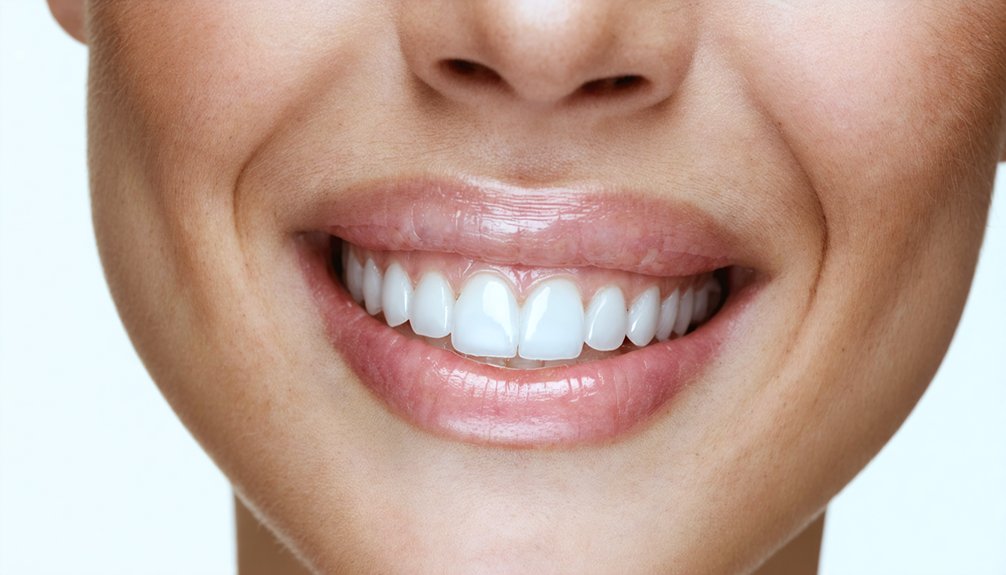
Zimba Whitening Strips deliver 3 core advantages that make them the best-value option among tested at-home whitening products: effective peroxide-based gel formulation, competitive pricing, and consistent stain removal results.
Unlike natural remedies or alternative treatments that lack clinical validation, Zimba uses hydrogen peroxide gel embedded in flexible strips that adhere directly to enamel surfaces, targeting both surface discoloration and deeper extrinsic stains.
You’ll apply strips using the standard protocol: position at the gumline, press firmly between teeth with a fingernail, and maintain contact for the full duration. Avoid gum overlap to minimize sensitivity.
Pair Zimba strips with whitening toothpaste and hydrogen peroxide-dipped floss to address interproximal staining that strips partially miss. This combination maximizes your stain removal outcomes while controlling treatment costs effectively.
Rembrandt 1 Week Kit: Best Strips for Sensitive Teeth
Rembrandt’s 1 Week Whitening Kit ranks as the top formulation specifically engineered for sensitive teeth, distinguishing itself from standard peroxide-heavy strips through a sensitivity-optimized bleaching gel that reduces enamel irritation without sacrificing stain removal efficacy.
Rembrandt’s 1 Week Whitening Kit leads sensitivity-focused formulations, delivering effective stain removal without the enamel irritation of standard peroxide strips.
You’ll achieve measurable whitening within seven days while maintaining your dental hygiene protocol without discomfort.
Key clinical advantages include:
- Reduced peroxide concentration minimizes tubular sensitivity while still penetrating extrinsic stain layers
- Stain prevention compatibility allows concurrent use with whitening toothpaste without compounding irritation
- Flexible strip adhesion ensures snug contact across tooth surfaces without gum extension
- Short application windows decrease cumulative enamel exposure per session
You control the whitening timeline precisely.
This kit delivers targeted stain elimination without compromising enamel integrity or disrupting your existing dental hygiene regimen.
Auraglow: Best nHAp Formula for Enamel-Safe Whitening
Auraglow ranks #4 among Amazon’s top whitening strips and distinguishes itself through its nHAp (nano-hydroxyapatite) formulation, which actively remineralizes enamel during the whitening process rather than solely degrading stain chromogens.
This dual-action mechanism addresses a critical trade-off: conventional peroxide strips prioritize stain penetration while potentially compromising enamel integrity over repeated applications. Auraglow’s nHAp particles deposit calcium and phosphate ions into enamel microporosities simultaneously, providing structural enamel protection that standard formulations don’t offer.
You’re getting measurable whitening alongside mineral reinforcement rather than choosing between the two outcomes. For users managing recurring stains who require frequent strip applications, this formulation reduces cumulative enamel stress.
If enamel preservation is a clinical priority alongside stain elimination, Auraglow’s chemistry delivers a structurally sound approach.
How to Apply Whitening Strips for Maximum Stain Coverage
Proper strip placement determines whether you achieve full stain coverage or leave critical areas undertreated. Strategic application drives effective color correction and maximizes stain removal across all tooth surfaces.
Follow this evidence-based application protocol:
- Center placement first: Align the strip at each tooth’s midpoint, then press outward toward edges.
- Inter-proximal pressure: Use a fingernail to push the strip between teeth, targeting stain accumulation zones.
- Gum boundary control: Keep strips within visible tooth margins—gum contact triggers sensitivity without improving results.
- Snug contact maintenance: Press firmly across the entire strip surface to eliminate air gaps that reduce gel penetration.
Maintain consistent contact throughout the full application window.
Compromised adhesion directly undermines bleaching gel effectiveness, leaving intrinsic stains partially treated and requiring additional correction cycles.
How to Use Whitening Strips Without the Tooth Sensitivity
To minimize sensitivity, you must guarantee your strips don’t extend onto gum tissue, as gum contact is the primary trigger for irritation during whitening.
If you’re prone to sensitivity, choose a formula specifically designed for sensitive teeth, such as the Rembrandt 1 Week Whitening Kit, which delivers effective results with a lower-irritation formulation.
You should also limit application frequency, spacing out treatments rather than applying strips daily, to give your enamel adequate recovery time between sessions.
Avoid Gum Coverage
One of the most critical application rules for minimizing whitening strip sensitivity is keeping the strip within the boundaries of your visible teeth and off your gum tissue entirely. Gum coverage triggers chemical irritation from peroxide contact, making sensitivity prevention dependent on precise placement.
Follow these technical guidelines:
- Align the strip’s lower edge flush with your gumline, not overlapping it
- Trim excess strip material if your tooth-to-gum ratio requires adjustment
- Press firmly against enamel surfaces only, using a fingernail to secure edges
- Recheck positioning at the 5-minute mark to correct any upward migration
Peroxide gel that contacts soft tissue causes localized inflammation and heightened nerve response. You control this outcome entirely through deliberate, anatomically accurate strip placement before each session begins.
Choose Sensitive Formulas
Precise placement protects your gums, but strip formula selection directly determines whether your enamel and dentin tolerate repeated peroxide exposure without hypersensitivity responses. Lower peroxide concentrations reduce tubular fluid movement within dentin, minimizing nerve stimulation during treatment cycles.
Prioritize enamel protection by selecting formulas with potassium nitrate or fluoride, which desensitize nerve endings and remineralize enamel post-application.
Rembrandt’s 1 Week Whitening Kit remains the clinically recommended option for sensitivity-prone users.
If you’re seeking natural remedies as adjunctive support, hydroxyapatite-containing formulas like Auraglow’s nHAp variant offer biomimetic remineralization without peroxide-induced irritation.
You should also space applications strategically—daily consecutive use amplifies sensitivity risk.
Matching formula potency to your enamel’s current tolerance threshold, rather than defaulting to maximum-strength strips, produces consistent whitening outcomes without compromising structural integrity.
Limit Application Frequency
Overuse of whitening strips compresses peroxide exposure into intervals too short for dentin recovery, amplifying tubular fluid disruption and nerve hypersensitivity. You’ll protect both enamel integrity and long-term cost considerations by adhering to evidence-based protocols rather than accelerating treatment cycles.
Follow these clinically supported frequency guidelines:
- Apply upper and lower strips for 30 minutes daily across four consecutive days, then shift to weekly maintenance.
- Use once-monthly Crest strip applications combined with nightly flossing and biannual professional cleanings to sustain results.
- Avoid consecutive daily use beyond manufacturer-specified windows, as cumulative peroxide load exceeds dentin’s buffering capacity.
- Reduce environmental impact by minimizing strip waste through disciplined scheduling rather than reactive overuse.
Controlled frequency maximizes whitening efficacy while preserving structural integrity, giving you measurable outcomes without unnecessary biological or material cost.
How Long Should You Wear Whitening Strips for Best Results?
Wearing whitening strips for the correct duration directly determines whether you’ll achieve meaningful stain removal or risk unnecessary sensitivity. Most standard strips require 30 minutes daily for four consecutive days, followed by weekly maintenance sessions.
Dissolving strip formulations complete their cycle in 15 minutes without requiring removal. Extended overnight application is permissible only if your formulation explicitly supports it.
To maximize results, pair each session with dental flossing using hydrogen peroxide-dipped floss to target interproximal stains strips can’t fully penetrate. Follow applications with teeth polishing using a complementary whitening toothpaste to reinforce surface stain removal.
Never exceed manufacturer-specified durations, as prolonged contact beyond recommended windows increases enamel sensitivity without proportionally improving whitening outcomes. Precision in timing controls both efficacy and safety.
Whitening Pens and Mouthwash That Target Stains Strips Miss
Whitening strips can’t always reach the narrow spaces between teeth, so a whitening pen lets you apply bleaching gel precisely to those missed contact points.
You should swish a whitening mouthwash thoroughly after strip sessions to target residual staining in interproximal and gumline areas.
For deeper between-tooth discoloration, you can dip floss in hydrogen peroxide before flossing to deliver active bleaching agent directly where strips fail to penetrate.
Whitening Pens Fill Gaps
Even the best whitening strips leave two problem zones largely untreated: the tight interproximal spaces between teeth and the gumline margins where strips can’t safely adhere. Whitening pens deliver precise, targeted application exactly where strips fail.
Use a pen’s brush tip to deposit peroxide gel directly between teeth, controlling placement to minimize gum irritation and protect enamel safety at vulnerable margins.
Pens excel in these specific scenarios:
- Targeting contact points strips physically can’t reach
- Spot-treating individual stained teeth without full-strip application
- Applying touch-ups immediately after consuming staining beverages
- Reinforcing gumline margins where strip adhesion would cause sensitivity
Hold your lips open for 30 seconds post-application to allow the gel to set before saliva dilutes the active concentration.
Mouthwash Targets Hidden Stains
Pens handle the interproximal zones, but mouthwash reaches the stain reservoirs strips and pens both miss: lingual surfaces, posterior molars, and the full gingival sulcus margin.
Mouthwash effectiveness depends on your swishing technique—vigorous, directed agitation forces the whitening agent into recessed anatomy that passive rinsing skips entirely. Swish thoroughly for 60 seconds minimum, directing the solution toward posterior surfaces where hidden stain removal is hardest to achieve mechanically.
Hydrogen peroxide-based formulas actively oxidize chromogenic compounds lodged in these anatomical dead zones.
You’re not replacing strips with mouthwash—you’re closing the coverage gap they leave behind. Used consistently after each strip session, whitening mouthwash compounds your cumulative results by targeting the precise surfaces your primary whitening system structurally can’t access.
Hydrogen Peroxide Flossing Benefits
Floss dipped in hydrogen peroxide closes the final coverage gap strips, pens, and mouthwash collectively leave behind: the true interproximal contact zone where enamel surfaces press directly against each other.
This technique delivers oxidizing agents directly where passive methods fail, supporting enamel strengthening through targeted chemical action rather than surface-level natural remedies alone.
Apply this protocol precisely:
- Use 3% hydrogen peroxide solution—higher concentrations risk soft tissue irritation
- Coat 2–3 inches of floss before working through each contact point slowly
- Maintain 10-second dwell time per interproximal space for adequate peroxide penetration
- Follow immediately with plain water rinse to neutralize residual acidity
Consistent execution eliminates stain accumulation at contact zones, giving you complete whitening coverage that no single product category achieves independently.
Frequently Asked Questions
Can Whitening Strips Effectively Remove Stains Caused by Medications or Fluorosis?
natural remedies and lifestyle habits won’t cut it here. Whitening strips can’t effectively remove medication-induced or fluorosis stains—they’re intrinsic. You’ll need professional-grade treatments for real results.
Are Whitening Strips Safe to Use With Dental Veneers, Crowns, or Bonding?
Whitening strips won’t address veneer discoloration or bonding stain removal since peroxide doesn’t penetrate synthetic materials. You’ll only whiten natural enamel, creating uneven color contrast. Consult your dentist before applying strips near restorations.
How Do Whitening Strips Compare in Cost to Professional In-Office Treatments?
Professional in-office treatments cost a universe more, but you’ll achieve comparable results with at-home strips. For cost comparison, strips win decisively. Treatment duration differs—strips require days versus one professional session, yet dentist take-home kits can ultimately prove cheaper long-term.
Can Children or Teenagers Safely Use Whitening Strips for Stubborn Stains?
You shouldn’t use whitening strips for children’s safety concerns, as developing enamel remains vulnerable. Teenager usage isn’t clinically recommended without dentist supervision, since peroxide formulations can cause heightened sensitivity and potential damage to incompletely mineralized teeth.
Do Whitening Strips Work Differently on Natural Teeth Versus Dental Restorations?
Yes, they don’t interact the same way. Whitening strips’ peroxide agents penetrate your natural teeth’s enamel, but they won’t alter dental restorations like crowns or veneers, potentially leaving you with uneven, mismatched color results.
References
- https://crest.com/en-us/oral-care-tips/teeth-whitening/how-to-get-rid-of-stains-on-teeth
- https://www.goodhousekeeping.com/health-products/g28723133/best-at-home-teeth-whitening-products/
- https://www.reddit.com/r/beauty/comments/10w15e7/in_relation_to_teeth_whitening_what_is_best_to/
- https://www.cnet.com/health/personal-care/best-teeth-whitening-strips/
- https://www.nbcnews.com/select/shopping/best-teeth-whitening-strips-rcna201114
- https://www.yahoo.com/lifestyle/articles/10-dentist-approved-strips-teeth-175300534.html
- https://www.vogue.com/article/best-teeth-whitening-strips
- https://www.youtube.com/watch?v=RgFMOMzrjpA