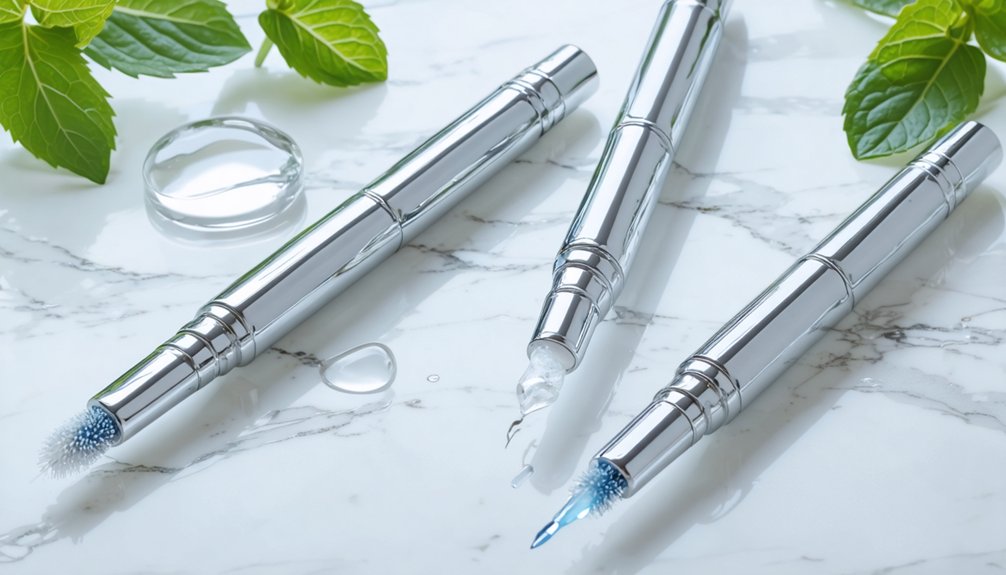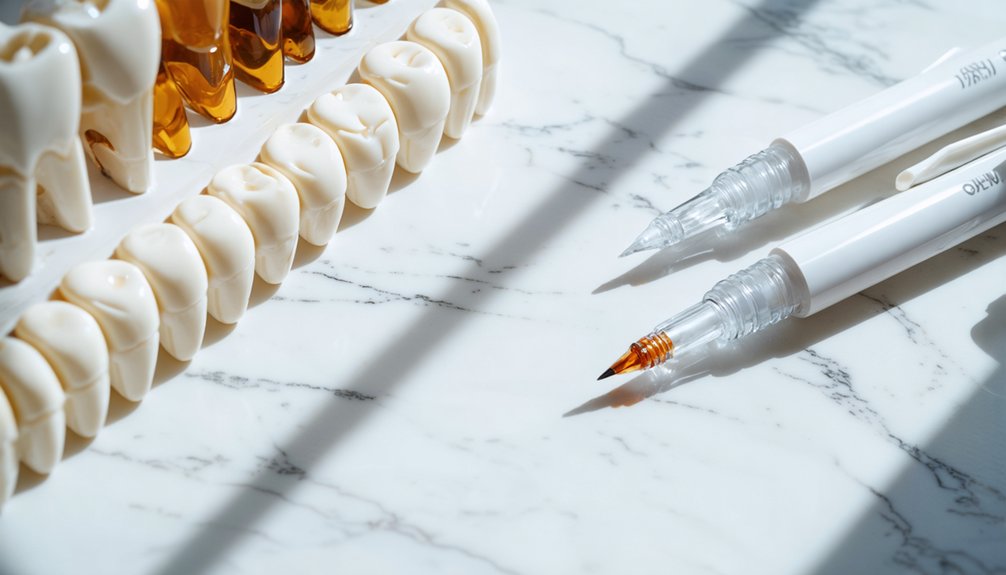
Precision whitening pens deliver targeted bleaching gel directly onto individual stained teeth using a fine applicator tip. They contain hydrogen peroxide or carbamide peroxide as active agents, making them most effective against extrinsic, surface-level stains from coffee, tea, wine, and tobacco. You’ll typically see visible results within 7–14 days of consistent application. They outperform strips and trays when treating specific teeth rather than an entire arch. There’s considerably more to understand about maximizing their effectiveness.
Key Takeaways
- Precision whitening pens deliver targeted bleaching gel directly onto discolored teeth using a fine brush tip for accurate application.
- Active ingredients like hydrogen peroxide or carbamide peroxide break down extrinsic stains from coffee, tea, wine, and tobacco.
- Pens are most effective on surface enamel stains and less effective on intrinsic discoloration from tetracycline or developmental issues.
- Teeth must be thoroughly dry before applying a thin gel layer; avoid food and drinks for 30 minutes after use.
- Consistent daily application over 7–14 days can achieve up to five to eight shades of visible whitening improvement.
What Are Precision Whitening Pens?
Precision whitening pens are pen-style bleaching devices designed to deliver a thin layer of whitening gel to specific teeth rather than the full arch. You use a fine brush or precision tip to place the formula directly onto stained surfaces, giving you targeted control that strips and routine dental hygiene practices can’t always match.
These tools suit crowded, crooked, or visible front teeth where standard applicators miss discoloration. They’re compact enough for on-the-go use and are often positioned as touch-up solutions within broader cosmetic procedures.
Some formulations also claim compatibility with dental restorations, though crowns, caps, and bonds don’t respond to peroxide the same way natural enamel does. Understanding their intended scope helps you apply them where they’ll perform most effectively.
What’s Actually Inside a Precision Whitening Pen: and Does It Work?
Most precision whitening pens rely on either hydrogen peroxide or carbamide peroxide as the active bleaching agent, with some formulas adding potassium nitrate to reduce sensitivity and xylitol for cavity-related oral-care support.
Flavor additives and stabilizing agents influence user compliance, while packaging design supports precise, controlled delivery.
What’s inside determines what you’ll actually achieve:
- Hydrogen peroxide: Fast-acting primary bleaching agent
- Carbamide peroxide: Slower-release alternative with comparable whitening potential
- Potassium nitrate: Targets sensitivity reduction during treatment
- Xylitol: Supports cavity-related oral-care alongside whitening
- Aloe or coconut oil: Comfort-enhancing additives with no whitening function
Results depend on consistent application and formula concentration. Natural enamel responds; restorations don’t.
You control outcomes through frequency, contact time, and product selection.
Which Stains Do Precision Whitening Pens Actually Target?
Stains from coffee, tea, wine, tobacco, soda, and food are the primary targets precision whitening pens are formulated to address. These dietary stains accumulate on enamel surfaces over time, creating visible discoloration that brushing alone doesn’t fully reverse.
Precision pens deliver concentrated peroxide gel directly onto affected areas, allowing you to treat specific teeth rather than applying a blanket approach across your entire arch.
Natural discoloration from aging or enamel thinning responds differently than surface staining, and precision pens work most effectively on extrinsic deposits sitting at or near the enamel surface. They’re not formulated for intrinsic staining caused by tetracycline use or developmental conditions.
Knowing which stain type you’re dealing with helps you determine whether a precision pen will deliver the results you’re targeting.
How Do You Actually Use a Precision Whitening Pen?
Getting the most from a precision whitening pen starts before you apply a single drop of gel. Dry your teeth thoroughly — moisture dilutes the formula and reduces contact efficiency. Twist or click the pen until gel reaches the brush tip, then apply a thin, controlled layer directly onto target surfaces.
- Guarantee teeth are clean before each session
- Apply gel only to natural enamel, not restorations
- Hold your mouth open briefly to let the gel set
- Follow product-specific contact times (30 seconds to 10 minutes)
- Avoid food and drinks for at least 30 minutes post-application
Consistent dental hygiene between sessions maximizes cumulative results. Follow product storage instructions — heat and light degrade peroxide formulas.
Precision matters; sloppy application reduces both efficacy and your control over outcomes.
How Long Before Precision Whitening Pens Show Real Results?
Results vary by product and consistency, but several brands report visible changes within a single course of use. Some formulas claim up to five shades of improvement; others market four to eight shades with consecutive daily application.
Historical context matters here — your baseline shade, shaped by years of dietary habits and environmental impact from staining agents like coffee, wine, and tobacco, directly influences how quickly you’ll see a response.
BURST allows up to twice daily use over seven days. Global White supports a 14-day course. Venus Visage emphasizes consecutive daily application for measurable results.
Sporadic use consistently underperforms scheduled regimens across brands. You’ll get the most accurate read on progress by tracking shade changes against a consistent reference point throughout your chosen treatment window.
When Do Precision Whitening Pens Beat Strips?
If your teeth are crowded or crooked, strips can’t conform to uneven surfaces, leaving stained recesses untreated—precision pens let you place gel exactly where you need it.
You’ll also find the pen more practical than strips when you’re targeting a single discolored tooth or blending visible staining near a crown rather than bleaching your entire arch.
For touch-ups after a full whitening course, a pen gives you control that a strip simply can’t match.
Crooked Teeth Targeting Advantage
For crowded or crooked teeth, precision whitening pens offer a targeting advantage that strips simply can’t match. Strips conform to a relatively flat arch — they miss recessed, rotated, or overlapping surfaces entirely. A precision tip puts gel exactly where you direct it.
Key advantages for irregular dentition:
- Rotated teeth receive direct gel contact on all visible stained surfaces
- Overlapping zones can be traced manually, reducing missed coverage
- Gum sensitivity risk decreases since you control placement and avoid soft tissue
- Recessed teeth that sit behind the arch line become accessible targets
- Cost considerations favor pens for touch-up use rather than full-strip replacement courses
You’re not relying on adhesion or strip tension — you’re applying clinical precision to a structurally inconsistent surface.
Touch-Up Versus Full Application
Whether you need a full whitening course or a targeted touch-up determines which format actually delivers results. Strips cover the full arch uniformly, making them better suited for thorough stain removal across all visible teeth.
Precision pens, however, give you direct control over placement, letting you target isolated discoloration without retreating teeth that don’t need it.
For color matching after dental work or addressing a single stained tooth, pens outperform strips in both accuracy and efficiency.
If you’re maintaining results between whitening sessions, a pen applied to specific surfaces beats reapplying a full strip unnecessarily.
The compact format also supports on-the-go stain removal after coffee or wine.
Use strips to establish your baseline whitening level, then switch to a precision pen to sustain and refine it.
Frequently Asked Questions
Can Precision Whitening Pens Be Used Safely on Dental Restorations?
Over 15% of adults have restorations. You can apply precision whitening pens, but they won’t alter dental material safety or restoration bonding—natural enamel whitens; crowns, caps, and bonds don’t respond the same way.
How Should a Precision Whitening Pen Be Stored Between Uses?
Store your pen capped, upright, and away from heat or direct sunlight. These storage tips protect formula integrity and extend shelf life. You’ll maintain consistent gel viscosity and active ingredient potency between precise, controlled applications.
Are Precision Whitening Pens Safe to Use During Pregnancy or Breastfeeding?
You shouldn’t use precision whitening pens during pregnancy or breastfeeding without consulting your doctor first. Safety concerns exist around ingredient considerations like hydrogen peroxide absorption, and no established evidence confirms these products are risk-free for you or your baby.
Can Children or Teenagers Safely Use Precision Whitening Pens?
Children’s safety and teenagers’ use aren’t confirmed with precision whitening pens. You should consult a dentist before allowing minors to use these products, as no standardized safety data supports their use in developing dentition.
How Do Precision Whitening Pens Compare in Cost to Professional Whitening Treatments?
In any cost comparison, you’ll find precision whitening pens far more budget-friendly than professional treatments. This affordability analysis confirms you’re trading extensive coverage for lower spend, making pens practical for targeted touch-ups rather than full clinical whitening outcomes.
References
- https://www.amazon.com/MySweetSmile-Whitening-Sensitivity-Free-Pocket-Sized-Travel-Friendly/dp/B0B134KRY5
- https://mysweetsmile.com/en-us/products/teeth-whitening-pen
- https://www.youtube.com/watch?v=-tiX9aou0YI
- https://burstoralcare.com/products/precision-whitening-pen
- https://goldapple.sa/19000472919-teeth-whitening-gel
- https://mysweetsmile.com/es/collections/products/products/teeth-whitening-pen
- https://sleekshop.com/products/glorysmile-gel-teeth-whitening-pen.html
- https://www.amazon.com/Venus-Visage-Effective&Painless-Sensitivity-Travel-Friendly/dp/B082X2GSGJ