Hydroxyapatite toothpaste is considered the best for enamel because it’s biomimetically identical to your tooth’s natural mineral composition. It deposits calcium and phosphate directly into demineralized enamel, restoring crystalline structure at a microscopic level. It also occludes dentin tubules, resists acid erosion, and reduces plaque adhesion without harsh abrasives or chemical oxidizers. Unlike conventional toothpaste, it addresses the underlying mineral deficits causing damage. Everything you need to know about how it works is covered ahead.
Key Takeaways
- Hydroxyapatite deposits calcium and phosphate directly into demineralized enamel, rebuilding its crystalline structure at a microscopic level.
- It forms a protective coating that absorbs acid attacks, reducing demineralization and strengthening enamel against dietary and bacterial acids.
- Nano-sized hydroxyapatite particles occlude dentin tubules, blocking nerve stimuli and delivering sustained, measurable sensitivity relief.
- By filling enamel micropores and limiting plaque adhesion, it prevents decay while naturally whitening teeth without abrasive agents.
- As a biocompatible, fluoride-free alternative, it safely supports enamel repair for health-conscious individuals with erosion or cavity concerns.
What Makes Hydroxyapatite Toothpaste Different From Regular Toothpaste?
When you compare hydroxyapatite toothpaste to conventional fluoride or abrasive-based formulas, the core difference lies in its mechanism: rather than simply cleaning or coating teeth, hydroxyapatite actively deposits calcium and phosphate into demineralized enamel, restoring lost mineral structure at the crystalline level. This process drives genuine enamel regeneration, not surface masking.
Regular toothpastes typically rely on fluoride to harden existing enamel or abrasives to polish away stains, but neither replaces lost mineral directly.
Hydroxyapatite’s biocompatibility gives it a structural advantage—it’s the same mineral your enamel is made of, allowing seamless integration into damaged sites. That mineral enhancement translates to measurable improvements in enamel density, surface integrity, and resistance to acid attack, giving you precise, material-level control over your enamel’s condition.
How Hydroxyapatite Toothpaste Actually Rebuilds Damaged Enamel
Understanding that hydroxyapatite replaces lost mineral rather than simply hardening what remains sets the stage for examining the actual repair mechanism.
When acid exposure creates porous, demineralized zones in your enamel, hydroxyapatite particles bind directly to those compromised surfaces and initiate mineral deposition into the damaged lattice. This process drives genuine enamel regeneration rather than surface-level occlusion.
Nano- and micro-crystalline hydroxyapatite particles are small enough to penetrate subsurface lesions, depositing calcium and phosphate where structural loss has already occurred. Research indicates this penetration depth exceeds what fluoride typically achieves, which tends toward surface remineralization.
Over repeated brushing cycles, you’re systematically restoring crystalline structure to weakened enamel, rebuilding integrity at the microscopic level where acid damage originates.
Why Hydroxyapatite Toothpaste Protects Against Acids and Decay
Once hydroxyapatite rebuilds weakened enamel, it doesn’t stop contributing—it forms a crystalline coating that actively defends against subsequent acid attack. This protective layer supports ongoing enamel strengthening by replacing minerals lost during acid exposure, reducing the net mineral loss that drives cavity formation.
When dietary acids or bacterial byproducts contact your teeth, the hydroxyapatite barrier absorbs that chemical assault before it reaches compromised enamel structure.
Research confirms that this mechanism delivers measurable acid resistance, with in vitro and in situ studies documenting reduced demineralization in hydroxyapatite-treated enamel. The smoother surface that results also limits plaque adhesion, cutting off a primary source of acid production at the biofilm level.
You’re not just repairing damage—you’re actively interrupting the cycle that causes it.
How Hydroxyapatite Toothpaste Fills the Gaps Causing Tooth Sensitivity
Tooth sensitivity develops when dentin tubules—microscopic channels running from the enamel surface to the nerve—become exposed through enamel erosion or gum recession, allowing thermal, chemical, and mechanical stimuli to reach the pulp.
Hydroxyapatite toothpaste addresses this directly by occluding those tubules with mineral deposits, physically blocking the pathways that trigger discomfort. Nano-sized hydroxyapatite particles match the scale of tubule openings, enabling precise infiltration rather than surface-level coverage.
Simultaneously, enamel mineralization progresses as hydroxyapatite binds to demineralized zones, restoring structural density and reducing permeability. You’re not masking sensitivity—you’re correcting the underlying mineral deficit that caused it.
Clinical and review evidence identifies tubule occlusion and enamel reinforcement as the two primary mechanisms by which hydroxyapatite delivers measurable, sustained sensitivity reduction.
What the Research Actually Says About Hydroxyapatite Toothpaste
Research on hydroxyapatite toothpaste spans in vitro, in situ, and clinical study designs, and the evidence across all three levels is consistently promising without yet being definitive.
The evidence for hydroxyapatite toothpaste is consistently promising across multiple study designs, though not yet definitive.
Studies confirm that hydroxyapatite engages remineralization mechanisms by depositing calcium and phosphate directly into compromised enamel microstructure, restoring mineral density where acid exposure has created porosity.
Some reviews indicate that nano-hydroxyapatite penetrates demineralized lesions more deeply than fluoride, which literature describes as operating primarily at the surface level.
Comparative data positions hydroxyapatite as equally effective to fluoride in multiple remineralization outcomes.
You’re working with a material that’s biomimetically aligned with enamel composition, giving you a mechanistically sound option.
The evidence base continues to grow, and current findings support its use for early erosion, sensitivity, and caries prevention.
Hydroxyapatite vs. Fluoride: Which Is Better for Enamel?
When comparing hydroxyapatite and fluoride for enamel repair, the distinction isn’t simply about which ingredient is stronger—it’s about how each one works at the structural level.
Fluoride promotes enamel regeneration by converting hydroxyapatite into fluorapatite, a harder compound, but its mineral bonding activity remains largely surface-level.
Hydroxyapatite, by contrast, directly replicates your enamel’s native mineral composition, allowing deeper penetration into demineralized lesions rather than reinforcing only the outer layer.
Reviews indicate hydroxyapatite can match fluoride’s remineralization outcomes in some contexts and may outperform it in early-stage lesion repair.
If you’re prioritizing structural enamel restoration over surface hardening, hydroxyapatite gives you a biomimetic mechanism that works with your tooth’s existing architecture rather than altering its chemical identity.
How Hydroxyapatite Toothpaste Whitens Without Harsh Abrasives
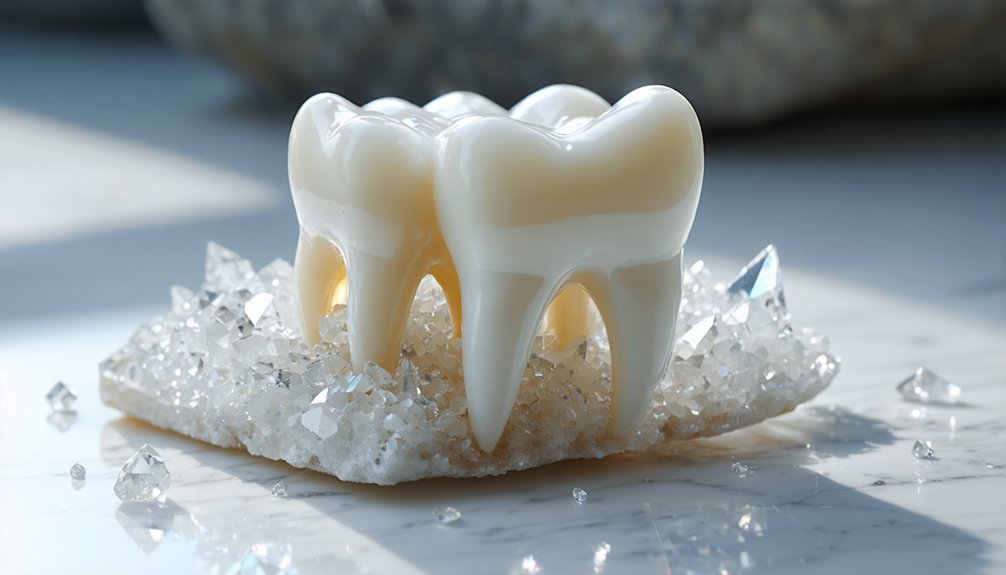
Unlike bleaching agents that chemically oxidize pigments, hydroxyapatite toothpaste whitens by restoring the enamel surface itself. Through enamel remineralization, hydroxyapatite deposits calcium and phosphate into microporous defects, rebuilding the crystalline structure that acid erosion and mechanical wear have degraded. That structural restoration is what drives the whitening effect.
Surface smoothing plays an equally critical role. Rough, irregular enamel retains pigments and biofilm more readily than intact enamel does. By filling microscopic scratches and irregularities, hydroxyapatite reduces the surface area available for stain adhesion.
The result is a cleaner, more reflective enamel surface, not a chemically altered one.
You’re not masking discoloration here. You’re correcting the structural conditions that allow staining to occur, which gives you a more durable and biologically sound whitening outcome.
Is Hydroxyapatite Toothpaste Actually Safe?
Safety concerns about any oral care ingredient are reasonable, and hydroxyapatite holds up well under that scrutiny. Hydroxyapatite is the same calcium phosphate mineral that makes up your enamel and dentine, which means your body recognizes it as structurally familiar. That biocompatibility supports its role in enamel regeneration without introducing foreign chemistry into your oral environment.
Hydroxyapatite is the same mineral as your enamel — your body already knows exactly what to do with it.
From a mineral safety standpoint, hydroxyapatite is stable, low-solubility, and non-toxic. Reviews consistently describe it as well-tolerated, with no significant adverse effects reported in clinical and in vitro studies.
It doesn’t rely on chemical oxidizers or high-abrasion mechanics, so it won’t compromise surrounding soft tissue or existing enamel integrity.
If you’re avoiding fluoride for personal or health reasons, hydroxyapatite gives you a clinically supported, biomimetic alternative you can use with confidence.
Who Has the Most to Gain From Hydroxyapatite Toothpaste?
While hydroxyapatite toothpaste supports general enamel health, certain groups stand to benefit from it most directly. If you experience early-stage enamel erosion, acid-related demineralization, or chronic tooth sensitivity, hydroxyapatite directly targets your underlying deficits.
Its capacity for enamel regeneration makes it particularly relevant if your enamel has sustained microscopic damage from dietary acids, reflux, or frequent citrus consumption. You’ll also gain if you’re actively managing tooth mineralization after whitening treatments, which can temporarily compromise enamel integrity.
Those avoiding fluoride due to personal preference or medical concern gain a clinically supported alternative. If you’re prone to cavities, hydroxyapatite’s cariostatic properties offer measurable protection.
In short, if your priority is structural enamel repair rather than cosmetic masking, hydroxyapatite gives you a precise, biomimetic solution.
How to Use Hydroxyapatite Toothpaste Effectively
Getting the most from hydroxyapatite toothpaste depends on applying it correctly and consistently. Proper technique maximizes enamel mineralization and leverages the toothpaste’s oral biocompatibility with your tooth structure.
Consistent application and correct technique are key to maximizing hydroxyapatite toothpaste’s enamel-strengthening and mineralizing benefits.
- Apply a pea-sized amount to a soft-bristled brush and brush for two full minutes, ensuring even coverage across all surfaces.
- Don’t rinse immediately — allow residual toothpaste to remain on enamel for one to two minutes post-brushing to extend mineral contact time.
- Brush twice daily at minimum, prioritizing nighttime use when saliva flow drops and acid clearance slows.
- Avoid eating or drinking for 30 minutes after brushing to prevent disrupting the hydroxyapatite coating before it bonds to enamel surfaces.
Frequently Asked Questions
Can Children Safely Use Hydroxyapatite Toothpaste Every Day?
“Better safe than sorry” — yes, you can confidently support children’s safety with hydroxyapatite toothpaste’s daily use. It’s biocompatible, non-toxic, and mimics natural enamel mineral composition, making it a clinically sound fluoride-free pediatric option.
How Long Before Hydroxyapatite Toothpaste Produces Noticeable Enamel Improvements?
You’ll typically notice reduced tooth sensitivity within two to four weeks of consistent use. Measurable enamel regeneration, however, requires eight to twelve weeks of daily application, as hydroxyapatite gradually remineralizes and restructures compromised enamel surfaces.
Does Hydroxyapatite Toothpaste Expire or Lose Effectiveness Over Time?
Like all good things, it fades — hydroxyapatite toothpaste does expire. Its shelf life typically spans two to three years, and poor storage conditions — heat, humidity, open caps — accelerate ingredient breakdown, reducing its remineralizing effectiveness.
Can Hydroxyapatite Toothpaste Be Used Alongside Other Dental Treatments?
Yes, you can safely integrate hydroxyapatite toothpaste alongside professional treatments. Its dental safety profile and strong treatment compatibility make it a reliable adjunct to fluoride therapies, sealants, or sensitivity protocols without interfering with clinical outcomes.
Is Hydroxyapatite Toothpaste Suitable for People With Dental Implants?
Yes, you can safely use it. Hydroxyapatite adhesion supports surrounding natural enamel without interfering with dental implant compatibility, as its biocompatible, non-reactive mineral matrix won’t compromise implant surfaces or osseointegration while actively protecting adjacent teeth.
References
- https://www.webmd.com/oral-health/hydroxyapatite-toothpaste
- https://www.healthline.com/health/dental-and-oral-health/hydroxyapatite-toothpaste
- https://pmc.ncbi.nlm.nih.gov/articles/PMC8930857/
- https://www.terraandco.com/blogs/natural-dental-products/does-hydroxyapatite-really-rebuild-enamel-what-the-research-says
- https://wayzatadental.com/hydroxyapatite-toothpaste/
- https://pmc.ncbi.nlm.nih.gov/articles/PMC11068243/
- https://hastingsdentalcentre.com.au/hydroxyapatite-toothpaste-pros-cons-should-you-switch/
- https://www.cnn.com/cnn-underscored/health-fitness/what-is-hydroxyapatite
- https://www.youtube.com/watch?v=eIWZ5J_h5oE&vl=en
- https://pmc.ncbi.nlm.nih.gov/articles/PMC8432723/