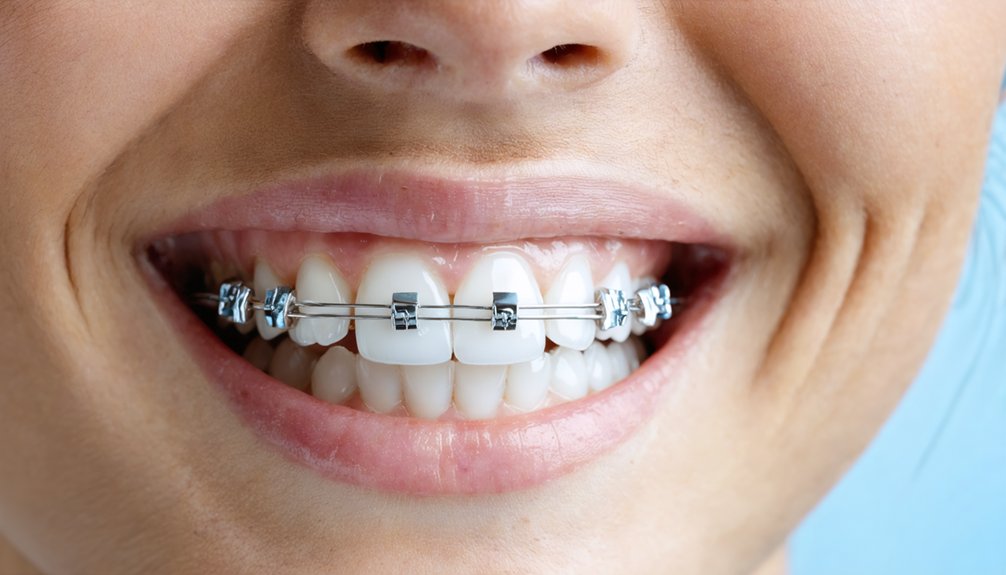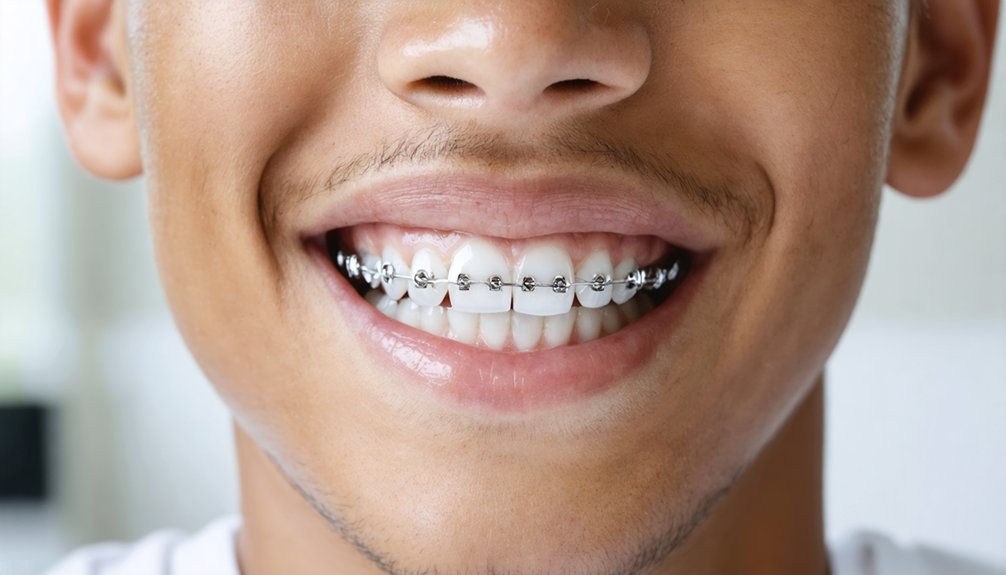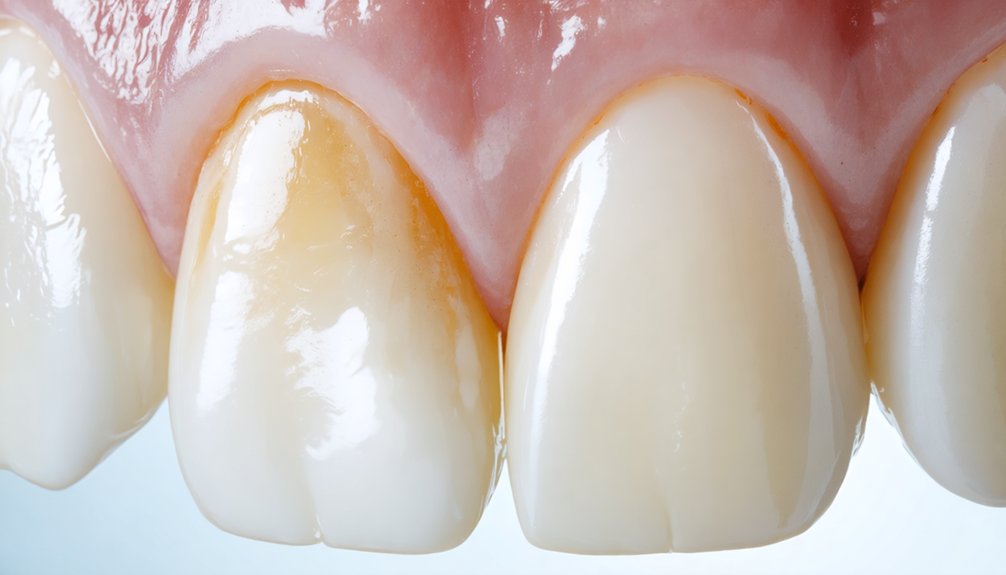
When you whiten your teeth, your composite bonding won’t follow suit. Whitening agents work by penetrating enamel’s porous crystalline structure, oxidizing stain molecules from within. Composite resin is non-porous, so hydrogen peroxide can’t infiltrate its sealed surface. Your natural teeth brighten progressively while bonding holds its original shade, creating a visible tonal gap. Understanding exactly why this happens — and what you can do about it — starts with looking closer at the chemistry involved.
Key Takeaways
- Composite bonding is non-porous, so whitening agents cannot penetrate its surface, unlike natural enamel which responds to hydrogen peroxide.
- Natural teeth brighten as peroxide oxidizes internal chromogenic compounds, while composite resin retains its original embedded color.
- The result is a visible color mismatch, with whitened enamel appearing lighter than the unchanged composite bonding.
- Composite resin lacks enamel tubules, preventing peroxide infiltration and making chemical whitening reactions impossible within the material.
- Over time, aging and hydrolytic degradation can increase composite porosity, causing it to absorb stains and shift in shade.
Does Composite Bonding Whiten With Your Natural Teeth?
When you whiten your teeth, composite bonding doesn’t respond the same way your natural enamel does.
Whitening agents penetrate porous enamel, lifting stains at a molecular level. Composite resin, however, is non-porous — it resists chemical infiltration entirely, leaving its original shade locked in place.
Whitening penetrates enamel. Composite resin resists it entirely — its shade locked in place, unchanged.
This creates a visible color mismatch that directly impacts aesthetic considerations. Your natural teeth brighten while your bonding stays static, making the contrast increasingly noticeable with each whitening session.
For those prioritizing composite longevity and consistent results, this incompatibility demands a deliberate treatment sequence.
You’re not just managing appearance — you’re managing material behavior. Understanding how bonding and whitening interact gives you precise control over your outcome before committing to either procedure.
Why Whitening Agents Don’t Work on Composite Bonding
When you apply a whitening agent to your teeth, it penetrates the porous surface of natural enamel through a process of oxidation, breaking down stain molecules beneath the surface.
Composite resin, however, has a sealed, non-porous structure that blocks this chemical penetration entirely.
This fundamental material difference means that no matter how many whitening treatments you undergo, your bonding won’t respond the way your natural teeth do.
Resin Resists Whitening Agents
There are two fundamental properties of composite resin that make whitening agents chemically ineffective against it: its non-porous surface structure and its synthetic polymer composition.
Understanding these resin properties explains why whitening effectiveness stops at the bonding margin.
Here’s exactly what’s happening at the material level:
- Resin has zero porosity — hydrogen peroxide can’t penetrate its sealed surface.
- Polymer chains are chemically inert — oxidizing agents find no reactive sites to break down.
- Color is embedded within the material — it’s not a surface stain you can lift.
- Natural enamel around it actively whitens — creating a visible contrast you can’t ignore.
You’re not dealing with staining. You’re dealing with a fixed synthetic material that simply won’t respond.
Porous Enamel Versus Sealed Bonding
Natural tooth enamel is riddled with microscopic tubules and pores that hydrogen peroxide exploits to penetrate beneath the surface and oxidize intrinsic chromogens. This structural porosity is precisely what makes whitening effective on natural dentition.
Composite resin, however, presents an entirely different material reality. Its sealed bonding surface is non-porous by design, creating a dense polymer matrix that actively repels peroxide molecules rather than absorbing them.
When you whiten your teeth, porous enamel responds and brightens, while sealed bonding remains chemically unchanged. You’re not dealing with a treatment failure — you’re dealing with a fundamental material incompatibility.
Understanding this distinction gives you control over your cosmetic outcomes and explains why shade-matching strategies must be established before bonding placement, not after whitening begins.
Does Composite Bonding Change Shade on Its Own Over Time?
Although composite bonding doesn’t whiten with bleaching agents, it’s not entirely static regarding shade over time. Aging effects and exposure gradually shift its color stability in ways you should anticipate:
- Staining absorption — Resin absorbs pigments from coffee, wine, and tobacco, darkening incrementally over months.
- Surface micro-abrasion — Daily brushing dulls the polished surface, altering light reflection and perceived shade.
- Resin matrix oxidation — Oxygen exposure causes subtle yellowing within the composite structure itself.
- Hydrolytic degradation — Prolonged moisture contact weakens the resin matrix, increasing porosity and accelerating discoloration.
These shifts occur independently of whitening treatments. Understanding this distinction gives you precise control over timing your maintenance appointments and managing long-term shade expectations with clinical accuracy.
How Natural Teeth Whiten While Bonding Doesn’t
When hydrogen peroxide or carbamide peroxide penetrates your enamel’s crystalline lattice, it oxidizes the chromogenic compounds embedded within dentinal tubules — a chemical process that genuinely lightens tooth structure from within.
Composite resin, however, contains no such tubules. Its dense, non-porous polymer matrix physically blocks peroxide penetration, leaving the material chemically unchanged regardless of teeth whitening intensity or duration.
As your natural enamel progressively shifts toward a lighter shade, your bonding retains its original hue with precision — and that’s where color contrast becomes a visible problem.
The mismatch isn’t subtle. Bonded surfaces appear darker against brightened surrounding teeth, creating an aesthetic inconsistency that undermines your result.
You’re not dealing with staining; you’re dealing with a fundamental material limitation that whitening chemistry simply can’t override.
What Causes the Color Mismatch Between Bonding and Natural Teeth
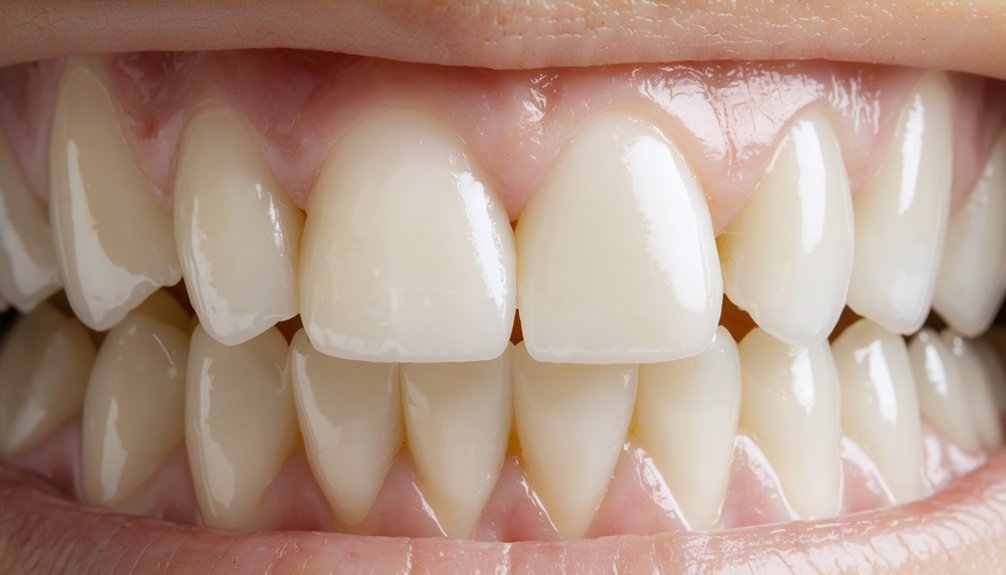
When you whiten your natural teeth, the bleaching agents penetrate your enamel’s porous structure and oxidize the pigment molecules within—a chemical process your composite bonding simply can’t replicate.
Your bonding resin is a non-porous material, so it holds its original shade while your surrounding enamel shifts to a lighter tone.
This material contrast is the direct cause of the visible mismatch you’ll notice after whitening.
Natural Enamel Whitens Differently
Because composite resin and natural enamel respond to whitening agents in fundamentally different ways, a visible color mismatch almost always develops after treatment.
Your natural enamel contains microscopic pores that absorb bleaching agents, allowing oxidation to lighten pigmented molecules within the tooth structure. Bonding materials lack this porosity entirely.
Here’s precisely why the contrast appears:
- Enamel permeability allows hydrogen peroxide to penetrate and chemically alter chromogens.
- Resin density blocks whitening agents at the surface level.
- Shade progression occurs only in natural enamel, shifting it visibly lighter.
- Static bonding retains its original color while surrounding teeth brighten.
You’re left with a two-tone result that compromises your aesthetic outcome — one entirely predictable when you understand the underlying material science.
Material Contrast Creates Mismatch
The contrast you see after whitening isn’t accidental — it’s a direct consequence of how composite resin and natural enamel interact with light differently at a structural level.
Enamel’s crystalline, porous matrix scatters and absorbs bleaching agents, shifting its optical properties and lifting its shade. Composite resin, by contrast, maintains rigid color stability — its non-porous polymer structure reflects light uniformly, unchanged by whitening chemistry.
That structural divergence is precisely what creates visible mismatch. The aesthetic considerations here aren’t subtle; under natural or clinical lighting, the tonal gap between brightened enamel and static bonding becomes immediately apparent.
You’re not dealing with a gradual drift — you’re dealing with two materials responding to the same stimulus in fundamentally incompatible ways, producing a contrast you can’t correct with further whitening.
How to Fix a Color Mismatch After Whitening
Once a color mismatch develops between your whitened enamel and existing composite bonding, you’ve got two primary corrective paths: replace the bonding entirely or have your dentist shade-match and reapply a fresh composite layer over the affected restorations.
Both color correction approaches demand clinical precision to achieve seamless integration.
Prioritize these steps for effective bonding repair:
- Schedule a shade assessment immediately after whitening stabilizes—typically two weeks post-treatment.
- Request composite replacement if discoloration is severe or the existing layer has degraded.
- Opt for surface repolishing for minor shade discrepancies before committing to full replacement.
- Confirm your final whitening shade before new composite is placed, locking in a stable baseline.
Acting decisively prevents the mismatch from compounding further.
Why You Should Whiten Before Getting Composite Bonding
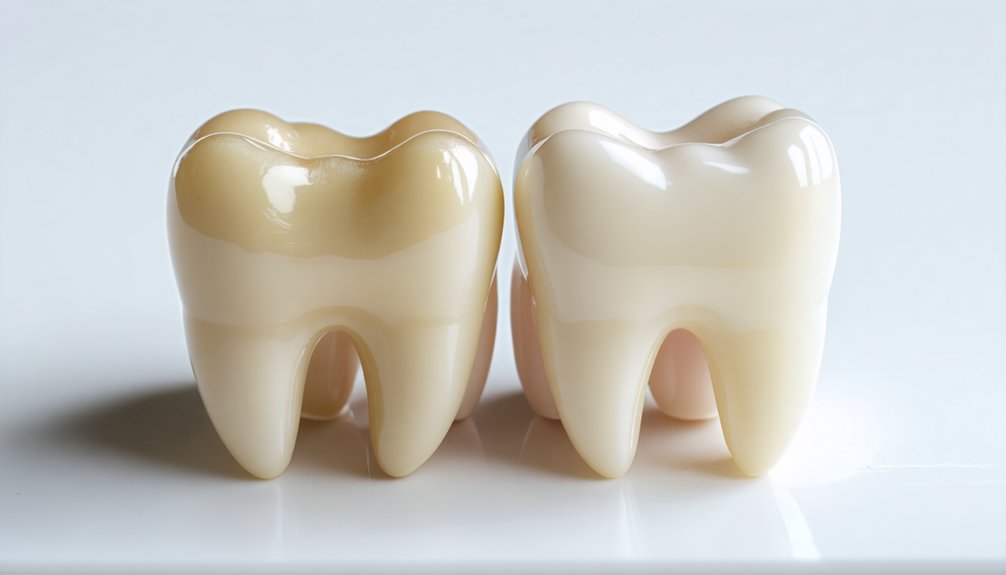
Whitening before composite bonding is the single most effective way to prevent future shade mismatches.
By optimizing your whitening timing first, you allow your enamel to reach its brightest, most stable shade before any resin is placed.
Once your natural teeth stabilize — typically two weeks post-whitening — your dentist can precisely match the composite to that final tone during bonding preparation.
After two weeks, your whitened enamel stabilizes — giving your dentist the perfect, consistent shade to match your composite bonding.
This sequence gives you complete control over your outcome.
You’re setting the baseline, not reacting to a mismatch after the fact.
Since composite resin won’t respond to whitening agents, establishing your target shade beforehand eliminates the need for costly replacements or repairs.
It’s a precise, proactive strategy that guarantees your bonding integrates seamlessly with your whitened enamel from day one.
Frequently Asked Questions
Can Composite Bonding Be Removed and Replaced With a Whiter Shade?
Yes, you can have your composite bonding materials removed and replaced using updated color matching techniques. Your dentist’ll apply a whiter shade, giving you precise control over your smile’s final aesthetic outcome.
How Long Does Composite Bonding Typically Last Before Needing Replacement?
Like a polished gem slowly losing its luster, your composite durability peaks at 5–10 years. Your bonding lifespan depends on oral habits, bite pressure, and maintenance—you’ll need replacement when chipping, staining, or noticeable wear compromises aesthetics.
Does Composite Bonding Stain Differently Than Natural Teeth Over Time?
Yes, your composite bonding stains differently than natural teeth. Its non-porous resin resists whitening agents, compromising color matching over time. Monitoring composite durability guarantees you’ll maintain aesthetic control, requiring professional shade adjustments as surrounding enamel naturally shifts.
Is Composite Bonding Safe to Use With Professional Whitening Treatments?
You can safely use professional whitening treatments, but your composite bonding won’t respond—it stays static while natural enamel brightens, creating a color mismatch that compromises your dental aesthetics and limits your treatment options for uniform results.
Can All Dentists Perform Composite Bonding Touch-Ups After Whitening?
Not every dentist’s a master painter—color matching demands specialized skill. You’ll want a cosmetic dentist experienced in bonding techniques to precisely restore your composite’s shade after whitening, ensuring seamless, aesthetically refined results you can fully control.
References
- https://www.southkenmd.co.uk/blog/composite-bonding-teeth-whitening-shade-matching
- https://diamond-smile.com/can-composite-bonding-be-whitened/
- https://www.drbobsdentalcare.com/can-cosmetic-bonding-be-whitened/
- https://www.cosmeticdentistryclinic.co.uk/blog/how-to-whiten-composite-bonding-safely
- https://www.premierdentalohio.com/blog/how-to-whiten-bonding
- https://www.youtube.com/watch?v=A2hTwAX7e5s
- https://www.highdesertdental.com/can-dental-bonding-be-whitened/
- https://magictouchdentalclinic.com/can-you-whiten-composite-bonding.html
- https://www.realself.com/question/bonding-discolored-retouched-drilling
- https://pmc.ncbi.nlm.nih.gov/articles/PMC6343991/