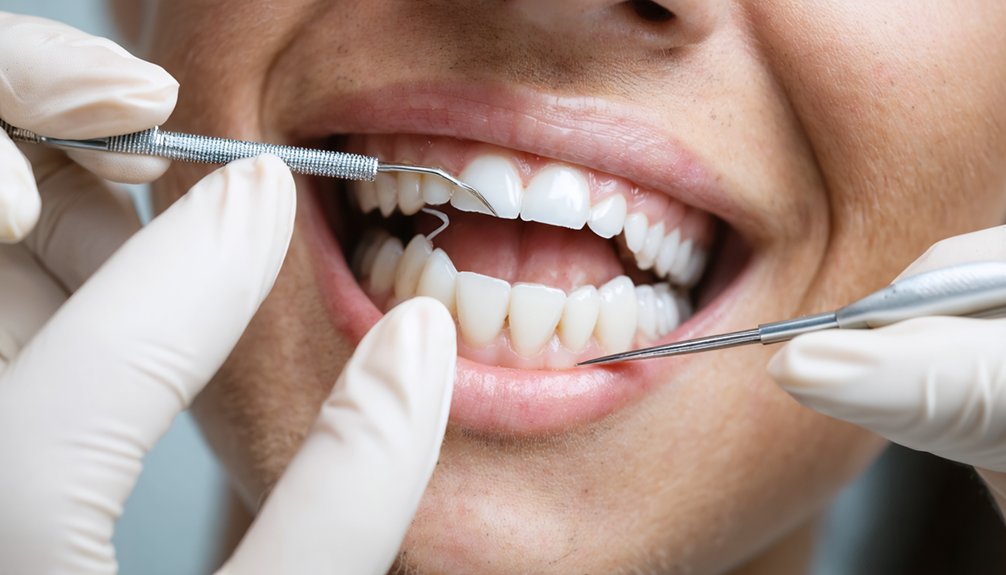
Teeth whitening chemicals break down stains by triggering oxidation reactions that dismantle the molecular structures causing discoloration. When you apply a peroxide-based agent, it releases free radicals that attack chromogens—organic compounds containing conjugated double bonds that absorb visible light. These free radicals break those bonds, fragmenting chromogens into smaller, colorless molecules that can no longer absorb light. Understanding each step of this chemical process reveals exactly why some whitening methods work far better than others.
Key Takeaways
- Teeth whitening chemicals use peroxide-based agents that release free radicals, which target and break down stain-causing compounds called chromogens.
- Free radicals disrupt conjugated double bonds in chromogens, eliminating their ability to absorb light and causing discoloration to disappear.
- Hydrogen peroxide acts immediately upon contact, while carbamide peroxide decomposes gradually, releasing hydrogen peroxide over extended periods.
- Peroxide penetrates enamel to reach intrinsic stains within dentin, while extrinsic stains on the surface are more easily accessible.
- Fragmented stain molecules lose their chromophore structure, becoming colorless and causing teeth to reflect more light than they absorb.
What Makes Teeth Whitening Chemistry Actually Work?
Teeth whitening works through a targeted oxidation reaction that chemically dismantles the organic compounds responsible for discoloration. When you apply a peroxide-based agent, it releases free radicals that attack stain composition at the molecular level.
These radicals break conjugated double bonds within chromogen structures, converting large, light-absorbing molecules into smaller, colorless fragments.
Understanding oxidation benefits helps you make informed decisions about treatment selection and concentration levels. Hydrogen peroxide penetrates porous enamel, reaching intrinsic stains embedded deep within dentin.
Knowing how oxidation works empowers smarter choices in whitening treatments, concentrations, and how deeply active ingredients penetrate enamel.
Carbamide peroxide releases active hydrogen peroxide upon contact with water, extending the reaction period for sustained results.
The broken molecular fragments reflect light rather than absorbing it, producing measurable whitening. Efficacy depends directly on agent concentration, contact duration, and penetration depth into the tooth structure.
Which Two Peroxides Do Most Whitening Products Use?
Most whitening products rely on two peroxide compounds: hydrogen peroxide and carbamide peroxide. Each delivers whitening effectiveness through distinct chemical pathways you should understand before selecting a product.
Hydrogen peroxide acts as the direct oxidizing agent, immediately releasing free radicals upon contact with tooth surfaces. It penetrates enamel quickly, targeting chromogen molecules embedded within the dentin structure.
Carbamide peroxide offers greater peroxide stability, making it preferable for extended-contact applications like overnight trays. It decomposes into hydrogen peroxide and urea when it contacts water, releasing its active component gradually. This slower release reduces sensitivity risk while maintaining consistent oxidation of stain-causing compounds.
Knowing how each compound behaves lets you match the agent to your specific whitening goals, contact duration, and sensitivity tolerance with precision.
What’s the Real Difference Between Carbamide and Hydrogen Peroxide?
Both compounds whiten teeth through oxidation, but their chemical behavior differs in ways that directly affect how you’d apply them.
Hydrogen peroxide acts immediately upon contact, releasing free radicals that attack chromogen double bonds without requiring conversion. That immediacy makes it suitable for short, high-concentration professional treatments.
Carbamide peroxide, however, is a stable complex that first requires contact with water to decompose into hydrogen peroxide and urea.
This conversion slows the release of active oxidizing agents, producing a more gradual reaction. You’d typically use carbamide peroxide in extended overnight or at-home applications where sustained, lower-intensity oxidation is preferred.
The urea byproduct contributes nothing to whitening but improves the compound’s shelf stability.
Your choice between them should reflect treatment duration, concentration tolerance, and desired penetration depth.
How Do Free Radicals Break Down Stains During Teeth Whitening?
When hydrogen peroxide contacts your teeth, it breaks down into unstable free radicals—highly reactive oxygen molecules that immediately seek chemical targets within the tooth structure.
These free radicals attack the conjugated double bonds within chromogen molecules, the organic compounds responsible for discoloration. Breaking those bonds dismantles the chromophore, converting large, light-absorbing stain molecules into smaller, colorless fragments that your tooth’s microstructure can then flush out.
Free Radical Generation Process
Once hydrogen peroxide contacts your teeth, it breaks down into free radicals—highly reactive oxygen molecules that immediately target stain-causing compounds.
These free radicals carry unpaired electrons, making them chemically aggressive and primed to attack chromogen molecules lodged within your enamel and dentin.
The oxidation power behind this reaction is significant. Free radicals assault the conjugated double bonds within chromogen structures, systematically dismantling the molecular architecture responsible for discoloration.
Each bond broken reduces the chromogen’s ability to absorb light, converting dark, complex molecules into smaller, colorless fragments.
You’re fundamentally triggering a controlled chemical chain reaction. The moment peroxide decomposes, the process becomes self-directed—free radicals propagate through the tooth’s microstructure, ensuring both surface-level and deeply embedded stains face consistent, targeted oxidative breakdown.
Breaking Chromogen Double Bonds
Free radicals don’t simply collide with stain molecules—they chemically dismantle them by targeting the conjugated double bonds within chromogen structures. This bond disruption is precise: free radicals attack the electron-rich double bonds that give chromogen types their light-absorbing properties.
Here’s what happens at the molecular level:
- Bond cleavage breaks the conjugated system, eliminating the chromophore responsible for discoloration.
- Molecular fragmentation reduces large pigment compounds into smaller, less complex units.
- Altered light interaction causes fragments to reflect rather than absorb light.
- Increased solubility allows broken-down molecules to flush out through the tooth’s water content.
You’re not just bleaching the surface—you’re restructuring the molecular architecture of embedded stains, permanently neutralizing their optical impact on enamel and dentin.
Why Can Whitening Agents Reach Stains Deep Inside Your Teeth?
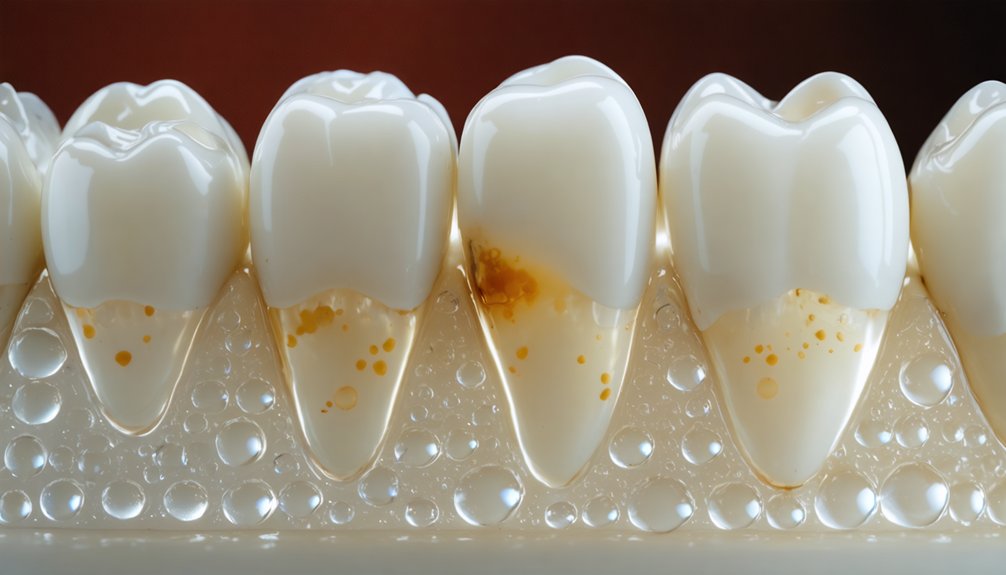
Because enamel isn’t a solid, impenetrable barrier, whitening agents can seep through its microscopic gaps to reach stains lodged deep within the tooth’s structure.
Enamel’s porous matrix, composed of inorganic salt crystals, contains channels small enough for peroxide molecules to navigate. This penetration depth determines which stain types you can effectively eliminate—both extrinsic surface discoloration and intrinsic pigmentation embedded within dentin.
Carbamide peroxide requires contact with water before releasing active hydrogen peroxide, which then advances through enamel into the underlying dentin.
Once there, free radicals target organic chromogen molecules anchored within the tooth’s microstructure. Your whitening agent’s molecular size directly controls how far it penetrates, making concentration and formulation critical variables in achieving thorough stain removal at every structural layer.
What Are Chromogens and Why Do They Discolor Your Teeth?
Whitening agents penetrate deep into dentin to target the specific molecules causing discoloration—chromogens. These organic compounds contain conjugated double bonds that absorb visible light, producing the colors you see as stains.
Understanding chromogen types and stain sources gives you precision over your whitening approach.
Knowing your stain source transforms whitening from guesswork into a targeted, precise solution.
Chromogens fall into two primary categories:
- Extrinsic chromogens — derived from coffee, tea, wine, and tobacco that bond to enamel surfaces
- Intrinsic chromogens — embedded within dentin through aging, trauma, or antibiotic exposure
- Direct chromogens — pigmented compounds that attach independently to tooth structure
- Indirect chromogens — colorless precursors that oxidize into pigmented molecules after contact with saliva
Their conjugated double bonds create chromophores—the functional structures responsible for light absorption.
Disrupting these bonds eliminates the discoloration at its chemical source.
How Does Breaking Molecular Bonds Make Teeth Look Whiter?
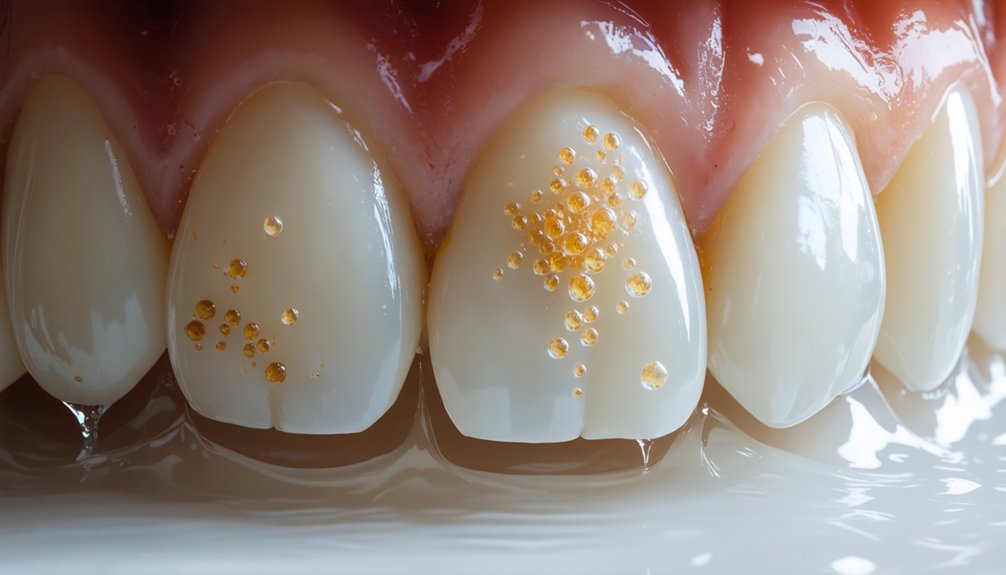
Once free radicals break the conjugated double bonds within chromogen molecules, the resulting fragments lose their chromophore structure entirely. This molecular transformation converts large, light-absorbing compounds into smaller, structurally simpler components.
Without intact conjugated bonds, these fragments can’t absorb visible light the way original chromogens did. This shift directly alters the optical properties of your tooth’s dentin and enamel. Instead of absorbing and retaining light—which produces that dark, stained appearance—the smaller molecules scatter and reflect it.
Your teeth appear noticeably whiter because the compounds responsible for discoloration no longer interact with light in the same way.
Additionally, these fragmented molecules become more water-soluble, allowing your tooth structure to flush them out efficiently. You’re left with a structurally cleaner, optically brighter tooth surface.
How Does Teeth Whitening Change the Way Your Teeth Reflect Light?
When chromogens absorb light, they create the dark, discolored appearance you see on stained teeth.
Once whitening agents break down these molecules, the resulting fragments lose their ability to absorb light at the same wavelengths.
Your teeth then reflect more light than they absorb, producing the brighter, whiter appearance that effective whitening treatments deliver.
Molecular Light Absorption Changes
The chemical breakdown of chromogens directly alters how your teeth interact with light. When oxidizing agents fragment stain molecules, you’re fundamentally changing their optical properties across both stain types—extrinsic and intrinsic.
Here’s what that molecular shift produces:
- Reduced light absorption: Smaller fragments can’t absorb light wavelengths the way intact chromogens do.
- Increased light scattering: Dismantled molecules scatter incoming light rather than trapping it within the tooth structure.
- Colorless byproducts: Broken conjugated bonds eliminate the chromophore responsible for visible discoloration.
- Altered surface reflectance: Enamel and dentin reflect more light uniformly, producing a visibly brighter appearance.
You’re not masking discoloration—you’re chemically eliminating the molecular structures that cause it, achieving a measurable, structural change in how your teeth process light.
Whitened Teeth Reflect Differently
Whitened teeth reflect light through three distinct optical changes that result directly from the chemical breakdown of chromogens.
First, fragmented stain molecules lose their ability to absorb visible light wavelengths, eliminating the dark appearance they previously created.
Second, increased light scattering occurs across the enamel surface as smaller molecular fragments distribute light more uniformly rather than concentrating absorption at specific wavelengths.
Third, the altered optical properties of both enamel and dentin shift how your teeth interact with incoming light at a structural level.
You’re effectively resetting the molecular composition of your tooth surface.
The oxidation process converts large, light-blocking chromogens into smaller, colorless compounds that no longer interfere with light reflection.
The result is measurably brighter teeth with fundamentally changed surface optics.
Is Teeth Whitening Chemistry Safe for Your Enamel?
How safe are whitening chemicals for your enamel? When you use professionally formulated gels, controlled peroxide concentrations guarantee whitening effectiveness without compromising enamel integrity. Enamel safety depends on precise application and appropriate contact duration.
Key factors governing safe whitening chemistry include:
- Concentration control: Professional-grade gels limit peroxide levels to prevent structural enamel degradation.
- Contact duration: Overexposure increases sensitivity risk; following timed protocols protects enamel.
- Penetration depth: Agents target organic stain molecules without dissolving inorganic enamel salts.
- Agent stability: Carbamide peroxide releases hydrogen peroxide gradually, reducing aggressive tissue exposure.
You maintain control over outcomes by adhering to recommended application guidelines. The chemistry is clinically validated—when used correctly, it oxidizes stain compounds effectively while preserving your enamel’s structural and optical integrity.
Why Do Some Stains Respond Better to Teeth Whitening Than Others?
Beyond enamel safety, understanding why certain stains respond more readily to whitening chemicals reveals how stain composition directly governs treatment outcomes.
Stain types differ fundamentally in molecular structure, directly affecting oxidation efficiency. Extrinsic stains from coffee or tobacco feature surface-level chromogens with accessible conjugated double bonds, making them highly vulnerable to free radical attack.
Intrinsic stains, embedded deep within dentin, require deeper peroxide penetration before oxidation begins, slowing the process considerably.
Metallic or antibiotic-induced discoloration involves inorganic compounds or tightly bound tetracycline molecules that resist standard peroxide oxidation entirely.
You achieve better results when you match agent concentration and contact duration to the specific stain type and its molecular complexity, ensuring free radicals effectively dismantle the targeted chromophore structures responsible for discoloration.
Frequently Asked Questions
Can Teeth Whitening Chemicals Interact Negatively With Dental Fillings or Crowns?
Yes, whitening chemicals can affect your fillings materials and crowns durability. They don’t bleach restorations, creating shade mismatches. You’ll notice peroxides may weaken composite bonds, so consult your dentist before proceeding.
How Long Does the Whitening Effect Typically Last Before Stains Return?
You eat, you drink, you stain—whitening effects typically last six to twelve months. Stain longevity depends on your dietary habits and oral hygiene. You’ll maintain results longer through consistent whitening maintenance and avoiding pigment-heavy foods and beverages.
Does the Temperature of Whitening Agents Affect Their Chemical Breakdown Speed?
Yes, temperature impact directly accelerates your whitening agent’s oxidation rate. Higher temperatures speed free radical release, but they’ll compromise chemical stability, degrading peroxides prematurely. You’ll achieve ideal breakdown by storing and applying agents at recommended temperatures.
Can Natural Alternatives Like Charcoal Replicate the Oxidation Process of Peroxides?
Like a broom versus bleach, charcoal efficacy relies on physical adsorption, not oxidation. You can’t replicate peroxide’s free-radical stain removal — charcoal merely scrubs surface deposits without breaking chromogen double bonds chemically.
Are There Genetic Factors That Influence How Teeth Respond to Whitening Chemicals?
Yes, your genetic variations directly influence whitening outcomes. They determine your enamel thickness, affecting how deeply peroxides penetrate. Thinner enamel allows faster agent diffusion, while denser enamel may require extended treatment duration for effective chromogen breakdown.
References
- https://sandlakedental.com/blog/understanding-the-science-behind-teeth-whitening/
- https://www.youtube.com/watch?v=HV9eIdrX2LQ
- https://pmc.ncbi.nlm.nih.gov/articles/PMC4058574/
- https://www.teethwhitening.london/blog/how-does-teeth-whitening-remove-stains-from-inside-a-tooth
- https://www.willowdentalcare.com.au/faq/teeth-whitening-work/37051
- https://science.howstuffworks.com/innovation/everyday-innovations/tooth-whitening1.htm
- https://www.darlie.com.my/en/oral-health/all-tips/unveiling-the-science-of-teeth-whitening-how-does-it-work
- https://www.youtube.com/watch?v=dOPBOPy-NN8
- https://sites.psu.edu/cosmeticdentistry/2023/11/16/the-scientific-basis-of-teeth-whitening-mechanistic-insights-into-dental-chromogenic-stain-removal/
- https://dentistmckinneytexas.com/teeth-whitening-chemistry-explained/