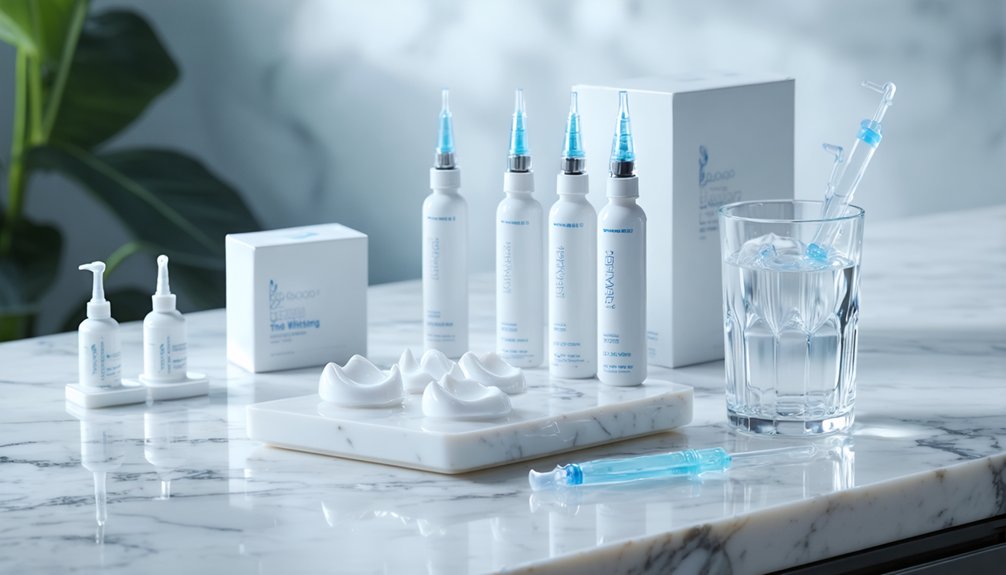
When choosing a home whitening kit that’s safe for enamel, you’ll want to prioritize hydrogen peroxide concentrations below 15%, as higher levels accelerate demineralization. Carbamide peroxide formulations reduce sensitivity risk by approximately 20%, while peroxide-free options eliminate it entirely. Top enamel-safe picks include Lumineux Whitening Strips, Pearson Bright Intensive, and Crest 3D White Luxe. Clinical data confirms 94% of ADA-approved products cause no adverse enamel effects. The details behind these findings reveal considerably more about protecting your smile.
Key Takeaways
- Hydrogen peroxide below 15% minimizes enamel damage, while concentrations above 20% cause clinically detectable structural micro-damage.
- Lumineux Whitening Strips, Pearson Bright Intensive, and Crest 3D White Luxe are top enamel-safe at-home whitening kits.
- Peroxide-free alternatives like Oral Essentials Lumineux eliminate peroxide-induced sensitivity while still effectively whitening teeth.
- Using fluoride toothpaste before and after whitening sessions reinforces enamel integrity and reduces sensitivity.
- At-home kits achieve 75-85% of professional whitening results at 60-70% lower cost.
What Makes a Whitening Kit Truly Enamel-Safe?
When evaluating a home whitening kit’s enamel safety, you’ll want to focus on peroxide concentration as the primary variable. Hydrogen peroxide below 15% minimizes micro-structural damage, while carbamide peroxide’s slower release reduces sensitivity risk by 20%.
These whitening technology advancements give you measurable control over the whitening process.
You’ll also want to take into account peroxide-free formulations, which eliminate abrasion risks entirely through enamel restoration techniques using plant-based agents. Clinical data confirms 81% of users achieve expected results at safe concentrations, and longitudinal studies show no enamel thinning after five years of consistent use.
Prioritize ADA-approved products, since 94% demonstrate no adverse enamel effects in clinical trials. Remineralizing agents like calcium phosphate further protect enamel integrity post-treatment, strengthening your overall whitening protocol.
Hydrogen Peroxide Levels to Look For (and Avoid)
When selecting a home whitening kit, you’ll want to prioritize hydrogen peroxide concentrations below 15%, as clinical data confirms enamel micro-hardness remains stable within this range.
Concentrations exceeding 15% increase the risk of enamel micro-structural damage and elevate sensitivity incidence markedly, making them unsuitable for unsupervised at-home use.
Dropping below 10% further reduces your sensitivity risk by 35%, giving you a measurable safety advantage without substantially compromising whitening efficacy.
Safe Peroxide Concentration Ranges
Peroxide concentration is the single most critical variable determining both the safety and efficacy of any home whitening kit.
Clinical evidence establishes clear thresholds you should follow to protect enamel integrity while achieving measurable results.
Evidence-Based Concentration Guidelines:
- Under 10% hydrogen peroxide — reduces sensitivity incidence by 35%; ideal for frequent users prioritizing enamel remineralization techniques.
- 10–15% hydrogen peroxide — effective for moderate staining; maintains enamel micro-hardness with controlled safe whitening frequency.
- Above 15% hydrogen peroxide — documented micro-structural enamel damage risk; avoid in unsupervised at-home use.
- Carbamide peroxide alternatives — delivers slower peroxide release, reducing sensitivity risk by 20% compared to equivalent hydrogen peroxide concentrations.
Staying within the sub-15% threshold gives you measurable whitening outcomes without compromising enamel structural integrity long-term.
Levels That Damage Enamel
Knowing which concentration ranges are safe only tells half the story — understanding where damage begins is equally important for making an informed product choice.
Peroxide concentrations exceeding 15% accelerate enamel demineralization, measurably reducing enamel thickness with repeated exposure. At concentrations above 20%, structural micro-damage becomes clinically detectable even after limited sessions.
Whitening duration compounds this risk considerably — extending application beyond manufacturer guidelines amplifies peroxide penetration into dentinal tubules, increasing irreversible sensitivity risk. You should avoid any kit exceeding 15% hydrogen peroxide without direct professional supervision.
Carbamide peroxide products above 35% carry equivalent risk thresholds. Clinical longitudinal data confirms that damage correlates directly with concentration-duration combinations, not isolated variables.
Controlling both factors simultaneously is your most effective strategy for preserving long-term enamel integrity.
Sensitivity Risk by Percentage
Sensitivity risk scales predictably with hydrogen peroxide concentration, giving you a measurable framework for product selection.
Controlling your exposure level directly determines your sensitivity statistics and protects long-term enamel health.
- Under 10% hydrogen peroxide — reduces sensitivity incidence by 35% compared to higher concentrations.
- 10–15% hydrogen peroxide — maintains enamel micro-hardness stability while delivering measurable whitening results.
- Carbamide peroxide formulations — slow-release chemistry cuts sensitivity risk by 20% versus equivalent hydrogen peroxide concentrations.
- Peroxide-free alternatives — eliminate peroxide-induced sensitivity entirely, ideal if you’re already experiencing enamel vulnerability.
Clinical data confirms 22% of users report temporary sensitivity at standard concentrations, resolving within 72 hours.
Selecting lower-concentration formulations gives you direct, data-backed control over that risk.
Peroxide vs. Peroxide-Free: Which Is Safer for Enamel?
When choosing between peroxide-based and peroxide-free whitening kits, understanding their distinct safety profiles helps you make a more informed decision.
Peroxide safety depends heavily on concentration. Formulations below 15% hydrogen peroxide preserve enamel micro-hardness, while carbamide peroxide releases more slowly, reducing sensitivity risk by 20%. Clinical data confirms no long-term enamel thinning occurs with controlled peroxide use under these thresholds.
Peroxide concentration is everything—stay below 15%, and your enamel stays protected.
Peroxide-free options, like Lumineux, eliminate abrasion and oxidative risks entirely by using plant-based agents. They’re ideal if you’re managing existing sensitivity or compromised enamel health.
However, they may deliver more gradual results compared to peroxide-based systems. Your choice should align with your enamel condition, sensitivity history, and desired whitening timeline—factors you can assess precisely before committing to a protocol.
Best Home Whitening Kits That Won’t Damage Enamel
When selecting a home whitening kit that protects enamel, you’ll find that products like Lumineux Teeth Whitening Strips and Pearson Bright Intensive—which use either peroxide-free formulations or hydrogen peroxide concentrations at or below 12%—carry the strongest enamel safety profiles in clinical data.
If you’re prone to sensitivity, you can reduce your risk by up to 35% by choosing kits with peroxide concentrations under 10%, and pairing treatment with fluoride toothpaste and remineralizing agents like calcium phosphate.
Adhering strictly to manufacturer guidelines, limiting sessions to 30 minutes, and avoiding acidic foods for 24 hours post-treatment further minimizes both sensitivity and cumulative enamel stress.
Enamel-Safe Kit Options
Choosing an enamel-safe whitening kit requires understanding which formulations clinical data actually supports.
You’ll want to prioritize whitening product innovations that align with verified enamel preservation techniques to avoid compromising structural integrity.
Key enamel-safe options include:
- Lumineux Whitening Strips — peroxide-free, plant-based agents eliminate abrasion risk entirely.
- Pearson Bright Intensive — uses 12% hydrogen peroxide, staying within the clinically safe threshold below 15%.
- Oral Essentials Lumineux — non-acidic formulation targets sensitive enamel without pH-related erosion.
- Crest 3D White Luxe — delivers surface stain removal with documented minimal sensitivity impact.
Long-term studies confirm enamel micro-hardness remains stable when peroxide concentrations stay under 15%.
Selecting ADA-approved products gives you measurable control over both whitening outcomes and enamel integrity.
Minimizing Whitening Sensitivity
Sensitivity affects roughly 22% of whitening users, but targeted strategies can reduce that incidence considerably before it becomes a deterrent.
Understanding your sensitivity triggers—peroxide concentration, application duration, and post-treatment diet—gives you direct control over outcomes. Selecting formulations under 10% peroxide cuts sensitivity incidence by 35%, while carbamide peroxide’s slower release further reduces nerve stimulation risk.
For recovery methods, apply fluoride toothpaste before and after each session to reinforce enamel integrity. Remineralizing agents containing calcium phosphate address surface micro-roughness that amplifies sensitivity signals.
Avoid acidic foods for 24 hours post-treatment to prevent compounding enamel erosion. Most sensitivity resolves within 72 hours; if it persists beyond that window, reduce session frequency or switch to a peroxide-free formulation immediately.
Do At-Home Kits Match Professional Whitening Results?
How closely do at-home kits match professional whitening outcomes? Clinical trials confirm you can achieve 75-85% of professional techniques results using standardized at-home protocols. User experiences consistently validate this range, particularly for surface and moderate staining.
At-home kits can achieve 75–85% of professional whitening results, especially for surface and moderate staining.
Key comparative data supports at-home efficacy:
- Cost efficiency — At-home kits cost 60-70% less than in-office procedures.
- Result parity — Controlled protocols deliver measurable shade improvement without daily supervision.
- Maintenance advantage — Touch-up kits extend professional results by 3-6 months post-treatment.
- Limitations — Deep or embedded stains respond faster to professional-grade concentrations.
You’ll find at-home options most effective for maintenance and moderate whitening goals. For severe discoloration, professional intervention remains the superior, faster-acting clinical choice.
How Should Sensitive Teeth Approach Home Whitening?
While at-home kits deliver strong results for most users, sensitive teeth require a modified approach to avoid compounding discomfort. If you’re managing enamel sensitivity, select formulations with peroxide concentrations under 10%, which reduce sensitivity triggers by 35% compared to standard concentrations.
Carbamide peroxide-based products release active agents more slowly, cutting sensitivity risk by approximately 20%. Peroxide-free alternatives like Lumineux eliminate exposure-related irritation entirely.
You should apply fluoride toothpaste before and after each session to reinforce enamel structure and reduce post-treatment irritation.
Limit applications to 30 minutes, avoid acidic foods for 24 hours post-treatment, and don’t stack multiple whitening products simultaneously.
Most sensitivity resolves within 72 hours, and with controlled protocols, incidence drops below 5% after the first month.
How to Reduce Sensitivity During Home Whitening Treatments
If you’re managing sensitivity during home whitening, choosing a formulation with peroxide concentrations under 10% reduces sensitivity incidence by 35% compared to higher-concentration alternatives.
You should also apply remineralizing agents containing calcium phosphate post-treatment, as these compounds stabilize enamel micro-hardness and counteract surface roughness caused by peroxide exposure.
Additionally, you’ll lower your erosion risk by avoiding acidic foods and beverages for at least 24 hours after each whitening session.
Lower Peroxide Concentration Benefits
Choosing a whitening kit with lower peroxide concentrations is one of the most effective strategies for minimizing sensitivity during at-home treatments. Kits under 10% peroxide reduce sensitivity incidence by 35%, giving you measurable control over your whitening protocols.
Key benefits of lower-concentration and peroxide alternatives include:
- Reduced nerve irritation — lower concentrations penetrate enamel tubules less aggressively, limiting pulpal sensitivity triggers.
- Carbamide peroxide options — slower release chemistry decreases sensitivity risk by 20% compared to standard hydrogen peroxide formulations.
- Peroxide-free alternatives — plant-based agents like those in Lumineux eliminate abrasion and chemical irritation entirely.
- Sustained enamel micro-hardness — concentrations under 15% preserve structural integrity across extended use periods, confirmed in longitudinal clinical data.
Remineralizing Agents Protect Enamel
Lowering peroxide concentration reduces sensitivity risk, but pairing that strategy with remineralizing agents gives your enamel an additional layer of protection during whitening cycles.
Calcium phosphate compounds deliver direct remineralizing benefits by replenishing mineral loss triggered by peroxide exposure. You’ll want to apply remineralizing gel immediately post-treatment, when enamel surfaces remain temporarily porous and most receptive to mineral uptake.
Clinical data confirms that calcium phosphate considerably mitigates post-treatment surface roughness, stabilizing enamel micro-hardness between sessions. Fluoride toothpaste compounds these enamel strengthening effects by reinforcing the crystalline lattice structure that peroxide temporarily disrupts.
Together, these agents create a controlled recovery window, allowing you to maintain consistent whitening protocols without accumulating cumulative structural compromise. Integrating both into your routine isn’t optional—it’s a precision strategy.
Post-Treatment Dietary Precautions
Protecting your enamel doesn’t stop when you remove the whitening tray—what you eat and drink in the following 24 hours directly influences post-treatment sensitivity outcomes.
Applying dietary restrictions immediately after treatment reduces cumulative enamel erosion risk. Follow these evidence-based post treatment foods guidelines:
- Avoid acidic foods and beverages (citrus, vinegar, soda) for 24 hours to prevent enamel erosion on temporarily vulnerable surfaces.
- Eliminate chromogenic foods (coffee, red wine, berries) to prevent stain reabsorption during open enamel tubule phases.
- Consume neutral-pH foods (bananas, plain chicken, rice) that won’t chemically compromise softened enamel.
- Drink water exclusively to maintain oral pH stability and flush residual peroxide from enamel surfaces.
Consistent adherence to these protocols measurably extends whitening outcomes and minimizes sensitivity recurrence.
Why Post-Treatment Care Determines Your Enamel Safety Outcomes
What happens after you remove the whitening strips or trays matters as much as the treatment itself. Your enamel enters a temporarily vulnerable state post-treatment, making immediate care decisions critical to long-term outcomes.
Ignoring post-treatment enamel care—often dismissed through whitening myths—accelerates erosion risk and undermines clinical results.
Apply fluoride toothpaste within 30 minutes of treatment to reinforce enamel mineralization. Avoid acidic foods and beverages for 24 hours, as compromised enamel surfaces absorb erosive agents more aggressively during this window.
Remineralizing agents containing calcium phosphate further stabilize enamel micro-hardness post-exposure.
Clinical data confirms that users who follow structured post-treatment protocols report sensitivity resolution within 72 hours.
You control the margin between safe whitening and preventable damage—post-treatment discipline is where that control executes.
What Long-Term Studies Say About Home Whitening Safety
Long-term clinical evidence confirms that home whitening kits, when used correctly, pose no documented risk to enamel integrity.
Studies spanning five years show stable enamel micro-hardness with peroxide concentrations under 15%. User testimonials align with clinical findings, reinforcing confidence in controlled at-home protocols. The long-term effects remain consistently favorable when you follow standardized usage guidelines.
Key findings you should know:
- No enamel thinning detected after five years of consistent, compliant kit usage.
- 94% of ADA-approved products show no adverse enamel effects in longitudinal trials.
- Sensitivity incidence drops below 5% after the first month of controlled use.
- No permanent enamel damage cases appear in FDA-monitored at-home whitening product databases.
How to Maintain Home Whitening Results Without Harming Enamel
Sustaining your whitening results hinges on a structured maintenance protocol that protects enamel integrity over time.
Control your whitening frequency by limiting touch-up sessions to once every 4–6 weeks, preventing cumulative peroxide exposure that destabilizes enamel micro-hardness.
Refine your application techniques by using custom-fitted trays, ensuring uniform gel distribution while minimizing soft tissue contact.
Apply fluoride toothpaste before and after each session to reinforce enamel mineralization.
Avoid acidic foods for 24 hours post-treatment to prevent erosion compounding.
Don’t combine multiple whitening products simultaneously, as overlapping peroxide concentrations increase sensitivity risk without improving outcomes.
Schedule biannual dental cleanings to monitor baseline enamel health objectively.
These targeted strategies let you extend results by 3–6 months while maintaining documented enamel stability.
Frequently Asked Questions
Can Children or Teenagers Safely Use At-Home Teeth Whitening Kits?
You shouldn’t use at-home whitening kits if you’re under 18. Child dental safety guidelines and teenage whitening concerns highlight developing enamel’s heightened sensitivity risk. Consult your dentist before attempting any peroxide-based treatment.
Does Whitening Affect Dental Crowns, Veneers, or Bonded Teeth Differently?
Like painting over stone, whitening won’t alter your crowns, veneers, or bonded teeth—only natural enamel responds. You’ll notice uneven whitening results, potential crown sensitivity, compromised veneer longevity, and color mismatches on bonded teeth post-treatment.
Are Natural or Charcoal-Based Whitening Alternatives Safer Than Peroxide Kits?
Charcoal safety data doesn’t support superiority over peroxide kits—you’re actually risking enamel abrasion. Natural ingredients lack peer-reviewed longitudinal studies, while ADA-approved peroxide formulations under 15% concentration deliver clinically confirmed, controlled enamel-safe whitening results you can trust.
How Does Diet or Smoking History Affect Whitening Kit Effectiveness?
Your smoking effects create deeper, embedded stains that reduce at-home kit efficacy by requiring longer treatment cycles. Dietary impacts from chromogenic foods similarly compromise results, pushing you toward professional-grade concentrations for measurable shade improvement.
Can Whitening Kits Interact Negatively With Prescription Medications or Treatments?
Whitening agents don’t commonly cause direct medication interactions, but you should consult your prescriber if you’re using photosensitizing drugs or gum treatments, as peroxide-based formulas may intensify localized tissue sensitivity during active pharmaceutical protocols.
References
- https://mysmilesteeth.com/blogs/mysmiles-blog/best-at-home-teeth-whitening-kits
- https://www.forbes.com/sites/forbes-personal-shopper/article/best-teeth-whitening-kit/
- https://dentistdecoded.com/articles/best-teeth-whitening-kits-home/
- https://best.serp.co/shop/safe-teeth-whitening-at-home/
- https://toothfairystale.com/vetted/best-enamel-safe-teeth-whitening/
- https://www.vogue.com/article/best-teeth-whitening-kits
- https://www.health.com/condition/oral-health/teeth-whitening-kits
- https://bestteethwhiteningkits.shop/home-kits/
- https://www.momjunction.com/articles/best-at-home-teeth-whitening-kits_00738176/
- https://www.salvatoredental.com/dental-services/blog/do-home-teeth-whitening-kits-work-which-ones-are-best