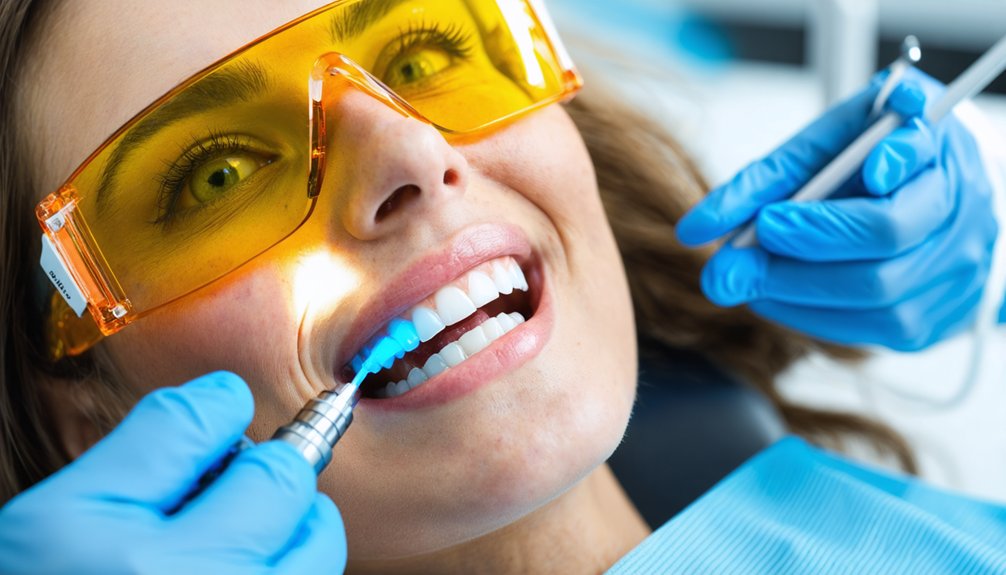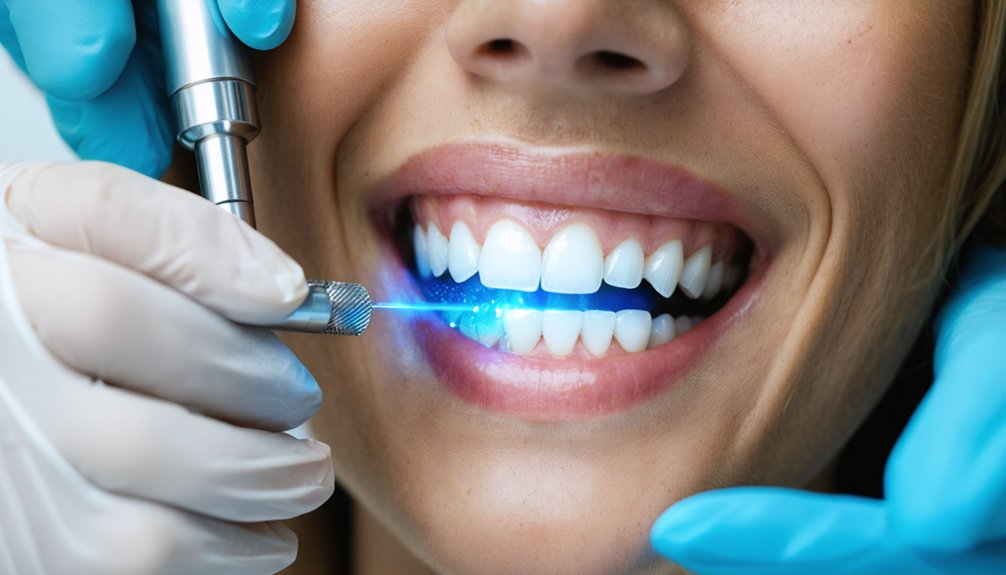
Most dental insurance plans exclude laser teeth whitening as a cosmetic procedure, but you can maximize coverage by proving medical necessity through documented discoloration caused by trauma, medication, or disease. Your dentist must supply clinical notes, photographs, and precise ADA CDT codes (D9971–D9975) to support your claim. Employer plans or cosmetic riders may also offer partial reimbursement. Understanding your policy’s exact exclusion language is where your real coverage opportunity begins.
Key Takeaways
- Most dental insurance plans exclude whitening as cosmetic, but exceptions exist when discoloration results from trauma, medication, or documented medical conditions.
- Establish medical necessity through detailed dentist documentation, including diagnostic notes, clinical photographs, and treatment plans reflecting clinical rather than cosmetic intent.
- Use accurate ADA CDT codes (D9971–D9975) and obtain preauthorization records to strengthen claims and avoid automatic cosmetic exclusion denials.
- Employer-sponsored plans may offer cosmetic riders or annual whitening allowances up to $100; verify eligibility and network restrictions before scheduling treatment.
- When contacting insurers, ask about cosmetic allowances, preauthorization requirements, and rider availability; document representative names, dates, and reference numbers.
Does Insurance Cover Laser Teeth Whitening?
Laser teeth whitening is classified as a cosmetic procedure, which means most dental insurance plans won’t cover it. Approximately 83% of dental insurance plans in the United States exclude whitening benefits entirely.
You’ll typically find explicit insurance limitations within your policy’s exclusions section, where terms like “cosmetic procedures,” “external bleaching,” or “bleaching” appear.
Coverage exceptions exist but are narrow. Your plan may provide partial reimbursement if discoloration results from trauma, medication, or a diagnosed condition requiring restorative treatment.
Without a medically necessary classification, you’re responsible for the full out-of-pocket cost.
Understanding these insurance limitations early allows you to plan financially and explore available options.
Knowing your coverage limits upfront helps you budget wisely and consider alternative whitening solutions.
Reviewing your Summary of Benefits directly gives you the clearest picture of what whitening benefits, if any, your plan actually includes.
Cosmetic vs. Medically Necessary: Why the Label Determines Coverage
When your insurer labels a procedure cosmetic, you’re immediately excluded from standard reimbursement, regardless of clinical outcome.
If a dentist instead documents your discoloration as resulting from trauma, medication, or restorative necessity, that classification can activate benefits your plan would otherwise deny.
Your claim’s success ultimately hinges on the precision of your clinical documentation, not the procedure itself.
Cosmetic Label Limits Coverage
Whether a procedure gets covered often comes down to a single classification: cosmetic or medically necessary. Insurers use this label to enforce strict insurance limitations, and laser teeth whitening almost always lands on the wrong side. Cosmetic procedures are explicitly excluded in most dental plans, meaning your intent—improving appearance—overrides the technology used.
Here’s what that classification controls:
- Reimbursement eligibility – Cosmetic labels trigger automatic exclusions in roughly 83% of dental plans.
- Preauthorization outcomes – Insurers deny preauthorization requests when no medical necessity is documented.
- CDT code assignment – Codes D9971–D9975 signal cosmetic intent, prompting immediate claim rejection.
- Allowance access – Only select riders grant partial cosmetic benefits, requiring explicit policy verification.
You can’t change the procedure—but you can understand exactly where the barrier stands.
Medical Necessity Unlocks Benefits
Securing coverage hinges on one factor: whether your insurer classifies the procedure as medically necessary. If your discoloration stems from trauma, medication, or a documented disease condition, you’ve got grounds to argue medical necessity and access insurance benefits that cosmetic claims can’t utilize.
Your dentist must provide clinical documentation confirming the functional or substantial aesthetic impact of the discoloration. Submit that evidence alongside a preauthorization request, referencing the appropriate ADA CDT codes. Insurers respond to specificity, not assumptions.
If whitening is part of a restorative plan—matching new crowns or bridges, for example—request that your dentist explicitly frame it within that treatment context.
Positioning the procedure correctly in your claim documentation directly determines whether your insurer approves or denies reimbursement.
Documentation Determines Claim Outcomes
The label your insurer assigns to a procedure—cosmetic or medically necessary—directly controls whether your claim gets approved or denied.
Your claim documentation must reflect clinical language, not cosmetic intent. Precise treatment justification shifts the outcome in your favor.
Submit these four items to support your claim:
- Dentist’s written narrative confirming discoloration stems from trauma, medication, or disease
- Clinical photographs documenting pre-treatment condition and functional or restorative need
- ADA CDT codes D9971–D9975 accurately applied to the submitted procedure
- Preauthorization records showing insurer acknowledgment before treatment begins
Incomplete claim documentation triggers automatic denials.
You control the paper trail—build it deliberately.
Every document you submit either reinforces or undermines your treatment justification, so precision at this stage is non-negotiable.
Why Most Dental Insurance Plans Exclude Whitening Entirely
When your dental plan evaluates a procedure, it draws a hard line between treatments that restore health and those that improve appearance—and whitening falls firmly on the cosmetic side.
You’ll typically find explicit exclusion language in your policy’s limitations section, using terms like “cosmetic procedures,” “bleaching,” or “external bleaching” to disqualify coverage entirely.
Because insurers classify whitening as elective rather than medically necessary, approximately 83% of dental plans offer zero reimbursement for any whitening treatment, regardless of the method used.
Cosmetic Versus Medical Coverage
Most dental insurance plans exclude teeth whitening entirely because insurers classify it as a cosmetic procedure rather than a medically necessary treatment. Understanding this distinction helps you navigate coverage limits and build stronger claim support.
Insurance exclusions typically apply when:
- Treatment necessity is absent — no functional impairment or medical condition drives the procedure.
- Policy details classify it as aesthetic enhancements — bleaching appears explicitly under exclusions.
- Dental benefits are restricted — plans only reimburse procedures restoring health, not appearance.
- Cosmetic procedures lack documentation — insurers reject claims without clinical evidence of medical need.
You must review your plan’s exclusions section carefully. Identifying whether discoloration stems from trauma, medication, or disease is critical, as these exceptions can shift whitening from an aesthetic category into covered dental benefits.
Explicit Policy Exclusion Language
Knowing that insurers classify whitening as cosmetic sets the foundation, but the actual barrier to coverage is the specific language written into your policy documents.
Most plans embed policy exclusions directly into the limitations section, using terms like “external bleaching,” “bleaching agents,” or “cosmetic procedures” to block reimbursement. This specific language is legally binding and overrides any verbal assurances from agents or general benefit summaries.
You need to locate your Summary of Benefits and the full exclusions schedule, then search for these exact terms.
If your plan references ADA CDT codes D9971 through D9975 under excluded services, whitening is explicitly off the table.
Don’t rely on assumptions—your leverage depends on reading the precise contractual language that defines what your insurer will and won’t reimburse.
Whitening As Elective Treatment
Dental insurance operates on a foundational principle: benefits apply to procedures that prevent disease, restore function, or treat injury—not to those that improve aesthetics. Whitening techniques fall entirely outside this framework, classifying them as elective regardless of patient expectations or clinical quality.
Insurers exclude whitening because it meets none of their coverage criteria:
- No disease is treated — discoloration isn’t a medical condition
- No function is restored — appearance improvement doesn’t qualify
- No injury is addressed — unless trauma documentation supports the claim
- No clinical necessity exists — elective intent overrides procedural sophistication
Understanding this classification lets you stop pursuing standard reimbursement and instead focus on exceptions, riders, or allowances that actually align with your plan’s benefit structure.
When Insurance Actually Covers Laser Teeth Whitening
Although laser teeth whitening is almost universally classified as cosmetic, a narrow set of circumstances can trigger actual insurance coverage. Your plan may cover whitening when discoloration results directly from trauma, medication side effects, or a documented disease condition.
Laser teeth whitening can qualify for insurance coverage when discoloration stems from trauma, medication, or disease.
Coverage exceptions also apply when whitening integrates into a medically necessary restorative plan, such as shade-matching adjacent crowns or bridges.
To qualify, you’ll need thorough treatment documentation from a licensed dentist establishing clinical necessity rather than elective intent. Insurers require proof linking the discoloration to a specific medical cause before authorizing any reimbursement.
Submit supporting records, including diagnostic notes, photographs, and a detailed treatment plan. Without precise documentation, your claim will default to the standard cosmetic exclusion, regardless of the underlying condition causing the discoloration.
What Your Employer Plan or Cosmetic Rider Might Pay

Beyond medically necessary exceptions, your employer-sponsored plan or a cosmetic rider may open a separate pathway to partial reimbursement.
Employer allowances and cosmetic riders vary greatly, so you’ll need to verify specifics directly with your plan administrator.
Check these four coverage variables before scheduling treatment:
- Annual allowance cap – Some plans, like Humana’s, offer $100 yearly toward in-office whitening.
- Cosmetic riders – Separate add-on riders explicitly covering elective procedures require independent verification within your policy documents.
- Network restrictions – Allowances typically apply only to credentialed in-network providers.
- CDT code eligibility – Confirm whether codes D9971–D9975 qualify under your specific rider or employer benefit.
Contacting your HR department directly guarantees you’re working from accurate, plan-specific data rather than generalized summaries.
What Policy Language to Look for Before Assuming You’re Covered
Before you schedule a whitening appointment, review your policy’s limitations and exclusions section—not just the general benefits summary—to find explicit language that determines your actual coverage.
Look for terms like “cosmetic procedures excluded,” “external bleaching,” or “elective treatments not covered.” These phrases signal direct policy exclusions that eliminate whitening reimbursement entirely.
Specific policy language like “cosmetic procedures excluded” or “elective treatments not covered” signals zero whitening reimbursement.
Next, search for ADA CDT codes D9971 through D9975 in your member portal to identify whether whitening services are listed, restricted, or absent.
Coverage nuances often hide in rider language or annual allowance caps rather than standard benefit tables.
If you’re unsure, contact your insurer directly and ask about preauthorization requirements, deductibles, and any cosmetic service allowances.
Don’t assume coverage exists—verify it through the actual policy document.
Exactly What to Ask Your Insurer About Laser Whitening Benefits

When you call your insurer, ask specifically whether ADA CDT codes D9971 through D9975 are covered under your plan and whether laser-activated whitening is classified separately from standard bleaching treatments.
These insurance inquiries eliminate assumptions and force definitive coverage clarifications.
Confirm these four points directly:
- Preauthorization requirements — Ask whether whitening requires prior approval before treatment begins.
- Allowance caps — Determine if a cosmetic allowance exists and its exact dollar limit per benefit year.
- Rider availability — Ask whether a cosmetic services rider can be added to your current plan.
- Network restrictions — Confirm whether discounts apply only to specific in-network providers performing laser whitening.
Document every response with the representative’s name, date, and reference number to protect yourself during claims processing.
Laser Teeth Whitening Costs When You’re Paying Out of Pocket
Most patients paying out of pocket for laser teeth whitening will face costs ranging from $300 to $1,500 per session, depending on geographic location, provider credentials, and the specific light-activated system used.
Metropolitan providers typically charge closer to $1,500, while suburban clinics average $300 to $800. If your treatment plan requires three to four sessions, your total out of pocket expenses can reach $1,800 or more.
You’ll want to compare all available treatment options strategically. Dentist-prescribed at-home kits with professional-grade gels run $100 to $600 and deliver measurable results at reduced cost.
Over-the-counter products range from $10 to $100 but lack the concentrated formulations used clinically. Knowing these cost tiers lets you allocate your budget precisely and negotiate more effectively with your provider.
Frequently Asked Questions
Can Flexible Spending Accounts or HSAS Pay for Laser Teeth Whitening?
Coincidentally, just like insurance, FSAs and HSAs won’t cover your whitening expenses since the IRS classifies it as cosmetic. You’re subject to strict coverage limits — only medically necessary dental procedures qualify for tax-advantaged reimbursement.
Does Switching Dental Plans Mid-Year Affect Whitening Coverage Eligibility?
Switching mid-year can reset waiting periods and alter coverage implications entirely. You’ll need to review your new plan’s exclusions carefully, as most dental plan options don’t cover whitening regardless of when you switch.
Are There Tax Deductions Available for Medically Necessary Whitening Procedures?
You can deduct medically necessary whitening costs if your dentist documents medical necessity and you meet the IRS’s strict whitening criteria. Include it under qualifying medical expenses exceeding 7.5% of your adjusted gross income.
How Does Teeth Whitening Coverage Differ Between PPO and HMO Plans?
Like town criers of old, PPO advantages let you choose any dentist for whitening claims, while HMO limitations restrict you to network providers—but neither plan typically covers cosmetic laser whitening regardless of your chosen structure.
Can a Dentist Appeal a Denied Whitening Claim on Your Behalf?
Yes, your dentist can drive the claim process through dentist advocacy by submitting clinical documentation proving medical necessity, challenging cosmetic exclusions, and formally appealing the denial directly to your insurer on your behalf.
References
- https://www.aflac.com/resources/dental-insurance/does-insurance-cover-teeth-whitening.aspx
- https://www.guardianlife.com/dental-insurance/teeth-whitening
- https://www.insurebodywork.com/blog/what-does-teeth-whitening-insurance-cover
- https://www.dentalinsurance.com/resources/oral-health/insurance-teeth-whitening/
- https://www.humana.com/dental-insurance/dental-resources/teeth-whitening
- https://www.deltadentalct.com/our-plans/individual-and-family-plans/whitening
- https://cedardentalgroup.com/does-dental-insurance-cover-teeth-whitening/
- https://www.investopedia.com/ask/answers/111615/does-dental-insurance-cover-teeth-whitening.asp
- https://www.gentledental.com/resources/articles/does-insurance-cover-teeth-whitening
- https://www.youtube.com/watch?v=w5_cOSdbUIQ