Tetracycline stains aren’t surface-level problems, so surface-level products can’t fix them. The discoloration bonds directly to your dentin during tooth development, making it impossible for store-bought strips to reach. You need professional-grade systems like KöR Whitening or laser treatments that penetrate enamel and break those embedded chromophore bonds at the source. Choosing professional whitening means targeting the actual cause, not masking it. The right treatment depends on your stain’s severity, and there’s more to uncover ahead.
Key Takeaways
- Professional tetracycline whitening systems like KöR penetrate deep into dentin tubules, targeting intrinsic stains that over-the-counter products cannot reach.
- Laser whitening drives radical oxide molecules into dentin, achieving genuine deep stain removal rather than superficial brightening alone.
- Higher peroxide concentrations in professional systems break chromophore bonds within tetracycline stains, producing measurable and lasting results.
- Mild-to-moderate tetracycline stains respond well to professional bleaching, offering a less invasive alternative to porcelain veneers.
- Custom-fitted trays maximize whitening agent contact with stained surfaces, optimizing treatment outcomes over consistent, extended use.
What Tetracycline Staining Actually Does Inside Your Teeth
Tetracycline, a once-common antibiotic, doesn’t just pass through your body — it actively binds with calcium ions during tooth mineralization, embedding itself permanently within the dentin layer beneath your enamel.
This process creates intrinsic staining, meaning the discoloration originates deep within your tooth’s structure, not on its surface.
Initially, these stains appear fluorescent yellow. However, prolonged sunlight exposure oxidizes the chromophores, shifting colors toward gray or dark brown.
Your anterior teeth typically show more severe discoloration than molars because of greater sunlight exposure.
Exposure during childhood development or in utero from maternal antibiotic use triggers this irreversible process.
Understanding this mechanism gives you power — because addressing intrinsic staining requires targeted professional strategies, not surface-level solutions your drugstore shelf can offer.
Why Whitening Strips and Store Products Won’t Touch These Stains
Now that you understand why tetracycline staining embeds itself so deeply within your dentin, it’s easier to see why whitening strips and over-the-counter gels can’t deliver meaningful results.
These store product limitations stem from their low peroxide concentrations, typically too weak to penetrate beyond your enamel surface. Tetracycline chromophores bond within dentin, sitting far beneath where surface-level bleaching agents can reach.
Ineffective whitening methods like strips, rinses, and drugstore trays weren’t engineered for intrinsic staining—they target surface discoloration only.
Even with consistent use, you won’t break the chemical bonds holding those stains in place. You need professional-grade systems that drive oxygen deep into tooth microstructure.
Without that penetration, you’re simply treating the surface while the real problem remains untouched underneath.
Professional Whitening Systems Ranked for Tetracycline Cases
When over-the-counter options fail, you’ll need to evaluate professional-grade systems specifically engineered for tetracycline’s deep chromophore bonds.
Not all professional treatments perform equally—KöR Whitening consistently outranks competitors by penetrating tooth microstructure to break stubborn stain molecules that standard in-office bleaching can’t reach.
Understanding how each system targets tetracycline discoloration lets you make an informed decision before committing to a months-long treatment protocol.
Top-Ranked Whitening Systems
Three professional whitening systems stand out for tackling tetracycline stains, each offering distinct mechanisms and results. Unlike home remedies, these options penetrate dentin where stains embed permanently.
Top systems you should consider:
- KöR Whitening — breaks chromophore bonds within tooth microstructure for superior, longer-lasting results.
- Opalescence PF — 10–15% peroxide concentration delivers noticeable changes over consistent months-long application.
- Zoom!/Laser Whitening — combines high-energy photon activation with bleaching agents for mild-to-moderate cases.
- KTP Laser Treatment — facilitates radical oxide penetration into dentin without compromising pulp integrity.
Patient testimonials consistently highlight KöR as the benchmark system for severe tetracycline discoloration.
You’ll need professional supervision to match treatment intensity to your stain severity, optimizing outcomes rather than guessing with ineffective alternatives.
Comparing Professional Treatment Options
Choosing the right whitening system for tetracycline stains requires more than picking the most popular option—it demands matching treatment intensity to your stain’s depth, severity, and chromophore bond strength.
KöR Whitening leads in treatment effectiveness for severe cases, penetrating tooth microstructure to break resistant chromophore bonds where standard systems fail.
Opalescence PF at 10-15% peroxide delivers measurable improvement over months through consistent overnight tray application.
Patient testimonials consistently distinguish KöR from Zoom! or standard in-office bleaching, particularly for grade III-IV staining.
Laser-assisted treatments using KTP technology enhance radical oxide penetration into dentin without pulp compromise, making them viable for moderate cases.
You’re not selecting convenience—you’re selecting precision. Match your system to your stain’s chemistry, and you control your outcome.
How KöR Whitening Treats Deep Tetracycline Stains
When you choose KöR Whitening, you’re selecting a system engineered specifically to break chromophore bonds—the molecular structures responsible for tetracycline’s stubborn, embedded discoloration.
Unlike standard bleaching agents, KöR’s refrigerated gels maintain peak chemical activity, allowing oxygen radicals to penetrate deeply into dentin where surface treatments can’t reach.
This dual action of bond breakdown and deep structural penetration makes KöR the most clinically effective option you’ll find for severe tetracycline staining.
KöR’s Chromophore Bond Breakdown
Because tetracycline stains bind deep within dentin during tooth mineralization, they resist conventional whitening agents that can’t penetrate far enough to break the chromophore bonds responsible for discoloration.
KöR effectiveness stems from its refrigerated, high-concentration peroxide formulation, which maintains peak oxygen activity throughout treatment, enabling deeper microstructural penetration.
This sustained chromophore release systematically dismantles discoloration bonds conventional systems can’t reach.
KöR’s approach delivers measurable advantages:
- Continuous oxygen diffusion saturates dentin tubules for prolonged reaction time
- Refrigerated formula integrity prevents premature peroxide breakdown before application
- Microstructure penetration targets chromophore bonds embedded below the enamel surface
- Controlled delivery via custom trays maximizes agent contact and absorption
You’re not gambling on unpredictable results—you’re executing a clinically precise process engineered to systematically reduce even severe tetracycline discoloration.
Deep Dentin Stain Penetration
KöR’s chromophore bond breakdown works precisely because its formulation reaches where conventional agents fail—deep within dentin.
When tetracycline binds calcium during tooth mineralization, it embeds stain molecules below the enamel surface—far beyond where strips or standard gels penetrate.
KöR’s refrigerated, high-concentration peroxide maintains potency long enough to diffuse through enamel into dentin, targeting those embedded chromophores directly.
This sustained oxygen radical activity is what drives genuine deep stain removal, rather than superficial brightening.
You’re not masking discoloration—you’re chemically dismantling it at its structural source.
That distinction determines whitening effectiveness for tetracycline cases.
What Laser Whitening Actually Does to Tetracycline Stains
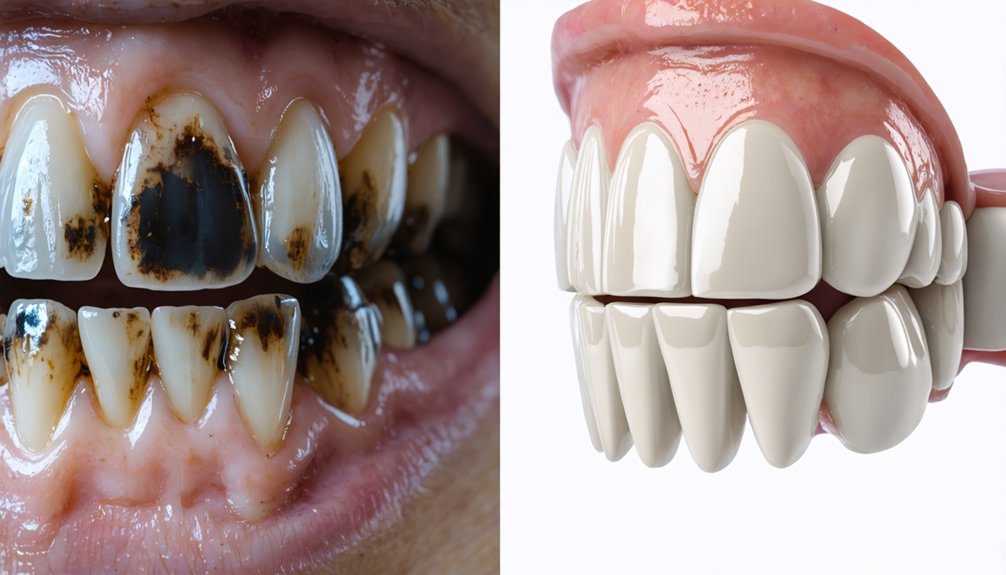
Laser whitening takes a fundamentally different approach to tetracycline stains than conventional bleaching methods. Using KTP laser technology, it drives radical oxide molecules directly into dentin, targeting chromophore bonds that standard gels can’t reach. This laser efficacy translates into measurable stain removal at the structural level—not just the surface.
Here’s what the laser actually accomplishes:
- Delivers higher photon energy than LED or diode alternatives
- Penetrates dentin without causing pulp damage
- Breaks chromophore bonds embedded within tooth microstructure
- Works synergistically with bleaching agents for enhanced oxidation
After irradiation, your dentist applies fluoride gel to seal dentinal tubules, preventing hypersensitivity.
You’re not guessing at results—you’re executing a clinically controlled process that targets tetracycline discoloration with precision unavailable through over-the-counter solutions.
How Long Does Tetracycline Teeth Whitening Actually Take?
Understanding what laser whitening does to tetracycline stains sets up a critical question: how long before you actually see results?
Treatment duration varies greatly based on stain severity. Mild-to-moderate cases typically require multiple professional sessions spanning several months, while overnight custom trays can demand up to 12 months of consistent use—compared to just six weeks for conventional staining.
Managing patient expectations is essential. You won’t achieve complete stain elimination; instead, you’ll experience gradual, progressive reduction in discoloration intensity.
Monthly maintenance treatments sustain those hard-won results long-term.
The timeline feels demanding, but patients consistently report noticeable improvements and positive feedback from others after committing to the process.
You control the outcome by staying consistent—skipping sessions directly compromises your results.
Porcelain Veneers for Tetracycline Stains Too Deep to Whiten
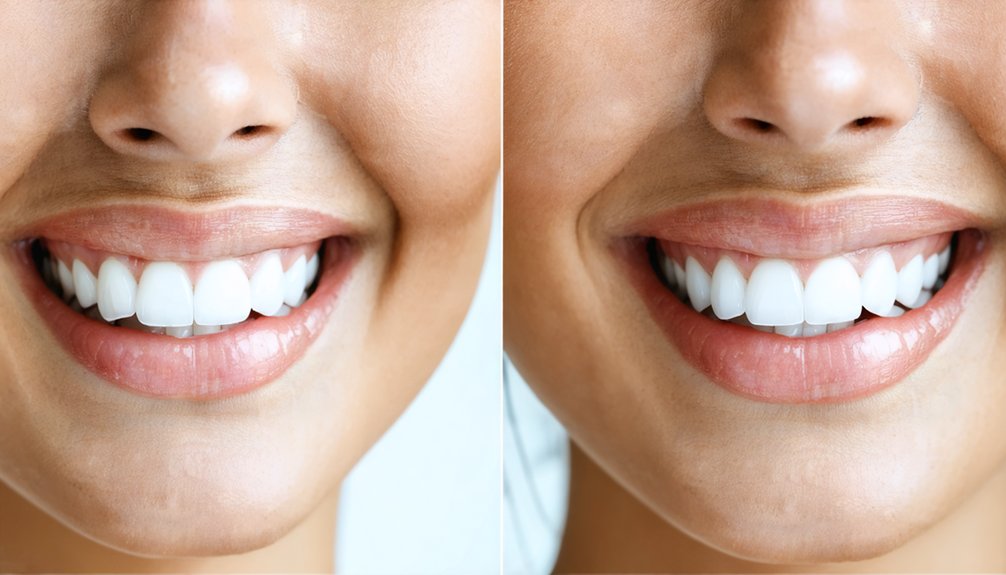
When whitening reaches its scientific limits, porcelain veneers become your most effective solution for tetracycline stains that bleaching agents simply can’t resolve.
Severe intrinsic discoloration embedded within dentin requires a restorative approach rather than chemical intervention.
Porcelain benefits extend beyond aesthetics — you’re gaining complete stain coverage, natural translucency, and customizable shade control.
Veneer durability guarantees your investment lasts 10-15 years with proper maintenance.
Consider veneers when:
- Stains remain after 12+ months of professional bleaching
- Discoloration penetrates deeply into dentin layers
- Predictable, immediate results are your priority
- Multiple teeth require uniform color correction
Your cosmetic dentist will evaluate stain severity, tooth structure integrity, and candidacy before recommending this precision-driven solution.
Veneers don’t compromise — they deliver definitive, controlled outcomes where whitening cannot.
How to Tell Whether Whitening or Veneers Is Right for Your Case?
Choosing between whitening and veneers isn’t guesswork — it’s a clinical decision based on stain depth, severity, and your treatment goals.
If your stains fall within mild-to-moderate classification, professional bleaching systems like KöR can penetrate dentin and break chromophore bonds effectively.
Don’t let whitening myths convince you that all intrinsic stains respond identically — severity dictates protocol. Your dentist evaluates fluorescence, band location, and enamel integrity before recommending a regimen.
For severe, deeply embedded discoloration unresponsive to extended bleaching, veneer advantages become undeniable — they mask stains entirely while reshaping tooth contour simultaneously.
You’re not choosing between inferior and superior options; you’re matching the right intervention to your specific clinical profile.
Get a professional assessment, review your stain classification, and make an evidence-based decision.
Frequently Asked Questions
Can Tetracycline Whitening Treatments Affect Existing Dental Crowns or Fillings?
Over 60% of restorations remain unaffected—tetracycline effects won’t alter your dental restoration materials. Bleaching agents don’t change crowns or fillings, so you’ll notice uneven whitening between natural teeth and existing restorations.
Is Tetracycline Teeth Whitening Covered by Dental Insurance Plans?
Dental insurance typically won’t cover tetracycline teeth whitening, as insurers classify it as cosmetic. You’ll likely bear treatment costs out-of-pocket, so consult your provider to explore flexible payment plans and maximize your investment in achieving brighter results.
What Age Is Considered Too Old for Tetracycline Whitening Treatment?
Forsooth, there’s no age limit for tetracycline whitening! Age considerations don’t restrict treatment effectiveness—you can pursue professional whitening at any adult age. Your dentist’ll assess your unique staining severity and customize a plan that delivers your brightest possible smile.
Can Pregnant Women Safely Undergo Tetracycline Teeth Whitening Procedures?
You shouldn’t undergo tetracycline whitening while pregnant due to serious safety concerns—bleaching agents may harm fetal development. Instead, explore alternative options like consulting your dentist post-pregnancy, when professional whitening treatments become safely accessible for your smile transformation.
Does Tetracycline Whitening Worsen Tooth Sensitivity Permanently Over Time?
Imagine a patient completing 12 months of KöR therapy—tooth sensitivity fades post-treatment. Tetracycline whitening doesn’t permanently worsen long-term effects; fluoride gel seals dentinal tubules, protecting you effectively throughout the process.
References
- https://www.healthline.com/health/tetracycline-teeth
- https://www.vegastoothdr.com/can-teeth-whitening-fix-tetracycline-stains
- https://elmhurstdentists.com/blog/elmhurst-cosmetic-dentist-explains-how-kor-whitening-can-lighten-tetracycline-stained-teeth
- https://www.dorsetstreetdental.com/tetracycline-stains-fighting-back-for-a-brighter-whiter-smile/
- https://pmc.ncbi.nlm.nih.gov/articles/PMC2741196/
- https://www.korwhitening.com/6-things-know-treating-tetracycline-patient-kor-whitening-products/
- https://goldstardentalstation.com/can-teeth-whitening-fix-tetracycline-stains/
- https://myserenitydental.com/remove-tetracycline-stains-from-teeth/
- https://blog.ultradent.com/transforming-tetracycline-stains-with-opalescence-whitening
- https://smilepath.nz/blogs/aesthetics/teeth-whitening-for-tetracycline-teeth