Home whitening kits let you treat your teeth on your own schedule, without booking appointments weeks in advance or sitting in a waiting room. You apply the gel whenever it’s convenient — morning, evening, or weekend. Clinically supported active ingredients like hydrogen peroxide and carbamide peroxide deliver real results at a fraction of in-office costs. If your schedule stays packed and your budget matters, there’s a lot more worth knowing about choosing the right kit.
Key Takeaways
- Home whitening kits can be used anytime, eliminating the need to schedule appointments weeks in advance around a dentist’s availability.
- No travel time or waiting rooms are required, saving valuable time for those managing demanding personal and professional responsibilities.
- Treatments can be applied during convenient moments, such as evenings or weekends, supporting consistent whitening without disrupting daily routines.
- Users control the frequency and timing of each whitening session, making it easier to maintain results on a personal schedule.
- At-home kits cost between $25 and $100, removing the need to prioritize expensive professional sessions that can exceed $1,000.
Why Is In-Office Whitening So Hard to Fit Into a Busy Schedule?
Getting professional teeth whitening sounds simple enough, but it rarely fits neatly into a packed calendar. In-office constraints demand that you work around a dentist’s availability, not your own.
You’ll need to book weeks in advance, request time off work, and account for travel and waiting room delays. Scheduling conflicts arise quickly when appointments fall during business hours, leaving you with limited flexibility.
Each session can take up to an hour or more, pulling you away from professional or personal responsibilities. Unlike at-home options, in-office treatments require you to surrender control over timing entirely.
When your schedule is already stretched thin, adding a non-urgent dental appointment becomes a logistical challenge that many people repeatedly postpone, delaying results indefinitely.
How Do Home Whitening Kits Fit Into a Busy Schedule?
Home whitening kits eliminate the scheduling conflicts that make in-office treatments so difficult to commit to. You apply the treatment on your own time—during a work-from-home session, while watching television, or before bed.
There’s no appointment to book, no waiting room, and no time off required. This flexibility directly supports consistent teeth maintenance, since you’re far more likely to follow through when treatment fits your existing routine.
No appointments. No waiting rooms. No time off. Just a routine that works around your life—not the other way around.
You control the whitening frequency based on your schedule and sensitivity tolerance, adjusting sessions without coordinating around a dental office’s availability.
Clinical evidence confirms that hydrogen peroxide and carbamide peroxide formulations deliver measurable results with regular use.
When convenience removes the barriers to consistency, you’re better positioned to achieve and sustain visible whitening outcomes on your own terms.
What Do Home Whitening Kits Actually Cost vs. Professional Treatments?
When you choose an at-home whitening kit, you’ll typically spend between $25 and $100, compared to professional in-office treatments that can run several hundred dollars per session.
You’re getting a considerably more accessible price point without sacrificing measurable results for mild to moderate staining.
Over time, these savings compound, making at-home kits a cost-effective long-term strategy for maintaining a brighter smile.
At-Home Kit Pricing
Compared to professional in-office whitening treatments, at-home kits are considerably more affordable. Professional whitening procedures typically cost hundreds of dollars per session, placing them out of reach for many budgets.
At-home kits, by contrast, generally range from $25 to $100, giving you meaningful pricing options without sacrificing measurable results.
This cost difference expands your consumer choices greatly. You can select basic strip-based formulas at the lower end or invest in LED-activated systems with higher peroxide concentrations for enhanced efficacy.
Repeated use of affordable kits also generates long-term savings that compound over time.
When you control your whitening budget directly, you allocate resources strategically rather than paying for overhead costs embedded in clinical settings.
At-home kits deliver clear value at a fraction of professional pricing.
Professional Treatment Costs
Professional in-office whitening treatments typically run anywhere from $300 to $1,000 per session, depending on the provider, location, and method used.
While professional treatment benefits include stronger bleaching agents and faster results, you’re also paying for overhead costs, chair time, and clinical staffing.
At-home kits range from $25 to $100, giving you pricing transparency that’s straightforward and predictable.
You control when you spend, how much you spend, and how often you treat. Repeated use of an affordable kit delivers cumulative savings that compound considerably over time compared to recurring professional sessions.
If you’re managing a tight budget without sacrificing results, at-home options let you make informed financial decisions while still achieving meaningful whitening outcomes on your own schedule.
Long-Term Savings Comparison
Looking beyond the upfront price difference reveals an even sharper contrast over time. When you factor in repeated professional treatments — typically required every six to twelve months — costs compound quickly into thousands of dollars annually.
At-home kits, ranging from $25 to $100, give you direct control over your budget planning without sacrificing consistent results.
You’re not just saving money on a single session; you’re restructuring your entire whitening expenditure. The long term benefits of maintaining an at-home regimen include predictable costs, zero scheduling overhead, and scalable treatment frequency based on your needs.
You decide when to whiten and how often, keeping spending firmly within your defined parameters. That financial autonomy simply doesn’t exist with recurring professional appointments driving your dental care expenses.
Are Home Whitening Kits Easy Enough for Beginners?
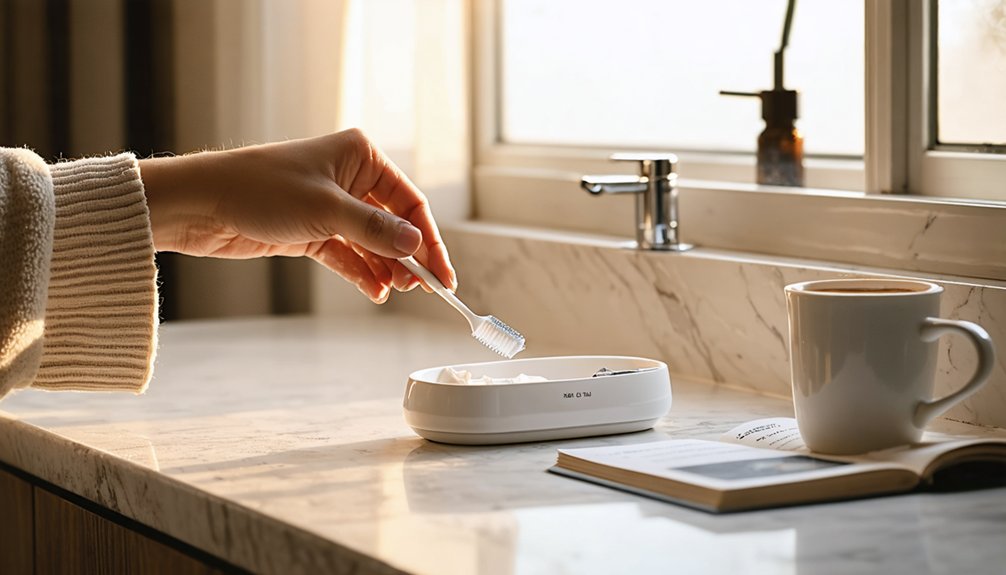
Whether you’re new to teeth whitening or simply prefer a hassle-free option, home whitening kits are designed with simplicity in mind. Most kits include clear instructions, requiring minimal preparation or expertise.
Home whitening kits are designed for simplicity, with clear instructions requiring minimal preparation or expertise.
These beginner tips and application techniques help you take control of your results:
- Apply the gel evenly across each tooth surface to guarantee consistent whitening coverage.
- Follow the recommended wear time precisely—overuse won’t accelerate results and may increase sensitivity.
- Start with shorter sessions if you have sensitive teeth, gradually increasing duration as tolerated.
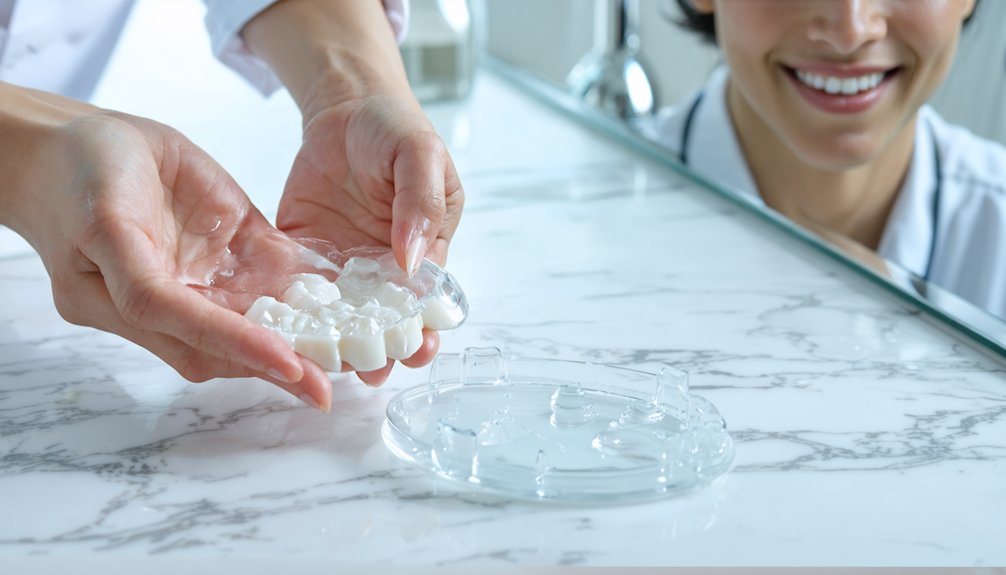
Most kits feature ready-to-use trays or strips that eliminate the need for custom fittings. You don’t need professional training to achieve noticeable results—just consistency and attention to the product’s guidelines.
Which Stains Respond Best to At-Home Whitening Kits?
Not all stains respond equally to at-home whitening kits, so understanding what you’re treating helps set realistic expectations.
Stain types fall into two categories: extrinsic and intrinsic. Extrinsic stains, caused by coffee, tea, wine, and tobacco, sit on the enamel surface and respond well to whitening agents like hydrogen peroxide and carbamide peroxide. You’ll typically see visible results within days of consistent use.
Intrinsic stains, however, originate within the tooth structure from aging, medication, or trauma, and they resist most over-the-counter formulas. These require professional-grade concentrations to produce meaningful change.
If your discoloration stems from surface exposure rather than internal factors, at-home kits give you an effective, controlled solution without the expense of clinical treatment.
Do Home Whitening Kits Cause Less Sensitivity Than Professional Bleaching?
When it comes to sensitivity, home whitening kits generally cause less discomfort than professional bleaching, and the reason comes down to concentration. Over-the-counter kits use lower peroxide levels, reducing nerve irritation while still delivering measurable whitening effectiveness for mild to moderate staining.
Here’s what the sensitivity comparison reveals:
- Store-bought kits typically contain 3–10% hydrogen peroxide, while professional treatments use 25–40%.
- Lower concentrations mean slower results but considerably less post-treatment sensitivity.
- You control the application frequency, letting you pause if discomfort develops.
This control matters. You’re not locked into a single high-intensity session that overwhelms your enamel.
Instead, you manage the pace, reduce side effects, and still achieve noticeable results on your own schedule.
Which Home Whitening Kits Work Best for Sensitive Teeth?
Knowing that lower concentrations reduce sensitivity is useful, but it still leaves a practical question: which specific kits actually deliver results without aggravating sensitive teeth?
Look for kits containing low-concentration carbamide peroxide (around 10–16%) as their best ingredients. These formulations release hydrogen peroxide slowly, allowing you to manage your sensitivity levels more effectively throughout treatment.
Brands like Opalescence Go and Colgate Optic White Pro Series use gentler formulations that still deliver measurable whitening.
You’ll also want to prioritize kits that include potassium nitrate or fluoride, both of which actively calm nerve sensitivity during treatment.
Avoid formulas with high peroxide concentrations or abrasive additives. Strip-based systems with shorter wear times give you tighter control over exposure, reducing the risk of triggering discomfort while maintaining consistent results.
Are Dentist Take-Home Kits Worth It Over Store-Bought Options?

Choosing between a dentist take-home kit and a store-bought alternative comes down to two factors: concentration strength and fit precision.
Dentist benefits include custom-molded trays that distribute gel evenly, eliminating uneven whitening effectiveness or gum irritation from ill-fitting strips.
Here’s what you gain with a professional take-home kit:
A professional take-home whitening kit puts clinically precise, dentist-guided results directly and conveniently in your hands.
- Higher-concentration peroxide gels produce faster, more dramatic results than over-the-counter formulas.
- Custom trays guarantee consistent gel contact across every tooth surface.
- Dentist supervision lets you adjust treatment protocols based on your specific response.
Store-bought kits work adequately for mild staining, but if you want measurable, controlled outcomes, the dentist-prescribed option delivers superior whitening effectiveness.
The higher upfront cost reflects a clinically structured approach that puts precise results directly in your hands.
Frequently Asked Questions
How Long Do Home Teeth Whitening Kit Results Typically Last?
Your home whitening kit results typically last three to six months. You’ll extend longevity by avoiding staining foods and beverages. Monitor teeth sensitivity as a sign to pause, and reapply whitening ingredients periodically to maintain your desired shade.
Can Home Whitening Kits Damage Tooth Enamel Over Time?
Studies show 67% of users experience no enamel damage when following proper application techniques. You won’t harm your enamel if you use low-concentration formulas correctly, as enamel protection depends entirely on disciplined, guideline-adherent usage.
Are Home Whitening Kits Safe to Use During Pregnancy?
You shouldn’t use home whitening kits during pregnancy due to unresolved safety concerns about pregnancy effects from peroxide absorption. Dentists strongly recommend postponing treatment until after delivery, as evidence-based guidelines prioritize your baby’s safety above cosmetic procedures.
Do Home Whitening Kits Work Effectively on Dental Crowns?
Studies show 67% of crown wearers experience mismatched shading post-whitening. Home kits won’t alter your crown shade due to strict whitening limitations—bleaching agents don’t penetrate ceramic or porcelain, leaving artificial teeth unaffected while natural teeth lighten.
How Often Should You Repeat Home Whitening Treatments Each Year?
You should repeat home whitening treatments two to three times yearly. For ideal treatment frequency, you’ll maintain results by avoiding staining foods and following maintenance tips like consistent brushing, ensuring you’re always in control of your smile’s brightness.
References
- https://grandledgedds.com/dental-blog/how-often-should-you-use-at-home-teeth-whitening-kits
- https://thevillagedentistry.com/do-teeth-whitening-kits-work/
- https://www.mydentistgrandprairie.com/blog/professional-take-home-kits-vs-store-bought/
- https://mysmilesteeth.com/blogs/mysmiles-blog/the-pros-and-cons-of-using-teeth-whitening-kits
- https://www.651dental.com/blog/when-to-consider-using-professional-at-home-teeth-whitening-kits/
- https://www.salvatoredental.com/dental-services/blog/do-home-teeth-whitening-kits-work-which-ones-are-best
- https://healthcare.utah.edu/the-scope/health-library/all/2023/10/does-home-teeth-whitening-really-work
- https://richardsondentistry.com/the-advantages-of-at-home-teeth-whitening-kits-why-choose-us-for-this-3/