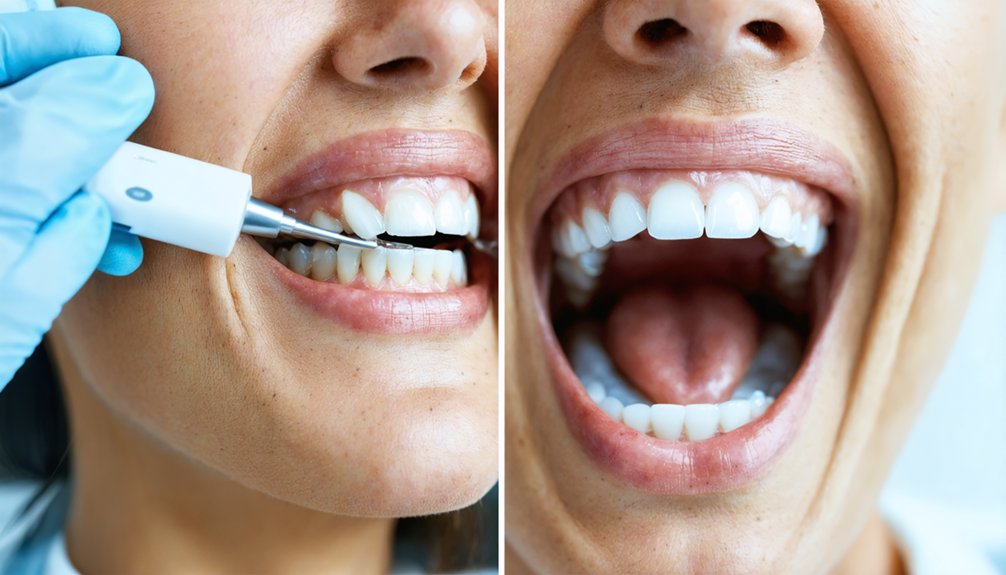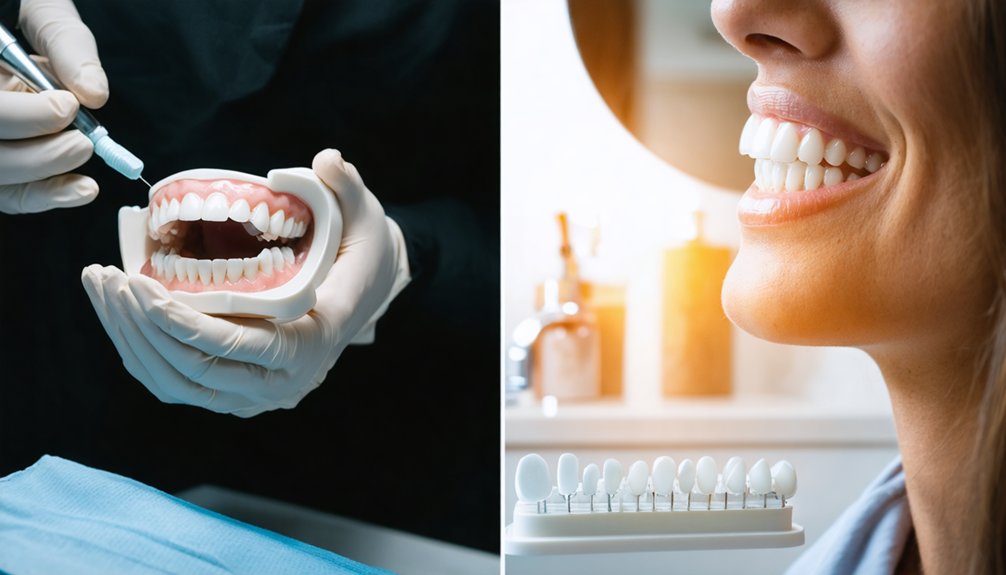
Professional whitening uses 25%–40% hydrogen peroxide with light activation, delivering 4–8 shade improvements in 1–2 hours and results lasting 1–3 years. At-home kits use concentrations as low as 0.1%, producing gradual results over weeks that fade within months. Your choice affects speed, evenness, sensitivity risk, and long-term cost. Each method works differently at a chemical and clinical level, and understanding those differences helps you make a smarter, more informed decision.
Key Takeaways
- Professional treatments use 25–40% hydrogen peroxide, while at-home kits are capped at 0.1%, making professional options significantly stronger.
- In-office whitening delivers results in 1–2 hours, improving 4–8 shades, while at-home kits take 2–8 weeks for gradual results.
- Professional whitening ensures uniform, consistent results, whereas at-home kits risk uneven or patchy outcomes without strict adherence to instructions.
- Professional results last 1–3 years, while at-home whitening typically fades within 3–6 months, requiring more frequent reapplication.
- In-office whitening costs around $650 per visit, while over-the-counter kits cost $20–$100 but need frequent replacement.
What’s Actually Inside Professional vs At-Home Whitening Products?
The single biggest difference between professional and at-home whitening products comes down to active ingredient concentration. In-office treatments use 25% to 40% hydrogen peroxide, allowing deeper dentin penetration and faster oxidization of stain molecules.
Dentist-dispensed take-home trays contain 10% to 22% carbamide peroxide, offering a middle ground between speed and control.
Compare that to over-the-counter kits, which UK regulations cap at 0.1% hydrogen peroxide. That’s a dramatic gap in whitening ingredients, and it directly determines what results you can realistically expect.
Higher concentrations require stricter safety measures. Clinics use protective barriers and light activation devices to manage sensitivity and protect soft tissues.
Without professional oversight, you’re working with weaker formulas and no clinical safeguards — a trade-off you need to understand before choosing your approach.
How Do Professional and At-Home Whitening Treatments Work?
Both professional and at-home whitening treatments rely on oxidization to break down stain molecules, but the mechanism’s speed and depth differ considerably.
Whitening treatments—professional or at-home—both harness oxidization to dissolve stains, yet their speed and depth vary dramatically.
In-office treatment mechanisms use 25–40% hydrogen peroxide with light activation, enabling professional supervision to drive ingredients deeper into dentin within one session. You experience dramatic results because higher concentrations oxidize stains faster and more completely.
At-home application techniques work more gradually. Over-the-counter kits deliver weaker formulas without customization options, increasing sensitivity management challenges and uneven coverage risks.
Dentist-dispensed trays offer a middle path, balancing ingredient differences with controlled professional oversight.
Your user experience, cost effectiveness considerations, and long-term effects all depend on which mechanism you choose. Stronger professional solutions penetrate further, while at-home methods trade speed for convenience and accessibility.
How Many Shades Whiter Can Each Option Realistically Deliver?
When you choose professional in-office whitening, you can realistically expect 4 to 8 shades of improvement within a single 1 to 2 hour session.
At-home kits, by contrast, typically deliver 3 to 6 shades of gradual lightening spread across 2 to 8 weeks of consistent use.
While both options produce measurable results, professional treatment gives you faster, more dramatic color change in one visit compared to the multiple applications at-home methods require.
Professional Whitening Shade Results
Professional in-office whitening delivers 4 to 8 shades of improvement in a single session lasting 1 to 2 hours, making it the most effective option for rapid, dramatic results.
Professional techniques guarantee shade consistency across all tooth surfaces through controlled application and supervised protocols.
Key outcome advantages include:
- Results visible within 1 to 14 days post-treatment
- Uniform surface penetration eliminating patchy or uneven lightening
- Dramatic color change achievable in one appointment
- Longevity lasting 1 to 3 years with proper maintenance
You’re getting predictable, measurable outcomes when a licensed professional manages every variable.
Unlike store-bought alternatives, professional techniques eliminate guesswork, giving you full confidence in your results before you leave the chair.
At-Home Kit Shade Gains
While in-office treatments set the benchmark for rapid shade gains, at-home kits occupy a different performance tier entirely. You’re working with lower active ingredient concentrations, which directly limits oxidization speed and depth.
Over-the-counter strips and trays typically deliver 3 to 6 shades of improvement, but that result unfolds gradually over 2 to 8 weeks of consistent application.
The effectiveness comparison matters when you’re weighing control against convenience. Your user experience with at-home kits demands discipline—missed applications extend timelines and reduce final outcomes.
Intrinsic stains respond poorly to weaker formulas, often producing uneven results across tooth surfaces. If you prioritize measurable, predictable shade gains on your own schedule, dentist-dispensed take-home trays using 10% to 22% carbamide peroxide represent a stronger, more reliable middle-ground option.
Comparing Both Whitening Outcomes
How far can each whitening method realistically take you? Whitening technology and treatment safety differ greatly between options, directly affecting your results. Here’s what the evidence shows:
- In-office professional whitening delivers 4 to 8 shades of improvement within 1 to 2 hours using 25% to 40% hydrogen peroxide.
- At-home kits produce 3 to 6 shades of gradual lightening over 2 to 8 weeks with maximum 0.1% peroxide.
- Dentist-dispensed trays offer a middle ground, achieving consistent results with 10% to 22% carbamide peroxide under supervised treatment safety protocols.
- Coverage consistency favors professional methods, as store-bought strips frequently create patchy or uneven results on deeper stains.
You control the outcome by choosing the method matched to your whitening goals.
How Long Do Professional vs At-Home Whitening Results Last?
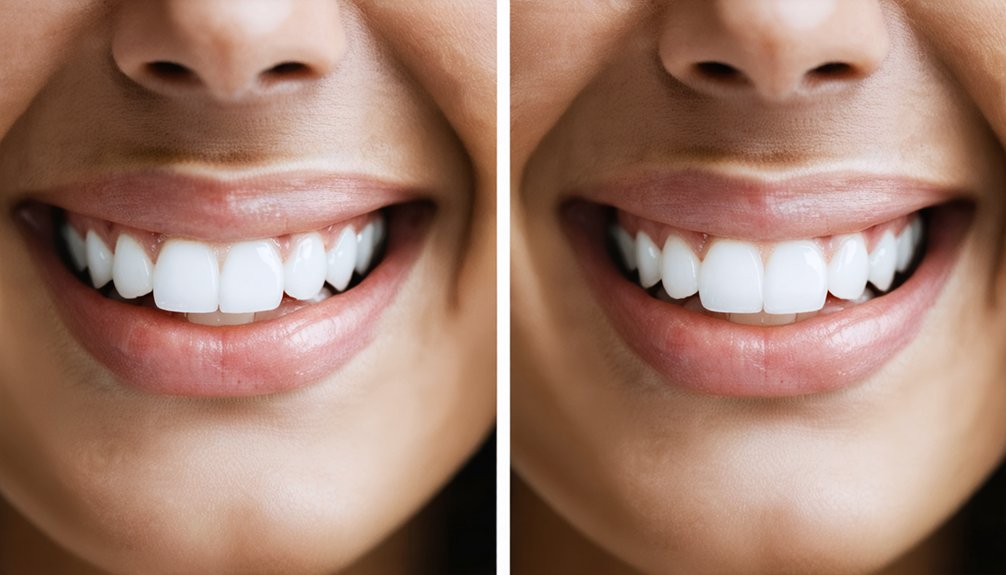
When you invest in professional whitening, you can expect your results to last 1 to 3 years with proper maintenance, greatly outpacing at-home alternatives.
Over-the-counter kits, by contrast, typically fade within 3 to 6 months, meaning you’ll need repeated purchases to sustain your results.
To extend the longevity of either treatment, you’ll need to manage stain-causing habits like coffee consumption and tobacco use while following your dentist’s maintenance recommendations.
Professional Results Longevity
Professional whitening results last notably longer than at-home alternatives, with in-office treatments maintaining brightness for 1 to 3 years under proper maintenance.
Your long-term maintenance strategy directly controls how effectively you preserve that investment.
Key factors influencing professional result longevity:
- Dietary habits — Limiting staining agents like coffee, red wine, and tobacco extends brightness duration greatly.
- Oral hygiene consistency — Daily brushing and flossing prevent surface stain accumulation between treatment cycles.
- Treatment frequency — Scheduling periodic touch-up appointments every 12 to 18 months sustains ideal color retention.
- Post-whitening protocol — Following your dentist’s aftercare instructions during the 48-hour sensitivity window protects enamel integrity.
Controlling these variables puts you in command of your results, maximizing the value of professional-grade whitening over time.
At-Home Results Duration
At-home whitening results fade considerably faster than professional treatments, typically lasting only 3 to 6 months before noticeable color regression occurs.
Without professional-grade peroxide concentrations, your results depend heavily on consistent reapplication and precise application techniques to maintain any visible improvement.
You’ll need to repurchase over-the-counter kits repeatedly, accumulating costs that rival professional options over time.
Generic trays complicate sensitivity management since poor fit increases gel contact with gum tissue, limiting how frequently you can safely retreat.
Dietary habits, tobacco use, and oral hygiene directly accelerate fading in at-home results.
You maintain control over your schedule, but that control requires disciplined adherence to product instructions and realistic expectations about the gradual, shorter-lasting outcomes these weaker formulations deliver.
Maintenance For Lasting Whitening
Maintaining your whitening results depends greatly on which treatment path you’ve chosen, since professional in-office treatments last 1 to 3 years while at-home kit results fade within 3 to 6 months.
Your post treatment care directly controls how long brightness persists. Effective whitening maintenance requires disciplined habits regardless of your chosen method.
Follow these evidence-based strategies to extend your results:
- Avoid staining agents like coffee, tea, and red wine immediately after treatment.
- Use dentist-recommended whitening toothpaste during daily brushing routines.
- Schedule periodic touch-up sessions aligned with your treatment type’s fade timeline.
- Maintain consistent dental hygiene appointments for professional monitoring.
At-home kit users face more frequent re-purchasing cycles, making disciplined post treatment care economically critical.
Professional patients retain results longer through supervised maintenance protocols.
How Fast Will You See Results With Each Whitening Method?
At-home options operate on a fundamentally different timeline. Over-the-counter kits require 2 to 8 weeks of consistent application before visible whitening occurs.
At-home whitening kits demand consistency — expect 2 to 8 weeks before any visible results appear.
Dentist-dispensed take-home trays perform better, producing gradual improvement across several weeks with lower sensitivity risk.
If speed is your priority, professional treatment is your most reliable option.
At-home methods demand patience and repeated applications, with results that are slower to appear and faster to fade without ongoing maintenance.
What Does Professional Whitening Cost Compared to At-Home Kits?
Speed comes at a price. Your cost comparison choices directly control how fast, safe, and lasting your results will be.
A thorough value assessment means weighing upfront costs against longevity and retreatment frequency.
Here’s what you’ll typically spend:
- In-office professional whitening — approximately $650 per visit, lasting 1–3 years
- Dentist-dispensed take-home trays — $250–$500 per treatment cycle with supervised safety
- Over-the-counter kits — $20–$100 per purchase, requiring replacement every 3–6 months
- Long-term OTC spending — repeated purchases accumulate costs that rival professional options
Professional treatments deliver superior longevity, reducing retreatment frequency.
At-home kits appear affordable initially, but fading results demand continuous repurchasing.
You control the equation by calculating total cost against sustained outcome quality.
Which Whitening Option Carries More Risk for Tooth Sensitivity?
How much discomfort you experience depends directly on the concentration of active ingredients and how closely a professional monitors your treatment.
In-office whitening uses 25% to 40% hydrogen peroxide, which penetrates deeper into dentin and elevates short-term sensitivity risk factors considerably. However, licensed dentists implement active sensitivity management strategies, including custom-fitted trays that prevent gel from contacting soft tissues.
At-home kits present a different risk profile. Over-the-counter products contain maximum 0.1% hydrogen peroxide, reducing chemical intensity, but you’re managing application entirely alone.
Generic ill-fitting trays increase gum irritation risk and offer zero sensitivity management support. Dentist-dispensed take-home trays using 10% to 22% carbamide peroxide balance gradual application with supervised guidance, making them the lower-risk middle ground between both options.
Do At-Home Whitening Kits Deliver the Same Even Coverage?
Coverage consistency separates professional whitening from store-bought alternatives in ways that affect your final results considerably.
At-home kits frequently produce uneven coverage due to imprecise application techniques and generic tray designs that don’t conform to your unique dental anatomy.
Key coverage limitations with at-home kits include:
- Strip misalignment leaves rear teeth untreated or partially whitened.
- Generic tray fit allows gel migration, reducing contact with target surfaces.
- Uneven coverage appears most noticeably on intrinsic stains resistant to weaker formulas.
- Inconsistent application techniques create patchy, asymmetrical lightening patterns.
Professional in-office treatments use custom-fitted trays and controlled application techniques ensuring complete surface penetration across every tooth.
Dentist oversight guarantees symmetric, uniform brightness that store-bought products structurally can’t replicate.
Which Teeth Whitening Option Is Right for You?
Choosing the right whitening option depends on your budget, timeline, and how dramatically you want to change your tooth color.
If you need fast, uniform results, professional in-office treatment delivers 4 to 8 shades of improvement in a single session.
If cost is your priority, over-the-counter kits offer gradual lightening at a fraction of the price, though results fade faster and uneven coverage remains a real limitation.
Dentist-dispensed take-home trays balance both factors effectively.
Don’t let whitening myths mislead you into assuming all products perform equally—concentration, fit, and supervision directly impact outcomes.
Not all whitening products are created equal—concentration, fit, and supervision determine whether you see real results.
Your teeth health also plays a role; underlying sensitivity or enamel erosion may eliminate certain options entirely.
Assess your priorities clearly, then choose accordingly.
Frequently Asked Questions
Can Teeth Whitening Treatments Damage Existing Dental Crowns or Veneers?
Whitening treatments won’t damage crowns or veneers, but they don’t alter their color either, reducing whitening effectiveness. You’ll notice uneven results and potential teeth sensitivity where natural teeth lighten but restorations remain unchanged.
Is Professional Teeth Whitening Suitable During Pregnancy or Breastfeeding?
You shouldn’t undergo professional teeth whitening while pregnant or breastfeeding due to significant safety concerns around peroxide exposure. You’ve got alternative options—postpone treatment until after breastfeeding, then pursue supervised professional whitening for ideal, controlled results.
How Soon After Whitening Can You Eat Staining Foods and Drinks?
You should avoid staining foods and drinks for at least 48 hours post-treatment. This window’s critical for maximizing your whitening duration, as pores remain open and absorb pigments more readily during this period.
Does Teeth Whitening Work on Naturally Yellow Versus Grey-Toned Teeth?
Whitening works better on naturally yellow teeth than grey-toned ones. Natural discoloration from staining responds well, but grey hues from trauma or tetracycline reduce treatment effectiveness considerably. You’ll achieve stronger results targeting yellow tones professionally.
How Often Can You Safely Repeat Professional Whitening Treatments Annually?
You can safely repeat professional whitening treatments once or twice annually. Your dentist controls whitening frequency to protect enamel integrity. Treatment safety depends on recovery time between sessions, typically six months, ensuring sensitivity subsides before your next appointment.
References
- https://www.dentalassociates.com/blog/professional-teeth-whitening-vs-at-home-teeth-whitening
- https://www.teethwhitening.london/blog/professional-teeth-whitening-vs-at-home-whitening
- https://www.veenstradental.com/blog/at-home-vs-professional-teeth-whiteningwhats-the-difference-
- https://drlorengrossman.com/professional-teeth-whitening-vs-at-home-and-which-one-wins/
- https://ofallondentalworks.com/professional-teeth-whitening-options/
- https://www.almostheavendentistry.com/blog/professional-teeth-whitening-vs-at-home-kits.html
- https://www.yourdentistryguide.com/inoffice-vs-athome/
- https://www.youtube.com/watch?v=S-TQeElIsAg
- https://familydentalclinic.com.au/news/in-chair-vs-at-home-teeth-whitening/
- https://www.reddit.com/r/Invisalign/comments/18kcw4m/whitening_at_dentists_vs_at_home/