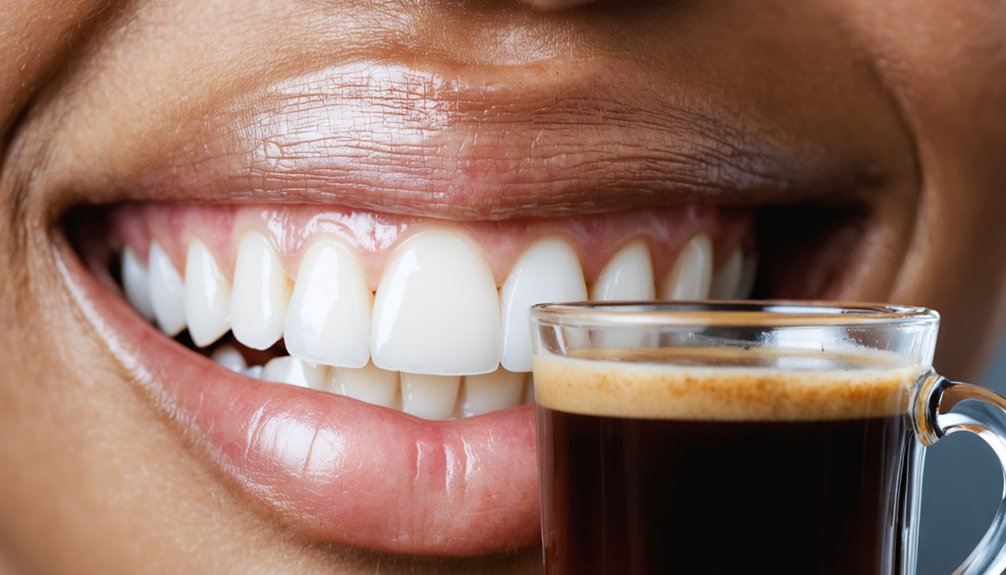
Your best treatment depends on how deep your staining goes. Light surface stains respond well to whitening toothpastes containing sodium hexametaphosphate or stannous fluoride used twice daily. Moderate staining often needs whitening strips with peroxide to oxidize embedded pigments over 2-3 weeks. Stubborn, years-long discoloration typically requires custom bleaching trays or professional in-office whitening for real penetration. The right daily habits also make a significant difference—and there’s much more to uncover ahead.
Key Takeaways
- Whitening toothpastes with sodium hexametaphosphate or stannous fluoride effectively combat light surface coffee stains when used twice daily.
- Whitening strips containing peroxide reduce moderate staining through oxidation, typically showing results within 2-3 weeks.
- Custom bleaching trays with higher peroxide concentrations penetrate deeper, stubborn stains that resist strips or toothpaste.
- Professional in-office whitening is the most effective option for long-term, severe coffee stains unresponsive to home treatments.
- Rinsing after coffee and waiting 30 minutes before brushing helps prevent new stains from forming or worsening.
Why Coffee Stains Your Teeth in the First Place
Coffee stains your teeth because of how its dark pigments, called tannins, bond to the outer layer of enamel. These compounds are inherently adhesive, and repeated exposure accelerates discoloration faster than most people expect.
Coffee brewing techniques influence stain intensity — darker roasts and longer brew times release higher tannin concentrations, increasing enamel contact with aggressive pigments. Espresso-based drinks, for example, deliver a more concentrated dose than filtered coffee.
In the tea vs coffee debate, both beverages contain tannins, but coffee typically produces more visible extrinsic staining due to its pigment density and acidity. Because these are surface-level stains rather than structural discoloration, you have real options for reversing them.
Understanding the cause gives you a precise starting point for choosing the right treatment strategy.
How Bad Are Your Coffee Stains, Really?
Before choosing any treatment, you need to honestly assess where your stains fall on the severity scale — because the right solution depends entirely on that starting point.
Your coffee brewing habits directly shape how deep that discoloration runs. Consider where you actually stand:
The way you brew your coffee determines exactly how deep — and how stubborn — your staining becomes.
- Light surface staining — Recent buildup that responds quickly to whitening toothpaste and consistent prevention habits.
- Moderate staining — Accumulated discoloration requiring strips, trays, or a professional cleaning for effective stain removal.
- Stubborn, long-term staining — Deep pigmentation that resists home methods entirely and demands in-office whitening intervention.
Misidentifying your stain level wastes time and money. If you’ve tried toothpaste for weeks without results, you’re not dealing with surface staining anymore — and treating it that way won’t work.
The Best Whitening Toothpastes for Coffee Stains
Whitening toothpastes work by combining mild abrasives with chemical agents that break down and lift extrinsic coffee stains from your enamel’s surface.
If you’re choosing a formula, prioritize ingredients like sodium hexametaphosphate, stannous fluoride, or peroxide, since research consistently links these compounds to stronger stain removal and color restoration.
For best results, you’ll want to brush twice daily and treat whitening toothpaste as a maintenance tool rather than a one-time fix.
How Whitening Toothpaste Works
Most whitening toothpastes work through two core mechanisms: mild abrasives that physically scrub surface stains off enamel, and chemical agents that break down or prevent pigment buildup. Coffee chemistry makes your teeth particularly vulnerable—tannins bind aggressively to enamel, demanding targeted stain removal strategies.
Here’s what separates effective formulas from ineffective ones:
- Sodium hexametaphosphate disrupts tannin adhesion at the molecular level, preventing coffee pigments from bonding to your enamel surface.
- Stannous fluoride strengthens enamel while actively fighting surface discoloration during routine brushing.
- Peroxide-based agents chemically oxidize embedded pigments, lightening stains that abrasives alone can’t fully eliminate.
Choosing a toothpaste with at least one of these ingredients puts you in control of progressive stain buildup before it demands professional intervention.
Top Ingredients To Seek
Not all whitening toothpastes deliver equal results against coffee stains, so knowing which active ingredients to prioritize can mean the difference between gradual fading and persistent discoloration. Coffee chemistry involves tannins that bind aggressively to enamel, so your toothpaste needs targeted compounds for effective stain removal.
Seek out sodium hexametaphosphate, which research identifies as the highest-efficacy ingredient against coffee-induced discoloration. It disrupts tannin adhesion at the surface level rather than simply abrading enamel away.
Stannous fluoride offers dual benefits, strengthening enamel while controlling surface staining.
Peroxide-based formulas chemically oxidize pigment molecules, breaking the bonds coffee chemistry creates.
Mild abrasives like hydrated silica support mechanical stain removal without excessive enamel wear.
Prioritizing these specific ingredients gives you measurable, evidence-backed control over progressive coffee discoloration.
Best Usage Practices
Choosing the right ingredients matters little if your application habits undermine them. Coffee composition—specifically its tannins and chromogens—drives rapid stain penetration, so timing and technique determine whether your toothpaste actually wins.
- Wait 30 minutes after your last cup before brushing. Coffee temporarily softens enamel, and brushing too soon accelerates surface erosion.
- Brush for a full two minutes using gentle, circular strokes. Rushing reduces contact time between active ingredients and stained surfaces.
- Rinse with water immediately after coffee, before stain penetration deepens. This one habit dramatically limits chromogen binding to enamel.
Consistency compounds results. Using the right toothpaste incorrectly still leaves you losing ground to daily coffee exposure.
Control your process, and the ingredients finally work as intended.
Do Whitening Strips Actually Work on Coffee Stains?
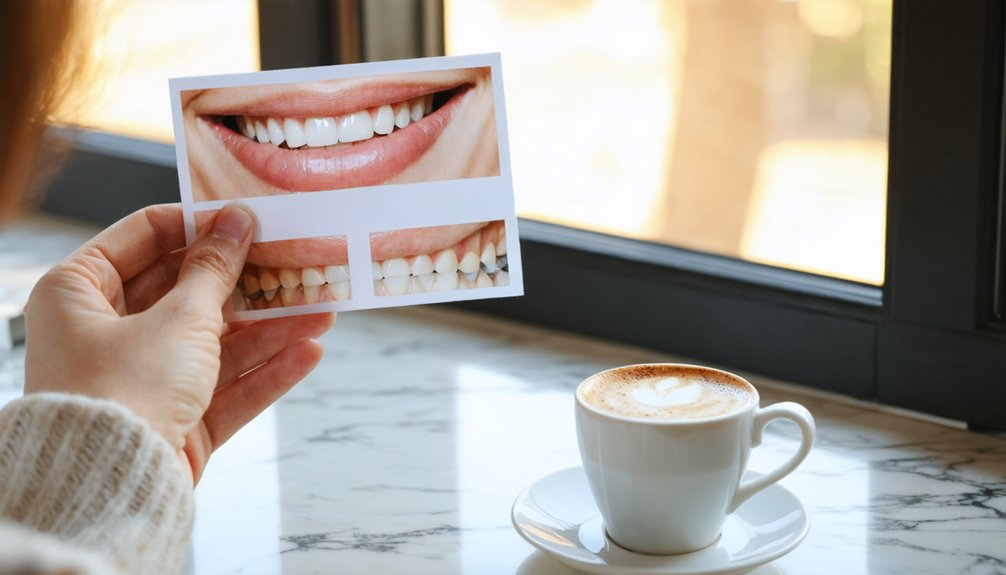
Whitening strips can reduce visible coffee staining, but their effectiveness depends on how deep the discoloration runs. Coffee chemistry involves tannins that bind to enamel proteins, and stain penetration determines whether strips can reach and break those bonds.
For surface-level buildup, strips deliver noticeable improvement within two to three weeks. They work by releasing peroxide, which oxidizes pigment compounds embedded in your enamel’s outer layers.
However, if you’ve allowed staining to accumulate over months or years, strips alone won’t deliver complete results. You’ll need to pair them with professional cleaning or in-office whitening for stubborn cases.
For best results, use strips consistently, maintain daily prevention habits, and don’t expect overnight transformation—strips reward disciplined, sustained application rather than sporadic use.
Home Remedies for Coffee Stains: What Actually Works
Home remedies for coffee stain removal range from genuinely useful to outright harmful, so understanding the evidence behind each option helps you avoid wasting time—or damaging enamel. Your coffee brewing habits directly influence stain severity, making your daily routine the first variable to control.
Not all home remedies are created equal—some remove coffee stains effectively, while others quietly destroy your enamel.
What actually delivers results:
- Baking soda — Its mild abrasive action physically lifts surface stains without aggressive chemical exposure.
- Hydrogen peroxide rinses — Chemically lightens stains when used correctly, though concentration and frequency matter considerably.
- Whitening toothpaste with sodium hexametaphosphate — The most evidence-backed home option for consistent stain removal.
Skip activated charcoal and apple cider vinegar. Charcoal lacks strong evidence, and vinegar’s acidity actively threatens enamel integrity—trading stains for structural damage isn’t a trade worth making.
Which Coffee Stains Actually Need Whitening Trays?

If your whitening toothpaste hasn’t reduced visible staining after consistent use, and strips have failed to deliver noticeable improvement over two to three weeks, your stains have likely progressed beyond surface-level discoloration.
Whitening trays—whether dentist-prescribed or over-the-counter—deliver stronger peroxide concentrations that penetrate deeper into enamel, making them the appropriate next step for stubborn or accumulated coffee stains.
You’ll typically need trays when discoloration appears uniform, yellowed, or resistant to mechanical and mild chemical treatments alone.
Toothpaste Has Failed
When whitening toothpaste stops delivering results after several weeks of consistent use, it’s a reliable sign that your coffee stains have progressed beyond what mild abrasives and surface-acting agents can address.
Repeated coffee absorption accelerates stain penetration into enamel layers that toothpaste simply can’t reach. At this stage, whitening trays with peroxide-based gel become necessary.
Recognize these clear indicators:
- Your teeth appear noticeably yellow despite twice-daily brushing with whitening toothpaste for four or more weeks.
- Surface discoloration has shifted from light tan to a deeper, more uniform brown tone.
- Stains remain visible immediately after brushing, confirming they’ve moved beyond the enamel surface.
Whitening trays deliver controlled bleaching directly where stain penetration has occurred, restoring results toothpaste can no longer achieve.
Stains Persist Despite Strips
Whitening strips plateau quickly once coffee stains have penetrated past the enamel surface, leaving you with diminishing returns after each treatment cycle. Strips deliver a fixed peroxide concentration across a generic fit, which limits both contact time and chemical penetration.
When each coffee bean you consume deposits pigment deeper into porous enamel, strips simply can’t maintain adequate bleaching exposure long enough to reverse that stain penetration.
Custom whitening trays solve this directly. A dentist-fitted tray holds higher-concentration gel flush against your tooth contours, extending active contact and driving peroxide further into stained enamel.
You control the treatment duration, allowing progressive whitening across multiple sessions. If strips have produced no visible improvement after two to three weeks, custom trays represent your most precise, evidence-backed escalation before committing to in-office whitening.
Deep Discoloration Requires Trays
Not every coffee stain warrants a custom tray, but certain patterns of discoloration signal that strips and toothpaste have already reached their ceiling. Coffee chemistry drives pigment compounds deep into enamel over time, making surface-level stain removal insufficient.
Trays become necessary when you recognize these situations:
- Yellowing persists after two full strip cycles, indicating pigment has penetrated beyond what low-concentration peroxide can reach.
- Discoloration appears uneven or patchy, suggesting inconsistent surface contact that only a fitted tray can correct through prolonged, controlled exposure.
- Staining has accumulated over years, meaning coffee chemistry has layered pigment repeatedly, requiring stronger bleaching concentration delivered consistently.
Custom trays give you precision. They hold higher-strength gel exactly where you need it, long enough to produce measurable stain removal results.
Professional Cleaning or In-Office Whitening: Which Do You Need?
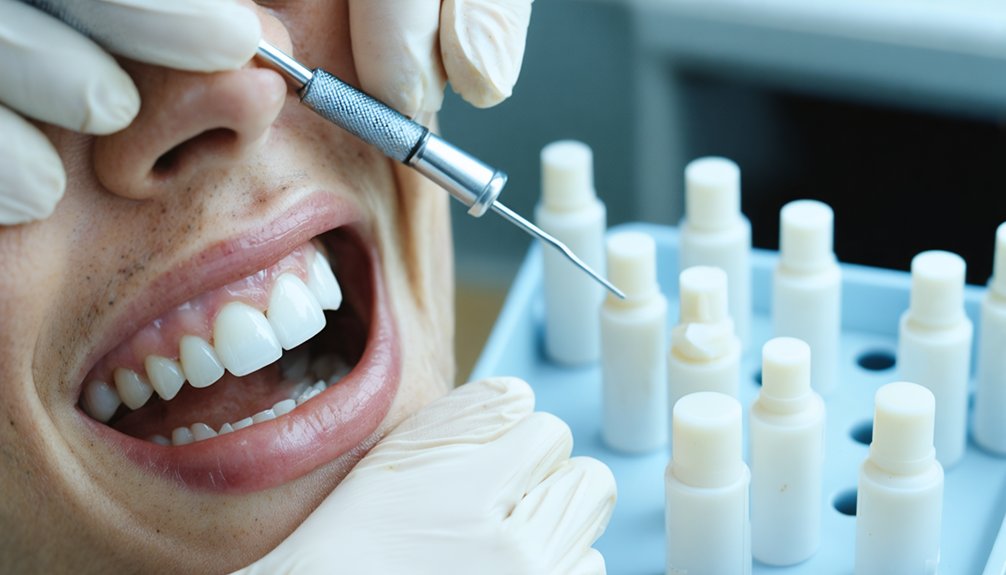
Choosing between a professional cleaning and in-office whitening depends on what’s actually causing your discoloration.
If coffee bean pigments have mixed with plaque and tartar buildup, a professional cleaning handles stain removal through scaling and polishing — restoring surface clarity without bleaching agents. That’s your starting point when hygiene-related buildup is the primary issue.
However, if your enamel carries deep, stubborn discoloration that at-home methods haven’t resolved, in-office whitening delivers faster, more dramatic results using high-concentration peroxide that over-the-counter products can’t match. You’re getting a controlled, dentist-supervised process that targets what brushing and strips leave behind.
Assess your situation precisely: surface buildup calls for cleaning first; persistent intrinsic discoloration demands whitening. Choosing the wrong option wastes time and delays results you could have sooner.
Daily Habits That Keep Coffee Stains Away
Professional treatments fix what’s already there — but your daily routine determines how fast stains return. Every coffee brewing session is another stain removal challenge. Control the outcome with these three non-negotiable habits:
- Rinse immediately after drinking — water dilutes pigments before they bind to enamel, cutting stain accumulation at the source.
- Wait 30 minutes before brushing — coffee softens enamel temporarily; brushing too soon accelerates surface damage rather than aiding stain removal.
- Brush twice daily with whitening toothpaste containing sodium hexametaphosphate — clinical evidence confirms it outperforms standard formulas for coffee-induced discoloration.
These habits don’t just slow staining — they extend the results of every professional treatment you’ve already invested in.
Consistency is your strongest defense.
The Right Treatment Plan Based on Your Stain Severity
How severe your stains are should determine every treatment decision you make — because applying in-office whitening to mild surface discoloration wastes money, while relying on toothpaste alone for deep, long-standing stains wastes time.
Stain severity should drive every treatment decision — mismatching the two wastes either your money or your time.
For light staining, consistent oral hygiene — twice-daily brushing with sodium hexametaphosphate or stannous fluoride toothpaste — handles routine stain removal effectively. Add rinsing after coffee, and you’ll likely maintain visible results.
Moderate staining responds better to whitening strips or trays over two to three weeks. If stains are mixed with tartar, schedule a professional cleaning first.
For stubborn, years-long discoloration that resists everything else, in-office whitening delivers the fastest, most dramatic correction.
Match your intervention to your stain severity, and you’ll avoid wasted effort at every stage.
Frequently Asked Questions
Can Coffee Staining Affect Dental Veneers or Crowns Differently Than Natural Teeth?
Studies show veneers resist staining up to 90% better than natural enamel. Coffee won’t penetrate your veneer’s porcelain surface, but you’ll notice crown discoloration at margins. Veneer durability depends on proper sealing and consistent maintenance.
Does the Type of Coffee Roast Affect How Badly It Stains Teeth?
Darker roasts carry lower coffee acidity but higher pigment concentration, meaning you’ll stain teeth faster. Apply targeted stain removal techniques—whitening toothpastes with sodium hexametaphosphate—to actively counteract roast-specific discoloration and maintain control over your smile.
Are Coffee Stains More Stubborn on Teeth With Existing Enamel Erosion?
Yes, enamel erosion accelerates stain penetration, making coffee stains considerably more stubborn on your teeth. When erosion compromises your enamel, pigments bind deeper into the surface, requiring stronger whitening interventions to effectively restore your tooth color.
Can Teeth Whitening Treatments Cause Sensitivity for People With Gum Recession?
Yes, whitening treatments can heighten gum sensitivity if you have recession. Recession impact exposes dentin, making peroxide penetrate deeper. You’ll want to choose lower-concentration formulas and consult your dentist to maintain control over discomfort levels.
Does Adding Milk or Creamer to Coffee Reduce Its Staining Effect on Teeth?
Adding milk reduces coffee’s staining potential through milk effects that dilute pigments, while creamer impact varies by formula. You’ll still need consistent whitening toothpaste and rinsing habits to effectively control stain buildup on your enamel.
References
- https://www.brownroaddental.com/ways-to-remove-coffee-stains-from-your-teeth/
- https://www.goodrx.com/conditions/dental-care/remove-coffee-stains-teeth
- https://oralhealthhq.com/teeth-whitening/coffee-stains/
- https://dentistinmanvel.com/goodbye-to-coffee-stains-8-effective-methods-to-brighten-your-smile/
- https://clubwhitesmile.com/top-tips-for-whitening-stained-teeth-from-coffee/
- https://pmc.ncbi.nlm.nih.gov/articles/PMC11551553/
- https://www.watforddentaloffice.ca/2023/01/20/ways-to-remove-coffee-stains-from-teeth/
- https://www.kin.es/en/evitar-manchas-cafe-dientes/
- https://www.barniescoffee.com/blogs/blog/a-coffee-lovers-guide-to-whiter-teeth
- https://www.healthline.com/health/dental-and-oral-health/what-does-coffee-do-to-your-teeth