The most effective whitening strips contain hydrogen peroxide at concentrations between 10% and 15%, which penetrate enamel to break down intrinsic stain molecules. Top-performing options include Crest 3D Whitestrips Professional Effects and Crest 3D Whitestrips with Light, the latter carrying the ADA Seal of Acceptance. You can expect results ranging from 7 to 23 shades lighter depending on the product and your baseline tooth color. There’s considerably more to know before choosing the right strip for your situation.
Key Takeaways
- Crest 3D Whitestrips Professional Effects whitens up to 23 shades using 10% hydrogen peroxide and holds the ADA Seal of Acceptance.
- Higher peroxide concentrations (e.g., 15%) deliver faster, more effective whitening results compared to lower-concentration alternatives.
- Crest 3D Whitestrips with Light combines peroxide with LED acceleration, making it a strong overall OTC option.
- Rembrandt strips produce approximately 7 shades of improvement within 2 weeks, offering a reliable mid-range option.
- Lumineux strips are the most effective peroxide-free option, providing clinically validated whitening safe for sensitive teeth.
What Makes Whitening Strips Actually Work?
Whitening strips work by delivering active bleaching agents—primarily hydrogen peroxide or carbamide peroxide—directly against the tooth surface, where they penetrate enamel and dissolve intrinsic stain molecules. Higher concentrations accelerate results, which is why professional-level strips containing 15% hydrogen peroxide outperform standard over-the-counter options.
Hydrogen peroxide penetrates enamel directly, dissolving stain molecules at the source for visibly faster, more effective whitening results.
Unlike more invasive cosmetic procedures, strips give you precise control over treatment frequency and intensity.
If you’re sensitive to peroxide, alternative ingredients derived from plant-based compounds are available, though they’re clinically less effective. Adhesive technology keeps the active layer in sustained contact with enamel, maximizing ingredient absorption with each session.
For consistent outcomes, you need proper strip placement—snug against the tooth surface, never overlapping the gums—to guarantee uniform delivery and minimize irritation risk.
Are Trays and LED Kits Actually Better Than Strips?
When comparing delivery systems, trays and LED mouthpieces do offer measurable advantages over strips—primarily in coverage and ingredient contact. However, alternative methods aren’t automatically superior for every user. Strips remain clinically effective, economical, and travel-friendly.
Consider these key distinctions before choosing:
- Coverage: Molded trays conform to tooth contours more precisely than adhesive strips.
- Ingredient contact: LED activation can accelerate peroxide penetration beyond passive strip application.
- Alternative methods: Custom trays allow higher peroxide concentrations under professional supervision.
- Natural remedies: Peroxide-free, plant-derived strips exist but consistently underperform bleaching-based systems.
If you prioritize convenience without sacrificing clinical results, strips remain a credible choice.
If maximum whitening control matters most, tray-based systems give you greater precision over concentration, duration, and fit.
The Best Whitening Strips You Can Buy Right Now
Once you’ve weighed delivery systems against your priorities, the next step is identifying which strips actually deliver on their claims. Crest 3D Whitestrips with Light holds the ADA Seal of Acceptance and remains the strongest over-the-counter option.
For maximum shade improvement, Crest 3D Whitestrips Professional Effects offers up to 23 shades of lightening using 10% hydrogen peroxide.
If ingredient safety is your primary concern, Lumineux provides a clinically validated, peroxide-free formulation suited for sensitive users.
REMEMBER Deeply White + Peroxide accelerates results through twice-daily application.
Cost comparison across these options reveals that higher-concentration strips carry premium pricing but reduce total treatment days.
Match your selection to your sensitivity threshold, whitening goals, and budget to maintain full control over your results.
How Much Whitening Can You Realistically Expect?
When using whitening strips, you can realistically expect anywhere from 7 to 23 shades of improvement depending on the product’s peroxide concentration and your adherence to the recommended protocol.
Most clinically supported treatments deliver visible results within 4 to 22 days, with higher-concentration formulas producing faster outcomes.
You’ll get the most accurate sense of your results by tracking shade changes against a dental guide rather than relying solely on brand claims, which often reflect best-case scenarios.
Shade Improvement Statistics
Shade improvement claims vary widely across whitening strip products, so understanding what the evidence actually supports helps you set realistic expectations. Results depend on your baseline tooth color, peroxide concentration, and adherence to protocol.
Key statistics to evaluate:
- Crest 3D Whitestrips Professional Effects claims up to 23 shades of lightening.
- Some brands advertise 18 shades within 20 days using a single 60-minute application.
- REMBRANDT’s twice-daily protocol delivers roughly 7 shades over two weeks.
- Dentist-recommended kits report 20 levels of whiteness after 22 days.
Color retention varies based on dietary habits and oral hygiene consistency. Without maintenance, stain reformation accelerates—particularly from coffee, tea, and wine.
You’ll achieve more predictable outcomes by selecting products with clinically supported shade claims rather than relying solely on marketing figures.
Realistic Whitening Timelines
Most whitening strip protocols deliver measurable results within 3 to 22 days, but your actual outcome depends on three variables: baseline tooth color, peroxide concentration, and protocol adherence.
Higher peroxide concentrations accelerate results but increase sensitivity risk, so you’ll need to balance speed against tolerance.
Gel consistency directly affects contact time and ingredient transfer—thinner gels may shift during wear, reducing efficacy.
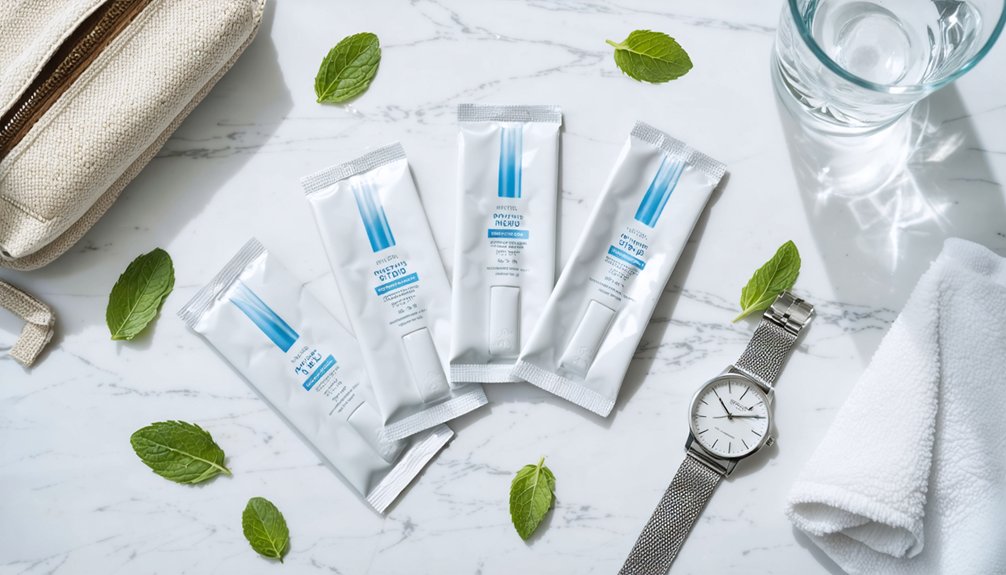
Packaging design also signals product quality; well-sealed, individually portioned strips preserve peroxide stability until application.
Realistically, you can expect 7 shades of improvement with twice-daily application over two weeks, or up to 20+ shades across 22 days with once-daily professional-grade strips.
Inconsistent use extends timelines considerably.
Track your progress against a shade guide to measure outcomes objectively.
Managing Whitening Expectations
Knowing your timeline is only half the equation—you also need a grounded sense of how much whitening you can realistically achieve. Whitening myths often set unrealistic benchmarks, leading to frustration when results plateau. Your baseline shade, enamel thickness, and teeth sensitivity all influence your outcome ceiling.
Evidence-based expectations include:
- Intrinsic stains from medications or trauma respond poorly to peroxide-based strips.
- Extrinsic stains from coffee or tobacco yield the most measurable improvement.
- Shade gains of 7–23 levels are clinically documented, but individual results vary markedly.
- Teeth sensitivity may force you to reduce frequency, extending your total treatment timeline.
You can’t whiten beyond your natural enamel color. Strips remove surface and subsurface stains—they don’t structurally alter tooth composition.
Hydrogen Peroxide vs. Peroxide-Free Strips
When choosing whitening strips, the distinction between hydrogen peroxide-based and peroxide-free formulas directly affects both your results and your safety profile. Hydrogen peroxide penetrates enamel at the molecular level, enabling effective color correction and deep stain removal that peroxide-free alternatives can’t replicate.
Hydrogen peroxide penetrates enamel at the molecular level — delivering results that peroxide-free formulas simply cannot match.
Higher concentrations of hydrogen peroxide accelerate results but increase sensitivity risk, so matching concentration to your tolerance is essential.
Peroxide-free strips rely on plant-derived compounds and offer a safer option if you have chronically sensitive teeth. However, their stain removal capacity is clinically limited, and you should expect modest outcomes.
If you’re prioritizing measurable whitening, hydrogen peroxide formulas remain the evidence-backed choice. If sensitivity is your primary concern, peroxide-free options provide a lower-risk alternative with the tradeoff of reduced effectiveness.
Do Whitening Strips Work on Sensitive Teeth?
If you have sensitive teeth, you can still use whitening strips by selecting products with lower peroxide concentrations or added desensitizing agents, such as Lumineux Teeth Whitening Strips, which offer a clinically proven, peroxide-free formula.
You should avoid brushing immediately before application, make certain strips fit snugly against teeth without contacting gums, and limit initial treatments to every two to three days rather than daily to reduce irritation.
If you experience gum or tooth discomfort during treatment, discontinue use immediately to prevent further enamel or soft tissue damage.
Sensitivity-Friendly Strip Options
Sensitive teeth don’t have to disqualify you from whitening treatment, but product selection matters considerably. Choosing the right formula means evaluating ingredient combinations carefully to match your tolerance threshold.
Key sensitivity-friendly options include:
- Lumineux Whitening Strips – peroxide-free, plant-derived ingredient combinations clinically proven safe for sensitive users
- Crest 3D Whitestrips Gentle Routine – lower hydrogen peroxide concentration with extended, gradual treatment timelines
- Opalescence Go low-concentration trays – carbamide peroxide formulas with built-in desensitizing agents
- Rembrandt Deeply White – shorter contact-time protocols that reduce cumulative enamel exposure
You should also consider the environmental impact of single-use strip packaging when selecting a sustainable routine. Brands offering recyclable or biodegradable materials provide responsible choices.
Always discontinue use immediately if irritation persists beyond initial application sessions.
Managing Tooth Sensitivity
Whitening strips can work on sensitive teeth, but your results depend heavily on how well you match the product’s active ingredient concentration to your enamel’s tolerance threshold. Higher peroxide levels accelerate whitening but increase the risk of tooth enamel degradation and nerve irritation.
You’ll want to start with lower-concentration formulas and apply strips every two to three days rather than daily. Avoid brushing immediately before application, as this reduces your enamel’s protective barrier.
Discontinue use immediately if irritation persists. Since dental insurance rarely covers cosmetic whitening treatments, selecting the right product upfront protects both your tooth enamel and your finances.
Desensitizing agents like potassium nitrate in select formulas provide measurable relief, giving you greater control over your whitening protocol without compromising safety.
Safe Application Practices
Applying strips correctly reduces your risk of sensitivity flare-ups and maximizes contact between the active ingredient and your enamel. Follow evidence-based protocols to protect your gum tissue and optimize results:
- Use dental floss before application to remove debris without brushing, which temporarily weakens enamel protection.
- Avoid oral rinses containing alcohol immediately before or after treatment, as they can amplify irritation.
- Press strips firmly against tooth surfaces, keeping edges away from gum margins to prevent tissue inflammation.
- Remove strips promptly at the recommended time—extended wear doesn’t accelerate whitening and increases damage risk.
If irritation develops, discontinue use immediately. Spacing applications every two to three days instead of daily gives enamel adequate recovery time while still progressing toward your whitening goals.
How Long Should You Wear Whitening Strips?
Most whitening strips require a minimum of 30 minutes of daily wear, though treatment duration varies by product concentration and formulation.
Historical trends in whitening protocols have shifted toward precision-based timing, reflecting evolving cultural perceptions of efficacy and safety.
Professional-grade strips containing 15% hydrogen peroxide typically require 15–20 minutes per session.
Standard over-the-counter options, like Crest 3D Whitestrips Professional Effects, recommend 45-minute daily applications across 3–20 days.
Some express formulations extend to 60 minutes for deeper results.
If you experience sensitivity, reduce frequency to every 2–3 days rather than daily.
Never exceed the manufacturer’s recommended wear time—prolonged contact increases enamel and gum irritation risk.
Consistent, timed application gives you measurable control over your whitening outcomes.
Why Strip Fit Determines Whether Whitening Is Uniform
Whether a whitening strip delivers consistent results depends almost entirely on how well it conforms to your tooth surfaces. Poor fit leaves gaps where the active ingredient never contacts enamel, producing uneven lightening you can’t correct after the fact. Personal preferences around comfort matter, but coverage precision matters more.
Evaluate fit using these criteria:
- Surface contact: The strip must adhere flush against each visible tooth without lifting at edges.
- Gum clearance: Misaligned strips touching gum tissue cause irritation without improving whitening.
- Strip length: Shorter strips won’t reach back teeth, creating visible contrast.
- Packaging design: Products with pre-molded or flexible strips typically indicate engineering built for anatomical variation.
Select strips engineered for your arch shape to maintain full control over your whitening outcome.
Application Habits That Maximize Whitening Results
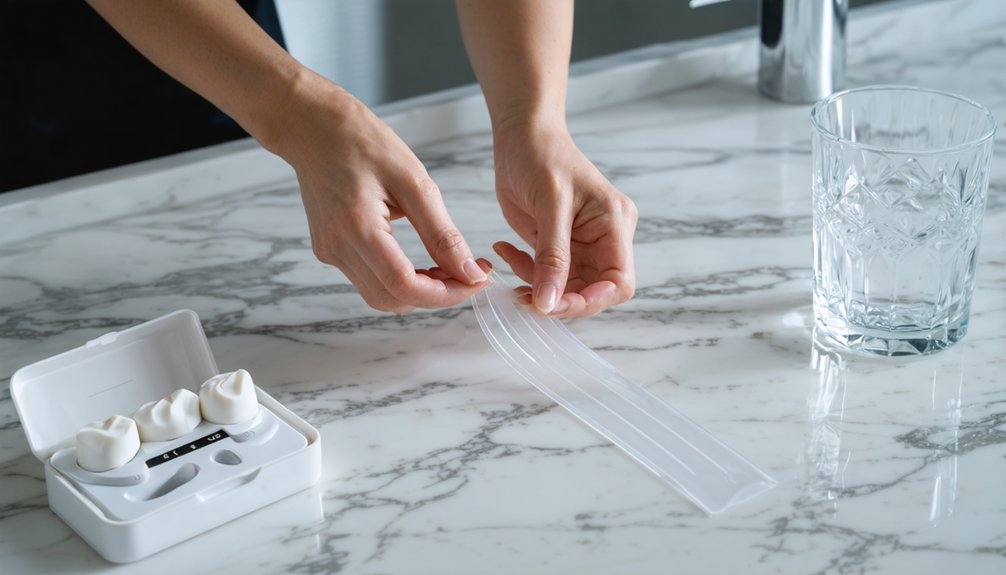
Even the most effective whitening strips underperform when applied incorrectly. You’ll maximize results by integrating smart application habits into your daily routines. Avoid brushing immediately before use—this reduces enamel sensitivity and improves peroxide penetration. Apply strips to dry teeth for stronger adhesion and more consistent contact.
Diet restrictions matter during treatment. Avoid staining agents like coffee, tea, red wine, and tobacco for at least one hour post-application, ideally longer. These substances counteract the whitening process before peroxide finishes acting on enamel.
Maintain your recommended treatment schedule without skipping sessions. Consistency compounds results. If sensitivity develops, space applications every two to three days rather than abandoning the protocol entirely. Controlled, methodical use—not aggressive overuse—produces the most reliable, measurable shade improvement over time.
Frequently Asked Questions
Can Whitening Strips Expire and Lose Effectiveness Over Time?
Yes, whitening strips expire and lose effectiveness. Products retaining only 50% potency past their expiration date waste your treatment investment. Poor storage conditions—heat and humidity—accelerate peroxide breakdown, undermining the clinical results you’re working to achieve.
Are Whitening Strips Safe to Use During Pregnancy or Breastfeeding?
You shouldn’t use whitening strips during pregnancy or breastfeeding without consulting your doctor first. Pregnancy safety data remains limited, and breastfeeding considerations include potential peroxide exposure. Opt for professional guidance before proceeding with any whitening treatment.
Do Whitening Strips Work on Dental Crowns, Veneers, or Implants?
Whitening strips won’t change your world on dental veneer whitening or implants—they only work on natural enamel. For crown color matching, you’ll need to consult your dentist to replace restorations after achieving your desired natural tooth shade.
Can You Eat or Drink Immediately After Removing Whitening Strips?
You shouldn’t eat or drink immediately after removing whitening strips. Diet restrictions matter for at least 30 minutes post-treatment. Avoiding staining substances optimizes long-term effects, protecting your enamel and maximizing the whitening results you’ve worked to achieve.
How Soon After Teeth Whitening Can You Drink Coffee?
Hold your horses — you shouldn’t drink coffee for at least 48 hours post-whitening. Your enamel’s vulnerable during this window, making staining prevention critical. To manage teeth sensitivity, stick to clear liquids only.
References
- https://www.forbes.com/sites/forbes-personal-shopper/article/best-teeth-whitening-kit/
- https://www.reddit.com/r/beauty/comments/15qfxdo/can_anyone_recommend_teeth_whitening_strips/
- https://www.nbcnews.com/select/shopping/best-teeth-whitening-strips-rcna201114
- https://www.vogue.com/article/best-teeth-whitening-strips
- https://www.cnet.com/health/personal-care/best-teeth-whitening-strips/
- https://www.forbes.com/sites/forbes-personal-shopper/article/best-teeth-whitening-strips/
- https://www.menshealth.com/grooming/g45326229/best-teeth-whitening-strips/