Whitening strips outperform pens in nearly every measurable category. Strips deliver 5–7 shades of improvement within 14 days, while pens typically yield around 3 shades over 3–4 weeks. Strips achieve this through higher peroxide concentrations and prolonged enamel contact time of 30–60 minutes, enabling deeper intrinsic stain breakdown. Pens better suit maintenance or targeted spot treatment, particularly for sensitive teeth. Your best choice depends on several factors worth examining closely.
Key Takeaways
- Whitening strips are more effective overall, improving teeth by 5–7 shades compared to approximately 3 shades achieved with whitening pens.
- Strips produce noticeable results within 7–10 days, while pens require 3–4 weeks for meaningful brightness improvement.
- Strips work by penetrating enamel deeply to break down intrinsic stains, whereas pens target surface-level extrinsic stains only.
- Pens are better suited for sensitive teeth, maintenance, or touch-ups due to shorter application times and reduced peroxide exposure.
- Neither OTC method matches professional whitening; severe or intrinsic discoloration requires in-office treatments like laser whitening or custom trays.
Whitening Strips vs. Pens: Which Actually Whitens Better?
When comparing whitening power, strips outperform pens across every measurable metric. Strips deliver 5–7 shades of improvement versus pens’ 3 shades, and they achieve significant results within 14 days rather than 3–4 weeks.
If you’re managing moderate to heavy staining, strips give you a stronger active ingredient concentration and longer gel contact time—both critical factors in effective dental hygiene outcomes.
Pens suit maintenance and targeted spot treatment, but they can’t match strips for initial whitening impact. Some LED-combined systems claim up to 9 shades, exceeding both options.
For overall oral health and cosmetic improvement, strips remain the evidence-backed choice for dramatic, lasting results. If you want measurable change fast, strips are your most effective at-home option.
How Do Whitening Strips and Pens Work on Stains?
When you apply whitening strips, the prolonged contact time allows higher-concentration peroxide gels to penetrate deeply into enamel, breaking down intrinsic stain molecules beneath the tooth’s surface.
Pens, by contrast, deliver a thinner gel layer precisely onto targeted teeth, making them better suited for addressing localized or surface-level extrinsic stains.
Understanding this mechanical difference helps you match the right product to your specific staining pattern and whitening goals.
Strips Penetrate Enamel Deeply
Whitening strips work by pressing a peroxide-saturated polymer film directly against your enamel surface, allowing the active bleaching agent to penetrate the tooth structure and break apart chromogenic compounds lodged within the enamel matrix.
The extended 30–60 minute contact time drives hydrogen or carbamide peroxide deeper into the enamel compared to brief pen applications. This sustained exposure oxidizes intrinsic stain molecules more thoroughly, producing 5–7 shade improvements within 14 days.
However, prolonged peroxide contact temporarily compromises enamel resilience by disrupting the mineral lattice. You’ll want to support tooth remineralization post-treatment using fluoride or hydroxyapatite-based products to restore structural integrity.
Without this recovery protocol, repeated strip applications increase sensitivity risk and may weaken the enamel surface over successive whitening cycles.
Pens Target Specific Stains
Unlike strips, whitening pens use a fine brush-tip applicator to deposit bleaching gel directly onto individual stained teeth, giving you precise control over where the peroxide contacts enamel. You can isolate discoloration on specific teeth without exposing adjacent, unaffected surfaces to unnecessary peroxide concentration.
This targeted delivery reduces cumulative sensitivity risk and allows you to adjust application thickness based on stain severity.
However, pens deliver lower peroxide concentrations than strips, custom trays, or LED lights-assisted systems, which limits their efficacy against moderate to severe discoloration. Clinical evidence suggests pens yield approximately 3 shades of improvement — suitable for maintenance or spot correction, but insufficient for detailed whitening.
If you’re managing isolated surface stains rather than generalized discoloration, a pen’s precision makes it a clinically rational, controlled option.
How Fast Do Whitening Strips and Pens Show Results?
If you use whitening strips consistently, you’ll typically notice visible results within 7–10 days, with full effects achieved by day 14.
Pens, however, deliver a more gradual progression, often requiring several weeks before you see meaningful brightness improvements.
Regardless of the method you choose, your consistency with daily applications ultimately determines the final outcome.
Strips’ Typical Result Timeline
When used consistently, whitening strips typically produce noticeable results within 7–10 days, with full whitening effects achieved by day 14. You can expect an average improvement of 5–7 shades when following the recommended protocol.
Unlike natural remedies, which lack clinical validation, strips deliver measurable, evidence-backed outcomes through sustained peroxide contact with enamel surfaces.
Dietary influences directly affect your results—consuming staining agents like coffee, tea, or red wine during treatment can counteract strip efficacy and extend your timeline. You’ll maximize outcomes by avoiding these substances throughout the 14-day cycle.
Strip results also tend to outlast pen results due to longer gel-to-tooth contact time, reducing your need for frequent reapplication and making strips the more time-efficient option for achieving significant whitening within a defined treatment window.
Pens’ Gradual Whitening Progress
Whitening pens deliver results more gradually than strips, typically requiring 3–4 weeks before you’ll notice meaningful brightness improvements. This slower progression stems from lower peroxide concentrations and shorter gel contact time per application.
You’re applying a thin layer to tooth enamel for just 2–3 minutes, limiting how deeply the active agent penetrates staining. Most users achieve roughly 3 shades of improvement—measurably less than strips’ 5–7 shade average.
However, this controlled delivery suits those managing sensitivity or maintaining dental hygiene between deeper treatments. Pens won’t address moderate-to-severe discoloration effectively, and some clinical experts classify them as insufficient for initial whitening without higher bleaching concentrations.
Use them strategically—for spot treatment or maintenance—rather than as your primary whitening intervention.
Consistency Determines Final Outcomes
Both strips and pens can produce visible results within the first week, but your consistency throughout the treatment window determines how close you get to maximum whitening potential. Missing applications disrupts the cumulative peroxide exposure needed for meaningful enamel penetration, directly compromising color stability over time.
With strips, skipping sessions reduces total contact time, weakening oxidation depth and shortening whitening longevity.
With pens, inconsistent application leaves uneven gel distribution across tooth surfaces, producing patchy outcomes rather than uniform brightness.
Follow the manufacturer’s protocol precisely — same time daily, correct duration, proper isolation from saliva.
Your adherence to a structured schedule isn’t optional; it’s the primary variable separating moderate improvement from peak results.
Treat consistency as a clinical requirement, not a suggestion.
Which Delivers Better Value: Strips or Pens?
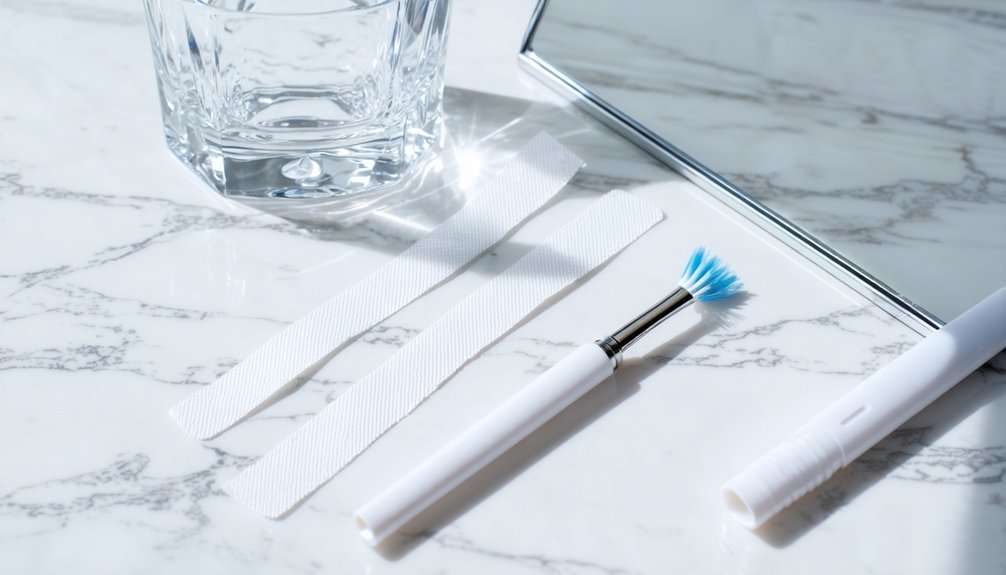
Choosing between whitening pens and strips ultimately comes down to your specific goals and budget.
Strips deliver superior value for initial whitening, offering 5–7 shades of improvement with stronger color retention over 14 days. Most kits include 14–28 treatments, making them cost-effective for changing from moderate to heavy staining.
Pens, however, give you precise control over ingredient safety exposure, letting you apply thinner gel layers to minimize sensitivity while targeting specific teeth. They’re more practical for maintenance than primary treatment.
If you’re managing an existing bright smile, a pen’s affordability suits that role well.
For maximum whitening impact per dollar spent, strips outperform pens clinically. But if you prioritize application control and sensitivity management, pens offer functional value that strips can’t replicate.
Are Whitening Strips or Pens Safer for Sensitive Teeth?
For sensitive teeth, pens carry a measurably lower risk profile than strips. You control gel volume, layer thickness, and contact zones, letting you avoid already-compromised enamel.
Historical trends in at-home whitening show that sensitivity complaints spike disproportionately among strip users, largely because strips maintain sustained peroxide contact across the full arch without discrimination.
Cultural perceptions have long framed whitening discomfort as an acceptable trade-off for faster results, but that assumption doesn’t hold when sensitivity becomes a barrier to consistent use.
Strips sustain higher peroxide concentrations against gum tissue and exposed dentin, compounding irritation risk.
If you’ve experienced prior whitening sensitivity, start with a pen. You’ll retain precise application control while minimizing unnecessary peroxide exposure to vulnerable areas.
Which Is Easier to Use in Your Daily Routine?
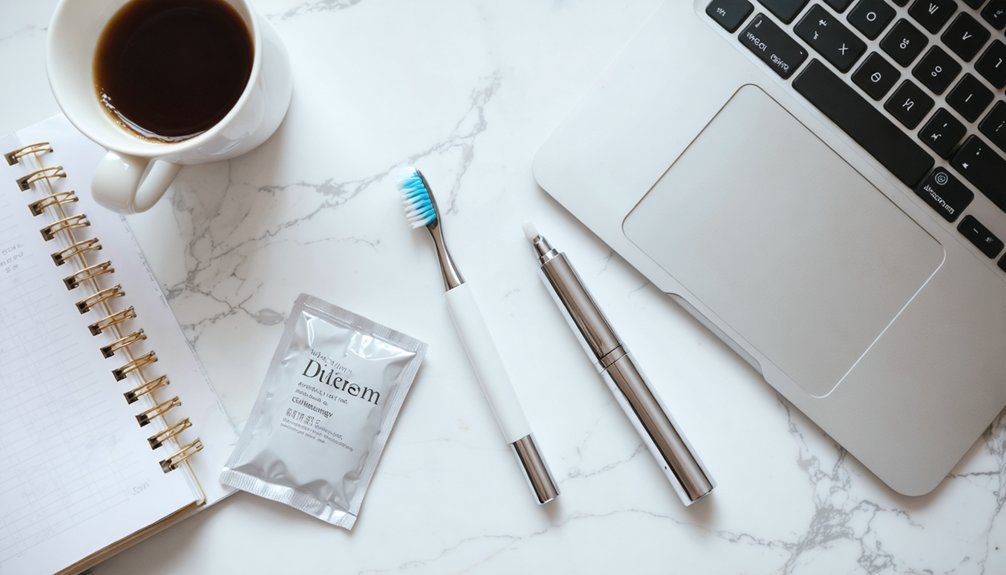
When weighing daily usability, pens win on time efficiency—each application takes 2–3 minutes, compared to the 30–60 minutes strips demand. If you’re managing a structured schedule, pens integrate seamlessly without disrupting workflow.
Strips, however, require sustained contact time, limiting speech and consumption during use.
Your dietary influences matter here—if you frequently consume staining agents like coffee or wine, strips offer a more intensive corrective response within a compressed treatment window. Pens function better as precision maintenance tools between meals or social engagements.
Unlike natural remedies, both formats deliver clinically measurable outcomes, but convenience dictates compliance. Strips demand consistent daily commitment; pens accommodate flexible, targeted use.
Ultimately, your lifestyle cadence should determine which format you’ll realistically sustain over a full treatment cycle.
When Should You Choose a Pen Over Strips?
Pens outperform strips in specific clinical scenarios where controlled, localized application matters more than broad whitening intensity. If you have sensitive teeth, pens let you apply thinner gel layers and avoid vulnerable areas entirely, reducing peroxide exposure and minimizing post-treatment discomfort.
Pens beat strips when precision matters more than power — ideal for sensitive teeth needing controlled, targeted application.
They’re also the smarter choice when you need precision targeting on isolated stained teeth without disrupting adjacent enamel.
For maintenance after completing a full strip regimen, pens integrate seamlessly into your dental hygiene routine without demanding extended wear time. Following routine teeth cleaning, a quick 2–3 minute pen application reinforces whitening results efficiently.
If your schedule doesn’t accommodate 30–60 minute strip sessions, pens offer a practical alternative. Choose pens when control, sensitivity management, and targeted application outweigh your need for dramatic, rapid shade transformation.
What Dentists Recommend for At-Home Whitening
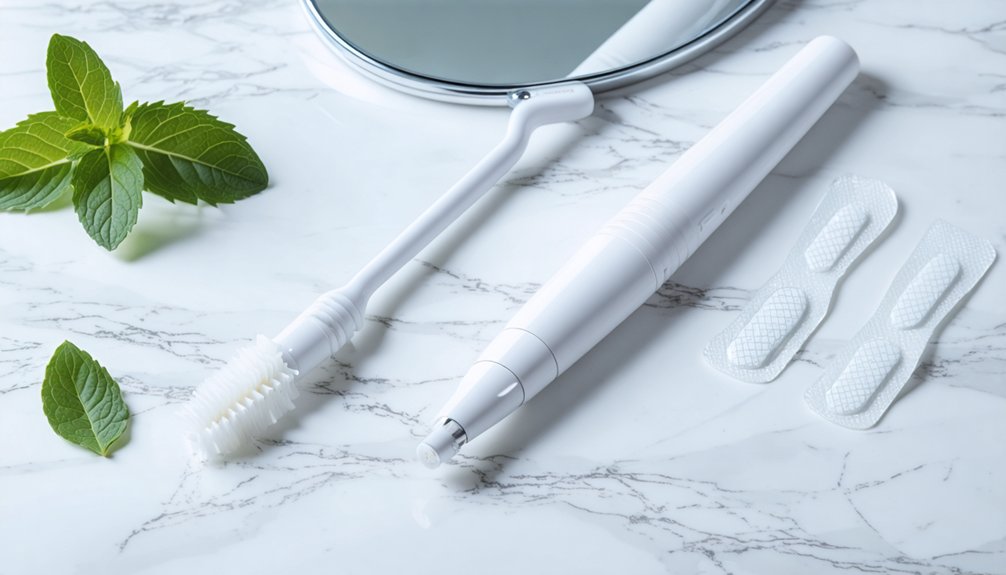
Understanding when pens fit your routine is useful, but dentists’ recommendations carry more clinical weight when you’re choosing an at-home whitening method. Dental professionals consistently favor whitening strips for at-home use, citing their balanced safety profile and clinically validated results.
Strips deliver controlled peroxide exposure across the full tooth surface, making them more reliable than pens or unverified natural remedies that lack evidence-based support.
If you maintain strong dental hygiene practices—consistent brushing, flossing, and routine cleanings—strips integrate effectively into your whitening protocol.
Dentists caution that neither strips nor pens replicate in-office outcomes. For moderate staining, strips remain the clinically preferred choice.
For severe discoloration, professionals recommend escalating to laser whitening rather than relying on over-the-counter options, regardless of marketing claims.
When Neither Strips nor Pens Are Enough
Both strips and pens hit a ceiling when staining is severe or when you need rapid, dramatic results. At-home options can’t overcome deep intrinsic discoloration, structural damage, or years of neglect.
At-home whitening has limits—severe staining and deep discoloration demand more than any strip or pen can deliver.
If your dental hygiene history involves tooth decay, trauma, or extensive staining, professional intervention becomes clinically necessary.
Consider these realities:
- Professional laser whitening delivers results no strip or pen can replicate, achieving dramatic shade changes in a single session.
- Untreated tooth decay disqualifies you from any whitening treatment—bleaching agents worsen compromised enamel.
- Custom bleaching trays prescribed by dentists provide controlled, higher-concentration gel application, outperforming every OTC method available.
You deserve precise, measurable outcomes. When strips and pens consistently underdeliver, escalating to professional treatment isn’t optional—it’s the evidence-based decision.
Frequently Asked Questions
Can Whitening Pens or Strips Damage Existing Dental Crowns or Veneers?
Neither whitening pens nor strips damage crowns or veneers, but they won’t whiten them either. You’ll notice dental material compatibility issues as enamel sensitivity may increase around restoration margins with prolonged peroxide exposure.
How Long Should You Wait Between Whitening Strip Treatment Cycles?
You should wait 3–6 months between strip cycles to protect enamel integrity. This interval optimizes stain removal efficiency, prevents sensitivity escalation, and maintains ideal application frequency without compromising structural dental health or diminishing long-term whitening outcomes.
Is It Safe to Use Whitening Pens and Strips Simultaneously?
You can combine both, but it’s risky. Simultaneous use increases peroxide exposure, heightening sensitivity. For user convenience and product longevity, alternate applications strategically—strips for base whitening, pens for precision touch-ups—to maintain controlled, evidence-based results.
Can Pregnant or Breastfeeding Women Safely Use Teeth Whitening Products?
You shouldn’t use whitening products while pregnant or breastfeeding. Dental safety guidelines advise against peroxide exposure during these stages, as product effectiveness hasn’t been tested on this population, and potential risks to your baby remain unknown.
Do Whitening Strips or Pens Work on Naturally Yellow Teeth?
Yes, both work on natural discoloration—but here’s what matters: strips outperform pens, delivering 5–7 shades of improvement. If you’re managing enamel sensitivity, you’ll want to start with pens for controlled, precise application.
References
- https://www.natrusmile.com/blogs/news/teeth-whitening-pens-vs-strips
- https://biancabright.com/blogs/news/whitening-pen-vs-strips
- https://www.wisdomdentalemergency.com.au/blog/blogsection/oral-surgeon-melbourne/the-ugly-truth-about-whitening-strips-and-pens
- https://smileprep.com/whitening-strips-vs-pens/
- https://www.cinoll.com/es/blog/effectiveness-comparison-whitening-strips-vs-whitening-pens-vs-gels/
- https://media-01.imu.nl/storage/whiteteeth.ie/3389/teeth-whitening-pens.pdf
- https://www.trysnow.com/blogs/news/led-whitening-vs-strips-vs-pens
- https://mysmilesteeth.com/blogs/mysmiles-blog/why-should-you-use-teeth-whitening-pens-instead-of-strips