You can transform yellow teeth at home, but success depends on matching the right toothpaste to your stain type. Extrinsic stains from coffee, tea, or tobacco respond well to abrasive agents like hydrated silica and sodium bicarbonate. Intrinsic stains require hydrogen peroxide-based formulas for deeper penetration. Top picks for 2026 include Supersmile, Colgate Optic White Renewal, and Sensodyne Clinical White. Keep exploring to find the exact formula and technique that fits your situation.
Key Takeaways
- Supersmile, Colgate Optic White Renewal, Crest 3D White, and Sensodyne Clinical White rank among the best whitening toothpastes for 2026.
- Hydrogen peroxide, hydrated silica, sodium bicarbonate, and Calprox are four clinically proven ingredients that effectively combat tooth discoloration.
- Extrinsic stains respond well to whitening toothpastes, while intrinsic stains require professional-grade peroxide treatments for effective results.
- Brush twice daily for two minutes using a pea-sized amount to maximize whitening while protecting enamel from overuse damage.
- Over-the-counter whitening toothpastes range from $8 to $38, offering cost-effective solutions primarily for surface-level extrinsic stains.
Why Are Your Teeth Yellow in the First Place?
Before reaching for a whitening toothpaste, it’s worth understanding what’s actually causing your teeth to yellow. Discoloration falls into two distinct categories: extrinsic and intrinsic staining.
Extrinsic staining affects your enamel’s outer surface. Your dietary impacts matter greatly here—coffee, tea, red wine, and dark-pigmented foods deposit chromogens directly onto enamel. Lifestyle habits like tobacco use accelerate this process considerably.
Intrinsic staining originates within the tooth structure itself. Causes include tetracycline exposure during tooth development, excessive fluoride intake, or natural aging as enamel thins and underlying dentin darkens.
Identifying your stain type determines your treatment pathway. Extrinsic stains respond well to whitening toothpastes with abrasive or enzymatic agents.
Intrinsic discoloration typically requires professional-grade peroxide treatments beyond what standard toothpaste can deliver.
Extrinsic vs. Intrinsic Stains: Which Type Do You Have?
Knowing which stain type you’re dealing with is the critical first step toward choosing an effective treatment.
Extrinsic stains settle on your enamel’s outer surface, typically from coffee, tea, tobacco, or dark foods. Whitening toothpastes with abrasives or peroxide directly target these deposits, making whitening effectiveness measurable within weeks.
Intrinsic stains, however, originate within your tooth’s dentin layer. Tetracycline exposure, fluorosis, or trauma commonly drive this deeper discoloration. Standard toothpastes can’t reach intrinsic stains, so professional-grade peroxide gels or clinical trays become necessary interventions.
Stain longevity differs sharply between types. Extrinsic stains respond faster but return without behavioral changes. Intrinsic stains resist most home treatments and require sustained, professionally guided protocols.
Accurately identifying your stain type eliminates guesswork and directs your resources toward treatments that’ll actually work.
Which Whitening Toothpaste Ingredients Actually Remove Stains?
Once you’ve identified your stain type, you can match it to the right active ingredient.
Abrasive agents like sodium bicarbonate and hydrated silica physically scrub extrinsic stains from enamel surfaces, while chemical whiteners like hydrogen peroxide and carbamide peroxide penetrate deeper to break down intrinsic discoloration.
Choosing between these two mechanisms—or a formula that combines both—determines how effectively your toothpaste addresses your specific yellowing.
Proven Stain-Removing Ingredients
When choosing a whitening toothpaste, the ingredients list tells you exactly how well it’ll perform. Understanding ingredient effectiveness lets you make precise, results-driven decisions rather than relying on marketing claims.
Four clinically proven stain-removing ingredients to prioritize:
- Hydrogen peroxide – penetrates enamel to bleach intrinsic discoloration at the molecular level.
- Hydrated silica – polishes extrinsic surface stains without compromising enamel integrity.
- Sodium bicarbonate – a trusted natural alternative that mechanically scrubs away extrinsic deposits.
- Calprox – an enzyme-based natural alternative that dissolves biofilm without abrasive damage.
Each ingredient targets stains through distinct mechanisms. Peroxide addresses discoloration chemically, while abrasives and enzymes work physically and biologically.
Matching the right ingredient to your stain type maximizes your whitening outcome efficiently.
Abrasive Versus Chemical Whiteners
Whitening toothpastes remove stains through two distinct mechanisms: abrasion and chemical bleaching. Understanding both helps you select the right formula for your specific discoloration type.
Abrasive techniques, including hydrated silica and sodium bicarbonate, physically polish extrinsic stains from enamel surfaces. They’re effective against coffee, tea, and tobacco residue but can’t penetrate tooth structure. Overuse risks enamel erosion, so you’ll want to verify a toothpaste’s Relative Dentin Abrasivity score before committing.
Chemical effectiveness depends on peroxide concentration. Hydrogen peroxide and carbamide peroxide oxidize chromogenic compounds within enamel, addressing intrinsic discoloration that abrasives can’t reach.
For surface stains, abrasives deliver faster visible results. For deeper yellowing, chemical agents are clinically superior. Many high-performing formulas strategically combine both mechanisms for thorough stain elimination.
Best Whitening Toothpastes for Yellow Teeth in 2026
Finding the right whitening toothpaste for yellow teeth in 2026 doesn’t have to be overwhelming. Dental innovations and emerging whitening trends have produced clinically validated options suited to your specific needs.
Top-performing formulas include:
- Supersmile Teeth Whitening Toothpaste — best overall stain removal, $25
- Colgate Optic White Renewal — deep stain elimination at strong value, $16
- Crest 3D White Deep Stain Remover — targets persistent yellowing and dark spots, $20
- Sensodyne Clinical White — best choice for sensitivity-prone users
Each product addresses extrinsic staining through abrasive or peroxide-based mechanisms.
You should verify ADA Seal certification before committing to any formula.
Consult your dental provider to confirm compatibility with your enamel condition.
Best Whitening Toothpaste for Sensitive Teeth
Sensitive teeth require specialized whitening formulas that balance stain removal with enamel and nerve protection. If you experience discomfort during whitening, prioritize products containing potassium nitrate, which delivers clinically proven sensitivity reduction by calming exposed nerve endings.
Nano hydroxyapatite enhances ingredient effectiveness by filling microscopic enamel cracks, strengthening your tooth structure while blocking new stain formation.
Sensodyne Clinical White stands as the top recommendation for sensitive users, combining gentle abrasives with fluoride to maintain decay protection throughout the whitening process.
You’ll want to avoid aggressive peroxide concentrations and charcoal-based formulas, as both accelerate enamel erosion.
Brush twice daily for two minutes, and consult your dentist before switching formulas to confirm your selected product aligns with your specific sensitivity diagnosis.
Best Whitening Toothpaste Under $10
Budget-conscious shoppers have 2 strong options under $10 that deliver clinically supported whitening results.
Don’t let whitening myths convince you that effective toothpaste ingredients require premium pricing.
Top picks under $10:
- Arm & Hammer Advance White ($8) — sodium bicarbonate abrasive removes extrinsic stains without compromising enamel integrity.
- Colgate Optic White Renewal — peroxide-based formula targets surface discoloration through verified chemical action.
- Confirm ADA Seal presence — certification validates that toothpaste ingredients meet established safety and efficacy benchmarks.
- Prioritize fluoride inclusion — anti-cavity protection guarantees whitening doesn’t compromise structural tooth health during daily use.
You’re in control of your results.
Brush twice daily for two minutes, and you’ll maximize both options’ stain-removal potential without exceeding your budget.
How to Use Whitening Toothpaste for Best Results
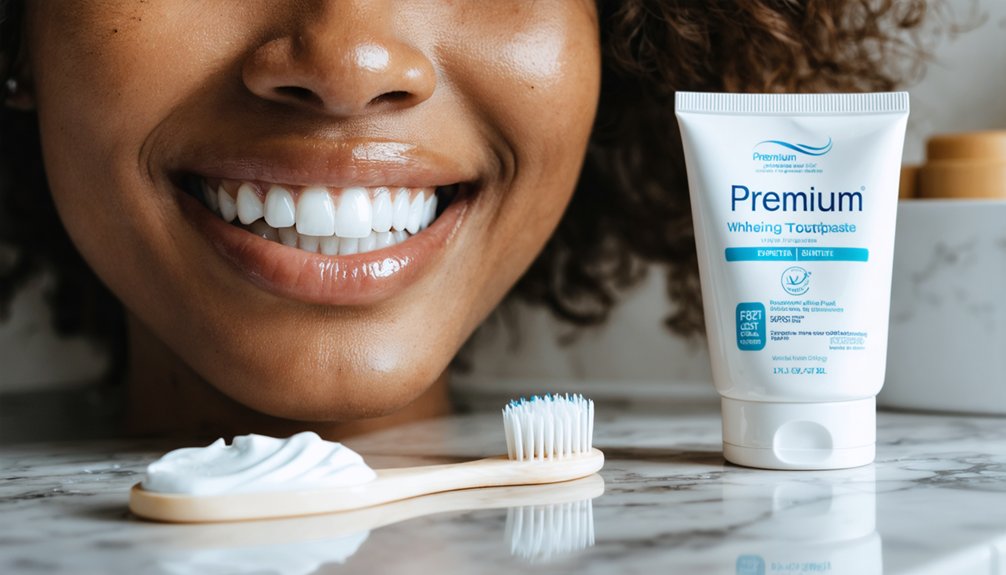
Three simple habits determine whether your whitening toothpaste delivers measurable results or falls short of its potential.
First, control your whitening frequency — brush twice daily, exactly two minutes per session. Reducing sessions compromises cumulative stain removal; exceeding them risks enamel abrasion.
Brush twice daily, two minutes each session — consistency drives cumulative whitening while protecting enamel from overuse damage.
Second, master paste application by loading a pea-sized amount onto your brush. Excess product doesn’t accelerate whitening — it wastes formula and increases sensitivity risk.
Third, floss before brushing so abrasive agents contact clean surfaces rather than biofilm-coated enamel. You’ll maximize active ingredient penetration this way.
Replace your toothbrush every three to four months, since worn bristles reduce mechanical stain removal efficiency.
Before switching formulas, consult your dental provider — especially if you’re combining whitening toothpaste with peroxide trays or professional treatments.
Whitening Toothpaste vs. Professional Treatment: Which Do You Need?
Your stain type determines whether whitening toothpaste or professional treatment will actually work for you.
If you’re dealing with extrinsic stains from coffee, tea, or tobacco, an abrasive or peroxide-based toothpaste can effectively lift surface discoloration at a fraction of the cost.
Intrinsic staining, however, requires professional peroxide gel treatment, since no over-the-counter toothpaste can penetrate the tooth’s internal structure.
Stain Type Determines Treatment
Before choosing a whitening toothpaste or scheduling a professional treatment, you need to identify which type of staining you’re dealing with. Stain type determines your most effective intervention.
- Extrinsic stains form on the enamel surface from dietary impacts like coffee, tea, and wine — whitening toothpaste with abrasives or peroxide addresses these directly.
- Intrinsic stains develop within the tooth structure and require professional peroxide gel treatment.
- Stain prevention tips include limiting acidic and pigmented foods between meals to reduce extrinsic buildup.
- Home whitening trays with professional-grade gels can target both stain types but require dental guidance.
Misidentifying your stain type wastes time and money. Consult your dentist to confirm the correct diagnosis before committing to any whitening regimen.
Cost Versus Clinical Results
Once you’ve identified your stain type, the next decision comes down to cost and clinical outcomes. A cost analysis reveals a clear divide: over-the-counter whitening toothpastes range from $8 to $38, while professional treatments command considerably higher fees.
However, clinical effectiveness depends entirely on stain classification.
Extrinsic stains respond well to abrasive and peroxide-based toothpastes like Colgate Optic White Renewal or Crest 3D White, making professional intervention unnecessary.
Intrinsic discoloration, however, requires chairside peroxide gels or custom trays that penetrate dentin — no toothpaste addresses this effectively.
You’re in control of this decision when you match treatment to stain type. Spending $38 on Opalescence won’t correct intrinsic yellowing, but it’ll maintain results after professional treatment concludes.
Frequently Asked Questions
Can Whitening Toothpaste Safely Be Used on Dental Crowns or Veneers?
You can use whitening toothpaste on crowns or veneers, but don’t expect whitening effectiveness on dental materials—they won’t respond to bleaching agents. Consult your dentist to match your natural teeth’s shade precisely.
How Long Does It Typically Take to See Noticeable Whitening Results?
You’ll typically notice whitening effectiveness timelines of two to four weeks with consistent twice-daily use. Individual results variability depends on your stain type, product concentration, and dental health—extrinsic stains respond faster than intrinsic discoloration.
Is Whitening Toothpaste Safe for Children and Teenagers to Use Daily?
Over 40% of pediatric dentists advise caution with whitening toothpaste ingredients for children under 12. You shouldn’t use adult formulas daily without checking age recommendations first—consult your dentist to guarantee safe, appropriate whitening for teenagers.
Can You Use Whitening Toothpaste While Pregnant or Breastfeeding Safely?
You should consult your dentist before using whitening toothpaste while pregnant or breastfeeding. The risks involved with peroxide-based formulas aren’t fully studied, so choose safe ingredients like fluoride and nano hydroxyapatite instead.
Does Whitening Toothpaste Interact Negatively With Orthodontic Braces or Retainers?
Whitening ingredients won’t damage your braces, but they can’t reach bracket-covered enamel, causing uneven results. For orthodontic safety, you should consult your provider before using peroxide or abrasive formulas near retainers or adhesive materials.
References
- https://www.nbcnews.com/select/shopping/best-whitening-toothpastes-ncna1294908
- https://cloveoralcare.com/pages/best-toothpaste-in-india-for-yellow-teeth-2025-top-dentist-recommended-whitening-options
- https://www.health.com/best-whitening-toothpaste-11909626
- https://oraalsprays.blogspot.com/2024/10/top-10-best-toothpaste-in-india-for.html
- https://implantjournal.com/best-toothpaste-for-yellow-teeth/
- https://blog.emergencydentalservice.com/which-toothpaste-is-best-for-yellow-teeth/
- https://www.youtube.com/watch?v=aZJ79BxlddI
- https://www.youtube.com/watch?v=HvpjIR-qrsc
- https://www.youtube.com/watch?v=IkoH8S987o0
- https://www.amazon.com/best-whitening-toothpaste-yellow-teeth/s?k=best+whitening+toothpaste+for+yellow+teeth