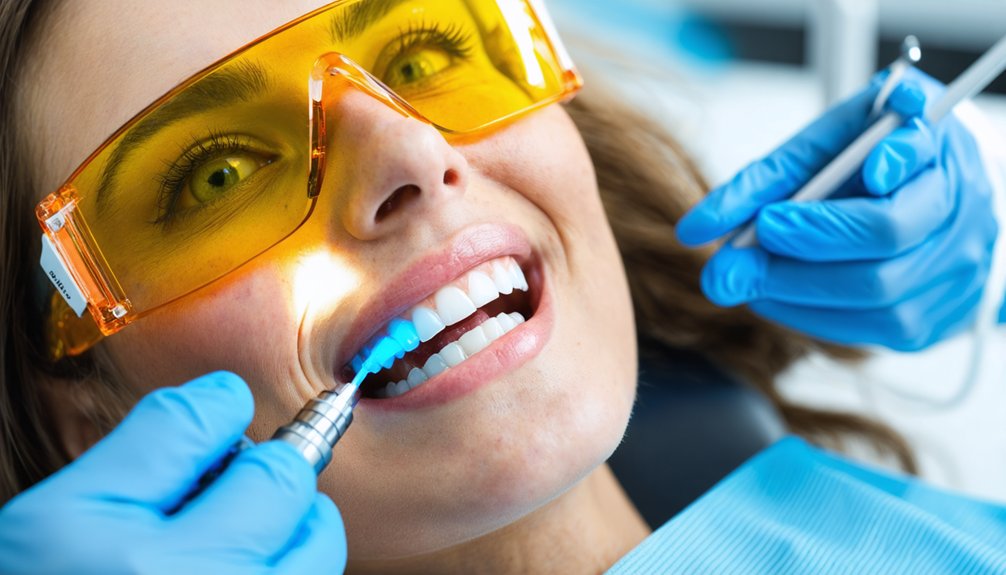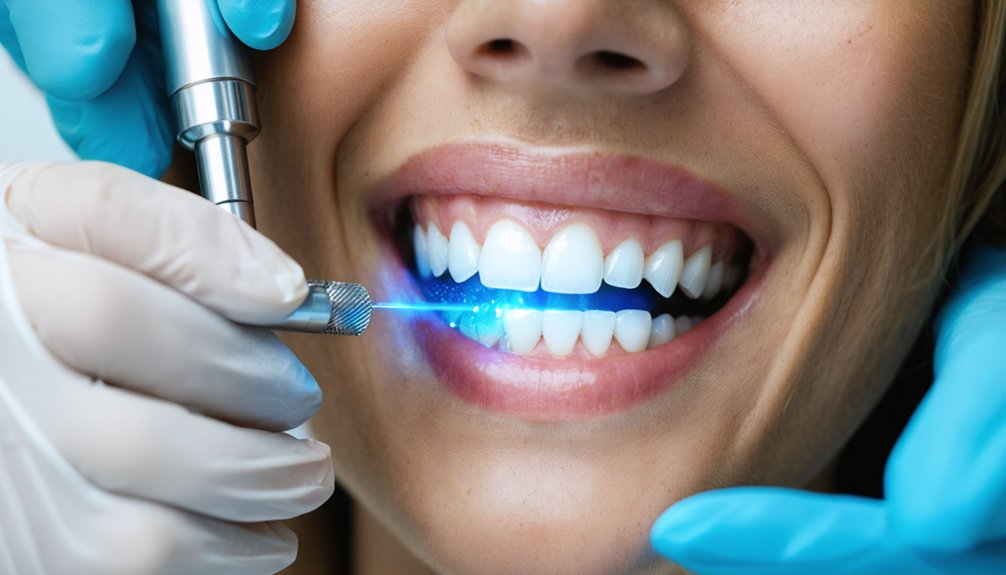
Laser teeth whitening uses concentrated bleaching gels activated by laser energy to break down stubborn yellow stains in a single session. Top systems include Zoom, Biolase, KöR, Erchonia, and LumaArch, each targeting different stain types and severity levels. Results can reach up to 10 shades brighter, with treatments lasting 60 minutes and costing between $300 and $1,500. If you want to find the right system for your specific needs, there’s much more ahead.
Key Takeaways
- Zoom, Biolase, LumaArch, KöR, and Erchonia are among the top laser whitening systems, offering up to 10 shades of improvement.
- Laser whitening uses concentrated bleaching gels activated by laser energy, with sessions typically lasting around 60 minutes.
- Ideal candidates have moderate to severe extrinsic yellowing, but those with cavities or gum disease are excluded.
- Results last 6 months to 2 years; avoiding coffee, tea, and red wine helps maintain whitening outcomes.
- Costs range from $300 to $1,500 per session, varying by location, system used, and dental practice expertise.
What Is Laser Teeth Whitening and How Does It Work?
Laser teeth whitening uses concentrated bleaching gels activated by targeted laser energy to penetrate enamel and break down deep-set stains. The heat generated by the laser accelerates the bleaching reaction, delivering results far faster than non-activated methods.
Before gel application, your dentist performs an initial cleaning to eliminate plaque and surface debris, ensuring maximum treatment efficacy.
Laser whitening benefits include precise targeting of stubborn yellow stains and measurable shade improvement within a single session. You’ll experience consistent, clinically validated outcomes rather than unpredictable results from over-the-counter alternatives.
Regarding whitening safety, advanced laser systems are engineered to minimize heat damage to enamel and surrounding tissue. Desensitizing treatment applied post-procedure further reduces irritation risk, making this a controlled, evidence-backed option for addressing significant discoloration effectively.
Are You a Good Candidate for Laser Whitening?
Understanding how laser whitening works naturally raises the question of whether it’s the right treatment for you. Candidate assessment begins with evaluating your stain type.
You’re an ideal candidate if you have moderate to severe extrinsic yellowing caused by smoking, aging, diet, or poor hygiene. Intrinsic discoloration and tetracycline staining also respond to laser treatment.
However, you’re not a suitable candidate if you have untreated cavities or active gum disease—these conditions must be resolved first.
Teeth sensitivity is another factor your dentist will assess, since high-concentration gels carry elevated sensitivity risks for some patients. A clinical evaluation determines whether desensitizing protocols are necessary before proceeding.
Taking control of your results starts with an honest, thorough assessment of your current oral health status.
How Many Laser Whitening Sessions Do You Need?
How many sessions you’ll need depends primarily on the severity and type of your staining. For most extrinsic discoloration, a single 60-minute session delivers dramatic, measurable results.
However, session frequency increases when you’re dealing with deeper intrinsic staining or tetracycline-related discoloration, often requiring multiple visits spaced one to two weeks apart.
Treatment customization is central to effective outcomes. Your dentist evaluates stain depth, enamel condition, and your target shade before recommending a protocol.
Light surface staining typically resolves within one to two sessions, while severe cases may extend across several weeks. Each session runs approximately 20 to 30 minutes under light activation.
You retain control over your results by following your prescribed schedule precisely and committing to the full recommended treatment cycle without interruption.
Zoom Laser Whitening: Best for Moderate Yellow Staining
Zoom laser whitening delivers targeted bleaching performance specifically suited for moderate yellow staining caused by poor hygiene, dietary habits, aging, or genetics.
The system activates a concentrated bleaching gel using high-intensity light, breaking down extrinsic discoloration efficiently within a single session. Most patient experiences involve minimal sensitivity, supported by desensitizing agents applied post-treatment to protect gum tissue and enamel.
You’ll typically see results up to eight shades brighter immediately after your appointment. Maintaining those results depends heavily on your home care discipline.
Your dentist will recommend whitening toothpaste and advise you to eliminate coffee, tea, and red wine from your routine. Periodic touch-ups every six to twelve months preserve ideal whiteness, keeping your results consistent and clinically measurable over time.
Biolase Laser Whitening: Clinical-Grade Results in One Visit
Biolase laser whitening delivers clinical-grade results by using precision laser energy to activate a concentrated bleaching gel that penetrates enamel and breaks down stubborn stains at the source.
You’ll typically complete the entire treatment in a single visit of roughly 60 minutes, achieving up to 10 shades of improvement as confirmed by clinical chromatic standards.
Because the laser targets discoloration with high accuracy, you can expect consistent, visible results immediately after your first and often only session.
Clinical-Grade Whitening Process
When you undergo Biolase laser whitening, a trained clinician first cleans your teeth to eliminate plaque and surface debris before applying a concentrated bleaching gel directly to the enamel.
The treatment technology then activates this gel using precise laser energy, accelerating oxidation to break down stubborn yellow stains efficiently. These clinical advantages deliver measurable results within a single session.
- Laser activation penetrates enamel to target intrinsic and extrinsic discoloration
- Controlled heat minimizes damage to surrounding tissue
- Desensitizing agents applied post-treatment reduce sensitivity risk
- Chromatic standards confirm up to 10 shades of improvement
- Precise targeting guarantees consistent, uniform whitening across all surfaces
You maintain full control over your outcome by following post-treatment protocols, including avoiding coffee, tea, and red wine immediately after your session.
Single-Visit Results
One 60-minute Biolase laser whitening session delivers up to 10 shades of improvement, confirmed by clinical chromatic standards.
You’ll see a 76% reduction in discoloration immediately after treatment, making single visit convenience a measurable clinical reality rather than a marketing claim.
The laser activates concentrated bleaching gel, driving it deep into enamel to break down stubborn yellow stains caused by aging, smoking, poor hygiene, or genetics.
You don’t wait weeks for gradual results — immediate satisfaction defines this protocol.
Visible brightness appears the same day, giving you direct control over your outcome without committing to extended treatment cycles.
For moderate to severe extrinsic staining, one session produces the dramatic shift you’re seeking, backed by precise laser targeting and evidence-based application techniques.
LumaArch Laser Whitening: Built for Severe Discoloration
If you’re dealing with severe intrinsic discoloration or deep staining from tetracycline use, LumaArch’s high-intensity laser system targets dentin-level pigmentation that standard whitening methods can’t reach.
You can expect results of up to 10 shades whiter within a single extended session, with clinical chromatic standards confirming a 76% reduction in discoloration.
For extreme cases, your dentist may schedule multiple visits spaced one to two weeks apart to complete the full treatment cycle.
Targeting Severe Discoloration Effectively
Severe discoloration—whether from years of tetracycline use, deep intrinsic staining, or chronic enamel degradation—demands a whitening system engineered beyond standard clinical thresholds.
LumaArch targets severe stains with precision laser activation, delivering treatment options that outperform conventional bleaching protocols.
- Penetrates dentin-level discoloration through high-intensity laser concentration
- Achieves up to 10 shades of improvement in a controlled single session
- Addresses intrinsic and extrinsic staining simultaneously with calibrated gel activation
- Minimizes sensitivity risk through integrated desensitizing post-treatment protocols
- Produces clinically measurable results immediately following the first appointment
You’re not managing surface yellowing—you’re correcting structural chromatic damage.
LumaArch’s system gives you precise control over outcomes, targeting resistant pigmentation where standard systems fail to reach measurable clinical thresholds.
Treatment Duration And Results
Correcting severe discoloration is only part of the equation—understanding what that correction demands in time and what it delivers in results helps you set accurate clinical expectations.
LumaArch typically requires a single session lasting 60 minutes or more, though severe intrinsic staining may necessitate multiple visits spaced one to two weeks apart.
Treatment effectiveness is measurable—you can expect up to 10 shades of improvement, with visible results appearing immediately after your first session.
Patient experiences consistently confirm minimal sensitivity during and after the procedure, supported by post-treatment desensitization protocols.
Results hold for six months to two years depending on your lifestyle habits. Avoiding coffee, tea, and red wine while maintaining regular dental check-ups extends those outcomes considerably.
KöR Laser Whitening: Targeting Deep and Intrinsic Stains
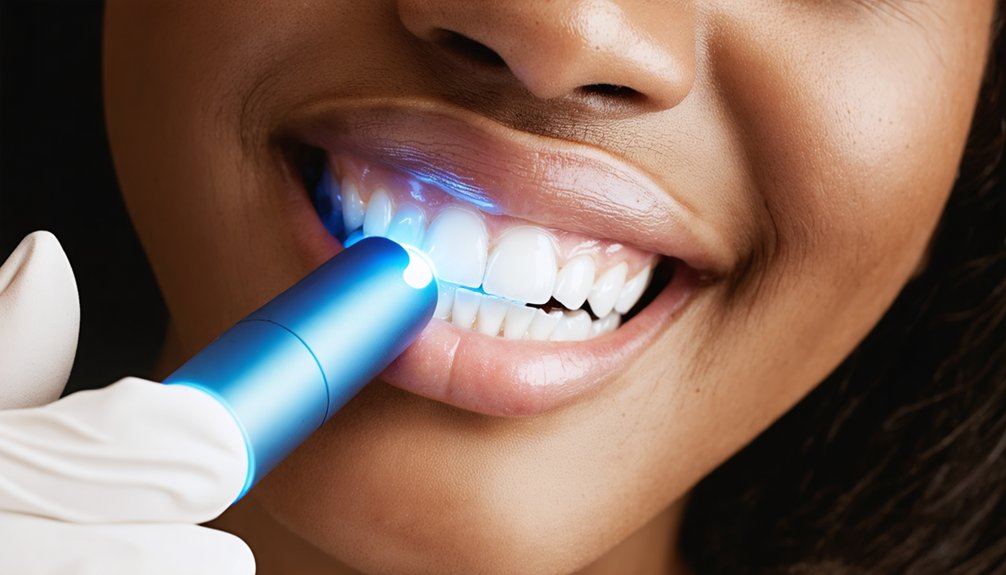
Treating deep intrinsic stains requires a system engineered specifically for that challenge, and KöR laser whitening delivers precisely that. This system targets intrinsic discoloration at the dentin level, where conventional methods fail.
- Penetrates enamel to achieve deep stain removal beyond surface-level treatment
- Addresses tetracycline staining, aging-related yellowing, and genetic discoloration
- Utilizes refrigerated bleaching gels that preserve chemical potency for maximum effectiveness
- Combines laser activation with a conditioning protocol to optimize gel absorption
- Delivers measurable shade improvements even in clinically resistant cases
You’ll benefit from a structured multi-session approach tailored to your stain severity.
Clinical outcomes confirm KöR’s reliability for moderate to severe intrinsic discoloration, giving you precise control over your whitening results without compromising enamel integrity.
Erchonia Laser Whitening: Low-Heat Option for Sensitive Teeth
Sensitivity concerns don’t have to exclude you from professional laser whitening, and Erchonia’s low-level laser technology addresses that barrier directly.
Unlike high-intensity systems, Erchonia uses cold laser energy that activates bleaching gel without generating significant heat, reducing the risk of enamel irritation or post-treatment sensitivity. For sensitive patients, this controlled approach delivers measurable shade improvement while keeping discomfort minimal throughout the session.
Cold laser energy activates whitening gel without heat, minimizing sensitivity while still delivering measurable results.
Erchonia benefits extend beyond comfort. The system’s precise low-level wavelengths target extrinsic yellowing caused by food, aging, and lifestyle habits without compromising surrounding tissue.
You can expect visible results within a single session, typically completed in 20 to 30 minutes. If you’ve avoided whitening due to sensitivity history, Erchonia’s clinical profile makes it a strategically sound option worth discussing with your provider.
How Long Do Laser Whitening Results Last?
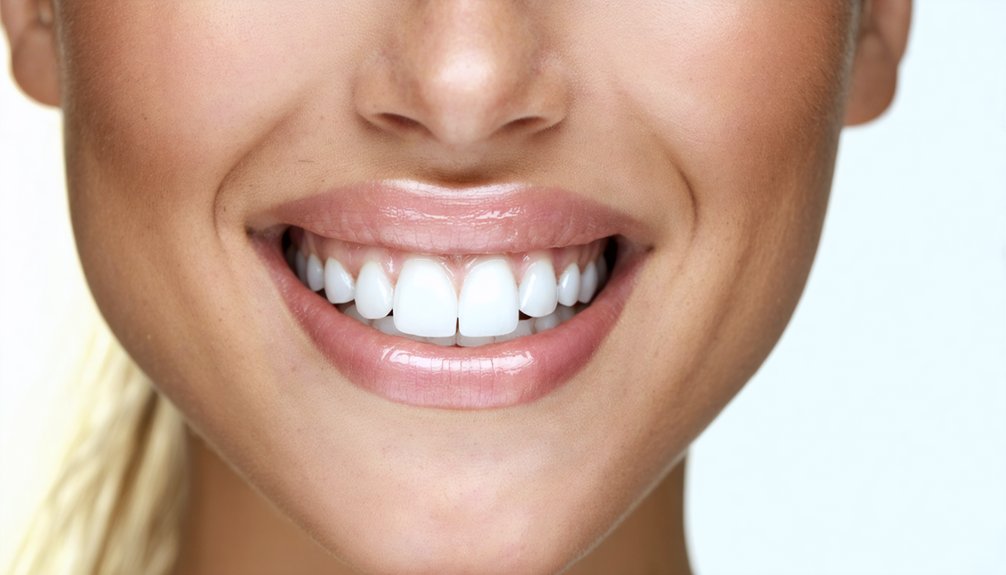
Your laser whitening results typically last between 6 months and 2 years, depending largely on your dietary habits, oral hygiene routine, and lifestyle choices like smoking.
You’ll accelerate discoloration by regularly consuming staining agents such as coffee, tea, and red wine, so limiting these extends your results considerably.
To maintain ideal whiteness long-term, you should use dentist-recommended whitening toothpaste, schedule periodic touch-ups, and keep up with regular dental check-ups.
Typical Results Duration
Laser teeth whitening results typically last anywhere from 6 months to 2 years, depending largely on your lifestyle habits and post-treatment care.
Treatment variability means your results consistency depends on controllable factors you actively manage.
- Avoid coffee, tea, and red wine to prevent rapid yellowing recurrence
- Schedule periodic touch-ups to maintain peak whiteness over time
- Use dentist-recommended whitening toothpaste to extend treatment results
- Attend regular dental check-ups to preserve overall oral health
- Limit smoking, which accelerates stain reaccumulation considerably
You control how long your results last.
Patients who follow post-treatment protocols consistently maintain brighter smiles closer to the two-year mark.
Those who neglect dietary restrictions and maintenance appointments experience faster discoloration.
Your commitment directly determines the longevity of your whitening investment.
Lifestyle Impact On Longevity
While laser whitening delivers results lasting 6 months to 2 years, your daily habits determine where you fall within that range. Your dietary habits directly influence how quickly stains return. Consuming coffee, tea, red wine, and tobacco accelerates discoloration, often cutting results short well before the two-year mark.
Committing to strategic lifestyle changes extends your investment considerably. Avoid staining foods and beverages immediately following treatment, when enamel remains most vulnerable to pigment absorption.
Using dentist-recommended whitening toothpaste reinforces brightness between sessions. Scheduling regular dental check-ups allows early intervention before discoloration progresses.
You control the outcome. Patients who actively manage dietary habits and maintain consistent oral hygiene routinely achieve results closer to two years, while those who don’t often require touch-ups within six months.
Maintaining Whiteness Long-Term
Maintaining your results after laser whitening requires consistent, deliberate effort. Whitening maintenance and stain prevention are non-negotiable if you want results lasting anywhere from six months to two years.
- Use dentist-recommended whitening toothpaste daily to slow discoloration.
- Avoid coffee, tea, and red wine—primary contributors to recurrence.
- Schedule periodic touch-ups before noticeable yellowing returns.
- Attend regular dental check-ups to monitor enamel health.
- Quit smoking to eliminate one of the most aggressive staining agents.
You control how long your results last. Clinical evidence confirms that patients who actively manage dietary habits and follow structured whitening maintenance protocols retain remarkably whiter teeth longer.
Stain prevention isn’t passive—it demands deliberate behavioral choices that directly determine whether your investment holds or deteriorates prematurely.
Laser Whitening Costs and What to Expect After Treatment
Several factors influence the cost of laser teeth whitening, including geographic location, the dental practice’s expertise, and the severity of your staining.
Cost variations typically range from $300 to $1,500 per session, with advanced high-intensity systems commanding premium pricing. You’ll generally receive more predictable outcomes when you invest in clinically established practices.
Post-treatment care directly determines how long your results last. You should avoid staining agents like coffee, tea, and red wine immediately following your procedure.
Your dentist may apply a desensitizing agent to minimize gum irritation and enamel sensitivity. Using whitening toothpaste and scheduling periodic touch-ups reinforces your initial results.
Adhering strictly to these protocols keeps recurrence minimal and guarantees your investment in laser whitening delivers sustained, measurable brightness over time.
Frequently Asked Questions
Can Laser Whitening Damage Existing Dental Veneers or Crowns?
Like armor untouched by fire, your crown durability remains intact — laser whitening won’t damage veneers or crowns. However, veneer sensitivity may occur since lasers don’t whiten artificial materials, leaving color mismatches you’ll need to address.
Is Laser Teeth Whitening Safe During Pregnancy or Breastfeeding?
You shouldn’t undergo laser teeth whitening if you’re pregnant or breastfeeding. Safety concerns exist due to unknown pregnancy effects from bleaching gel absorption. It’s best to postpone treatment until after breastfeeding concludes for complete safety assurance.
Does Insurance Typically Cover Laser Teeth Whitening Treatments?
Surprisingly, your insurance won’t fund your vanity—laser whitening’s considered cosmetic. You’ll cover cost considerations yourself. Given treatment duration spans one session, you’re investing in immediate, dramatic results without financial assistance from providers.
Can Teenagers Safely Undergo Laser Whitening for Yellow Teeth?
Teenagers generally shouldn’t undergo laser whitening until adulthood. Whitening age guidelines recommend waiting for fully developed teeth. Teenage dental health priorities focus on cavity prevention first. Consult your dentist to determine if you’re a clinically appropriate candidate.
How Does Laser Whitening Compare to Professional Tray-Based Whitening?
Coincidentally, if you’re short on time, laser efficiency wins decisively. You’ll achieve up to 8 shades brighter in one session, while tray-based methods demand weeks. Laser’s treatment duration—60 minutes—delivers faster, clinically measurable results you control.
References
- https://www.forbes.com/sites/forbes-personal-shopper/article/best-teeth-whitening-kit/
- https://www.mylifesmiles.com/teeth-whitening-clinic/what-are-the-best-laser-teeth-whitening-methods
- https://www.cifsourcing.com/professional-teeth-whitening-machines/
- https://www.target.com/s/best+laser+teeth+whitening
- https://www.aarp.org/health/conditions-treatments/teeth-whitening/
- https://www.ofzenandcomputing.com/best-teeth-whitening-kits/
- https://www.gentledental.com/resources/articles/teeth-whitening-products
- https://www.amazon.com/Best-Sellers-Teeth-Whitening-Products/zgbs/hpc/3778441
- https://vitrinclinic.com/teeth-whitening-treatments/
- https://www.carecredit.com/well-u/health-wellness/best-ways-to-whiten-teeth/