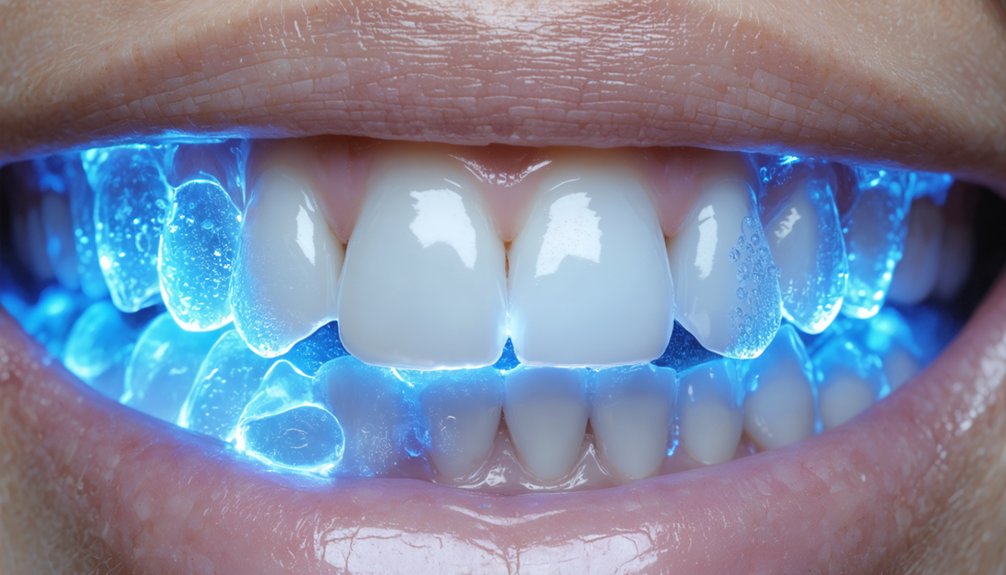
Blue light teeth whitening works by pairing a peroxide-based bleaching gel with blue LED light at wavelengths between 480 and 520 nm. The light transfers photon energy to hydrogen peroxide, lowering its activation energy threshold and accelerating free radical release. These radicals target chromophores — the molecules responsible for tooth discoloration — breaking their chemical bonds through photooxidation. If you want to understand exactly what’s happening at a molecular level, there’s considerably more to uncover.
Key Takeaways
- Blue light (480-520 nm wavelengths) activates peroxide-based whitening gels by lowering the activation energy needed to release stain-removing free radicals.
- Free radicals generated by photoactivated hydrogen peroxide break down chromophore molecules, converting colored compounds responsible for tooth discoloration into colorless structures.
- LED-accelerated whitening can lighten teeth by 4 to 8 shades, depending on stain type, gel concentration, and treatment duration.
- Blue light acts as a catalyst enhancing peroxide efficiency; the gel’s chemistry performs actual stain removal, not the light alone.
- Some short-term brightness following treatment may result from tooth dehydration rather than genuine stain removal, making realistic expectations important.
What Is Blue Light Teeth Whitening and How Does It Work?
Blue light teeth whitening combines a peroxide-based bleaching gel with a blue LED light source to accelerate the stain removal process. Light wavelengths between 480 and 520 nanometers activate the peroxide, transferring photon energy directly to the molecules and lowering their activation energy barriers.
This photocatalytic reaction generates free radicals that break down chromophores responsible for tooth discoloration.
Understanding the underlying gel chemistry helps you separate fact from whitening myths. The light acts as a catalyst, not the primary bleaching agent. Peroxide oxidizes stain molecules, while light accelerates that reaction.
Dehydration can create a temporary illusion of brightness without actual stain removal. When you understand this mechanism, you make more informed decisions about treatment options and set accurate expectations for your results.
How Blue Light Activates Hydrogen Peroxide in Whitening Gels
When blue light strikes hydrogen peroxide molecules in a whitening gel, it transfers photon energy directly to the peroxide, lowering the activation energy barrier required to initiate oxidative breakdown. This hydrogen activation process accelerates free radical release, allowing reactive oxygen species to penetrate enamel and target chromophore bonds responsible for discoloration.
You’re not relying on the light alone — the gel’s chemistry drives the outcome. Blue wavelengths between 480 and 520 nanometers optimize peroxide efficiency by reducing the energy threshold the molecule needs to decompose. The result is a faster, more controlled oxidative reaction.
Clinical research confirms this mechanism, though outcomes vary. Understanding the photochemical process lets you evaluate treatment options with precision rather than assumption.
Why Chromophores Are the Real Target of Blue Light Whitening
Peroxide activation matters only because of what it targets — chromophores, the molecular structures responsible for tooth discoloration.
You’re dealing with two primary chromophore types: extrinsic stains from coffee, wine, and tobacco, and intrinsic discoloration embedded within enamel and dentin. Each carries distinct stain characteristics that determine how aggressively treatment must work.
Extrinsic and intrinsic stains aren’t equal — their differences dictate exactly how aggressively your whitening treatment needs to work.
Blue light directly excites these chromophores, destabilizing their chemical bonds through photooxidation.
Once destabilized, peroxide-generated free radicals convert colored molecular structures into colorless compounds. Some chromophores respond to peroxide alone, but others require combined light and chemical activation for effective breakdown.
Understanding this mechanism gives you a clearer picture of what you’re actually treating.
The light isn’t decorative — it’s functionally targeting the precise molecular source of your discoloration.
What Photooxidation Actually Does to Tooth Stains
When blue light activates hydrogen peroxide, it accelerates oxidation reactions that directly attack the chemical bonds within chromophore molecules embedded in your enamel.
This bond disruption converts colored chromophores into colorless molecular structures, eliminating the underlying cause of discoloration rather than masking it.
You’re fundamentally witnessing photon energy lower the activation barrier for peroxide, making oxidation faster and more effective than gel chemistry alone could achieve.
Chromophore Bond Disruption
Photooxidation doesn’t simply bleach tooth stains—it dismantles them at the molecular level. When blue light activates hydrogen peroxide, the resulting free radicals directly attack chromophore stability by targeting the conjugated double bonds responsible for light absorption. These bonds carry specific bond energy thresholds, and once oxidative radicals exceed those thresholds, the molecular structure collapses.
You’re not masking discoloration—you’re eliminating the chemical architecture that creates it. Colored chromophores absorb visible light because of their electron configurations.
Photooxidation disrupts those configurations, converting complex stain molecules into simpler, colorless compounds. The tooth surface doesn’t reflect stain-absorbed wavelengths anymore because the molecules producing that effect no longer exist in their original form.
That’s precise, targeted chemistry—not surface-level treatment.
Colorless Molecular Conversion
Once free radicals breach chromophore stability, the conversion process becomes irreversible.
Photooxidation doesn’t merely weaken stain molecules—it restructures them entirely. Through molecular transformation, colored chromophores lose their conjugated bond systems, the precise molecular architecture responsible for visible discoloration.
You’re not watching a surface effect here.
Photooxidation drives colorless conversion by systematically breaking the electron delocalization patterns that allow chromophores to absorb visible light. Once those patterns collapse, the molecule can no longer reflect color back to the eye.
Clinical research confirms this mechanism operates at the chemical level, not cosmetically.
The resulting molecular fragments are structurally incapable of producing discoloration. Understanding this distinction matters—you’re not masking stains. You’re eliminating the molecular conditions that make staining visible.
Peroxide Oxidation Acceleration
Blue light doesn’t whiten teeth on its own—it accelerates the chemistry that does. When blue light at 480–520 nm strikes hydrogen peroxide, it transfers photon energy directly to peroxide molecules, reducing the activation energy needed to initiate oxidation pathways.
This disrupts peroxide stability in a controlled, targeted way—breaking molecular bonds faster than gel alone achieves at rest.
The result is a surge of free radicals that attack chromophore bonds responsible for staining. You’re not relying on passive diffusion; you’re driving an accelerated oxidative reaction through applied photochemistry.
Clinical research confirms this mechanism produces measurably greater shade improvement compared to unactivated gel. Understanding this process lets you evaluate whitening systems based on actual chemistry rather than marketing assumptions about what light contributes.
How Many Shades Can Blue Light Teeth Whitening Realistically Deliver?
When considering realistic outcomes, LED-accelerated whitening systems can lighten teeth by 4 to 8 shades over a two-week regimen, according to clinical data. Your actual shade improvement depends on initial tooth color, stain type, gel concentration, and treatment consistency.
Extrinsic stains from coffee, tea, and tobacco typically respond more predictably than intrinsic discoloration.
You’ll notice that whitening duration directly influences final results — shorter or inconsistent treatment schedules reduce efficacy.
Clinical research confirms that light-accelerated protocols outperform gel-only applications in measurable shade advancement.
However, you should understand that dehydration can temporarily exaggerate brightness immediately post-treatment. True, stable shade improvement becomes accurately assessable 48 hours after your final session, once tooth rehydration normalizes the enamel’s optical properties.
Does Blue Light Actually Speed Up the Whitening Process?
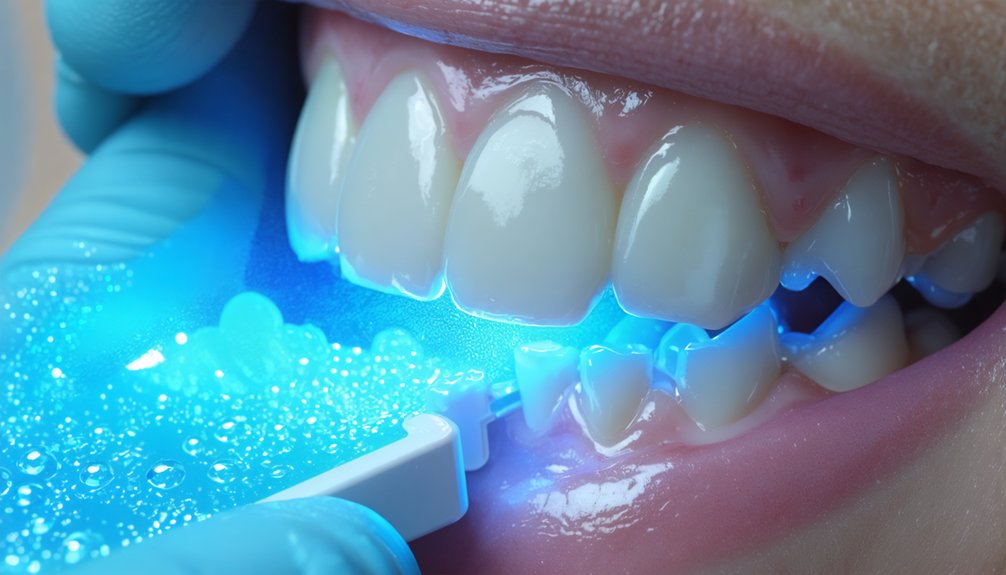
Beyond shade improvement metrics, you’ll want to understand the mechanism driving those results — specifically, whether blue light genuinely accelerates the whitening process or simply accompanies it.
Clinical evidence is mixed. A 2014 Journal of Conservative Dentistry study confirmed LED-accelerated whitening produced greater shade improvement than gel alone, supporting photocatalysis as a legitimate accelerant.
A 2014 Journal of Conservative Dentistry study confirmed LED-accelerated whitening outperformed gel alone, validating photocatalysis as a legitimate accelerant.
Blue light wavelengths between 480–520 nanometers transfer photon energy directly to peroxide molecules, lowering activation energy barriers and generating free radicals faster. This can reduce whitening duration and address stain persistence more efficiently than gel chemistry alone.
However, some literature indicates light adds no measurable benefit beyond dehydration effects. You should treat light as a catalyst that enhances peroxide performance — not a standalone agent — to set accurate outcome expectations.
What the Clinical Research Really Says About LED Whitening
What does the clinical literature actually confirm about LED whitening’s effectiveness? The research is mixed. A 2014 study in the Journal of Conservative Dentistry validated LED-accelerated whitening, showing greater shade improvement compared to gel alone.
However, other clinical findings challenge these results, suggesting light activation adds no measurable advantage to peroxide’s chemical action.
When you examine treatment efficacy across studies, a clear pattern emerges: the gel chemistry drives results, while light functions as a potential accelerator rather than an independent whitening agent.
Some research attributes short-term brightness to tooth dehydration rather than actual stain removal.
You’re best served by understanding that clinical outcomes vary depending on peroxide concentration, application time, and individual tooth composition—not solely on light exposure intensity.
Professional In-Office vs. At-Home Blue Light Whitening Kits
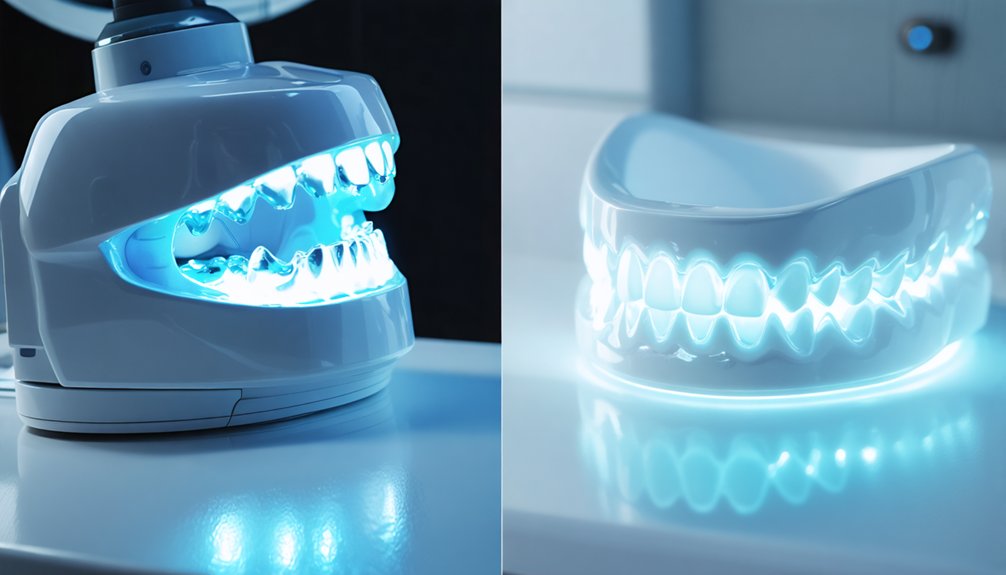
How you access blue light whitening technology considerably shapes your treatment outcomes.
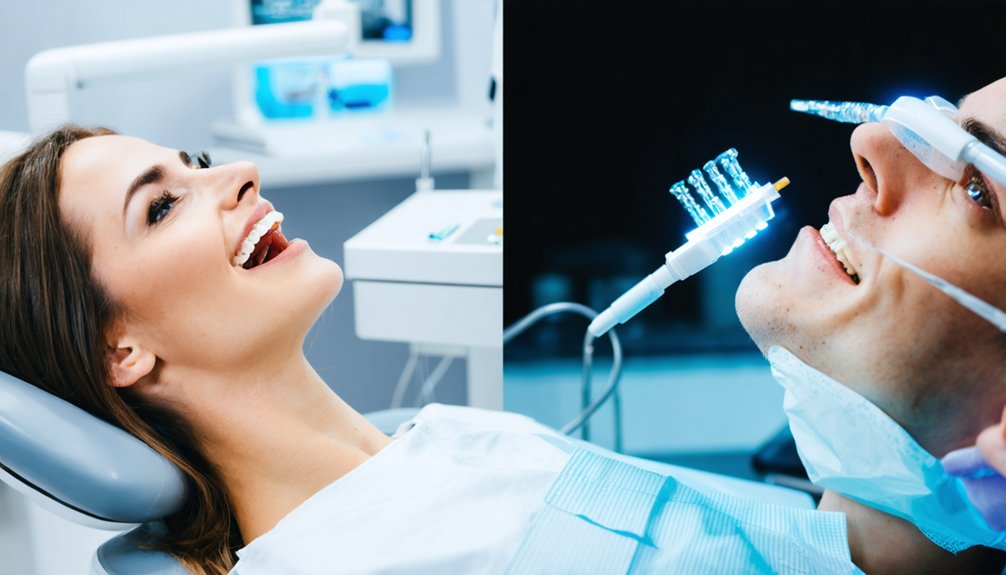
Professional treatment utilizes high-intensity blue LED devices paired with concentrated peroxide gels, delivering 4 to 8 shade improvements under clinical supervision. Dentists control exposure duration, gel concentration, and light intensity, which minimizes sensitivity risks while maximizing efficacy.
Professional blue light whitening delivers 4 to 8 shade improvements through clinician-controlled gel concentration and exposure duration.
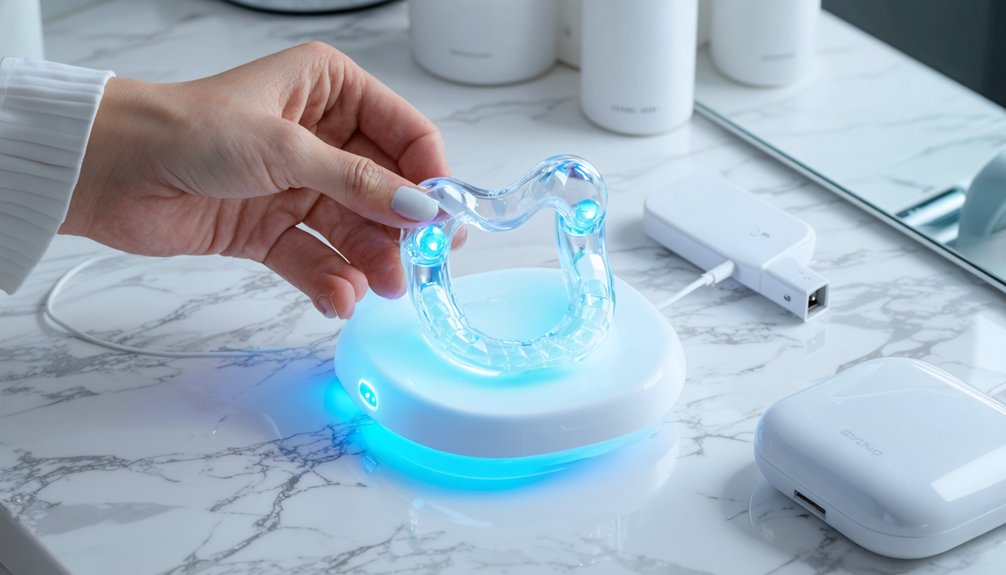
At-home care kits combine dentist-formulated gels with portable blue light units, offering flexibility at reduced intensity levels.
Philips Zoom! technology bridges both categories, providing professional and home-based options within a structured regimen.
You should understand that neither format relies on light alone. The gel chemistry drives actual stain removal, while light accelerates peroxide breakdown.
Choosing between professional treatment and home care depends on your desired speed, supervision preference, and shade goal.
Is Blue Light Teeth Whitening Safe for Sensitive Teeth?
Whether you choose professional treatment or an at-home kit, sensitivity remains a practical concern before starting any blue light whitening regimen.
Blue light itself doesn’t directly cause sensitivity; the peroxide concentration in the gel is the primary contributing factor. Overuse or improper application increases your risk of temporary irritation and discomfort.
Effective sensitivity management starts before treatment. Using potassium nitrate-based desensitizing toothpaste two weeks prior can reduce nerve response considerably.
During treatment, your clinician may apply fluoride barriers or reduce gel contact time to support patient comfort without compromising results.
If you have pre-existing sensitivity or enamel erosion, consult your dentist before proceeding.
Professional supervision allows you to adjust peroxide concentration and exposure duration to minimize adverse effects while maintaining whitening efficacy.
Why Light Is a Catalyst, Not the Cure, in Teeth Whitening
Although blue light accelerates the whitening process, it doesn’t remove stains on its own. The gel’s peroxide chemistry does the actual work.
Light functions as a catalyst, triggering photochemical reactions that lower the activation energy required for peroxide to oxidize chromophores. Without the gel, your light perception of brighter teeth may simply reflect temporary tooth dehydration rather than genuine stain removal.
Understanding this distinction gives you control over your expectations and treatment choices. Clinical evidence confirms that peroxide concentration, contact time, and application technique determine your results far more than light intensity alone.
Blue light optimizes the process, but it doesn’t replace it. You’re investing in a photochemically assisted system, not a standalone device. The chemistry leads; the light accelerates.
Frequently Asked Questions
Can Blue Light Whitening Damage Existing Dental Crowns or Veneers?
While crowns durability remains intact, blue light won’t chemically damage your restorations. However, you’ll notice veneer sensitivity may increase temporarily. The light targets natural enamel chromophores, leaving porcelain and composite materials structurally unaffected during treatment.
How Long Do Blue Light Whitening Results Typically Last After Treatment?
Your blue light whitening results typically last six to twelve months. You’ll maintain whitening efficacy longer by avoiding staining foods and managing teeth sensitivity post-treatment, as lifestyle factors directly influence how quickly chromophore stains reaccumulate on enamel surfaces.
What Age Restrictions Apply to Blue Light Teeth Whitening Procedures?
Surprise—teeth whitening isn’t for toddlers! You should follow age recommendations starting at 18, though some guidelines permit 16 with supervision. Always consult safety guidelines, as professional oversight guarantees you’re controlling outcomes responsibly and effectively.
Can Blue Light Whitening Work on Teeth With Intrinsic Discoloration or Stains?
Blue light whitening’s effectiveness on intrinsic stains is limited. You’ll find the gel chemistry drives results, but deeply embedded discoloration often requires alternative professional treatments since light primarily accelerates peroxide rather than targeting structural tooth discoloration directly.
How Often Can Blue Light Whitening Treatments Be Safely Repeated Annually?
You can safely repeat blue light whitening treatments two to three times annually. Monitor your sensitivity concerns closely, as overuse risks temporary discomfort. Your dentist should guide treatment frequency to maintain enamel integrity and ideal, evidence-based outcomes.
References
- https://pmc.ncbi.nlm.nih.gov/articles/PMC7881219/
- https://biancabright.com/blogs/news/does-led-teeth-whitening-work-the-science-behind-blue-light-whitening
- http://www.iosrjournals.org/iosr-jdms/papers/Vol23-issue4/Ser-4/L2304044451.pdf
- https://www.sciencedirect.com/science/article/pii/S2405844021000189
- https://www.ohtoothbrush.com/post/detail/373/
- http://www.nzctwa.org.nz/wp-content/uploads/2018/01/Science-behind-light-Accelerated-Whitening1.pdf
- https://azdentist.com/how-led-teeth-whitening-transforms-your-smile/
- https://www.healthline.com/health/dental-and-oral-health/blue-light-teeth-whitening
- https://www.rodeodental.com/educational-blogs/how-blue-led-teeth-whitening-works-and-the-science-behind-it/
- https://bepetal.com/blogs/beauty/led-whitening-science-explained