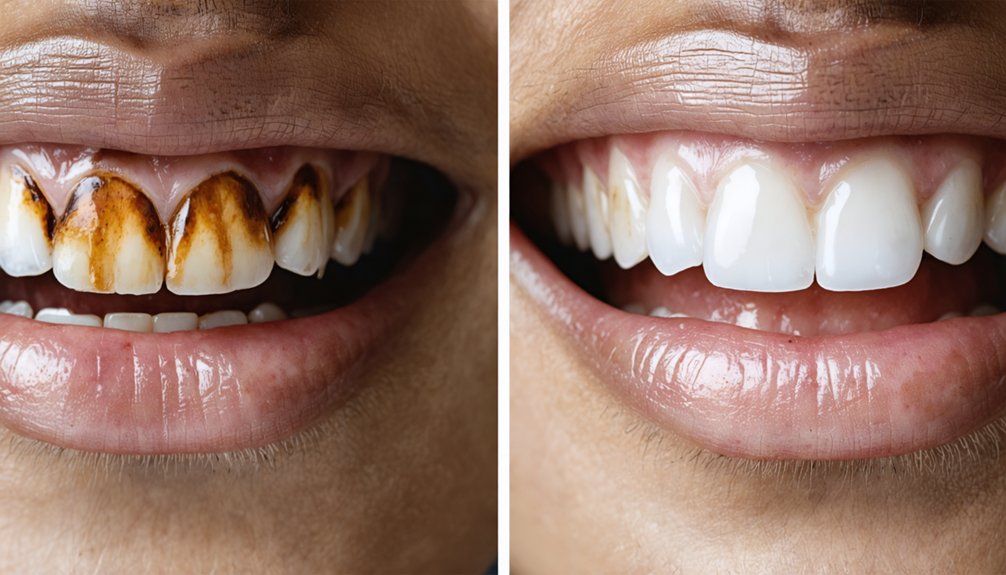
Smoker teeth stain differently because nicotine and tar penetrate deep into enamel pores, creating discoloration that resists conventional removal. You’ll need professional-grade treatments — like 10% carbamide peroxide — to achieve meaningful before-and-after results. Clinical data confirms significant color improvement is possible, though maintenance is critical since re-staining can appear within six months. Understanding the science behind tobacco stains, the right treatments, and how to protect your results will help you make smarter whitening decisions.
Key Takeaways
- Nicotine and tar penetrate deep into enamel, causing stubborn discoloration that requires professional-grade whitening agents for visible transformation results.
- Professional treatments using 10% carbamide peroxide or hydrogen peroxide deliver significant color improvements, effectively reversing deep tobacco stains in smokers.
- Long-term smokers often require multiple in-office sessions to achieve dramatic before-and-after results due to increased enamel porosity.
- The first 48 hours post-whitening are critical; avoiding smoking prevents rapid re-staining and preserves transformation results longer.
- Bi-yearly professional cleanings combined with daily fluoride whitening toothpaste help maintain smoker transformation results and slow stain re-accumulation.
Why Do Smoker Teeth Stain Differently Than Other Teeth?
Smoker teeth stain differently because nicotine and tar penetrate enamel pores and bond aggressively to the tooth surface, unlike food-related stains that sit superficially.
Understanding stain composition helps you recognize why standard brushing falls short. Tar creates dark, stubborn deposits while nicotine oxidizes upon air exposure, deepening yellow-brown discoloration over time.
Tar deposits and oxidizing nicotine work together, embedding discoloration that ordinary brushing simply cannot reach.
Smoking also reduces saliva flow, eliminating your mouth’s natural defense against stain accumulation.
Enamel health deteriorates under prolonged tobacco exposure, making pores increasingly receptive to stain particles. Your enamel becomes structurally compromised, allowing deeper pigment penetration with each cigarette.
These stains resist conventional removal methods precisely because they’re embedded within the enamel matrix rather than coating it. Recognizing this distinction gives you a clearer understanding of what treatment approach your situation actually requires.
How Deep Do Tobacco Stains Go: and What That Means for Whitening?
Knowing that tobacco stains bond aggressively to enamel tells only part of the story — the depth of penetration determines how your teeth respond to whitening treatment.
Tobacco composition includes both nicotine and tar, each penetrating enamel at different levels. Surface tar accumulates within superficial pores, while nicotine oxidizes and infiltrates deeper enamel layers over time.
This dual-layer stain penetration means whitening agents must work harder and longer to achieve visible results. Hydrogen and carbamide peroxide reach subsurface stains effectively, but deeply embedded discoloration from long-term smoking may require multiple professional sessions.
Understanding your stain depth isn’t passive knowledge — it directly informs your treatment plan, realistic expectations, and the number of whitening cycles you’ll need to achieve measurable, lasting improvement.
Teeth Whitening Before and After: What Smokers Actually Achieve
Before committing to treatment, you deserve a clear, evidence-based picture of what whitening actually delivers for smokers — not idealized outcomes, but realistic, documented results.
Clinical data confirms that 10% carbamide peroxide produces significant ΔE* improvements in smokers, with color stability maintained at one-year recall when professional prophylaxis is included.
Smoking effects compromise enamel health over time, increasing porosity and accelerating pigment re-bonding post-treatment. You’ll likely achieve measurable lightening, but surface stains rebound faster than in non-smokers, and long smoking histories often require multiple sessions.
Before-and-after documentation consistently shows genuine improvement — but also earlier recurrence within six months.
Reducing smoking frequency directly strengthens your long-term outcome. Whitening works; your behavioral choices determine how long those results hold.
Which Whitening Treatments Work Best If You Smoke?
Not all whitening treatments deliver equal results when tobacco stains are involved, so understanding which methods target your specific stain type matters.
Professional treatments using 10% carbamide peroxide or hydrogen peroxide penetrate enamel pores where nicotine and tar bond most aggressively, outperforming natural remedies like activated charcoal or oil pulling, which address only surface deposits.
Professional-grade peroxides penetrate deep enamel pores where tobacco bonds—activated charcoal and oil pulling simply cannot compete.
Custom take-home trays with professional-grade gel applied two hours daily over two weeks give you controlled, consistent results.
Combine this with lifestyle changes—reducing smoking frequency and scheduling bi-yearly prophylaxis—and you greatly extend your whitening outcomes.
Multiple in-office sessions may be necessary if you’ve smoked long-term.
Natural remedies and over-the-counter strips lack the concentration needed to reverse deeply embedded tobacco stains effectively.
Prioritize clinically supported protocols for measurable, lasting transformation.
What Clinical Studies Show About Before and After Results in Smokers
Clinical evidence confirms that whitening treatments produce measurable improvements in smokers, though outcomes differ from those in non-smokers. A study tracking 27 smokers and 28 non-smokers found significant ΔE* and ΔSGU improvements in both groups (p<0.001) after bleaching with 10% carbamide peroxide.
Color remained stable at one month and one year when combined with professional prophylaxis, demonstrating that smoking effects on enamel health don’t eliminate whitening’s effectiveness. However, without prophylaxis, slight darkening appeared by the one-year mark.
Smokers showed color rebound regardless of prophylaxis frequency. You can use these findings to set realistic expectations—multiple sessions and consistent professional cleanings are your strongest tools for maintaining measurable, documented results over time.
How Long Do Whitening Results Last If You Still Smoke?
If you continue smoking after whitening, you can expect your results to fade considerably faster than those of non-smokers, with noticeable re-staining often appearing within six months.
Your enamel’s temporary post-treatment porosity makes it especially vulnerable to nicotine and tar adhesion within the critical 24–48 hour window following your procedure.
Bi-yearly professional prophylaxis, daily whitening toothpaste, and minimizing smoking can meaningfully extend how long your results hold.
Whitening Longevity For Smokers
Whitening results tend to fade faster for smokers than for non-smokers, largely because nicotine and tar bond aggressively to freshly treated enamel.
Immediately post-treatment, increased enamel porosity accelerates re-staining, often reversing visible gains within six months. Clinical evidence confirms that without consistent professional prophylaxis, slight darkening appears as early as one year post-bleaching.
You can extend longevity by scheduling bi-yearly cleanings focused on stain removal, which preserve enamel health and slow discoloration recurrence.
Avoiding smoking for a minimum of 24–48 hours after treatment meaningfully reduces rapid pigment adhesion.
Research involving smokers using 10% carbamide peroxide demonstrated color stability at both one month and one year when prophylaxis was maintained.
Reducing smoking frequency remains the single most impactful variable controlling your long-term whitening outcome.
Re-Staining Risks After Whitening
Extending your whitening results through prophylaxis and reduced smoking is achievable, but understanding exactly how re-staining unfolds after treatment helps you set realistic expectations.
Immediately post-treatment, your enamel’s porosity increases, making it highly vulnerable to nicotine and tar adhesion. Smoking within 24–48 hours triggers rapid discoloration reversal, often undoing significant gains quickly.
Re-staining prevention depends heavily on your choices during this critical window. Unlike food-related surface stains, tobacco compounds bond aggressively to freshly whitened enamel, producing patchy, uneven discoloration against brighter surfaces.
Long-term smokers experience faster recurrence within six months versus non-smokers. Consistent enamel care—including bi-yearly professional cleanings, daily whitening toothpaste, and minimizing smoking frequency—significantly slows re-staining progression.
You retain more control over your results than you might assume.
Extending Results With Maintenance
Though maintenance strategies greatly influence longevity, whitening results in smokers typically last six months or less without consistent intervention.
You can extend outcomes considerably by combining professional prophylaxis with targeted whitening techniques, including custom take-home trays using 10% carbamide peroxide gel applied two hours daily over two weeks.
Bi-yearly dental cleanings remove extrinsic tobacco deposits before they penetrate enamel deeply. Daily fluoride and whitening toothpastes support enamel care by slowing surface stain accumulation.
Research confirms color stability at one year when prophylaxis accompanies bleaching, while subjects without cleanings showed measurable darkening.
Avoiding smoking for at least 48 hours post-treatment reduces immediate re-staining risk. Your commitment to these structured protocols directly determines how long your results remain clinically meaningful.
Why the First 48 Hours After Whitening Are Critical for Smokers
The first 48 hours after teeth whitening represent the most vulnerable window for smokers, as the whitening process temporarily increases enamel porosity, leaving the surface highly susceptible to re-staining.
Elevated enamel porosity means your tooth surface actively absorbs pigments, and nicotine’s stain adhesion during this period is considerably stronger than under normal conditions.
Tar and nicotine penetrate open enamel channels rapidly, reversing your results before stabilization occurs. You’re fundamentally undoing the treatment within hours.
Avoiding smoking during this critical window isn’t optional if you want lasting outcomes — it’s clinically necessary.
Even a single cigarette can trigger uneven discoloration against freshly whitened enamel.
Controlling your behavior in this narrow timeframe directly determines how effectively your whitening results hold long-term.
How Smokers Can Maintain Whitening Results Between Treatments
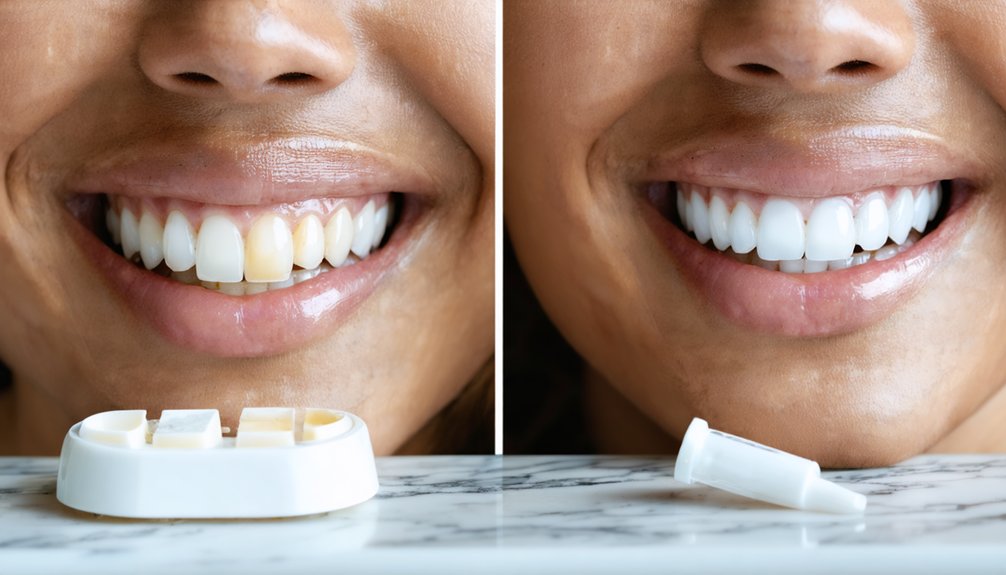
Once your whitening treatment is complete, you’ll need to limit smoking as much as possible, particularly avoiding it entirely for the first 48 hours when enamel porosity is at its highest.
Schedule bi-yearly professional cleanings to remove extrinsic tobacco stains before they penetrate deeper into enamel and reverse your results.
Use a fluoride-based whitening toothpaste daily to slow surface stain accumulation between clinical appointments.
Limit Post-Treatment Smoking
Limiting post-treatment smoking is one of the most critical steps you can take to preserve your whitening results. Immediately following treatment, your enamel’s porosity increases considerably, making it highly vulnerable to nicotine and tar penetration.
Among essential post-treatment precautions, avoiding smoking for a minimum of 24–48 hours is clinically supported and directly impacts how long your results last.
Your smoking habits beyond that initial window also matter. Nicotine oxidizes on contact with air, accelerating yellow discoloration on freshly whitened enamel.
Stains from tobacco bond more aggressively than food-related surface stains, causing faster and uneven color regression. Reducing smoking frequency—not just duration—directly extends the longevity of your whitening outcomes and reduces the number of retreatment sessions you’ll require.
Schedule Bi-Yearly Cleanings
Scheduling bi-yearly professional cleanings is one of the most effective strategies smokers can use to extend whitening results between treatments.
These appointments deliver critical cleaning benefits by removing extrinsic tobacco stains before they penetrate deeper enamel layers, preserving your whitened baseline longer. Research confirms color stability at one year post-bleaching when prophylaxis is maintained consistently.
For scheduling tips, align your cleanings every six months with your existing dental checkups to eliminate barriers to compliance.
Communicate your whitening goals directly to your hygienist so polishing protocols target tobacco-specific staining patterns. If you smoke heavily, consider requesting cleanings every four months instead.
Taking ownership of this schedule gives you measurable control over how quickly stains recur and how long your whitening investment actually lasts.
Use Whitening Toothpaste Daily
Daily use of whitening toothpaste serves as a practical frontline defense against tobacco stain accumulation between professional treatments. Whitening toothpaste benefits you by delivering mild abrasives and low-concentration peroxide agents that disrupt surface stain bonding before tar and nicotine penetrate deeper enamel layers.
Incorporating this into your daily oral hygiene routine doesn’t replace professional care, but it meaningfully slows visible discoloration between appointments.
You’re working against enamel that’s already porous from smoking, so consistency matters. Brushing twice daily with a fluoride-based whitening formula targets extrinsic stains while strengthening enamel structure.
Clinical evidence supports that surface-level tobacco stains respond faster to treatment than embedded deposits. Using whitening toothpaste daily gives you active control over stain progression rather than waiting for recurrence to worsen.
Frequently Asked Questions
Can Teeth Whitening Work if You Smoke Cigars or Pipe Tobacco?
“Where there’s a will, there’s a way.” Yes, whitening methods can work for you despite cigar or pipe tobacco’s smoking effects, though you’ll likely need multiple professional sessions to achieve and maintain ideal results.
Does Quitting Smoking Permanently Prevent Future Staining After Whitening?
Smoking cessation greatly reduces future staining, but it doesn’t guarantee permanent prevention. You’ll still need consistent dental hygiene practices, including bi-yearly cleanings and whitening maintenance, to protect your results and control long-term discoloration effectively.
Are Whitening Results Different for Heavy Smokers Versus Occasional Smokers?
Yes, smoking frequency directly impacts whitening effectiveness. If you’re a heavy smoker, you’ll likely need more sessions and experience faster color rebound, while occasional smokers retain results considerably longer with proper maintenance.
Can Whitening Toothpaste Alone Maintain Results for Smokers Long-Term?
Whitening toothpaste alone is a leaky bucket—it can’t sustain long-term whitening effectiveness for smokers. You’ll need professional dental hygiene cleanings and peroxide treatments to actively prevent tobacco stains from reversing your results.
Does Smoking Affect Whitening Results on Dental Crowns or Veneers?
Smoking doesn’t whiten crowns or veneers—whitening agents only work on natural teeth. You’ll notice crown discoloration and compromised veneer maintenance as tar and nicotine accumulate, requiring professional prophylaxis to manage surface staining effectively.
References
- https://pubmed.ncbi.nlm.nih.gov/26303401/
- https://www.prosmiledentalcare.com/how-teeth-whitening-holds-up-for-smokers-coffee-drinkers/
- https://www.saltlakedental.net/how-smoking-can-impact-teeth-whitening-results/
- https://whitehorsedental.com.au/ultimate-guide-smokers-teeth-whitening-journey/
- https://www.thesmilenova.com/post/the-ultimate-guide-to-teeth-whitening-for-smokers