If you’re dealing with genetic tooth discoloration, you’ve got seven proven techniques to contemplate. At-home bleaching strips and hydrogen peroxide remedies offer accessible starting points, while professional in-office bleaching delivers faster, more dramatic results. Laser bleaching provides precision, and internal bleaching targets nonvital teeth specifically. For severe cases, ceramic or resin veneers mask deep stains effectively, and zirconia crowns offer a permanent solution when nothing else works. Each technique ahead is broken down in full detail.
Key Takeaways
- At-home carbamide peroxide bleaching strips used twice daily for 14 days can achieve a 3–4 shade improvement in 70% of cases.
- Professional in-office bleaching uses 40% hydrogen peroxide with LED light activation, achieving 3+ shade improvements within 90 minutes.
- Laser bleaching activates 6% carbamide peroxide with a diode laser, offering targeted, controlled results for genetic discoloration.
- Internal bleaching techniques, including the walking bleach method, effectively treat nonvital teeth with deep, embedded genetic staining.
- Ceramic veneers and zirconia crowns provide restorative solutions for severe genetic stains unresponsive to bleaching treatments.
At-Home Bleaching Strips for Genetic Stains
Carbamide peroxide strips offer a practical starting point when you’re managing genetic tooth discoloration from home. Applied twice daily for 14 days, these strips deliver measurable results, achieving 3-4 shade improvement in 70% of genetic discoloration cases. You’re taking direct control of your treatment timeline without clinical appointments.
To maximize efficacy, pair strip application with strategic diet modifications—avoid chromogenic foods like coffee and red wine during your treatment cycle. Reinforcing consistent oral hygiene practices removes surface debris that otherwise reduces strip-to-enamel contact, directly compromising peroxide penetration.
Understand the limitations: these strips address genetic discoloration but won’t alter artificial restorations. If sensitivity develops, reduce application frequency. You’re managing a biochemical process—precision and consistency determine your outcome.
Which Home Remedies Actually Lighten Genetic Stains
While clinical treatments dominate the conversation, several home remedies demonstrate measurable efficacy against genetic tooth discoloration. You can achieve 1-2 shade improvement using a 1.5% hydrogen peroxide solution nightly for 30 seconds—a straightforward natural remedy backed by clinical data.
Baking soda paste, mixed at a 1:2 ratio with water, polishes away 20% of surface stains when applied twice weekly. Whitening toothpaste containing 0.5% sodium percarbonate targets 15% of daily stain accumulation, supporting consistent stain reduction over time.
However, you should understand that studies confirm home remedies only succeed in 35% of genetic discoloration cases. These options work best as supplementary strategies alongside professional treatments, not standalone solutions for deeply embedded genetic pigmentation.
Professional In-Office Bleaching for Fast Results
If you’re seeking rapid results, professional in-office bleaching with 40% hydrogen peroxide delivers a 4-5 shade improvement in just 90 minutes.
Your clinician can further boost peroxide efficacy by 30% by pairing the treatment with LED light acceleration at a 600nm wavelength.
Combined, these techniques give you a strong statistical advantage—ADA data confirms 75% of patients achieve 3+ shade improvement with in-office protocols.
High-Concentration Peroxide Treatment
When time is of the essence, professional in-office bleaching with high-concentration peroxide delivers results that at-home methods simply can’t match. Clinicians apply 40% hydrogen peroxide directly to your enamel, achieving 4-5 shade improvement within a single 90-minute session.
LED light at 600nm wavelength accelerates peroxide activation by 30%, maximizing penetration into genetically discolored dentin.
You’ll want to understand the biological response: high-concentration peroxide temporarily disrupts enamel remineralization, making post-treatment fluoride application non-negotiable. Saliva buffering helps neutralize residual acidity, but you shouldn’t rely on it alone.
Clinicians typically monitor sensitivity, as 25% of patients experience discomfort without desensitizing agents.
This controlled, precision-driven approach puts measurable, predictable outcomes directly in your hands—something no over-the-counter strip can guarantee.
LED Light Acceleration Benefits
The high-concentration peroxide applied during in-office treatment doesn’t work alone—LED light acceleration at 600nm wavelength pushes its efficacy up by 30%, fundamentally changing what’s achievable in a single appointment.
When the LED targets whitening gels directly, it accelerates the oxidation reaction responsible for breaking down chromogens embedded within dental enamel. You’re not waiting for passive chemistry—you’re controlling the activation process precisely.
This acceleration is why combined in-office protocols deliver 4-5 shade improvements within 90 minutes. Without LED activation, the same whitening gels would require markedly longer exposure to achieve comparable penetration through dental enamel.
You gain measurable results faster, with fewer sessions and predictable outcomes. For genetic discoloration specifically, that 30% efficacy increase often determines whether bleaching alone succeeds or prosthodontic intervention becomes necessary.
Combined Treatment Success Rates
75% of patients achieve 3 or more shade improvements when combining in-office protocols—a benchmark that underscores why professional bleaching remains the gold standard for fast, measurable results.
When genetic traits drive deep tooth pigmentation, single-method approaches often fall short. Combined protocols give you precise, layered control over outcomes.
Here’s what drives combined treatment success:
- 40% hydrogen peroxide delivers 4-5 shade correction in a single 90-minute session.
- LED light acceleration at 600nm increases peroxide efficacy by 30%, amplifying results.
- Custom tray follow-up with 25% carbamide peroxide sustains and extends shade gains.
- Professional cleaning beforehand removes 80% of extrinsic stains, maximizing peroxide penetration.
Stacking these methods strategically lets you directly counter genetically stubborn pigmentation with measurable, documented precision.
Laser Bleaching for Genetic Tooth Discoloration
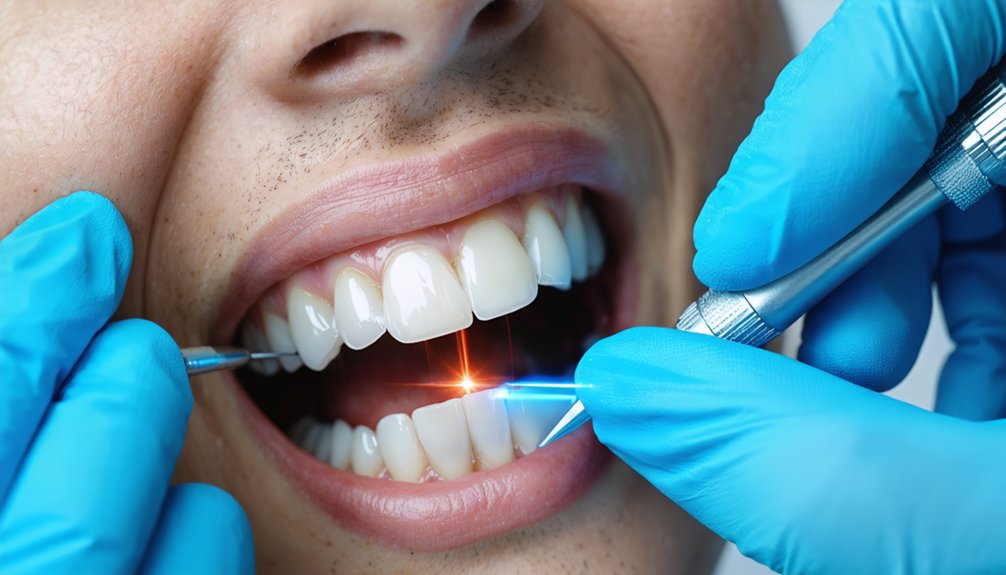
Laser bleaching offers a compelling option for patients struggling with genetic tooth discoloration, combining precision activation with minimal treatment time. Unlike historical methods that relied on prolonged chemical exposure, this technique uses 6% carbamide peroxide activated by a diode laser at 400mW power, delivering controlled, targeted results.
You’ll benefit from a procedure that aligns with modern cultural perceptions of efficiency and clinical precision. The diode laser accelerates peroxide breakdown, releasing oxygen radicals that penetrate enamel and dentin to disrupt chromogenic compounds causing genetic staining.
Clinical evidence supports measurable outcomes, though individual response varies based on discoloration severity. When you demand a technically advanced, minimally invasive approach, laser bleaching positions itself as a strategically sound choice within your exhaustive whitening treatment plan.
Internal Bleaching When Genetic Staining Affects a Dead Tooth
When genetic staining affects a nonvital tooth, you’ll find that internal bleaching methods offer targeted solutions that external techniques simply can’t match.
The walking bleach technique places 35% sodium perborate directly into the pulp chamber for 7-10 days.
While inside-outside bleaching combines 15% carbamide peroxide internally with 20% externally for a dual-action approach.
If you need faster results, thermocatalytic bleaching applies heated 10% hydrogen peroxide at 50°C in 5-minute intervals to accelerate the whitening process.
Walking Bleach Technique
How does a dentist treat genetic staining in a tooth that’s no longer essential? The walking bleach technique targets nonvital teeth by placing 35% sodium perborate directly into the pulp chamber, working from the inside out while preserving tooth enamel integrity.
Here’s what you can expect:
- Access opening — Your dentist drills into the pulp chamber to create a treatment canal.
- Chemical placement — 35% sodium perborate is sealed inside for 7–10 days.
- Progress monitoring — Dental shade guides track improvement between appointments.
- Resealing — The chamber is resealed after achieving the target shade.
Research confirms this method delivers 2–3 shade improvement in 65% of nonvital genetic discoloration cases, giving you measurable, controlled results.
Inside-Outside Bleaching Method
While the walking bleach technique works from the inside alone, the inside-outside bleaching method combines internal and external peroxide application simultaneously, targeting genetic staining in nonvital teeth from both directions. Your clinician places 15% carbamide peroxide inside the pulp chamber while applying 20% carbamide peroxide externally, creating a dual-action whitening effect that penetrates stubborn genetic discoloration more aggressively.
Before proceeding, your provider evaluates enamel thickness to verify sufficient structural integrity can withstand simultaneous peroxide exposure from both surfaces. Since pulp health is nonexistent in nonvital teeth, internal chemical exposure carries reduced biological risk, making this approach viable for severe genetic cases.
Research confirms this method delivers measurable shade improvement where single-direction bleaching falls short, giving you a more thorough solution for deep, genetically rooted discoloration.
Thermocatalytic Bleaching Process
Thermocatalytic bleaching introduces heat as a catalyst to accelerate hydrogen peroxide activity inside a nonvital tooth, making it a particularly effective option when genetic staining has deeply saturated the dentin. Your dentist applies 10% hydrogen peroxide at 50°C, leveraging thermal conductivity to drive the agent deeper into discolored tissue.
Here’s what you can expect from this process:
- Heat activation breaks molecular bonds in intrinsic pigmentation more aggressively than passive methods.
- Five-minute intervals let clinicians control exposure and minimize pulp tissue stress.
- Enamel porosity allows heated peroxide to penetrate dentin tubules efficiently.
- Precise temperature regulation ensures thermal conductivity enhances efficacy without compromising surrounding structures.
This technique gives you direct control over a measurable, clinically driven outcome for genetically discolored nonvital teeth.
Ceramic and Resin Veneers for Severe Genetic Staining
When severe genetic staining resists bleaching treatments, ceramic and resin veneers offer a reliable prosthodontic solution that’s proven to mask discoloration with a 95% success rate within six months. You’ll choose between two primary options based on your case severity.
Ceramic veneers deliver a 3-4 shade enhancement through precise porcelain layering at just 0.5mm thickness, achieving natural surface gloss enhancement that mimics enamel’s translucency. Their 90% porcelain composition ensures long-term durability and color stability.
Resin composite veneers provide a more conservative alternative, yielding 1-2 shade improvement using microfilled 40% resin material. Both options require 20% phosphoric acid etching for 15 seconds to ensure optimal bonding.
For severe genetic staining, ceramic veneers consistently outperform resin in masking depth and aesthetic longevity.
When Zirconia Crowns Are the Only Option
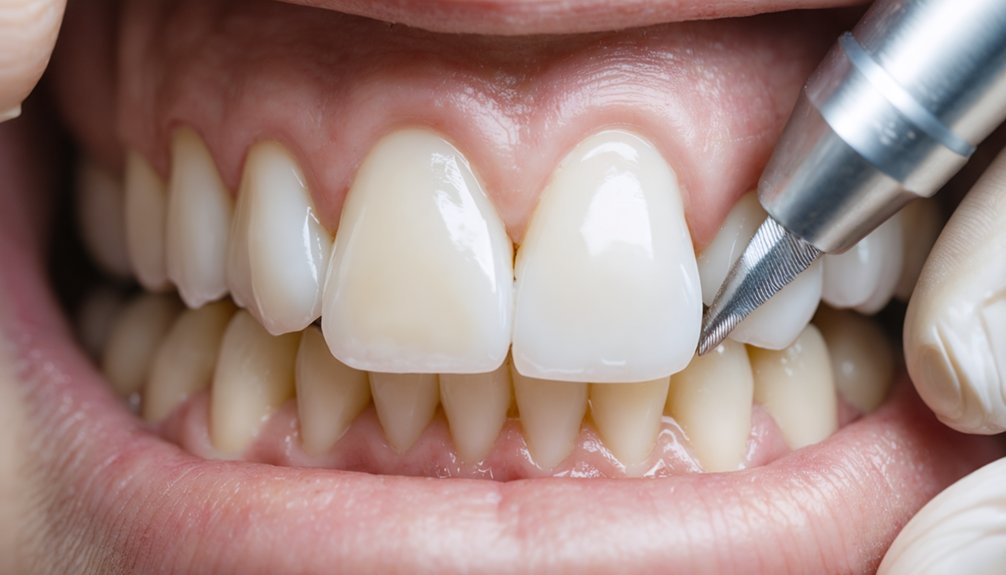
For the most severe cases of genetic discoloration, zirconia crowns stand as your final and most definitive restorative option. When bleaching and veneers fail, 1.0mm zirconia delivers 95% opacity, completely masking underlying discoloration. Dental material durability and patient aesthetic preferences converge here, giving you full control over your outcome.
Consider zirconia crowns when:
- Bleaching yields no measurable shade improvement after multiple professional sessions
- Enamel structure is too compromised to support veneer bonding
- Discoloration penetrates beyond dentin, making surface treatments ineffective
- Patient aesthetic preferences demand permanent, long-lasting correction without ongoing maintenance
Your dentist will remove 1.0mm of tooth structure, then seat a precision-milled crown engineered for both function and complete color masking within six months.
Frequently Asked Questions
Can Genetic Tooth Discoloration Worsen With Age Despite Whitening Treatments?
Yes, genetic factors can cause discoloration to worsen with age, even with treatments. You’ll find that environmental influences like diet and aging accelerate pigmentation changes, making consistent professional whitening essential to maintaining your results long-term.
Are Whitening Results Permanent for Teeth With Genetic Discoloration?
Whitening results aren’t permanent for genetic tooth pigmentation. Genetic factors continuously influence discoloration, requiring periodic retreatment. You’ll need consistent maintenance—whether through professional bleaching or home remedies—to sustain your achieved shade improvements effectively over time.
Does Genetic Discoloration Affect Children’s Baby Teeth Before Permanent Teeth Emerge?
Yes, genetic factors can affect your child’s baby teeth before permanent ones emerge. You’ll notice pediatric dental concerns early, as inherited discoloration often manifests in primary dentition, signaling potential permanent tooth involvement requiring proactive professional intervention.
Can Whitening Treatments Be Safely Combined for Faster Genetic Stain Removal?
You can safely combine whitening treatments for faster genetic stain removal through combination therapy, but you must prioritize safety considerations—monitor peroxide concentrations, avoid exceeding 35%, and consult your dentist to prevent sensitivity and gum irritation.
Does Dental Insurance Typically Cover Whitening Procedures for Genetic Tooth Discoloration?
You’ll find that dental insurance typically doesn’t cover cosmetic dentistry procedures like whitening, even for genetic discoloration. You must explore flexible spending accounts to manage costs while addressing tooth sensitivity concerns during treatment.
References
- https://pmc.ncbi.nlm.nih.gov/articles/PMC9790475/
- https://riverwalkdental.ca/can-teeth-that-are-genetically-yellow-be-whitened/
- https://d-nb.info/99112345X/04
- http://www.ijsrr.org/down_92063.php
- https://pocketdentistry.com/tooth-whitening-2/
- https://de.slideshare.net/slideshow/whitening-the-single-discolored-tooth-67896965/67896965
- https://www.ada.org/resources/ada-library/oral-health-topics/whitening
- https://de.slideshare.net/slideshow/bleaching-restorations-of-discolored-teeth-in-pediatric-dentistry/249939167
- https://www.rcseng.ac.uk/dental-faculties/fds/publications-guidelines/clinical-guidelines/-/media/cdd564e8285641f18634e6d028e3d722.ashx
- https://www.carolinacoastfamilydentistry.com/teeth-whitening-guide-tips-tricks/