You can preserve your enamel while whitening by staying at or below 10% hydrogen peroxide concentration and limiting full treatment cycles to twice annually. Avoid DIY hacks like lemon juice or activated charcoal, which cause irreversible demineralization and abrasion. Support recovery with hydroxyapatite toothpaste and calcium-rich foods between sessions. Professional supervision gives you precision that over-the-counter products simply can’t match. The full picture of what’s actually safe may surprise you.
Key Takeaways
- Keep hydrogen peroxide concentrations at or below 10% to minimize enamel erosion and reduce dentin exposure during whitening treatments.
- Limit full whitening cycles to twice annually, allowing adequate time for enamel recovery between sessions.
- Avoid DIY hacks like lemon juice or activated charcoal, as they cause irreversible enamel demineralization and abrasion.
- Use hydroxyapatite nanoparticle toothpaste daily before and after whitening to actively rebuild and strengthen enamel structure.
- Professional supervision ensures custom-fitted trays, controlled contact time, and pre-treatment assessments that protect enamel throughout whitening.
Why Whitening Damages Enamel: and How to Stop It
When whitening products penetrate your enamel’s crystalline structure, they can trigger a cascade of damage that’s both chemical and mechanical in nature. High-concentration peroxides dissolve calcium phosphate bonds, accelerating enamel erosion and leaving dentin exposed. That exposure directly causes tooth sensitivity, which signals structural compromise you can’t ignore.
High-concentration peroxides don’t just whiten—they dissolve the calcium phosphate bonds holding your enamel together.
You can stop this damage cycle by controlling three variables: concentration, contact time, and frequency. Never exceed recommended concentrations, limit treatments to twice annually, and always apply remineralizing agents before and after each session. Choose pH-neutral formulations to prevent acid-driven demineralization.
Professional supervision adds another critical layer of protection. A dentist evaluates your enamel’s baseline condition, identifies vulnerable zones, and customizes protocols that deliver visible results without sacrificing structural integrity.
You maintain control by demanding precision, not convenience.
What Peroxide Concentrations Are Actually Safe for Enamel?
When choosing a whitening product, you’ll want to stay at or below 10% hydrogen peroxide or its carbamide peroxide equivalent, as concentrations beyond that threshold cause measurable dentin exposure and heightened sensitivity.
Higher-strength formulas demand professional oversight to guarantee controlled contact time and enamel-protective protocols that OTC products simply can’t replicate.
Working with a licensed dentist gives you access to custom-fitted trays, pre-treatment enamel assessments, and clinically supervised application—safeguards that make a critical difference in long-term enamel health.
Safe Concentration Thresholds
Understanding safe peroxide concentrations is essential before you pursue any whitening treatment. Hydrogen and carbamide peroxide penetrate dental hard tissues effectively, but concentrations exceeding 10% cause measurable dentin exposure and heightened sensitivity.
You’ll want to stay within clinically validated ranges to maintain enamel protection tips that actually work.
For in-office treatments, dentists control contact time and application protocols, making higher concentrations manageable under supervision.
For at-home use, products at or below 10% hydrogen peroxide represent the threshold for safe whitening practices. Exceeding recommended concentrations doesn’t accelerate results—it accelerates damage.
Limit full whitening cycles to twice annually, giving enamel adequate recovery time between treatments.
Controlling concentration, contact time, and frequency gives you the whitest results without compromising structural integrity.
Professional Supervision Benefits
Professional supervision opens up whitening options that over-the-counter products simply can’t match safely. A licensed dentist evaluates your enamel condition, identifies stain type, and builds custom protocols tailored to your specific biology—not generic instructions.
You gain access to:
- Custom-fitted trays that deliver even gel application, preventing uneven exposure and localized enamel stress
- Enamel protection measures integrated before, during, and after treatment to support remineralization
- Controlled contact time with professional-grade concentrations, reducing sensitivity and structural risk
This level of precision matters. Without proper assessment, you’re guessing—and guessing with peroxide carries real consequences.
Professional supervision guarantees enamel protection isn’t an afterthought; it’s built into every step. You stay in control of your results while minimizing the biological cost of achieving them.
Professional Whitening Options That Keep Enamel Intact
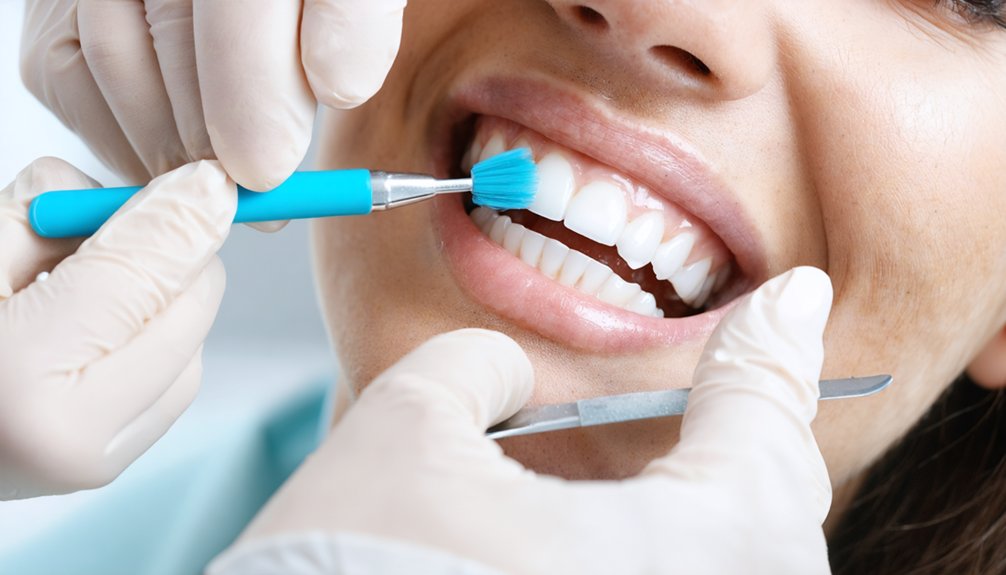
When you choose in-office bleaching, your dentist applies enamel-protective protocols that over-the-counter products simply can’t replicate.
Custom-fitted trays guarantee even gel distribution at controlled concentrations, eliminating the uneven exposure that causes sensitivity and surface damage.
Before any treatment begins, your dentist evaluates your enamel condition and stain type, tailoring the approach to your specific needs rather than applying a one-size-fits-all solution.
In-Office Bleaching Benefits
In-office bleaching stands as one of the most reliable ways to whiten your teeth while keeping enamel fully intact.
Dentist-supervised protocols combine advanced in office technology with precise concentration control, maximizing whitening efficacy while minimizing risk. You’re not guessing—you’re getting a calibrated treatment tailored to your enamel’s condition.
Key advantages you gain with in-office bleaching:
- Even application through professional-grade equipment eliminates uneven exposure that damages enamel
- Enamel-protective protocols including barrier application shield your gum tissue and dentin throughout treatment
- Pre-treatment assessment identifies stain type and enamel integrity before any bleaching agent touches your teeth
This level of precision isn’t available over the counter.
If protecting your enamel while achieving measurable results matters to you, in-office bleaching delivers both without compromise.
Custom Tray Advantages
Custom-fitted trays from your dentist deliver a level of precision that generic, one-size-fits-all strips simply can’t match. With personalized fitting, the tray conforms exactly to your dental arch, ensuring even gel distribution across every tooth surface while keeping bleaching agents off your gingival tissue.
The custom tray benefits extend beyond comfort. Your dentist controls the peroxide concentration, contact time, and treatment frequency, eliminating the guesswork that leads to enamel damage or sensitivity.
You’re not guessing at application—you’re executing a calibrated protocol designed specifically for your enamel condition and stain type.
This level of control also means you can integrate remineralizing agents into your routine between sessions, supporting enamel recovery. Custom trays give you professional-grade results without surrendering oversight of your own oral health.
Pre-Treatment Enamel Assessment
Before any whitening agent touches your teeth, a professional enamel assessment determines whether your enamel can safely withstand treatment. This enamel evaluation identifies vulnerabilities, stain types, and structural integrity—giving you precise control over your whitening readiness.
A dentist examines three critical factors before clearing you for treatment:
- Enamel thickness and erosion levels — compromised enamel requires remineralization before bleaching begins
- Stain classification — intrinsic versus extrinsic stains respond differently to peroxide-based agents
- Sensitivity indicators — existing dentin exposure signals higher risk of post-treatment discomfort
Skipping this step means proceeding blind. A pre-treatment assessment doesn’t slow your results—it protects them.
You’ll enter whitening with a clear clinical picture, reducing adverse outcomes and maximizing the effectiveness of whichever professional protocol your dentist recommends.
Which Over-the-Counter Whitening Products Are Actually Safe?
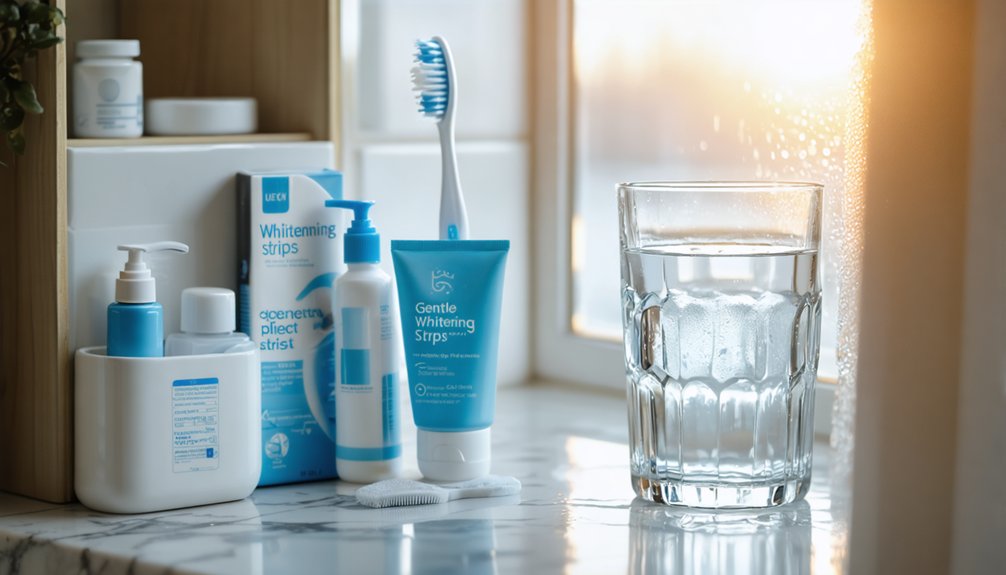
When it comes to over-the-counter whitening products, not all options carry the same safety profile for your enamel. You’ll want to prioritize products with lower peroxide concentrations and use them strictly as directed to avoid cumulative damage.
Sensitive strips are a reliable choice—they’re formulated to reduce enamel roughening and gingival irritation while still delivering measurable whitening results.
Natural toothpaste with an RDA below 70 offers a low-abrasivity alternative for daily surface stain removal without compromising enamel structure. Avoid charcoal-based products and lemon juice hacks entirely; their abrasive or acidic properties outweigh any cosmetic benefit.
Limit whitening treatments to twice annually. This controlled frequency gives your enamel adequate time to remineralize fully between applications, preserving long-term structural integrity while still achieving your whitening goals.
Natural Whitening Hacks That Quietly Destroy Enamel
While safer OTC options exist, the natural whitening space is littered with DIY hacks that promise gentle, chemical-free results but silently erode your enamel with every application.
Natural acid exposure from lemon juice and apple cider vinegar demineralizes enamel faster than most commercial products. Abrasive ingredients like undiluted baking soda and activated charcoal scratch enamel surfaces, creating roughened texture that traps more stains over time.
Avoid these three common offenders:
- Lemon juice rinses — prolonged natural acid exposure dissolves the enamel surface irreversibly
- Activated charcoal pastes — highly abrasive ingredients compromise enamel texture despite their visual appeal
- Undiluted baking soda — mechanical abrasion accelerates surface wear without professional-grade protective protocols
You’re not achieving whitening — you’re trading brightness for permanent structural damage.
How to Remineralize Enamel Between Whitening Treatments
Protecting your enamel between whitening sessions isn’t passive — it requires deliberate remineralization strategies that restore mineral density before your next treatment.
Apply hydroxyapatite nanoparticle toothpaste daily; it aggressively rebuilds crystalline structure at the microscopic level, making it one of the most effective remineralization techniques available without a prescription.
Daily hydroxyapatite nanoparticle toothpaste aggressively rebuilds enamel’s crystalline structure — no prescription required.
Use remineralizing products both before and after each whitening cycle to buffer mineral loss at its most vulnerable windows.
Incorporate calcium-rich foods — cheese, milk, broccoli — into your diet to supply the raw materials enamel needs for structural recovery.
Choose pH-neutral whitening formulas to minimize demineralization during active treatment phases.
Adequate spacing between sessions isn’t optional; it’s the interval your enamel requires to fully recover.
Consistent application of these strategies directly determines your long-term enamel health.
Daily Habits That Protect Enamel While You Whiten
Remineralizing between sessions builds your foundation, but your daily habits determine whether that foundation holds. Your whitening routine tips mean nothing if lifestyle choices undermine enamel integrity between applications.
Prioritize these protective actions:
- Brush twice daily with a soft-bristle brush and wait 30–60 minutes after eating to avoid abrading softened enamel.
- Choose enamel friendly snacks like cheese, milk, and broccoli, which actively reinforce mineral density.
- Use a straw for staining beverages like coffee or tea to minimize direct enamel contact.
Reduce sugar intake to limit acid erosion, and incorporate antibacterial mouthwash to maintain a balanced oral microbiome.
Every controlled decision you make daily compounds into measurable enamel protection—don’t let passive habits erase your active whitening investments.
Frequently Asked Questions
Can Teeth Whitening Affect Dental Restorations Like Crowns or Veneers?
Yes, whitening techniques don’t alter crowns or veneers since they’re non-porous. You must consider restoration compatibility before treatment, as mismatched shades can result. Consult your dentist to align your natural teeth’s whiteness with existing restorations effectively.
Is Teeth Whitening Safe During Pregnancy or While Breastfeeding?
You should avoid teeth whitening due to pregnancy safety risks and breastfeeding concerns, as peroxide compounds may absorb systemically. Consult your dentist, maintain excellent oral hygiene, and postpone whitening treatments until after pregnancy and breastfeeding conclude.
At What Age Is Teeth Whitening Considered Safe for Younger Patients?
“Better safe than sorry”—you should wait until age 14–16, when permanent teeth fully erupt. Youthful candidates must prioritize enamel safety, as developing teeth remain vulnerable to sensitivity and structural damage from whitening treatments.
How Long Do Whitening Results Typically Last Before Retreatment Is Needed?
Your whitening duration typically lasts six months to two years, depending on lifestyle habits. You’ll control retreatment frequency by limiting stain-causing beverages and scheduling treatments twice annually, ensuring safe, cumulative enamel protection throughout your whitening regimen.
Can Certain Medications Increase Enamel Sensitivity During Whitening Treatments?
Ironically, the medications meant to heal you can heighten enamel erosion risks during whitening. Medication interactions with peroxide-based treatments amplify sensitivity, so you’ll want to consult your dentist before proceeding to maintain complete control over your enamel’s integrity.
References
- https://pmc.ncbi.nlm.nih.gov/articles/PMC4058574/
- https://www.youtube.com/watch?v=d98KAyxTGwo
- https://stomatology.expertexpro.com/en/lechenie-zubov/otbelivanie-zubov/bezopasnoe-otbelivanie-zubov.html
- https://lustrodental.com/whitening-methods/
- https://www.ada.org/resources/ada-library/oral-health-topics/whitening
- https://leedervilledental.com.au/does-teeth-whitening-damage-enamel/
- https://crest.com/en-us/oral-care-tips/teeth-whitening/what-are-best-teeth-whitening-methods
- https://www.nirvanadental.com/blog/how-to-whiten-your-teeth-without-damaging-them
- https://www.youtube.com/watch?v=KloenqZIekw
- https://www.northeastdentalarts.com/blog/what-is-the-least-damaging-way-to-whiten-your-teeth/