Natural whitening kits can genuinely reduce extrinsic stains from coffee, tea, wine, and smoking. You’ll likely notice visible changes within ten days, with more complete results by week four — timelines controlled studies actually confirm. Ingredients like baking soda, activated charcoal, and hydroxyapatite each work differently, so your results depend on stain type, consistency, and proper application. If you want to know exactly what to expect and how to protect your enamel throughout, what follows covers it all.
Key Takeaways
- Natural whitening kits work best on extrinsic stains from coffee, tea, wine, or smoking, with visible results typically appearing by day 10.
- Key ingredients like baking soda and activated charcoal remove surface stains without peroxide, while hydroxyapatite supports enamel remineralization.
- Measurable whitening improvements are confirmed by week 4 in controlled studies, though results require ongoing maintenance to last.
- Overusing abrasive ingredients accelerates enamel erosion; strictly following manufacturer instructions ensures safer, more consistent whitening outcomes.
- Monitor sensitivity after each session and pause treatment if discomfort persists beyond 24 hours to protect long-term enamel health.
Do Natural Whitening Kits Actually Whiten Your Teeth?
Natural whitening kits can produce measurable results, but their effectiveness depends largely on the type of stains you’re dealing with and the specific ingredients in the formula.
Research confirms that natural alternatives like activated charcoal, baking soda, and hydroxyapatite deliver statistically significant whitening effects on extrinsic stains from coffee, tea, wine, and smoking.
Natural ingredients like activated charcoal and hydroxyapatite show measurable results against stains from coffee, tea, and wine.
In controlled studies, measurable changes appeared by day 10, with more complete results by week 4. User testimonials frequently align with this timeline, noting gradual but visible improvement with consistent application.
However, you won’t see the same outcomes if your discoloration stems from intrinsic sources like medications or genetics.
Understanding what’s causing your staining helps you set realistic expectations and choose a formula that’s actually suited to your needs.
The Ingredients That Drive Real Whitening Results
When you look at what separates effective natural whitening kits from ineffective ones, the ingredient list tells the story.
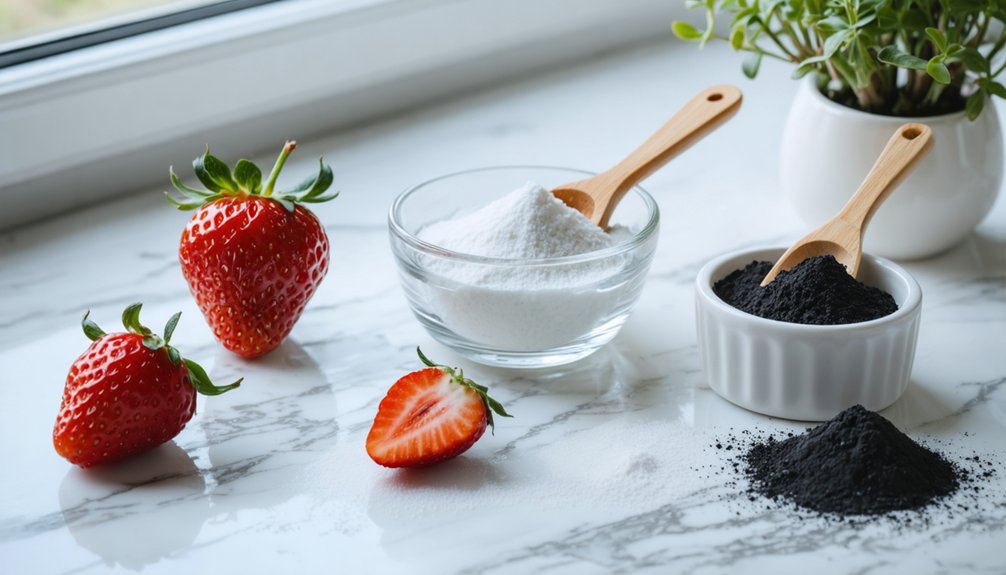
Baking soda works as a mild abrasive to lift surface stains. Activated charcoal binds to and removes extrinsic discoloration, and hydroxyapatite supports enamel integrity rather than breaking it down.
Understanding how each ingredient functions helps you evaluate whether a product can deliver measurable results or simply carries marketing appeal.
Baking Soda’s Whitening Power
Baking soda has been a fixture in whitening formulas for decades, and research supports its effectiveness as a mild abrasive that removes surface stains without the chemical action of peroxide.
Its stain removal mechanism works by polishing enamel surfaces, lifting discoloration left by coffee, tea, and wine. Studies confirm that baking soda-based products produce statistically significant whitening results, performing comparably to some over-the-counter bleaching agents.
When you use a kit containing baking soda consistently, you’re leveraging a well-documented ingredient rather than relying on marketing claims. It’s particularly useful if you have sensitivity concerns, since it avoids peroxide-related irritation.
However, overuse can affect enamel, so following product instructions precisely keeps stain removal effective while protecting your tooth structure long-term.
Activated Charcoal Stain Removal
Activated charcoal is one of the more debated ingredients in natural whitening kits, yet research places it among the formulas with measurable stain-removing effects. Studies confirm its stain lifting capacity produces statistically significant whitening, making it a credible option when you’re targeting extrinsic discoloration from coffee, tea, or wine.
The charcoal benefits stem from its porous structure, which binds to surface compounds before you rinse them away. That mechanism works directly on what you can control—surface stains—rather than altering tooth structure itself.
You’ll want to follow product directions precisely, though. Overuse can increase abrasive exposure to enamel, reducing your long-term gains.
Applied consistently and correctly, activated charcoal delivers results that comparative whitening research supports at the four-week mark.
Hydroxyapatite Enamel Support
Hydroxyapatite works differently from abrasive-based ingredients because it’s a calcium phosphate compound that mirrors the mineral structure of natural enamel. Rather than scrubbing stains away, it integrates into micro-damaged enamel surfaces, supporting enamel remineralization at a structural level.
This makes it particularly useful if your enamel has been weakened by acidic foods, prior whitening treatments, or general wear.
The hydroxyapatite benefits you’re likely to notice include smoother enamel texture, reduced sensitivity, and a brighter appearance resulting from light reflecting more evenly off a repaired surface.
It doesn’t bleach, but it restores the surface conditions that make whitening results look more consistent and last longer.
If you’re managing sensitivity alongside stain removal, hydroxyapatite-containing strips or serums give you a functionally different tool than charcoal or baking soda alone.
Who Gets the Best Results From Natural Whitening Kits?
People with extrinsic stains from coffee, tea, wine, or smoking tend to see the strongest results from natural whitening kits, since these products are formulated specifically to target surface-level discoloration.
Understanding your target audience within the whitening category means recognizing that not every stain type responds equally. Intrinsic discoloration from medications, genetics, or fluorosis falls outside what natural formulas can effectively address.
Effectiveness factors also include whether you have restorations like crowns or veneers, which don’t respond to any whitening agent. If your enamel is intact and your staining is primarily dietary or behavioral, you’re positioned to see measurable improvement.
Consistent application, following product directions precisely, and reducing stain-causing habits during treatment will directly influence how much change you actually achieve.
How Soon Can You Expect to See a Difference?
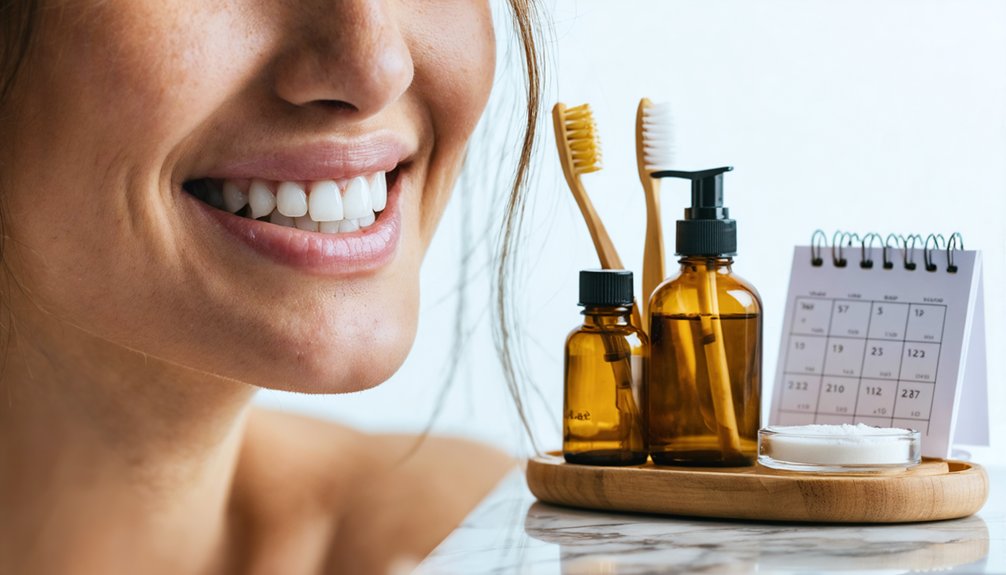
Timing varies depending on the product and your stain profile, but research gives a reasonable benchmark. In controlled studies, most groups showed measurable visible changes by day 10.
By week 4, statistically significant whitening was confirmed across nearly all tested formulas.
By week 4, nearly all formulas showed statistically significant whitening results across controlled study groups.
Your expected timeline may differ based on stain depth, ingredient concentration, and how consistently you apply the product. Surface stains from coffee, tea, or wine typically respond faster than deeper discoloration.
If you’re using activated charcoal or baking soda formulas, you can reasonably anticipate early shifts within the first one to two weeks with disciplined use.
Keep in mind that results aren’t permanent. Without maintenance, whitening fades over months, so tracking your progress and adjusting your routine gives you the most control over outcomes.
Where Natural Whitening Kits Fall Short
Understanding when results appear matters, but so does knowing the ceiling of what natural kits can realistically deliver. This limitations overview helps you set accurate expectations before committing to a routine.
Natural whitening kits work best on extrinsic stains from coffee, tea, wine, and smoking. They’re largely ineffective against intrinsic stains caused by medications, genetics, or fluoride exposure.
Crowns, veneers, and composite restorations won’t respond to any whitening agent.
In any product comparison, professional in-office treatments consistently produce larger shade changes than at-home natural formulas. Uneven application, inconsistent use, or continued staining habits also reduce results.
You’re not getting a flawed product—you’re using one with defined boundaries. Recognizing those boundaries lets you decide whether natural kits meet your specific whitening goals or whether professional intervention makes more sense.
How to Use Natural Whitening Kits Without Damaging Your Teeth
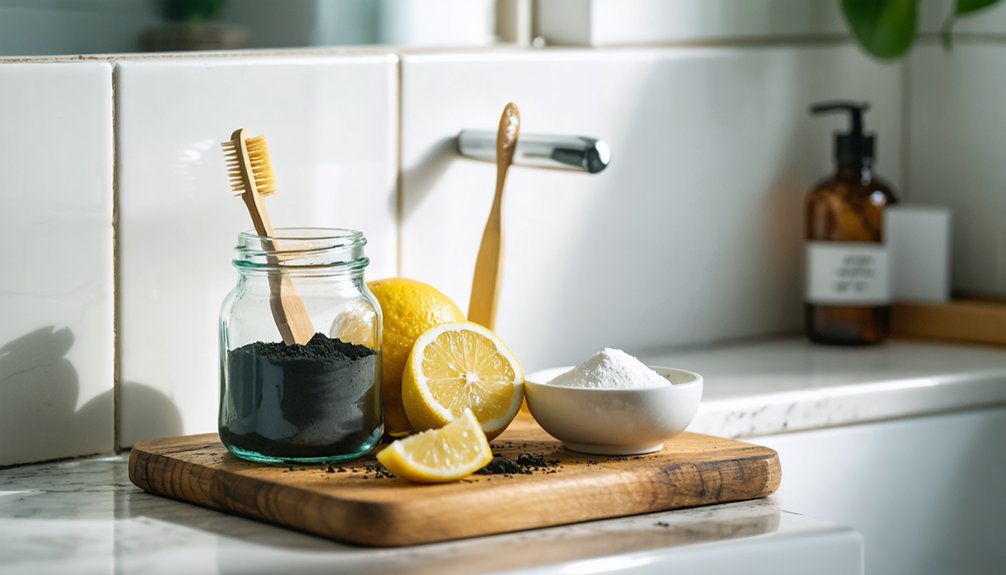
When using natural whitening kits, you should follow product instructions precisely, as deviating from recommended application times or frequency increases your risk of enamel abrasion and sensitivity.
You’ll want to avoid overusing abrasive ingredients like baking soda or activated charcoal, since repeated mechanical friction can gradually wear enamel even with gentler formulas.
Monitor your sensitivity throughout the process and discontinue use if discomfort persists, as ongoing irritation may signal that the product isn’t suited for your teeth.
Follow Product Instructions Carefully
Each natural whitening kit comes with specific instructions that directly affect both your results and your tooth safety, so following them precisely isn’t optional—it’s essential.
Deviation from recommended application techniques—such as applying too much product, leaving it on longer than directed, or using it more frequently than advised—increases your risk of enamel erosion and sensitivity without improving outcomes.
Product consistency depends on respecting the manufacturer’s protocol. Overuse doesn’t accelerate whitening; it compounds risk. If a kit specifies a 10-minute application once daily, that window reflects formulation testing, not arbitrary preference.
Read the full instructions before your first use. Track your application schedule, follow contact time limits, and don’t substitute steps.
Precision in how you use the product determines whether your results are safe and sustainable.
Avoid Overuse and Abrasion
Natural whitening kits can deliver real results, but overuse and improper application are among the fastest ways to undermine your enamel in the process.
Abrasion risks increase considerably when you use products more frequently than their usage guidelines recommend. Ingredients like baking soda and activated charcoal rely on mild abrasive action to lift surface stains — effective in measured doses, damaging with repeated overuse.
Even natural formulations aren’t exempt from this risk. You should treat the recommended frequency as a clinical boundary, not a suggestion. Exceeding it doesn’t accelerate whitening; it accelerates enamel erosion.
If sensitivity develops, reduce application immediately and allow recovery time before continuing. Controlled, consistent use within established parameters protects your enamel while still producing the measurable stain reduction these products are designed to achieve.
Monitor Sensitivity During Use
Sensitivity that develops during whitening isn’t something to push through — it’s your enamel signaling that the treatment load needs to be adjusted.
Sensitivity monitoring throughout your whitening cycle lets you catch problems before they escalate.
Track your response after each session by noting:
- Intensity shifts — mild tingling that worsens over successive sessions signals a need to reduce usage frequency
- Trigger patterns — sensitivity appearing with cold or pressure between sessions indicates cumulative enamel stress
- Recovery time — discomfort persisting beyond 24 hours after application warrants a complete pause before continuing
Adjust your usage frequency based on what you observe, not on a fixed schedule.
Your teeth’s response is real-time data. Use it to make informed decisions that protect your enamel while still achieving your whitening goals.
Frequently Asked Questions
Can Natural Whitening Kits Be Used Alongside Professional Dental Treatments?
Hark—you can use natural whitening kits alongside professional treatments, but you’ll want to confirm dental safety with your dentist first, ensuring natural ingredients won’t interfere with or compromise your prescribed professional whitening protocol.
Do Natural Whitening Kits Work on Children or Teenagers’ Teeth?
Natural whitening kits aren’t recommended for children’s developing teeth due to child dental health concerns. If you’re a teen, tooth sensitivity risks increase, so you should consult your dentist before attempting any whitening regimen.
How Should Natural Whitening Kits Be Stored to Maintain Effectiveness?
Store your natural whitening kits in a cool, dry place away from direct sunlight to maximize storage tips and effectiveness duration. You’ll preserve active ingredients longer, ensuring consistent results each time you use the product.
Can You Use Natural Whitening Kits While Pregnant or Breastfeeding?
Like a guardian at the gate, caution shields what matters most. You should pause natural whitening kits during pregnancy safety periods and follow breastfeeding guidelines, as insufficient evidence exists to confirm safety for you or your baby.
Are Natural Whitening Kits Safe for People With Braces?
You should avoid natural whitening kits with braces. Whitening ingredients won’t affect brackets or bonded areas, leaving uneven color once removed. Prioritize proper braces care first, then whiten after your orthodontist confirms treatment is complete.
References
- https://getcheeky.com/blogs/cheekys-blog/do-at-home-teeth-whitening-kits-really-work
- https://pmc.ncbi.nlm.nih.gov/articles/PMC10024105/
- https://healthcare.utah.edu/the-scope/health-library/all/2023/10/does-home-teeth-whitening-really-work
- https://www.rsndental.com/dental-services/cosmetic/blog/do-home-teeth-whitening-kits-work-which-ones-are-best
- https://www.forbes.com/sites/forbes-personal-shopper/article/best-teeth-whitening-kit/
- https://www.amazon.com/Happy-Tooth-Natural-Teeth-Whitening/dp/B0CJK598G8
- https://www.suttonpda.com/teeth-whitening-results/
- https://www.youtube.com/watch?v=kKDROOfF8yY
- https://nhdentistrybeverlyhills.com/press/6-of-the-best-teeth-whitening-kits-in-the-drugstore/
- https://www.consumerreports.org/beauty-personal-care/tooth-whitening-at-home/