Laser teeth whitening can eliminate wine stains that standard brushing simply can’t touch. Wine deposits chromogens and tannins deep into your enamel, creating discoloration that worsens over time. Laser technology activates a peroxide-based gel that penetrates those layers, breaking apart stain molecules at their source. Surface stains often clear in a single session, while deeper intrinsic stains require a tailored treatment plan. There’s much more to understand before you schedule your first appointment.
Key Takeaways
- Laser teeth whitening uses a peroxide-based gel activated by light to break apart chromogen and tannin molecules causing wine stains.
- Extrinsic wine stains on enamel surfaces typically respond well to laser whitening, often clearing within one to two sessions.
- Intrinsic stains that have penetrated beneath the enamel may require two to three laser whitening sessions for noticeable improvement.
- Severe or chronic wine stains unresponsive to laser whitening may benefit from alternative treatments like veneers or bonding.
- Preventing re-staining after treatment requires rinsing after drinking wine, regular professional cleanings, and limiting direct enamel exposure.
Why Wine Stains Your Teeth So Deeply
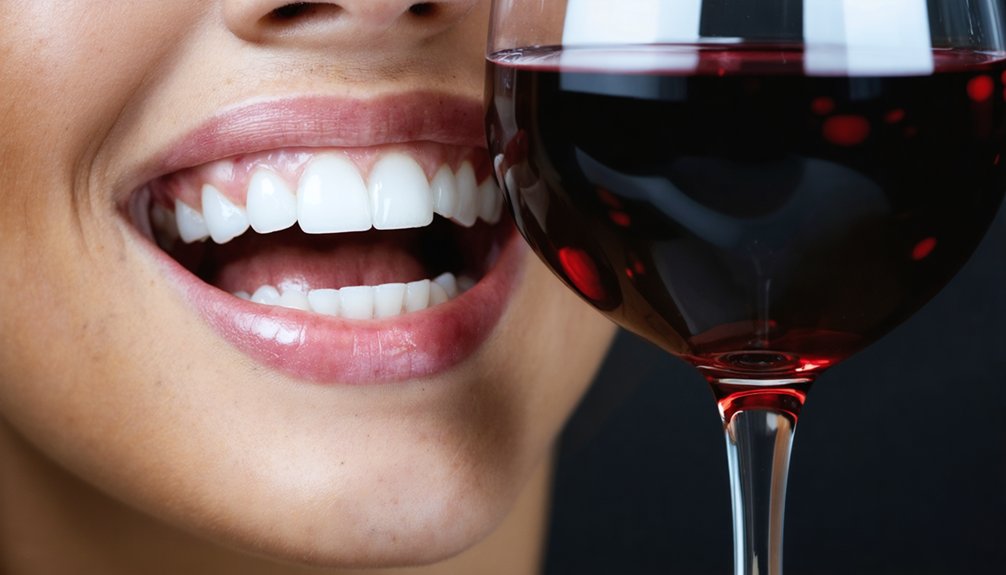
Wine leaves a lasting mark on your teeth because of three key compounds: chromogens, tannins, and acidic elements.
Chromogens are intensely pigmented molecules that drive pigment binding directly onto your enamel. Tannin effects amplify this process by acting as adhesives, locking those pigments firmly in place.
Chromogens bind pigment directly to enamel, while tannins act as adhesives that lock those stains firmly in place.
Wine acidity then accelerates enamel erosion, softening your tooth surface and creating microscopic pathways for deeper stain penetration.
White wine compounds this problem indirectly—its acidity primes your enamel for heavier discoloration from subsequent red wine exposure.
Over time, these stains migrate beneath the enamel surface, making stain prevention increasingly difficult without professional intervention.
Understanding this mechanism clarifies why whitening durability depends on treating both surface pigmentation and the structural vulnerabilities wine creates in your enamel.
Can Laser Teeth Whitening Really Remove Wine Stains?
Given how deeply wine’s chromogens and tannins embed into enamel, you’re likely wondering whether any whitening method can actually reverse that damage.
Laser teeth whitening delivers real, measurable results by using peroxide-based gel activated by concentrated light energy, breaking apart stain molecules at both the surface and dentin levels.
Surface wine stains respond quickly, often within a single session. Deeper, long-standing discoloration may require repeat treatments or whitening alternatives like veneers for complete correction.
Your outcomes depend on stain depth, enamel condition, and how consistently you’ve practiced wine stain prevention strategies like rinsing after drinking or scheduling routine cleanings.
Laser whitening won’t guarantee perfection in every case, but it gives you the most clinically advanced tool available to reclaim noticeably brighter, cleaner teeth.
Surface vs. Deep Wine Stains: Which Can Laser Whitening Fix?
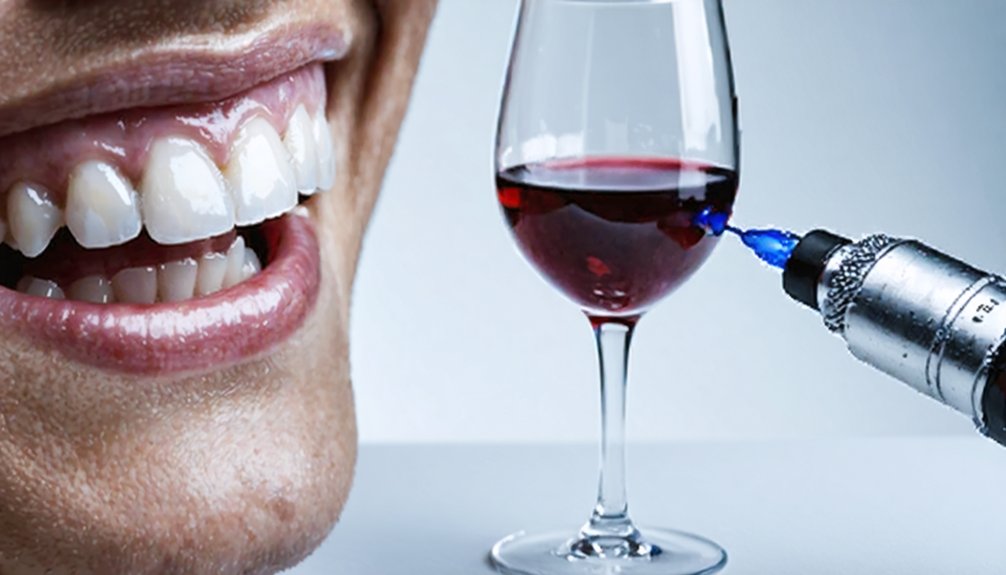
When red wine stains your teeth, the outcome of laser whitening depends largely on whether those stains sit on the enamel surface or have penetrated into the dentin beneath.
Surface stains, caused by chromogens and tannins binding to enamel, typically respond well to laser-activated peroxide gels, often clearing noticeably within a single session.
Deep intrinsic stains, however, resist standard treatment and may require multiple whitening sessions or alternative cosmetic solutions like veneers, making it critical that you choose the right approach based on your stain’s severity and history.
Enamel Surface Stain Removal
Red wine leaves two distinct categories of stains on your teeth, and understanding the difference determines how effectively laser whitening can help you.
Extrinsic stains form directly on your enamel surface when chromogens and tannins bind to exposed tooth structure. These surface deposits respond exceptionally well to laser-activated peroxide gels, which penetrate and break apart pigment molecules efficiently.
If you’ve prioritized stain prevention through regular professional cleanings, your surface stains are likely minor and highly treatable. Laser whitening typically clears extrinsic discoloration in a single session, restoring several shades of brightness.
However, whitening maintenance remains essential afterward because continued wine exposure will redeposit chromogens onto freshly treated enamel. Rinsing with water immediately after drinking wine greatly reduces how quickly surface staining returns.
Deep Intrinsic Stain Challenges
Unlike surface stains, intrinsic discoloration develops within the dentin layer beneath your enamel, making it considerably harder to treat.
These intrinsic stain characteristics—gradual pigment migration, structural absorption, and reduced peroxide penetration—mean laser whitening works against greater resistance.
Years of consistent wine exposure allow chromogens to infiltrate beyond the enamel surface, embedding themselves where bleaching agents struggle to reach effectively.
Deep stain prevention becomes critical once you recognize that intrinsic staining doesn’t respond to a single session the way extrinsic stains often do.
You may require multiple treatments or complementary procedures like veneers to achieve your desired outcome.
Understanding this distinction helps you set realistic expectations and commit to the thorough treatment plan your dentist recommends for measurable, lasting results.
Choosing The Right Treatment
Choosing the right whitening treatment starts with identifying whether your wine stains are extrinsic, intrinsic, or a combination of both.
Surface stains respond quickly to laser whitening, often clearing within a single session.
Deeper intrinsic discoloration demands a more aggressive approach — multiple treatments or complementary cosmetic procedures like veneers.
Don’t assume one solution fits every case. Your enamel thickness, staining history, and ongoing habits all influence which treatment options will deliver real results.
Seeking professional advice before committing to any procedure gives you a precise diagnosis and a targeted plan.
A qualified dentist can evaluate stain depth, recommend the most effective protocol, and set realistic expectations.
Taking that diagnostic step puts you in full control of your outcome.
How Laser Whitening Actually Breaks Down Wine Stains
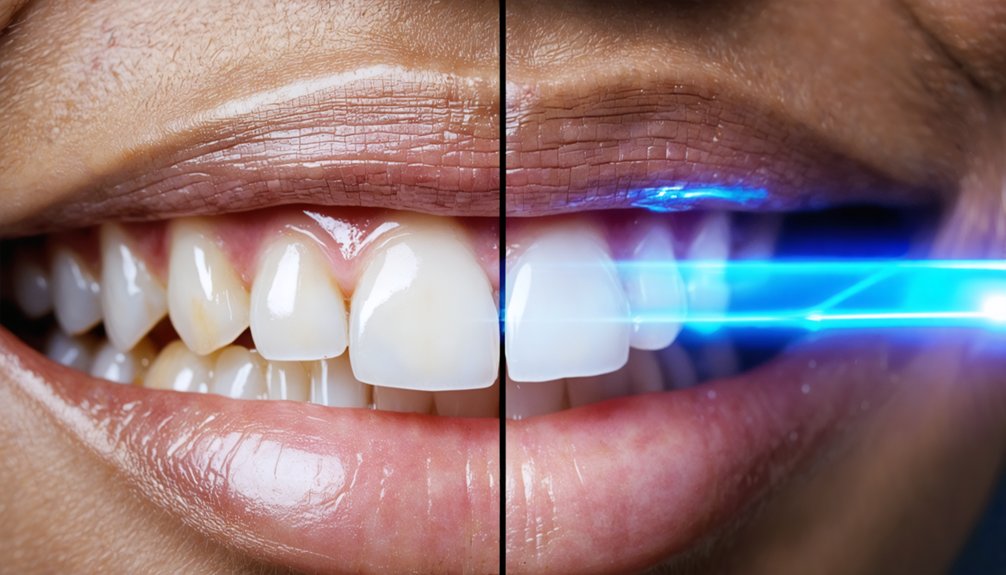
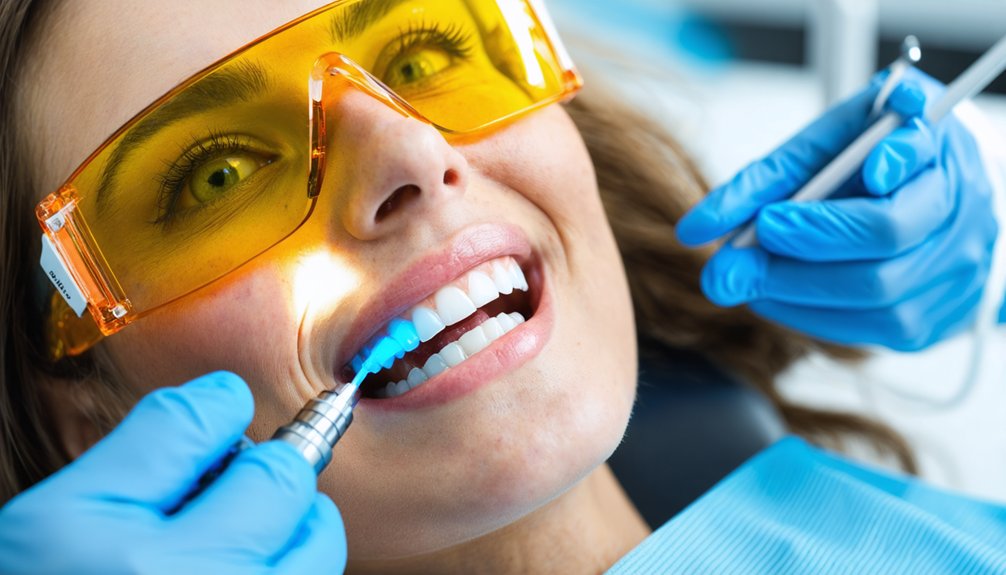
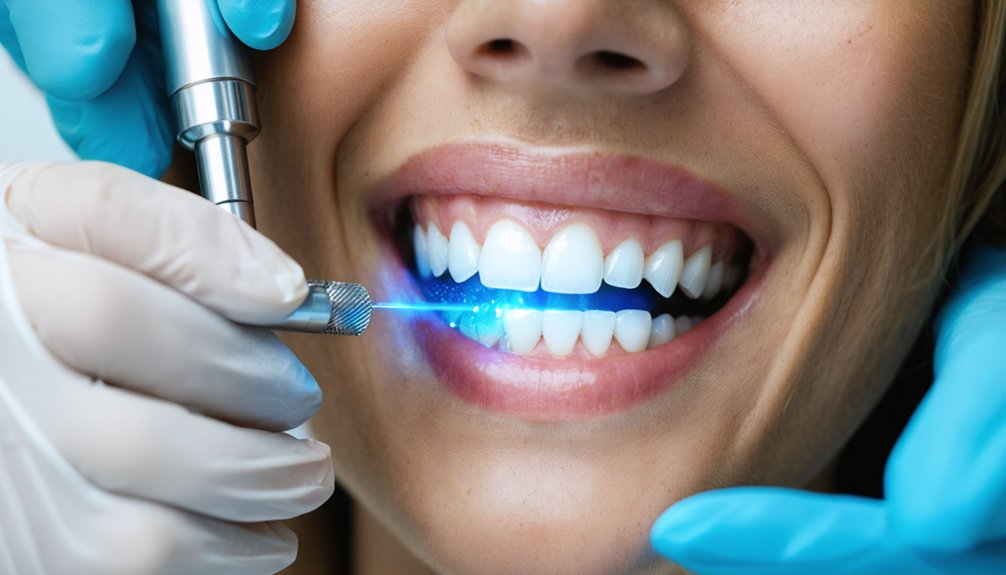
When your dentist applies the peroxide-based whitening gel, the laser activates it and accelerates a targeted chemical reaction directly on your tooth surface.
The activated gel penetrates your enamel and reaches into the dentin layer, where it breaks apart the chromogen and tannin molecules responsible for wine discoloration.
Those fragmented molecules scatter less light, making them far less visible and your teeth noticeably brighter.
Gel Activates Stain Breakdown
Once the peroxide-based gel makes contact with your enamel, the laser’s energy triggers a rapid chemical reaction that drives the whitening process forward.
Gel penetration carries the active agent beneath the surface, where it targets and dismantles stain molecules at their source.
The laser accelerates this process by:
- Breaking apart chromogens bonded to your enamel from years of wine exposure
- Oxidizing tannin-reinforced pigments that standard whitening can’t efficiently reach
- Fragmenting intrinsic discoloration within dentin for deeper, more visible results
You’re not simply masking discoloration—you’re chemically eliminating it.
The controlled energy delivery guarantees precision without unnecessary tissue exposure.
Each second the gel activates, it systematically dismantles the molecular structure responsible for your wine-related staining.
Molecules Become Less Visible
The chemical breakdown happening inside your enamel doesn’t stop at fragmentation—it ends with the stain molecules themselves becoming structurally unrecognizable.
When the laser accelerates the peroxide reaction, it doesn’t simply loosen wine pigments; it dismantles their molecular architecture. Chromogens responsible for stain absorption lose their ability to reflect the wavelengths your eye detects as dark discoloration.
That’s how molecule visibility drops—not through removal, but through chemical transformation. The pigment still exists within your enamel, but its structure no longer produces visible color.
You’re fundamentally rendering the stain optically inert. This precision is what separates laser whitening from surface-level solutions.
You’re not masking discoloration—you’re chemically eliminating its ability to appear, giving you measurable, verifiable control over your results.
What to Expect During a Laser Teeth Whitening Session
Before sitting in the dentist’s chair, it helps to know what’s actually happening during a laser teeth whitening session so you can set realistic expectations.
The process is controlled, precise, and built around laser safety protocols that protect your gums and surrounding tissue throughout.
Here’s what happens during a typical session:
- A peroxide-based gel gets applied directly to your enamel.
- A calibrated laser activates the gel, accelerating the bleaching reaction.
- Stain molecules break apart at a chemical level, lightening discoloration.
Don’t let whitening myths convince you the laser burns or damages your teeth.
When performed correctly, it’s a targeted procedure. You’ll leave with measurably lighter teeth, though deep wine stains may require follow-up sessions for ideal results.
How Many Sessions Will Wine Stains Actually Need?

How many sessions you’ll actually need depends on whether your wine stains are extrinsic or intrinsic. Surface-level extrinsic stains typically respond within one to two sessions.
However, stain longevity plays a critical role — years of accumulated wine exposure often push discoloration deeper into dentin, making it intrinsic and far more resistant.
For moderate intrinsic staining, expect two to three sessions to achieve meaningful improvement. Severe, long-standing discoloration may require additional treatments or complementary procedures like veneers.
Whitening frequency also matters for maintenance; even after successful treatment, continued wine consumption without protective aftercare will reintroduce staining over time.
To maintain control over your results, schedule professional cleanings regularly and limit enamel exposure between sessions.
Understanding your stain type lets you plan treatment with precision rather than guesswork.
What Your Teeth Will Actually Look Like After Laser Whitening
Once you’ve mapped out your session count, the next question is what you’ll actually see when treatment ends. Results vary, but most patients achieve a noticeably brighter smile with greatly reduced wine discoloration.
Expect these realistic outcomes:
- Surface stains respond fastest, often clearing visibly after one session within your whitening duration.
- Deeper intrinsic stains lighten gradually, requiring multiple treatments before achieving your target shade.
- Teeth sensitivity typically peaks within 24–48 hours post-treatment, then subsides without permanent damage.
Your enamel will appear cleaner and several shades lighter, though chronic staining rarely disappears completely in a single visit.
Maintaining results means controlling your wine intake and scheduling periodic professional cleanings. Understanding these realistic expectations lets you plan treatment with precision rather than guesswork.
When Veneers or Bonding Work Better Than Laser Whitening
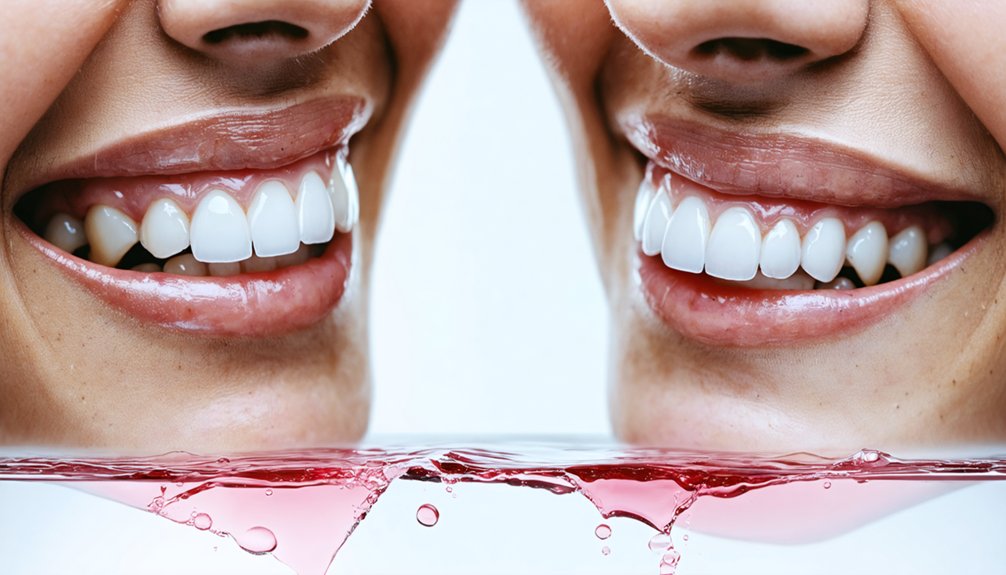
Laser whitening delivers impressive results for most wine-related discoloration, but it has hard limits when staining runs too deep or enamel is too compromised to respond adequately.
If you’ve accumulated years of intrinsic staining, bleaching agents simply can’t penetrate far enough to restore meaningful brightness. That’s when veneer advantages become relevant — porcelain veneers physically cover discoloration entirely, giving you complete control over your final shade.
Bonding benefits apply when damage is more localized; composite resin fills surface irregularities and masks stubborn stains without aggressive enamel removal.
Neither option depends on your tooth’s ability to respond to chemicals. If repeated whitening sessions haven’t produced satisfactory results, veneers or bonding aren’t fallback options — they’re superior solutions for specific clinical situations you shouldn’t ignore.
How to Stop Wine Stains From Coming Back
Restoring your smile through veneers, bonding, or laser whitening only solves half the problem if you return to the same habits that caused the staining in the first place.
Stain prevention and whitening maintenance require consistent, deliberate action after treatment.
Take control of your results by building these habits into your routine:
- Rinse immediately after drinking wine to minimize chromogen and tannin contact with enamel.
- Schedule regular professional cleanings to eliminate surface buildup before it penetrates deeper layers.
- Limit direct exposure by using a straw with staining beverages and pairing wine with hard cheeses or crunchy vegetables.
Your investment in laser whitening only holds if you actively protect it.
Discipline after treatment determines how long your results last.
Frequently Asked Questions
Does Laser Whitening Work on Teeth With Existing Crowns or Veneers?
Surprise — your crowns won’t magically whiten! Laser whitening doesn’t affect crowns longevity or veneer compatibility since restorations resist bleaching agents. You’ll need replacement or color-matched alternatives to achieve uniform, controlled results effectively.
Is Laser Teeth Whitening Safe for People With Sensitive Teeth?
Yes, you can undergo laser whitening with sensitive teeth, but you’ll need proper sensitivity management. Your dentist can adjust gel concentration and exposure time, or explore treatment alternatives like lower-intensity protocols to protect your comfort effectively.
How Does Laser Whitening Compare in Cost to At-Home Whitening Kits?
Why settle for less? Laser whitening costs more upfront than at-home effectiveness options, but the cost comparison favors professional results — you’ll achieve faster, deeper stain removal that at-home kits simply can’t match.
Can Laser Whitening Cause Any Long-Term Damage to Tooth Enamel?
When done correctly, laser whitening won’t permanently damage your enamel integrity. You’ll want to monitor whitening duration and frequency, as overuse can temporarily increase sensitivity, but professional supervision keeps your enamel protected and your results safely optimized.
Are There Age Restrictions for Patients Seeking Laser Teeth Whitening Treatment?
Ironically, youth won’t automatically qualify you for treatment eligibility. Age considerations typically exclude patients under 18, as developing teeth aren’t ideal candidates. You’ll need a dentist’s evaluation to confirm whether you’re ready for laser whitening.
References
- https://biggleswade.lateethwhitening.co.uk/laser-whitening-4-smoking-coffee-stains/
- https://www.roundlakedentistry.com/can-teeth-whitening-help-remove-wine-stains/
- https://www.myvalleyviewdental.com/can-teeth-whitening-remove-deep-stains-from-coffee-tea-or-wine/
- https://www.mondaygrazianidds.com/coffee-wine-and-smoking-can-teeth-whitening-really-reverse-the-damage/
- https://www.myfamilydentistlb.com/how-to-fix-red-wine-stained-teeth-valentines-date/
- https://brighterimagelab.com/wine-stains-begone-getting-a-whiter-smile-with-1-simple-solution/?archsel=/
- https://www.foreveryoungdentistry.com/blog/?p=108
- https://www.kavitapateldds.com/blog/the-dos-and-donts-of-drinking-wine-after-teeth-whitening/
- https://www.teethwhiteningseoul.com/blog/teeth-whitening-for-coffee-tea-and-wine-stains
- https://www.dionhealth.com/blog/wine-and-staining/