The banana peel teeth whitening method involves rubbing the inner peel against your teeth for two minutes, leaving residue briefly, then rinsing and brushing. It’s a widely shared DIY trend, but no credible scientific evidence confirms it actually whitens enamel. Any brightness you notice likely comes from light surface cleaning, not chemical whitening. Results are temporary, and re-staining happens quickly. If you want to understand why this method falls short, there’s more to uncover.
Key Takeaways
- Rub the inner white side of a ripe banana peel on teeth for two minutes, leave residue for 10–15 minutes, then rinse and brush.
- No scientific evidence confirms banana peels whiten teeth; any perceived brightness likely results from light mechanical surface cleaning.
- Results are temporary since no structural enamel change occurs, causing stains to quickly reaccumulate after treatment.
- Avoid combining banana peels with lemon juice or baking soda, as these pairings increase enamel erosion risk.
- For noticeable, lasting whitening, dentists recommend professional treatments over unproven DIY methods like banana peels.
What Is the Banana Peel Teeth Whitening Method?
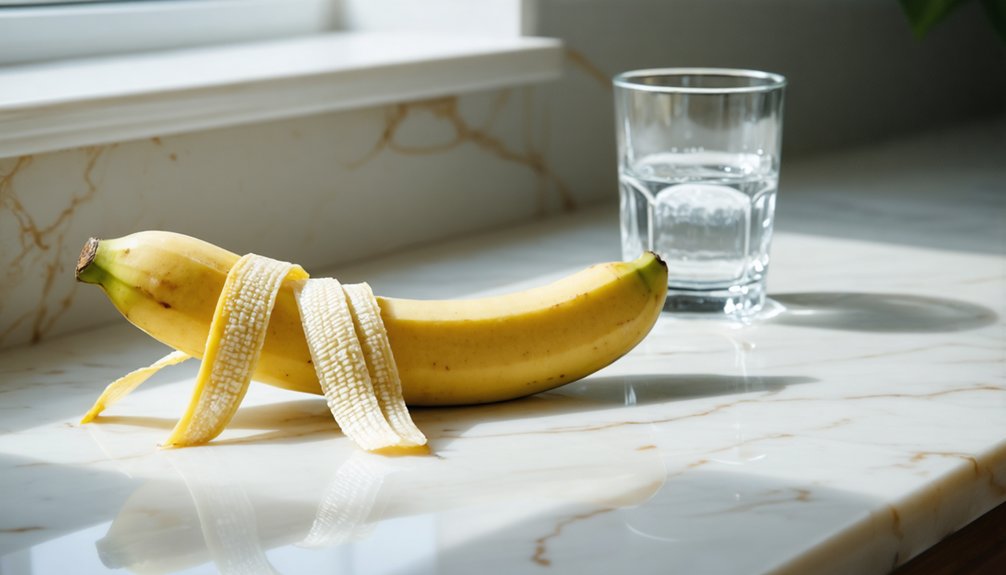
The banana peel teeth whitening method is a viral home remedy that involves rubbing the inner white side of a ripe banana peel against your teeth for roughly 2 minutes, leaving any residue on for 10–15 minutes, then rinsing and brushing.
Many natural remedies like this one gain traction through simplicity and low cost rather than clinical proof.
Proponents suggest repeating the process daily for one to three weeks. Some versions claim that minerals from the peel penetrate enamel, but no credible evidence supports that mechanism.
These home experiments may produce a brief perception of brightness, most likely from mild surface cleaning rather than any true whitening effect.
Before adopting this method, you should understand that the evidence base behind it remains fundamentally absent.
How Do You Actually Use a Banana Peel on Your Teeth?
If you’re curious about the actual steps behind this method, most online guides follow a consistent pattern: start with a ripe yellow banana, peel it intact, and rub the white inner side against your visible tooth surfaces for about two minutes using gentle pressure.
After rubbing, many instructions tell you to leave the residue on your teeth for 10–15 minutes before rinsing and brushing with toothpaste.
After rubbing, let the banana residue sit on your teeth for 10–15 minutes before rinsing and brushing.
Those drawn to natural remedies often repeat this daily for one to three weeks, treating it as a controlled home experiment.
However, you should recognize that these steps describe mechanical surface wiping, not chemical whitening.
No validated evidence confirms that following this sequence bleaches enamel.
If you choose to try it, keep your expectations grounded in what the evidence actually supports.
Does the Banana Peel Method Really Whiten Teeth?
Despite its popularity as a low-cost home remedy, the banana peel method lacks conclusive scientific support for actual teeth whitening. While natural remedies like this one dominate DIY trends, dental sources confirm that banana peels have no intrinsic whitening property.
Any brightness you notice isn’t coming from the peel bleaching your enamel. It’s coming from light mechanical cleaning that removes surface plaque.
That distinction matters. A toothbrush with fluoride toothpaste performs that same function more effectively.
Claims about minerals penetrating enamel aren’t supported by available lab research, and reported results remain inconsistent.
If you’re pursuing real control over your tooth color, you shouldn’t rely on a method that functions, at best, like a gentle wipe. Surface cleaner isn’t the same as whitening treatment.
Why Don’t the Results Last?
If you notice any brightness after rubbing a banana peel on your teeth, it’s most likely due to light mechanical removal of surface plaque or debris—not true enamel bleaching.
Banana peels don’t contain whitening agents capable of altering your tooth color at a structural level, so any visible change fades quickly as stains reaccumulate.
Without an active bleaching compound, you’re fundamentally wiping your teeth rather than whitening them.
Temporary Surface Stain Removal
While the banana peel method may leave your teeth looking slightly brighter immediately after use, that change doesn’t reflect true whitening. What you’re likely seeing is the result of mechanical action — the peel physically wiping away a thin layer of plaque or surface debris. That’s not a whitening effect; it’s temporary cleaning.
Natural remedies and DIY experiments like this one don’t penetrate enamel or alter tooth color at a structural level. Once plaque accumulates again, the appearance reverts. A toothbrush with fluoride toothpaste accomplishes the same surface cleaning more effectively and consistently.
If you’re tracking your results and noticing they fade within days, that’s why. The banana peel lacks any confirmed active ingredient capable of producing lasting brightness beyond what basic oral hygiene already achieves.
Lack of Whitening Agents
The short-lived appearance change connects directly to what the banana peel actually lacks: a whitening agent. No compound in the peel penetrates enamel or breaks down deep stains the way clinically validated bleaching agents do. What you’re experiencing is mechanical cleaning, not chemical whitening. The peel functions more like a gentle wipe than a treatment.
This distinction matters, especially when DIY trends frame natural remedies as equivalent to evidence-based options. They aren’t. Without an active bleaching ingredient, you can’t expect lasting color change. Once surface debris returns, so does the original tooth shade.
If you want results that hold, you need a method with documented whitening mechanisms. Relying on a banana peel keeps you busy without moving you forward. Know the difference before investing your time.
Is Brushing Better Than the Banana Peel Method?
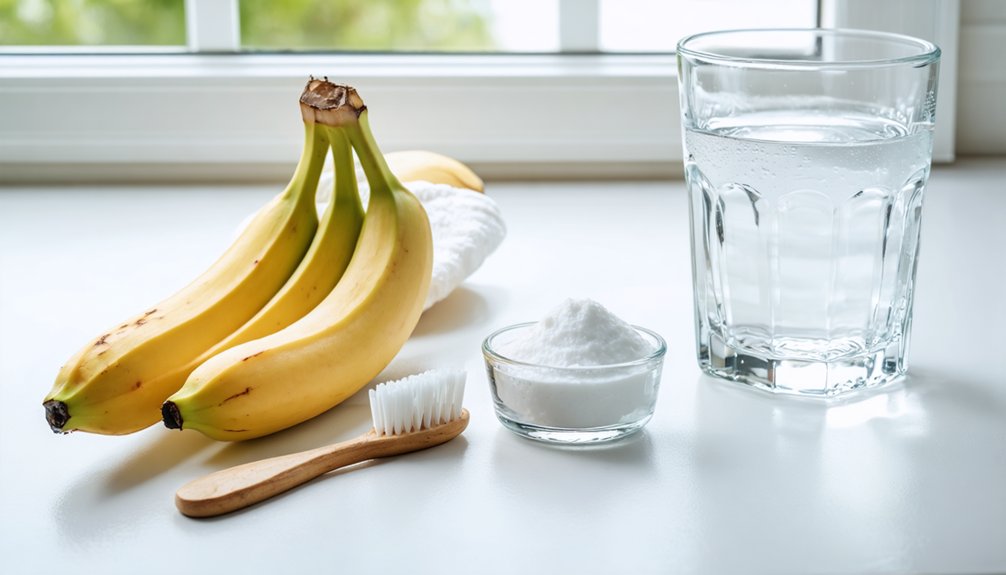
When you reach for a banana peel instead of your toothbrush, you’re trading a proven cleaning tool for one with no scientific backing.
A toothbrush physically disrupts and removes plaque across tooth surfaces in a way that rubbing a peel simply can’t replicate.
Fluoride toothpaste compounds that advantage by strengthening enamel and targeting stains, making the standard brushing routine a more effective baseline than any banana peel method.
Brushing Removes More Plaque
So, is rubbing a banana peel on your teeth actually better than brushing? The evidence says no. A toothbrush with fluoride toothpaste removes plaque more effectively than any natural remedies or DIY experiments involving fruit peels.
Plaque is a sticky bacterial film, and mechanical brushing disrupts it in ways that simply rubbing a peel can’t replicate.
When you brush, the bristles physically break up and clear plaque from tooth surfaces and along the gumline. A banana peel lacks that mechanical reach and contains no clinically validated whitening agent.
Any surface cleaning it provides is minimal by comparison.
If you want measurable plaque control, brushing twice daily remains your most reliable option. Natural remedies may feel appealing, but they don’t outperform the fundamentals of consistent oral hygiene.
Toothpaste Outperforms Banana Peels
Brushing with fluoride toothpaste doesn’t just clean your teeth — it does so through a combination of mechanical action and active ingredients that banana peels simply can’t replicate. Fluoride strengthens enamel, while mild abrasives in toothpaste actively break down surface stains.
Banana peels, despite their appeal as natural ingredients in home remedies, contain no compound shown to bleach or meaningfully alter tooth color.
If you’re evaluating these two approaches, the evidence points clearly in one direction. Toothpaste removes plaque more effectively, targets stains more precisely, and delivers measurable protective benefits.
The banana peel method offers none of those verified advantages. Before replacing proven oral hygiene habits with unvalidated techniques, consider what the research actually supports — and what it doesn’t.
Is the Banana Peel Method Safe for Teeth and Gums?
The banana peel method is generally considered low-risk, but that doesn’t mean it’s without concern. As natural remedies go, rubbing fruit peel on your teeth carries minimal chemical risk since there’s no bleaching agent involved. However, dental safety still applies here.
Aggressive scrubbing can irritate your gums and potentially contribute to enamel wear over time. The sources consistently recommend gentle pressure, so how you apply the peel matters. You’re also not replacing your brushing and flossing routine with this method — it’s an addition, not a substitute.
Avoid pairing banana peel with baking soda or lemon juice. Those combinations introduce abrasion and acid exposure, raising your risk of irritation and enamel erosion. If you experience gum sensitivity or discomfort, stop and consult your dentist.
What Do Dentists Say About DIY Whitening Methods?
Most dentists draw a clear line between surface cleaning and actual whitening — and DIY methods rarely cross it. When it comes to natural remedies like banana peels, dental professionals are consistent: no credible evidence supports them as true whitening agents. They may help remove light surface debris, but that’s mechanical cleaning, not bleaching.
Dental myths spread quickly because results feel plausible in the short term. You might notice slightly brighter-looking teeth after rubbing a peel, but dentists attribute that to plaque removal, not enamel lightening. That distinction matters.
If you’re serious about color change, dentists recommend professionally evaluated options with documented results. Brushing with fluoride toothpaste twice daily remains your most reliable baseline — no peel required.
When Should You See a Dentist Instead?
If you’ve been rubbing banana peels on your teeth for weeks without noticeable change, that’s not a cue to try a different home remedy — it’s a reason to book a dental appointment.
Weeks of banana peel remedies with no results isn’t a sign to try harder — it’s a sign to call your dentist.
Aesthetic concerns like deep discoloration, yellowing from medications, or intrinsic staining don’t respond to surface cleaning. A dentist can identify the actual cause and recommend treatments with clinical evidence behind them.
Lifestyle tips such as reducing coffee, tea, and tobacco will slow future staining, but they won’t reverse existing discoloration on their own.
You should also see a dentist if you notice sensitivity, gum irritation, or uneven patches.
Taking control of your smile starts with accurate information — and sometimes that means stepping away from DIY methods entirely.
Frequently Asked Questions
Can You Use a Banana Peel on Dental Veneers or Crowns?
banana peel rubbing risks veneer damage and has no crown compatibility benefit. You should consult your dentist before applying any DIY method to restorations.
Does the Ripeness Level of the Banana Affect Any Results?
Ripeness impact on results is negligible since there’s no scientific evidence supporting whitening regardless of nutrient variation between peels. You shouldn’t expect meaningful differences; the method lacks validation at any ripeness stage.
How Does the Banana Peel Method Compare to Whitening Strips?
Whitening strips offer proven results; banana peels don’t. Strips win on cost-effectiveness and ease of use — you’re applying clinically validated bleaching agents. Banana peels lack scientific backing, delivering surface cleaning at best, not true enamel whitening.
Can Children or Teenagers Safely Try the Banana Peel Method?
You shouldn’t let children or teenagers try this without consulting a dentist first. Children’s safety and teenagers’ safety matter—developing enamel is more vulnerable, and the method lacks scientific validation to justify unsupervised use.
Does Eating Bananas Regularly Have Any Effect on Tooth Color?
Eating bananas isn’t a silver bullet for tooth color. Your dietary habits don’t support natural remedies replacing evidence-based care. Bananas offer no clinically proven whitening effect, so you shouldn’t expect visible changes from regular consumption alone.
References
- https://www.rejuv-health.com/cosmetic-dentistry/banana-peel-teeth-whitening/
- https://www.yourmckinneydentist.com/do-banana-peels-whiten-teeth-guide-by-cosmetic-dentist/
- https://www.dawsondental.ca/site/blog/2025/08/08/banana-peel-teeth-whitening-will-it-give-you-a-brighter-smile
- https://www.dailytoothcare.com/archives/5686
- https://dentistryforyoubrokenarrow.com/can-you-whiten-your-teeth-with-banana-peels/
- https://www.puresmile.co.nz/teeth-whitening-home-remedies/
- https://www.wikihow.com/Whiten-Your-Teeth-with-Banana-Peel
- https://clubwhitesmile.com/diy-teeth-whitening-banana-peel-method/
- https://scienceinsights.org/how-to-whiten-teeth-with-banana-peel-does-it-work/
- https://www.reddit.com/r/explainlikeimfive/comments/1qgreo/eli5_how_does_banana_peel_whiten_teeth_or_is_it/