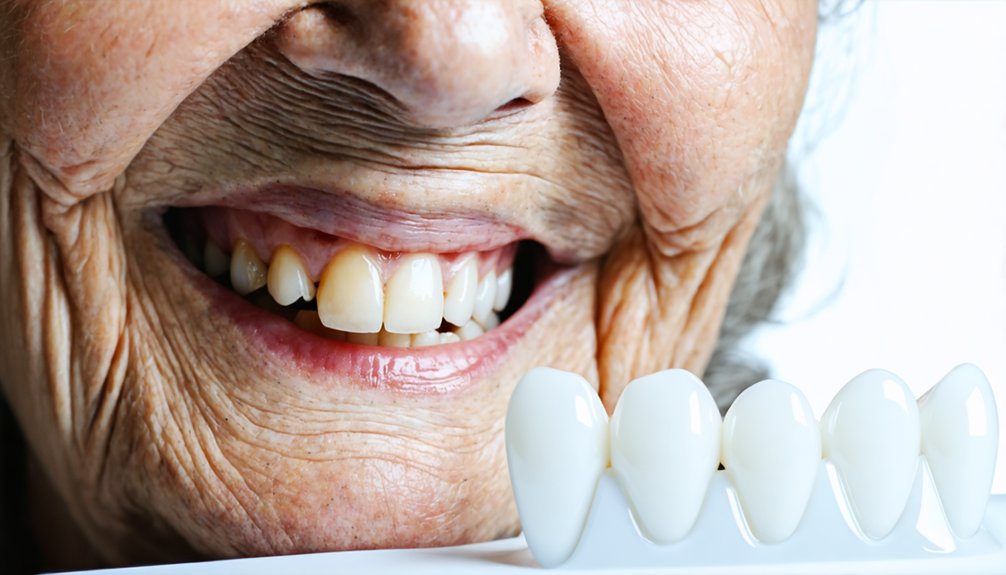
As you age, your teeth undergo structural changes that go beyond surface staining. Your enamel thins, exposing the naturally yellow dentin beneath, while secondary dentin builds up inside the tooth, darkening it from within. These internal shifts make discoloration more permanent and resistant to standard whitening treatments. Understanding exactly what’s happening to your teeth’s structure and which solutions actually work can help you make smarter decisions about your options.
Key Takeaways
- Enamel thins with age, exposing darker underlying dentin and causing teeth to appear increasingly yellow, dull, and less vibrant over time.
- Secondary dentin accumulates inside teeth as you age, darkening them from within and making standard whitening treatments far less effective.
- Micro-irregularities from enamel wear trap pigments from coffee, tea, wine, and tobacco, intensifying staining beyond normal age-related discoloration.
- Intrinsic discoloration from aging resists bleaching; deeper cases may require cosmetic solutions like veneers rather than traditional whitening treatments.
- Whitening works best before significant enamel thinning occurs; realistic expectations and professional evaluation are essential for aging teeth.
Why Teeth Get Darker and More Yellow With Age
As you age, your teeth naturally darken and shift toward yellower tones due to structural changes happening both on and beneath the enamel surface.
Tooth enamel thins progressively through chewing, grinding, and daily wear, exposing the dentin layer beneath. Dentin is inherently more yellow than enamel, so as coverage decreases, that warmer tone becomes increasingly visible.
Simultaneously, dentin transparency increases as enamel becomes thinner, reducing the bright, light-scattering quality that younger teeth maintain.
Secondary dentin also accumulates inside the tooth over time, adding internal density and a darker overall hue.
Clinical studies confirm that adults over 50 show measurably darker, more saturated tooth shades.
These changes originate structurally, meaning they reflect biological aging rather than surface contamination alone.
How Enamel Thinning Makes Tooth Discoloration Worse
Enamel thinning doesn’t just expose dentin—it amplifies every other discoloration mechanism happening in your mouth. As enamel erosion advances, your teeth become structurally compromised in ways that accelerate visible darkening.
Here’s what’s actually happening:
- Increased translucency — Thinner enamel lets dentin’s yellow tone show through more intensely.
- Surface roughness — Worn enamel develops micro-irregularities that trap pigments from coffee, tea, and wine more aggressively.
- Reduced light reflection — Compromised enamel scatters light less effectively, making teeth appear duller.
- Deeper stain penetration — Rougher, thinner enamel allows chromogens to embed further, reducing whitening effectiveness.
Understanding this progression lets you prioritize protective strategies—like limiting acidic foods and using remineralizing products—before erosion makes discoloration considerably harder to reverse.
How Secondary Dentin Makes Teeth Darker Over Time
As you age, your teeth produce secondary dentin—a new layer of dentin that forms inside the pulp chamber as a natural response to wear and aging. This added internal material is denser and darker than primary dentin.
This gradual process shifts your tooth color toward yellow or gray tones from the inside out. Because this darkening is intrinsic, standard whitening products struggle to reverse it, making age-related discoloration harder to treat than simple surface staining.
What Is Secondary Dentin
While enamel gets most of the attention in discussions about tooth color, secondary dentin plays a quieter but equally significant role in why teeth darken with age. Unlike enamel regeneration, which doesn’t naturally occur, secondary dentin continuously forms throughout your life inside the tooth, gradually shrinking the dental pulp chamber.
Here’s what you need to know:
- Formation: Secondary dentin deposits along the inner tooth walls after root development completes.
- Color: It’s naturally darker and yellower than primary dentin.
- Accumulation: It builds steadily, increasing internal opacity over decades.
- Visual impact: Thinner enamel combined with more secondary dentin intensifies the darker appearance.
Understanding this process helps you set realistic expectations when evaluating whitening options.
Secondary Dentin Darkens Teeth
Secondary dentin doesn’t just occupy space inside your tooth—it actively changes how your tooth looks from the outside.
As secondary dentin accumulates, it adds a denser, darker layer within the pulp chamber. This buildup shifts your tooth’s internal color toward deeper yellow or gray tones.
Unlike external staining, this internal staining originates beneath the enamel, where whitening agents struggle to penetrate effectively.
Even if your enamel remains intact, the increasing volume of secondary dentin reduces light transmission through the tooth, making it appear darker and less vibrant overall.
You can’t brush or rinse secondary dentin away—it’s a structural change.
Understanding this distinction helps you set realistic expectations when considering whitening treatments, since secondary dentin-driven discoloration responds differently than surface-level staining.
Whitening Aging Dentin Challenges
Because secondary dentin accumulates gradually, its effects on tooth color often go unnoticed until discoloration becomes significant. Whitening treatments target enamel-level stains, but secondary dentin sits deeper, making it largely resistant to standard bleaching agents.
Enamel regeneration isn’t currently possible, so once enamel thins, dentin visibility increases permanently. Dental sensitivity also intensifies as enamel thins, limiting your tolerance for stronger whitening concentrations.
To manage these challenges effectively, consider:
- Professional evaluation to distinguish surface staining from intrinsic dentin darkening
- Lower-concentration whitening agents to minimize dental sensitivity during treatment
- Extended treatment timelines since deeper discoloration responds more slowly
- Cosmetic alternatives like veneers when whitening fails to achieve acceptable results
Understanding these limitations helps you set realistic expectations and choose interventions that actually deliver measurable improvement.
When Does Tooth Discoloration Become Most Noticeable?
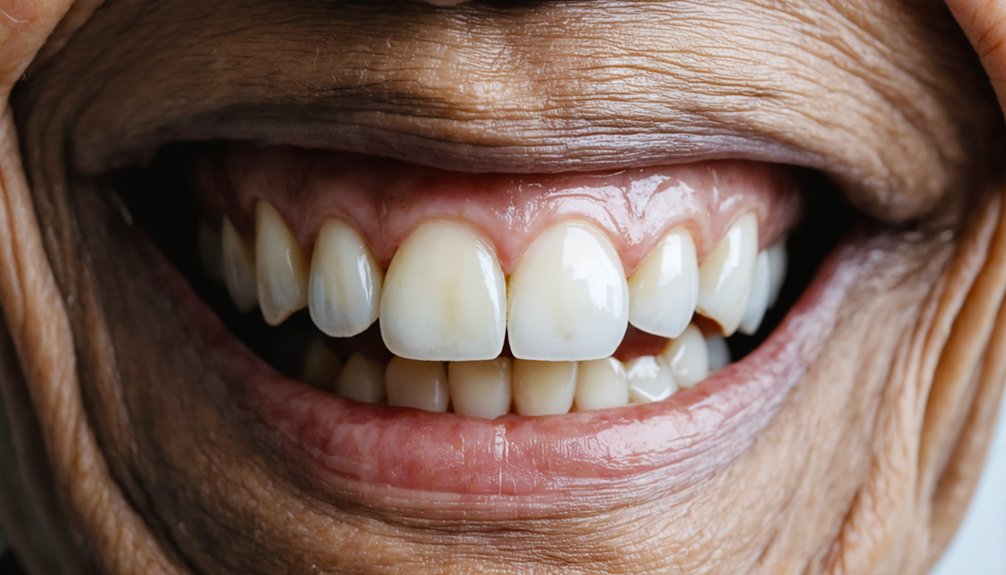
Tooth discoloration tends to become most noticeable after age 50, when cumulative enamel wear, dentin darkening, and years of extrinsic staining converge.
Enamel erosion accelerates the process by reducing the protective layer that shields dentin’s naturally yellow tone. As enamel thins, tooth translucency increases, allowing darker internal structures to show through more prominently.
Earlier decades of coffee, tea, wine, and tobacco exposure compound these internal shifts, making surface-level interventions less effective.
Research confirms that color changes during this period frequently exceed clinical acceptability thresholds, shifting teeth toward darker, more saturated yellow-gray tones.
Understanding this timeline helps you make informed decisions about whitening interventions—acting earlier, before significant structural changes occur, typically yields more predictable and effective results than addressing advanced discoloration later.
How Coffee, Tea, and Wine Accelerate Tooth Staining
Over time, coffee, tea, and red wine deposit chromogens—highly pigmented chemical compounds—into the microscopic pores and surface irregularities of your enamel.
As tooth enamel thins with age, dentin transparency increases, making accumulated stains more visually prominent.
You can manage this progression by targeting these four factors:
- Tannin binding – Tannins in tea and wine help chromogens adhere more aggressively to roughened enamel surfaces.
- Acid erosion – Acidic beverages weaken enamel, enlarging pores that trap pigments deeper.
- Exposure frequency – Daily consumption compounds staining faster than occasional intake.
- Saliva reduction – Decreased salivary flow limits natural pigment clearance, intensifying discoloration.
Limiting consumption and rinsing with water immediately after drinking gives you direct control over stain accumulation.
Does Dry Mouth Speed Up Tooth Discoloration?
Your saliva does more than keep your mouth moist—it actively rinses away food particles, neutralizes acids, and limits the time staining compounds stay in contact with your enamel.
When dry mouth reduces that protective action, pigments from coffee, tea, and wine linger longer on tooth surfaces, accelerating discoloration.
Managing dry mouth through hydration, saliva substitutes, or addressing underlying medication side effects can slow this process and support the effectiveness of any whitening approach you pursue.
Saliva’s Natural Protective Role
Saliva does more than keep your mouth moist — it actively rinses away food particles, neutralizes acids, and helps prevent pigments from settling into enamel. Its composition includes calcium and phosphate ions that support enamel regeneration by remineralizing weakened surface areas.
When saliva flow decreases, you lose these protective mechanisms:
- Acid neutralization drops, allowing enamel demineralization to accelerate.
- Pigment clearance slows, letting staining compounds from coffee, tea, and wine adhere longer.
- Enamel regeneration weakens, reducing your teeth’s natural ability to repair minor surface damage.
- Bacterial activity increases, raising cavity and discoloration risk simultaneously.
Maintaining adequate saliva composition is a controllable factor — staying hydrated, managing medications with your doctor, and stimulating flow with sugar-free gum all make a measurable difference.
How Dry Mouth Accelerates Staining
When saliva flow drops, the mouth’s built-in defense against staining breaks down quickly. Saliva normally dilutes pigments, neutralizes acids, and supports enamel repair through remineralization.
Without adequate flow, staining agents from coffee, tea, and wine stay in direct contact with your teeth longer, penetrating surface pores more deeply.
Dental plaque also accumulates faster when saliva isn’t clearing debris between brushings. That buildup traps chromogens—color-producing compounds—against enamel, intensifying discoloration over time.
Acids from plaque further weaken enamel, making it rougher and more porous.
Dry mouth becomes increasingly common with age, largely due to medications. If you’re experiencing it, addressing the underlying cause directly improves your teeth’s resistance to staining and makes whitening efforts more effective.
Managing Dry Mouth Discoloration
Dry mouth does speed up tooth discoloration, and managing it directly affects how well whitening efforts hold up over time. Reduced saliva production leaves staining compounds and acids in contact with enamel longer, compounding age-related darkening.
You can regain control through targeted strategies:
- Hydrate consistently — drinking water throughout the day mechanically rinses staining agents off tooth surfaces.
- Stimulate saliva production — sugar-free gum containing xylitol activates salivary glands and neutralizes acids.
- Review medications — consult your doctor about substitutes if current prescriptions contribute to dry mouth.
- Strengthen oral hygiene — fluoride rinses combined with twice-daily brushing reduce demineralization that makes enamel more stain-prone.
Addressing dry mouth preserves your whitening results and limits further discoloration accumulation.
Which Whitening Treatments Are Worth Trying on Aging Teeth?
Choosing the right whitening treatment for aging teeth requires understanding what’s actually causing the discoloration. Surface stains from coffee, tea, or wine respond well to professional cleanings and whitening toothpastes formulated for enamel repair. These options target external pigmentation without stressing already-thinned enamel.
For deeper discoloration, you’ll need treatments that address dentin bleaching directly. Professional peroxide-based systems, either in-office or custom tray applications, penetrate beyond the enamel surface and can lighten intrinsic dentin staining more effectively than over-the-counter strips.
However, results vary depending on how much dentin exposure and secondary dentin buildup you have.
Keep in mind that restorations like crowns won’t respond to bleaching agents. A dental evaluation helps you identify which discoloration type you’re targeting before committing to any treatment.
Why Age-Related Yellowing Is Harder to Whiten
Age-related yellowing is harder to treat because it originates inside the tooth, not on its surface.
As tooth enamel thins, underlying dentin becomes more visible, and that dentin naturally darkens over time. Whitening agents penetrate enamel to address dental pigmentation, but they can’t fully reverse structural aging changes.
Four reasons why this discoloration resists whitening:
- Dentin darkening occurs intrinsically, beyond the reach of most whitening formulas.
- Thinner tooth enamel increases dentin visibility, making brightness harder to restore.
- Secondary dentin deposits accumulate inside the tooth, deepening the yellow tone.
- Dental pigmentation from decades of staining bonds deeply within enamel’s microscopic structure.
Understanding these limitations helps you set realistic expectations and choose treatments that target what’s actually causing the discoloration.
What to Expect From Teeth Whitening After 50
Teeth whitening after 50 can still deliver noticeable results, but your outcomes will depend heavily on what’s driving the discoloration. Surface stains from coffee, tea, or wine respond well to professional treatments and whitening agents.
However, intrinsic dentin darkening—a natural consequence of aging—responds less predictably. Thinner enamel increases translucency, exposing the yellower dentin beneath, and no whitening product reverses that structural reality.
To improve surface reflectivity, tooth remineralization strategies can strengthen enamel, which may enhance whitening results. But enamel regeneration remains clinically limited at this stage.
Existing restorations like crowns or veneers won’t whiten alongside natural teeth, creating potential color mismatches.
A professional evaluation helps you set realistic expectations, identify the discoloration type, and choose a treatment approach that actually targets your specific condition.
When to See a Dentist About Tooth Discoloration
While surface stains often respond to over-the-counter products, certain types of discoloration signal conditions that require professional assessment. Attempting to whiten without identifying the underlying cause can worsen enamel loss or increase tooth sensitivity.
See a dentist when you notice:
- Sudden or uneven discoloration — may indicate decay, failing restorations, or internal tooth damage.
- Persistent tooth sensitivity during or after whitening — signals compromised enamel that needs evaluation before further treatment.
- Gray or dark brown tones — these often reflect intrinsic dentin changes that over-the-counter products can’t adequately address.
- Discoloration near gum recession or cavities — requires treatment before any whitening protocol begins.
Enamel regeneration isn’t currently achievable through whitening products, so protecting existing enamel depends on accurate diagnosis and targeted professional intervention.
Frequently Asked Questions
Can Teeth Whitening Damage Already Thinning Enamel in Older Adults?
Like sandpaper on worn wood, whitening agents can worsen enamel erosion in older adults. If your enamel’s already thinning, you’re at higher risk for tooth sensitivity, so consult your dentist before proceeding.
Do Dental Veneers Offer a Better Solution Than Whitening for Aging Teeth?
Dental veneer advantages include masking intrinsic aging stains that whitening can’t reverse. If you’re battling deep dentin discoloration, veneers outperform whitening longevity considerably. However, they require irreversible enamel removal, so consult your dentist before deciding.
Are Certain Teeth More Prone to Discoloration Than Others With Age?
Not all teeth age equally—your front teeth often show more discoloration due to greater enamel erosion and exposure. You’ll notice tooth sensitivity signals this thinning, making incisors and canines especially vulnerable to visible yellowing over time.
Does Teeth Grinding Accelerate Discoloration Beyond Normal Aging Processes?
Yes, teeth grinding accelerates discoloration by intensifying enamel erosion beyond normal aging, exposing dentin faster and increasing teeth sensitivity. You’re fundamentally compressing decades of wear into fewer years, making yellowing more pronounced and whitening less predictable.
Can Diet Changes Alone Meaningfully Reverse Existing Age-Related Tooth Yellowing?
Diet impact alone can’t meaningfully reverse existing age-related yellowing. Natural remedies and dietary changes help prevent new stains, but intrinsic dentin discoloration requires professional whitening treatments since you’re dealing with structural changes beyond surface-level intervention.
References
- https://www.tlnfamilydental.com/post/why-do-teeth-become-discolored-with-age
- https://pmc.ncbi.nlm.nih.gov/articles/PMC4588786/
- https://drewfamilydentistry.com/blog/why-do-teeth-turn-yellow-with-age/
- https://www.solaydental.com/post/the-link-between-aging-and-discolored-teeth
- https://www.premierfamilydentistrypeabody.com/how-age-affects-the-color-of-your-teeth-and-what-you-can-do/
- https://pmc.ncbi.nlm.nih.gov/articles/PMC9926594/
- https://pmc.ncbi.nlm.nih.gov/articles/PMC9376524/
- https://www.portersmilesdental.com/how-aging-affects-tooth-color-and-what-you-can-do-about-it/
- https://my.clevelandclinic.org/health/symptoms/10958-tooth-discoloration
- https://pubmed.ncbi.nlm.nih.gov/28858417/