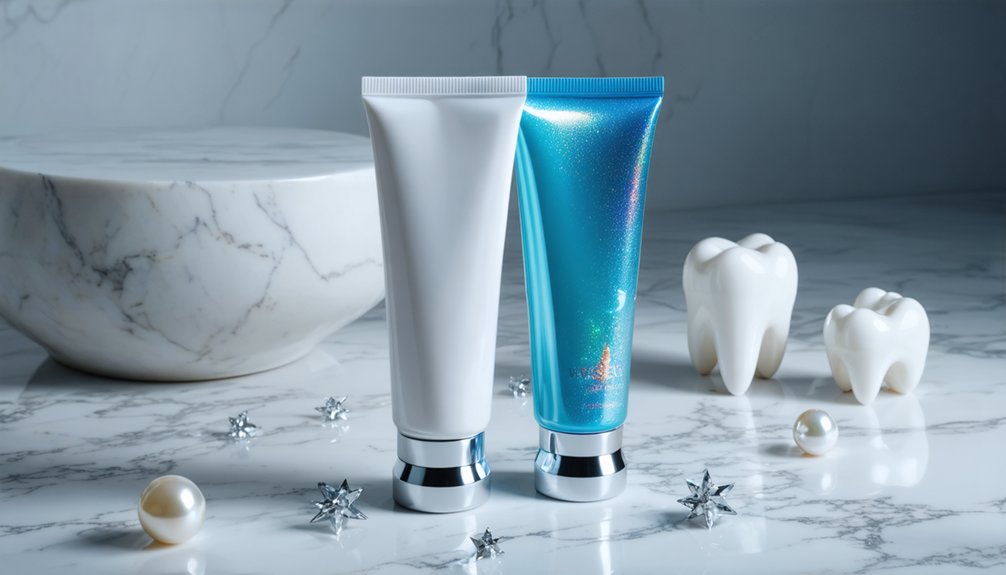
Crest 3D White edges out Colgate Optic White in overall whitening performance, earning a 4.2 rating with faster, more visible results for most users. Its silica polishing particles give it a mechanical advantage, while its lighter texture distributes active ingredients more efficiently. Colgate’s 2% hydrogen peroxide formula works better on deep, set-in stains but may cause more sensitivity. Your best choice depends on your specific needs, and the detailed breakdown ahead can help you decide.
Key Takeaways
- Crest 3D White outperforms Colgate Optic White in overall whitening, earning a 4.2 rating with more visibly whiter results for most users.
- Colgate Optic White’s higher peroxide concentration makes it better suited for removing deep, set-in stains effectively.
- Crest 3D White has a lighter, foamier texture, while Colgate feels heavier and requires more effort to rinse.
- Colgate offers a gentler mint flavor rated 4.5, whereas Crest’s stronger mint intensity may not suit sensitive users.
- Crest 3D White provides better overall value, with lower long-term costs due to reduced irritation and less product needed per use.
Which Whitening Toothpaste Actually Works Better?
When it comes to real-world whitening performance, Crest 3D White consistently outperforms Colgate Optic White across both controlled tests and user experiences.
In standardized egg-whitening tests, Crest foamed actively, visibly lifted stains, and rinsed cleanly. Colgate clung to surfaces and produced less dramatic brightening despite containing 2% hydrogen peroxide.
Don’t let whitening myths mislead you — higher peroxide concentration doesn’t automatically guarantee better results.
Crest 3D White pairs peroxide with silica polishing particles, creating a more effective stain-removal mechanism. Its overall whitening rating of 4.2 outpaces Colgate in head-to-head comparisons.
Consumer preferences largely align with test data — most users report visibly whiter teeth with Crest.
If whitening is your primary goal, the evidence clearly favors Crest 3D White.
What Ingredients Are in Each Toothpaste?
Both toothpastes rely on hydrogen peroxide as their primary whitening agent, but their formulations diverge in meaningful ways. Your ingredient analysis starts here:
Colgate Optic White contains 2% hydrogen peroxide paired with sodium monofluorophosphate, offering a gentler base formula designed for surface stain lifting.
Colgate Optic White pairs 2% hydrogen peroxide with sodium monofluorophosphate for a gentler, surface-level whitening approach.
Crest 3D White uses sodium fluoride alongside a higher implied peroxide concentration, and its Brilliance variant adds silica polishing particles for enhanced abrasion-assisted whitening.
For comparative effectiveness, these distinctions matter. Silica gives Crest a mechanical advantage, physically buffing stains while peroxide chemically breaks them down.
Colgate’s formula relies more heavily on chemical action alone. If you want dual-action stain removal, Crest’s formulation delivers it. If you prefer a lower-abrasion option, Colgate’s gentler base gives you that control.
How Do They Actually Feel When You Brush?
Texture and foaming tell you a lot about how a toothpaste performs before results even appear. When you brush with Crest 3D White, you’ll notice a lighter texture that foams quickly, spreading across teeth efficiently and rinsing off cleanly. Those brushing sensations signal active ingredient distribution working in real time.
Colgate Optic White feels heavier and thicker against your teeth. It’s less foamy, clings to surfaces longer, and takes more effort to rinse away. The texture differences between these two are immediately noticeable.
Colgate does deliver a gentle mint flavor with a slight sweetness, scoring well for overall brushing experience.
If you prioritize clean-rinsing, low-abrasion performance, Crest’s lighter formula gives you a more controlled, efficient brush. Colgate’s denser texture suits those who prefer a heavier, more substantial feel.
Which One Tastes Better Day to Day?
When it comes to daily brushing, you’ll notice Colgate Optic White delivers a gentle minty flavor with a subtle sweetness, earning a 4.5 taste rating from users.
Crest 3D White, by contrast, hits you with a stronger mint scent that some find sharper during brushing.
If you prioritize a milder, more balanced flavor experience, Colgate edges ahead, though Crest’s bolder profile suits users who prefer an intense clean feeling.
Flavor Profiles Compared
Flavor is one of those daily-use factors that can determine whether you actually stick with a whitening toothpaste long-term. Your mint preferences directly shape which formula you’ll tolerate twice daily without fatigue.
Colgate Optic White delivers a gentle minty flavor with a subtle sweetness, rating 4.5 for overall taste experience. Its lower flavor intensity suits users who find aggressive mint profiles irritating or overpowering during extended brushing sessions.
Crest 3D White carries a stronger, sharper mint scent and flavor, appealing to users who associate intensity with cleanliness. However, some users report it causes mild burning around the lips, which can discourage consistent use.
If sensitivity around your mouth is a concern, Colgate’s milder profile gives you greater daily control.
Daily Brushing Experience
Beyond taste alone, 3 factors shape how each toothpaste actually performs during daily use: texture, foam, and rinse behavior.
Crest 3D White feels lighter and foams actively during brushing, making it easier to integrate into fast-paced daily routines. It rinses cleanly, leaving no residue. If your brushing techniques prioritize efficiency, Crest delivers a cleaner post-brush result.
Colgate Optic White runs thicker, clings longer, and produces less foam. It burns slightly on skin around the mouth, which you’ll notice during extended brushing sessions.
However, its gentle mint with subtle sweetness earns consistent taste ratings of 4.5.
Your choice depends on what you optimize for: Crest wins on performance efficiency, while Colgate offers a smoother, more pleasant sensory experience during daily routines.
Which One Is Gentler on Sensitive Mouths?
Sensitivity matters just as much as whitening power, especially if you’ve got a reactive mouth.
Crest 3D White is easier on the skin around your lips, producing less burning compared to Colgate Optic White. In direct sensitivity comparison testing, Colgate’s formula clung more aggressively to surfaces and caused mild irritation around the mouth area.
Crest 3D White burns less and irritates less — a clear win for sensitive mouths over Colgate Optic White.
If mouth comfort is your priority, Crest’s lighter, low-abrasion formula gives you a measurable advantage. Colgate Optic White’s higher-viscosity base and 2% hydrogen peroxide concentration can trigger sensitivity in users with reactive gum tissue.
Crest 3D White Radiant Mint specifically targets low abrasion, making it the more clinically sound choice if you’re managing sensitivity while still pursuing effective whitening results.
What Do Real Users Say About Long-Term Results?
When it comes to long-term results, real users consistently report that Crest 3D White delivers more noticeable whitening over time. User testimonials confirm that most switchers who moved from Colgate to Crest observed a measurable brightness improvement within weeks.
Long term effectiveness favors Crest, particularly among users who prioritize visible stain removal rather than maintenance.
That said, you’ll find Colgate Optic White Renewal earns loyalty among users dealing with deep, set-in stains, thanks to its high hydrogen peroxide concentration. Some users switched from Crest to Colgate specifically for that reason.
Ultimately, your long-term outcome depends on your starting point. If you want consistent, progressive whitening, Crest 3D White gives you stronger, more reliable results backed by repeated user testimonials and comparative testing data.
Which One Should You Actually Buy?
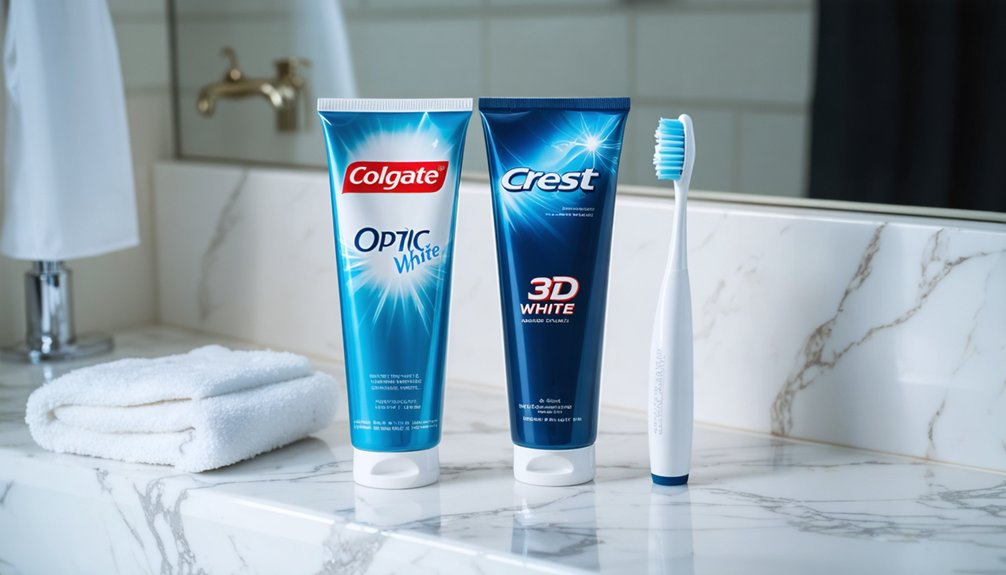
Your buying decision should hinge on three practical factors: your budget, your whitening goals, and your tooth sensitivity.
If you’re chasing aggressive stain removal, Crest 3D White’s superior peroxide-and-silica formula delivers measurably better results, while Colgate Optic White suits those prioritizing a gentler, more comfortable experience.
Sensitive teeth shift the equation further, since Crest 3D White causes less irritation around the mouth, making it the more tolerable daily-use option for reactive users.
Budget And Value Considerations
Both toothpastes sit in a similar price range, but the better value depends on what you’re actually trying to fix. Use this cost comparison and value assessment to guide your decision:
- Whitening priority: Crest 3D White delivers stronger whitening performance per dollar spent.
- Deep stain removal: Colgate Optic White Renewal justifies its price with high hydrogen peroxide concentration.
- Sensitive skin: Crest causes less irritation around the mouth, reducing secondary costs.
- Texture preference: Colgate’s thicker formula may require more product per use, affecting longevity.
- Enamel safety: Crest 3D White Brilliance offers peroxide plus silica without compromising enamel.
If whitening is your primary goal, Crest 3D White gives you more measurable results for comparable spend.
Your Whitening Goals Matter
Choosing the right toothpaste comes down to what you’re actually trying to accomplish.
If your whitening frequency is daily and your desired brightness level is moderate, Colgate Optic White’s 2% hydrogen peroxide formula delivers consistent, gentle stain removal without aggressive abrasion. It’s better suited for maintenance and sensitivity-prone users.
If you’re targeting deeper, more stubborn stains and want faster, more dramatic results, Crest 3D White Brilliance is your stronger option. Its peroxide-and-silica combination outperformed Colgate in direct whitening tests, foaming better and rinsing cleaner.
Match the product to your specific need.
Don’t over-invest in a high-peroxide formula if you only need upkeep. Conversely, don’t settle for a maintenance formula when you’re chasing a meaningful brightness shift.
Sensitive Teeth Or Not
Sensitivity changes everything when you’re picking between these two. Crest 3D White Brilliance is enamel-safe and lower-abrasion, making it more suitable if your sensitivity levels are elevated.
Colgate Optic White’s thicker formula and higher hydrogen peroxide concentration can intensify sensitivity for vulnerable enamel.
Match your choice to your teeth’s actual condition:
- High sensitivity → Crest 3D White Radiant Mint, low-abrasion formula
- Sturdy enamel → Colgate Optic White Renewal targets deep, stubborn stains
- Moderate sensitivity → Crest 3D White for better enamel protection without sacrificing results
- Skin sensitivity → Crest causes less burning around the lips
- Deep stain priority over sensitivity → Colgate Optic White delivers stronger peroxide action
Know your enamel condition before committing to either formula.
Frequently Asked Questions
Can Children Safely Use Colgate Optic White or Crest 3D White?
Neither toothpaste is recommended for young children’s dental health. You should consult your dentist before using these safe whitening options, as high hydrogen peroxide concentrations in both products aren’t suitable for developing teeth.
How Long Does Each Toothpaste Tube Typically Last With Daily Use?
with daily usage, both tubes typically last 4–6 weeks. Your tube longevity depends on brushing frequency and amount used—two minutes, twice daily, consuming roughly 1–2 grams per session.
Are These Whitening Toothpastes Safe to Use During Pregnancy?
You should consult your dentist before using these toothpastes during pregnancy. Their whitening ingredients, including hydrogen peroxide, lack confirmed pregnancy safety data, so you’d want professional guidance to control your oral care choices effectively.
Do Either of These Toothpastes Help Prevent Cavities Effectively?
Surprise—toothpaste actually prevents cavities! Both deliver cavity prevention through fluoride content: Crest 3D White uses sodium fluoride, while Colgate Optic White uses sodium monofluorophosphate. You’ll effectively strengthen enamel and reduce decay with either formula daily.
Where Can You Buy These Toothpastes and What Do They Cost?
You’ll find both toothpastes at major retailers like Walmart, Target, and Amazon. Price comparison shows Crest 3D White and Colgate Optic White typically range from $5–$10, giving you clear purchasing options across budgets.
References
- https://www.productplayoffs.com/crest-vs-colgate/
- https://getlivfresh.com/blogs/blog/crest-vs-colgate-toothpaste-comparison
- https://www.youtube.com/watch?v=gOa1875dz54
- https://www.beautylish.com/t/ywnxyc/crest-3d-white-vs-colgate-optic-white
- https://www.beautylish.com/v/rirwnu/crest-3d-white-vs-colgate-optic-white-review-comparision
- https://www.swartoutdental.com/blog/best-whitening-toothpastes-in-2025
- https://www.youtube.com/shorts/dWQTx1u3lWU