To remove years of coffee stains, you’ll need a layered approach targeting both surface and embedded pigments. Brush twice daily with a sodium bicarbonate whitening toothpaste, and use a baking soda paste up to twice weekly for mild abrasion. If stains persist, try whitening strips containing 6–10% hydrogen peroxide. Prevent future staining by rinsing with water immediately after drinking coffee. For deeper discoloration, professional cleaning may be necessary — and each method works differently depending on how far the stains have penetrated.
Key Takeaways
- Brush teeth twice daily with whitening toothpaste containing sodium bicarbonate, and brush within 30 minutes of drinking coffee to prevent deeper staining.
- Apply a baking soda and water paste up to twice weekly as a mild abrasive to lift stubborn coffee stains effectively.
- Use over-the-counter whitening strips with 6–10% hydrogen peroxide if stains persist after two weeks of consistent at-home treatments.
- Drink coffee through a straw and rinse your mouth with water immediately after to minimize enamel exposure and reduce staining.
- Seek professional dental cleaning when at-home remedies fail, stains resist whitening strips, or tartar buildup and enamel sensitivity worsen.
Why Coffee Stains Your Teeth So Deeply
Coffee stains your teeth so deeply because of tannins—naturally occurring compounds that bind to dental enamel and leave behind persistent discoloration.
When tannins penetrate your enamel’s microscopic pores, they embed pigments that standard brushing can’t fully reach. Plaque compounds the problem by absorbing coffee’s chromogens, accelerating buildup across your tooth surfaces.
Bacteria on your tongue and teeth further intensify staining over time.
Years of daily coffee consumption allow these pigments to evolve from surface-level discoloration into deeper, structural stains within the enamel itself.
Once stains penetrate beyond the outer layer, stain removal becomes considerably more challenging without targeted intervention.
Understanding this process gives you the precise knowledge needed to address discoloration systematically and protect your tooth enamel before damage compounds further.
How Deep Coffee Stains Actually Go
When you drink coffee, its tannins penetrate the porous surface of your enamel, embedding pigments that simple rinsing can’t dislodge.
Plaque compounds the problem by absorbing those same pigments, accelerating discoloration beyond what surface cleaning can address.
Over years of regular consumption, these stains migrate from superficial enamel pores into deeper layers, making them increasingly resistant to standard hygiene methods.
Enamel Pore Penetration
Though enamel appears solid, it’s actually a porous crystalline structure that absorbs pigmented compounds like those found in coffee. Tannins penetrate these microscopic pores and bond to the enamel surface, creating discoloration that worsens with repeated exposure.
Over time, pigments migrate deeper, making surface-level removal increasingly difficult. Your enamel care routine directly determines how far stains progress. Without consistent intervention, coffee particles settle into pores and harden, shifting from superficial discoloration to persistent structural staining.
Plaque accelerates this process by trapping additional pigments against the tooth surface. Effective stain prevention requires disrupting this cycle early. Rinsing immediately after consumption, maintaining rigorous brushing habits, and limiting prolonged enamel contact with coffee greatly reduces pigment absorption before it establishes at deeper structural levels.
Plaque Amplifies Staining
Plaque doesn’t just accumulate on your teeth — it actively worsens coffee staining by trapping pigmented compounds against the enamel surface.
Plaque buildup creates a porous, adhesive layer that absorbs chromogens from coffee far more readily than clean enamel. Once pigments penetrate this biofilm, they bond to the underlying enamel, producing discoloration that standard rinsing won’t reverse.
Controlling plaque buildup is thus central to stain prevention. When you allow plaque to persist, you’re effectively giving coffee pigments a direct route to deeper enamel layers.
Brush twice daily, floss consistently, and schedule biannual professional cleanings to disrupt this cycle. Eliminating plaque removes the primary vehicle through which coffee compounds infiltrate and set into your teeth, giving you measurable control over long-term discoloration.
Years Of Discoloration
Over time, repeated coffee exposure drives staining beyond the enamel surface into progressively deeper tooth structures. Understanding these discoloration causes helps you target stain removal more effectively.
- Tannins penetrate microscopic enamel pores, embedding pigment beneath the surface layer.
- Prolonged exposure allows chromogens to migrate into dentin, the layer beneath enamel.
- Accumulated plaque traps pigments, accelerating discoloration deeper into tooth structure.
- Years of unaddressed staining shift color from extrinsic to intrinsic, requiring stronger interventions.
- Surface stain removal becomes insufficient once pigments reach dentin, demanding professional-grade solutions.
You’re no longer dealing with superficial deposits after years of daily coffee consumption. The discoloration has structurally integrated into your teeth, meaning standard brushing alone won’t restore your baseline tooth color.
How to Brush to Lift Coffee Stains Daily
Daily brushing with the right technique is your most reliable defense against coffee stains setting into enamel. Use a soft-bristled brush twice daily for two minutes, applying consistent, circular strokes across all surfaces, including your tongue and inner tooth surfaces where residue accumulates.
Your daily routine should incorporate a whitening toothpaste containing sodium bicarbonate, which provides mild abrasive action to lift surface pigments without compromising enamel integrity. Brush within 30 minutes of consuming coffee to interrupt tannin adhesion before stains embed deeper.
Don’t neglect flossing—plaque between teeth absorbs coffee pigments rapidly, accelerating discoloration in areas your brush can’t reach. Maintaining this brushing technique consistently prevents surface stains from progressing into the persistent, deeper discoloration that requires more aggressive intervention to reverse.
The Right Whitening Toothpaste for Coffee Stains
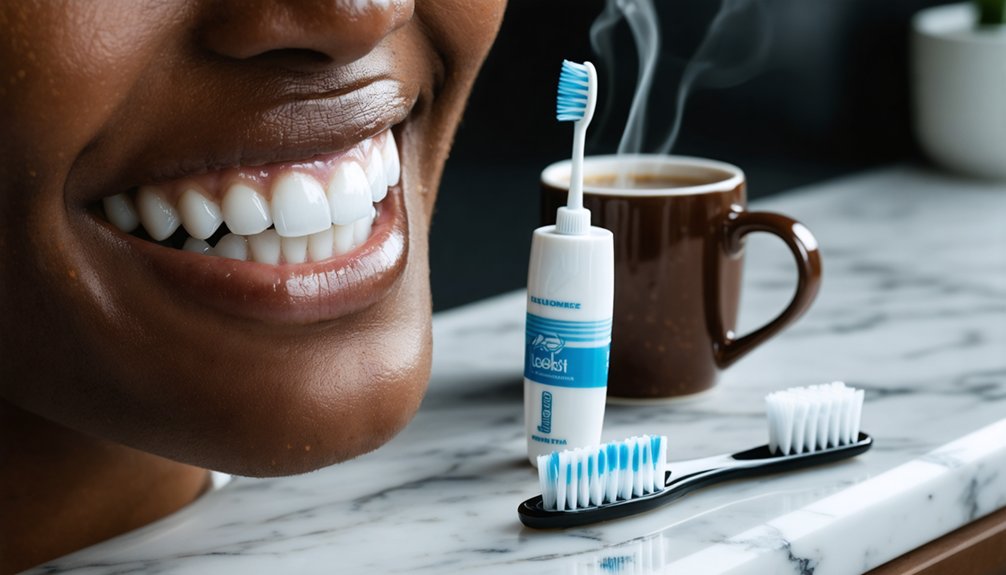
Whitening toothpastes work by incorporating mild abrasives—most notably sodium bicarbonate—that mechanically scrub surface pigments deposited by coffee tannins without chemically bleaching underlying enamel. Ingredient comparison determines whitening effectiveness considerably.
Whitening toothpastes use mild abrasives to scrub surface pigments—not chemically bleach enamel. Ingredients determine results.
- Choose ADA-sealed products like Arm & Hammer or Crest 3D Whitening for verified safety.
- Prioritize sodium bicarbonate as the primary abrasive over calcium carbonate for superior stain lift.
- Avoid high-RDA formulas exceeding 250, which compromise enamel integrity over time.
- Select toothpastes combining low-concentration hydrogen peroxide with abrasives for dual-action results.
- Use consistently twice daily to prevent coffee tannins from penetrating enamel pores.
You control stain accumulation through deliberate product selection.
Matching the right abrasive profile to your stain severity determines whether surface discoloration stays manageable or compounds into deeper, persistent discoloration.
Baking Soda Treatments for Coffee Stains at Home
Baking soda cuts through coffee stains using mild mechanical abrasion rather than chemical bleaching, making it one of the most accessible at-home treatments available.
This natural remedy works by physically scrubbing pigment from enamel pores without introducing harsh chemicals. To use it effectively, mix one teaspoon of baking soda with enough water to form a paste. Brush gently for one to two minutes, then rinse thoroughly.
You’ll notice gradual lightening with consistent application. Limit use to twice weekly, as excessive abrasion can weaken enamel over time.
For deeper stains, combining baking soda with a small amount of hydrogen peroxide increases efficacy. This approach gives you direct, measurable control over stain removal without relying on expensive professional treatments or over-the-counter products.
Oil Pulling and Apple Cider Vinegar for Coffee Stains

Oil pulling and apple cider vinegar offer two distinct natural approaches to lifting coffee stains, each working through different mechanisms. Understanding proper application maximizes oil pulling benefits and vinegar rinses while minimizing risks.
- Swish one tablespoon of coconut oil for 15–20 minutes, then spit it out—never swallow.
- Oil pulling benefits include lifting mild stains, reducing bacteria, and supporting gum health.
- Dilute one tablespoon of apple cider vinegar in one cup of water for vinegar rinses.
- Swish the diluted vinegar for 20–30 seconds, then rinse thoroughly with plain water.
- Limit vinegar rinses to several times weekly—acidity erodes enamel with overuse.
You control the frequency and method. Both options complement daily hygiene but don’t replace brushing, flossing, or professional cleanings.
Daily Habits That Prevent Coffee Stains
While removing existing stains requires effort, preventing them from forming costs far less time and delivers better long-term results. Stain prevention starts with consistent daily habits that limit pigment contact with enamel.
Prevention beats removal — consistent daily habits are your most powerful tool against long-term enamel staining.
Drink coffee through a straw to reduce direct enamel exposure. Rinse your mouth with water immediately after drinking. Brush within 30 minutes, using a soft-bristled brush for two full minutes. Floss daily to eliminate plaque that accelerates pigment absorption. Adding milk to your coffee dilutes tannin concentration, reducing discoloration risk.
If you’re exploring coffee alternatives like chicory or herbal blends, you’ll naturally reduce tannin intake altogether.
Eat crunchy vegetables and fruits to mechanically scrub tooth surfaces. These targeted habits compound over time, giving you measurable control over long-term staining.
When to Use Whitening Strips for Stubborn Coffee Stains

If daily hygiene and baking soda remedies haven’t resolved your discoloration after several weeks, you’re likely dealing with stubborn, set-in stains that require a stronger intervention.
You can gauge severity by examining whether stains appear yellowish and surface-level or have shifted toward a brownish, deeper discoloration that resists brushing.
For stubborn cases, look for ADA-approved whitening strips containing hydrogen peroxide, such as Crest 3D Whitening, as clinical evidence supports their superior efficacy over whitening toothpastes alone.
Identifying Stubborn Stain Severity
How severe are your coffee stains? Conducting an honest stain assessment helps you determine whether basic hygiene suffices or whether whitening strips are necessary.
Recognizing severity indicators early lets you intervene before discoloration becomes irreversible.
Examine your teeth against these classifications:
- Mild: Slight yellowing visible only under bright light
- Moderate: Consistent yellow-brown tone across multiple teeth
- Severe: Deep brown discoloration resistant to brushing and whitening toothpaste
- Surface stains: Respond well to abrasives and daily hygiene adjustments
- Intrinsic stains: Penetrate enamel deeply, requiring peroxide-based treatments
If your stains persist after two weeks of consistent brushing and baking soda treatments, you’ve crossed into moderate-to-severe territory.
That’s your objective signal to escalate toward whitening strips.
Choosing Effective Whitening Strips
When brushing, baking soda treatments, and whitening toothpaste fail to shift persistent brown or yellow discoloration after two consistent weeks, whitening strips become your next evidence-based intervention.
Whitening strip effectiveness depends on hydrogen peroxide concentration and consistent application. Over-the-counter strips containing 6–10% hydrogen peroxide penetrate enamel surface layers, oxidizing embedded coffee pigments that abrasives can’t reach.
For ideal strip application techniques, apply strips to dry teeth immediately after brushing, pressing firmly against enamel to eliminate air gaps that reduce peroxide contact. Wear strips for the manufacturer’s specified duration — typically 30 minutes — and avoid eating or drinking during treatment.
Complete the full recommended cycle, usually 14 days. Choose ADA-sealed products like Crest 3D Whitestrips to guarantee verified safety standards and reliable, clinically supported results.
When Professional Cleaning Is Worth It
Professional cleanings are worth pursuing once surface stains resist at-home remedies like whitening toothpastes, baking soda pastes, or whitening strips.
When at-home whitening solutions stop working, professional cleanings become the necessary next step.
Dentists remove calcified plaque and deep discoloration while protecting enamel health through controlled, clinical-grade techniques unavailable over the counter.
Consider professional cleaning when:
- Stains persist after consistent use of whitening strips or baking soda paste
- Plaque buildup has hardened into tartar, blocking stain prevention efforts
- Enamel sensitivity worsens with continued at-home whitening attempts
- Discoloration has penetrated beyond surface enamel into deeper layers
- You haven’t had a professional cleaning within the past six months
Scheduling biannual cleanings resets your baseline, giving at-home maintenance a stronger foundation.
You’ll achieve measurable results faster by combining professional intervention with a disciplined daily hygiene routine.
Frequently Asked Questions
Can Coffee Stains on Teeth Ever Become Completely Permanent and Irreversible?
Like rust on metal, deep coffee stains aren’t completely permanent — you can reverse them through consistent stain removal techniques and rigorous dental hygiene, though professional treatment may be necessary for severe, years-long discoloration.
Does the Temperature of Coffee Affect How Quickly Stains Develop?
Yes, hotter coffee opens your enamel pores wider, accelerating pigment absorption. You’ll experience faster staining because increased coffee acidity at higher temperatures intensifies penetration. Prioritize stain prevention by drinking cooler coffee and rinsing immediately afterward.
Are Certain Coffee Roasts More Likely to Stain Teeth Than Others?
Like a double-edged sword, dark roasts stain more due to higher tannin concentration, while light roasts carry greater acidity levels. Your brewing methods also influence stain intensity, so you’ll want to monitor both variables carefully.
Can Teeth Whitening Worsen Sensitivity in People With Existing Dental Problems?
Yes, whitening treatments can worsen teeth sensitivity if you have existing dental health issues. You should consult your dentist before using peroxide-based strips or pastes, as they’ll aggravate exposed roots, cavities, or enamel erosion considerably.
How Long After Whitening Treatment Should You Avoid Drinking Coffee?
After whitening products treatment, you should avoid coffee for at least 48 hours. Your enamel’s pores remain open, accelerating stain absorption. Prioritizing stain prevention during this window guarantees you’re maximizing your whitening results effectively.
References
- https://www.bridgepointedentistry.com/how-to-remove-coffee-stains-on-your-teeth/
- https://www.goodrx.com/conditions/dental-care/remove-coffee-stains-teeth
- https://www.brownroaddental.com/ways-to-remove-coffee-stains-from-your-teeth/
- https://www.averydentalwellness.com/how-to-remove-coffee-stains-from-teeth-naturally/
- https://www.healthline.com/health/dental-and-oral-health/what-does-coffee-do-to-your-teeth
- https://www.giangrecofamilydental.com/6-ways-to-remove-coffee-stains-from-your-teeth/
- https://www.youtube.com/watch?v=940WlpRuKy4