Genetic tooth discoloration remedies work when they target the structural source of the problem rather than just the surface. Conditions like dentinogenesis imperfecta and amelogenesis imperfecta cause intrinsic stains embedded deep within dentin or enamel—far beyond what store-bought whiteners can reach. Professional treatments use higher peroxide concentrations, custom trays, and restorative options like veneers or crowns to address these hereditary complexities directly. The right remedy depends entirely on your specific genetic condition, and there’s much more to uncover.
Key Takeaways
- Professional whitening uses higher peroxide concentrations that penetrate deeper into enamel and dentin, addressing hereditary discoloration more effectively than OTC products.
- Veneers and crowns physically mask or replace discolored tooth structure, bypassing genetic abnormalities that whitening cannot chemically reverse.
- Dental bonding applies composite resin directly over hereditary stains, concealing discoloration that originates within the tooth’s structural layers.
- Tailored treatment protocols account for genetic variations in enamel thickness, dentin abnormalities, and sensitivity levels, improving overall treatment effectiveness.
- Accurate professional diagnosis identifies the specific genetic condition, enabling targeted remedies that directly address the underlying cause of discoloration.
What Genetic Conditions Actually Cause Tooth Discoloration?
When your teeth resist whitening despite consistent effort, genetics may be the underlying culprit. Two primary hereditary conditions drive intrinsic discoloration: dentinogenesis imperfecta and amelogenesis imperfecta.
Dentinogenesis imperfecta disrupts normal dentin development, producing a characteristic dark amber or opalescent appearance throughout your entire dentition. It’s a structural anomaly you can’t reverse through conventional whitening alone.
Amelogenesis imperfecta targets enamel formation, leaving your teeth deficient in enamel thickness, density, and uniformity. The result is visible discoloration, mottling, and increased vulnerability to damage.
Beyond these conditions, you may simply inherit thinner, more translucent enamel that reveals the naturally yellow dentin beneath.
Your family dental history fundamentally predicts your baseline tooth color, directly influencing which treatment approach will deliver meaningful, lasting results.
Why Store-Bought Whiteners Fall Short for Inherited Stains?
When you reach for an over-the-counter whitening strip or gel, you’re targeting surface-level stains that respond to mild bleaching concentrations — but genetically inherited discoloration originates deep within the dentin or enamel structure, well beyond what these products can reach.
Intrinsic stains from conditions like dentinogenesis imperfecta or amelogenesis imperfecta resist standard bleaching chemistry, making store-bought solutions largely ineffective for your specific case.
Professional treatments, including higher-concentration peroxide gels and customized take-home trays, consistently outperform OTC options by penetrating deeper and addressing the structural nuances that genetics introduce.
OTC Whiteners’ Genetic Limitations
Though over-the-counter whitening products promise brighter smiles, they’re fundamentally ill-equipped to address inherited tooth discoloration. Their limited bleaching concentrations target surface stains, not the intrinsic structural abnormalities driving genetic discoloration.
Your genetic response to these agents varies considerably — enamel thickness, dentin composition, and saliva chemistry all influence how your teeth react.
Conditions like amelogenesis imperfecta or dentinogenesis imperfecta originate deep within tooth structure, beyond what OTC effectiveness can realistically reach. Store-bought strips and gels simply lack the clinical strength to penetrate these hereditary complexities.
You might notice minimal improvement after weeks of consistent use, yet the underlying discoloration persists unchanged.
Understanding this limitation empowers you to pursue targeted professional interventions rather than investing time and resources into treatments that won’t deliver meaningful, lasting results.
Intrinsic Stains Resist Bleaching
Inherited discoloration runs deeper than surface chemistry — and that distinction explains why store-bought whiteners consistently underperform.
When discoloration originates within the dentin or enamel structure itself — as it does in conditions like dentinogenesis imperfecta or amelogenesis imperfecta — you’re confronting intrinsic resistance that topical peroxide simply can’t penetrate effectively.
Bleaching challenges intensify because OTC formulations carry lower concentrations, designed for extrinsic stains sitting on enamel surfaces. Your genetic baseline tooth color, whether amber, gray, or yellow, reflects structural composition — not surface buildup.
Professional-grade bleaching achieves measurable improvement in documented DI cases, remaining stable at 3.5 years, but even clinical-strength agents enhance rather than fully reverse inherent color.
Understanding this distinction lets you pursue treatment with accurate expectations and strategic precision.
Professional Treatments Outperform Store-Bought
Store-bought whiteners fail at the source — they’re engineered for extrinsic staining, not the structural discoloration embedded in dentin or compromised enamel.
When genetic factors alter tooth composition at the cellular level, low-concentration peroxide gels can’t penetrate deeply enough to create meaningful change. You’re fundamentally applying a surface-level solution to a foundational problem.
Professional whitening operates differently. Higher peroxide concentrations, custom trays, and clinician-guided protocols allow targeted treatment that accounts for your unique genetic profile.
Dentists can calibrate intensity, monitor sensitivity, and sequence treatments to maximize results without compromising integrity. For conditions like dentinogenesis imperfecta or amelogenesis imperfecta, this precision isn’t optional — it’s critical.
You deserve a treatment strategy built around your biology, not a generic formula designed for coffee stains.
How Professional Bleaching Treats Genetic Tooth Discoloration?
When store-bought whiteners fail to address your genetically inherited discoloration, professional bleaching offers a more targeted and effective alternative.
Your dentist can apply 14% hydrogen peroxide gel in a controlled, take-home regimen that penetrates deeper into enamel and dentin, achieving significant shade improvement even in complex cases like dentinogenesis imperfecta.
You’ll typically see impressive, visible results within two weeks, with outcomes remaining stable for up to 3.5 years and no adverse effects observed.
Professional Bleaching Mechanisms
Professional bleaching works by using concentrated hydrogen peroxide or carbamide peroxide gels to penetrate the enamel and dentin, breaking down the chromogens responsible for discoloration at a molecular level.
Understanding the bleaching chemistry helps you set realistic expectations for treatment duration and outcomes.
Here’s how the process targets genetic discoloration:
- Peroxide molecules diffuse through enamel into discolored dentin layers.
- Free radicals oxidize pigmented compounds, neutralizing inherited chromogens.
- Professional-grade concentrations (14–40%) accelerate molecular breakdown beyond OTC capabilities.
- Repeated sessions progressively lighten deeply embedded genetic stains.
Your dentist controls gel concentration and exposure time, maximizing efficacy while minimizing sensitivity.
For conditions like dentinogenesis imperfecta, professional protocols deliver measurable shade improvements, with results remaining stable beyond three years when properly maintained.
Genetic Discoloration Treatment Outcomes
Outcomes from professional bleaching for genetic discoloration vary depending on the underlying hereditary condition, yet cases involving dentinogenesis imperfecta demonstrate particularly compelling results — stable shade improvements confirmed at 3.5 years with no adverse effects.
When you’re managing genetic variations in enamel composition or dentin structure, you’ll find that professional-grade hydrogen peroxide gels consistently outperform store-bought alternatives.
However, you must calibrate your treatment expectations carefully — bleaching enhances your baseline color rather than fully reversing hereditary pigmentation.
Intrinsic stains require ongoing maintenance, and your saliva’s genetically influenced pH directly affects whitening efficacy.
For conditions like amelogenesis imperfecta, you may ultimately need veneers or crowns to achieve your desired esthetic outcome.
Precision-driven planning guarantees you’re pursuing the most effective, realistic solution for your specific genetic profile.
When Do Veneers or Crowns Outperform Bleaching?
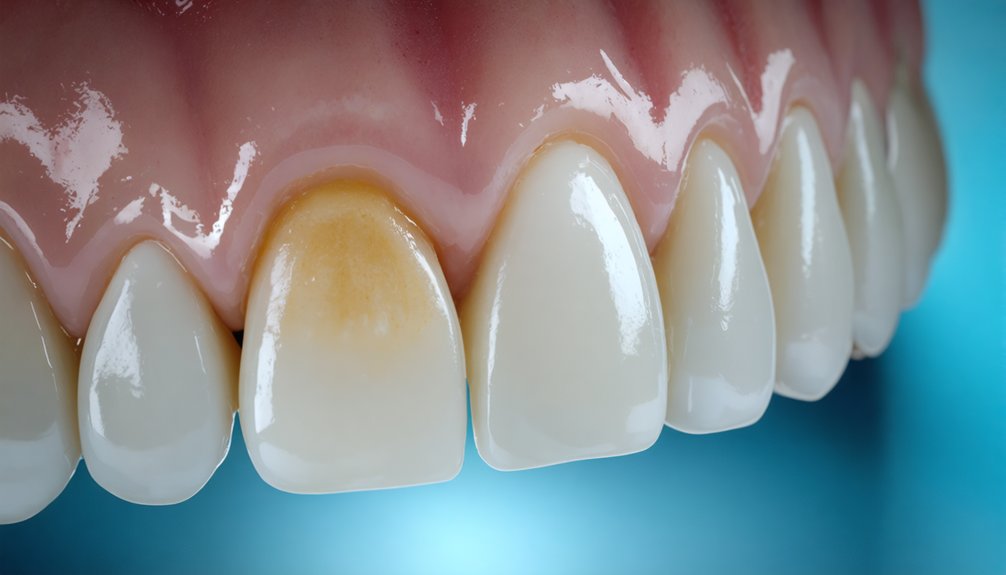
Certain genetic conditions push bleaching to its limits, making veneers or crowns the superior choice for lasting esthetic results. When intrinsic discoloration from amelogenesis imperfecta or dentinogenesis imperfecta resists whitening agents, you’ll need restorative solutions that physically replace compromised enamel surfaces.
Veneer advantages and crown benefits become decisive in these specific scenarios:
- Severe amber or gray opalescence that bleaching agents can’t penetrate sufficiently
- Structurally weakened enamel requiring protective coverage beyond cosmetic improvement
- Multiple failed bleaching attempts where intrinsic stains remain unresponsive
- Accompanying chips or fractures demanding simultaneous esthetic and structural correction
Ultra-thin porcelain veneers preserve natural tooth structure while permanently masking hereditary discoloration.
Crowns deliver thorough restoration when damage extends beyond surface-level concerns, giving you complete control over your final esthetic outcome.
What Affects Treatment Success for Genetic Tooth Discoloration?
Several interconnected variables shape how successfully any treatment addresses your genetic tooth discoloration. Your specific genetic variations directly influence how your enamel and dentin respond to bleaching agents, veneers, or bonding procedures.
Your genetic makeup directly shapes how well bleaching agents, veneers, and bonding procedures treat tooth discoloration.
Thinner enamel, hereditary dentin abnormalities, or conditions like amelogenesis imperfecta each demand distinct clinical approaches.
Your saliva’s pH and remineralization capacity, both genetically influenced, also affect how quickly and durably treatments perform. Sensitivity levels vary considerably between patients, sometimes limiting bleaching concentration or frequency.
Calibrating your treatment expectations accurately is crucial. Whitening can meaningfully improve genetically discolored teeth, but it won’t fully reverse intrinsic hereditary pigmentation.
Veneers or crowns deliver more predictable outcomes for severe cases. Partnering with your dentist guarantees your chosen protocol aligns precisely with your genetic profile and aesthetic goals.
Which Genetic Tooth Discoloration Treatment Is Right for You?
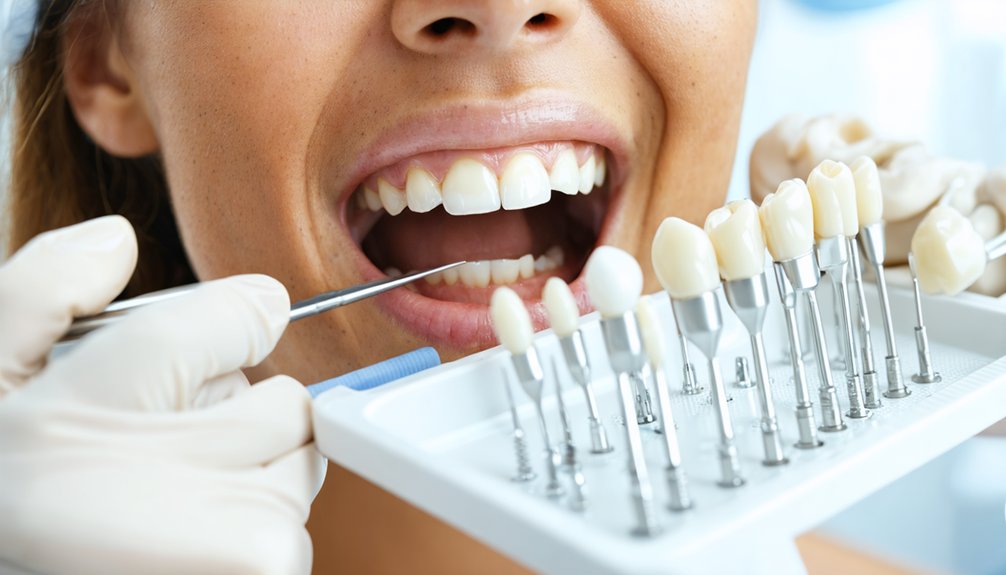
Understanding what shapes your treatment success leads naturally to the next step: matching the right solution to your specific genetic condition. Your inherited discoloration type, severity, and enamel integrity determine which approach delivers ideal results.
Consider these four targeted options:
- Personalized whitening — Professional-grade bleaching for mild-to-moderate genetic yellowing
- Dental bonding — Composite resin application concealing minor hereditary stains quickly
- Porcelain veneers — Ultra-thin coverage for moderate-to-severe intrinsic discoloration
- Crowns — Full restoration protecting structurally compromised, genetically affected teeth
You’ll want a dentist who evaluates your family dental history, enamel thickness, and sensitivity thresholds before recommending treatment.
Genetic conditions like amelogenesis imperfecta or dentinogenesis imperfecta demand precision-driven, case-specific protocols—not generalized solutions. Taking control starts with an accurate diagnosis.
Frequently Asked Questions
Can Genetic Tooth Discoloration Worsen With Age Despite Treatment?
Yes, genetic factors can cause your discoloration to worsen as aging effects thin enamel over time. You’ll need consistent professional treatments to maintain results, since whitening enhances but doesn’t fully reverse your inherited color baseline.
Does Saliva Genetics Affect How Well Whitening Treatments Perform?
Like a gatekeeper, your saliva composition, shaped by genetic variations, directly controls whitening efficacy. It influences pH and remineralization, meaning your unique genetic blueprint actively determines how effectively treatments brighten your smile.
Are There Any Long-Term Side Effects From Repeated Bleaching Treatments?
Repeated bleaching can cause sensitivity and enamel impact if you overdo it. Monitor your bleaching frequency carefully—your dentist’ll help you balance effective genetic discoloration treatment while preserving enamel integrity and achieving lasting aesthetic results.
Can Children With Genetic Tooth Disorders Receive Whitening Treatments Safely?
Over 30% of children have genetic factors affecting tooth development. You shouldn’t pursue whitening for children, as their pulp chambers are larger, increasing sensitivity risks. Prioritize children’s safety with bonding or veneers instead.
How Does Family Dental History Help Dentists Predict Treatment Outcomes?
Your family traits reveal inherited discoloration patterns, enabling dental predictions about bleaching effectiveness, veneer suitability, and sensitivity responses. You’ll gain precise treatment planning, ensuring your dentist tailors solutions that align with your genetic esthetic expectations.
References
- https://pubmed.ncbi.nlm.nih.gov/21323831/
- https://www.farmingtonvalleydental.com/blog/2022/03/28/hereditary-tooth-discoloration/
- https://nhakhoachampion.com/rang-xin-mau-bam-sinh?lang=en
- https://barcofamilydentistry.com/blog/1370673-tooth-discoloration-common-causes-and-what-you-can-do-to-stop-it
- https://mystldentist.com/teeth-whitening-and-the-role-of-genetics-what-you-cant-control/
- https://www.dentistryofthequeencity.com/2024/11/treatment-options-for-tooth-discoloration/
- https://yourauroradentist.com/how-genetics-influence-teeth-whitening-results/
- https://my.clevelandclinic.org/health/diseases/amelogenesis-imperfecta
- https://www.budadental.com/blog/stained-teeth-and-the-role-of-genetics/