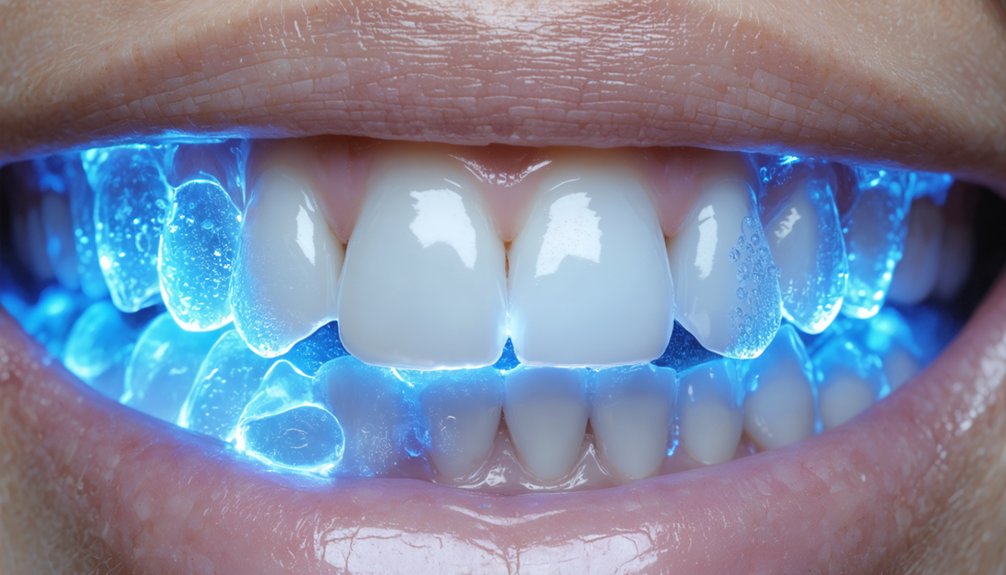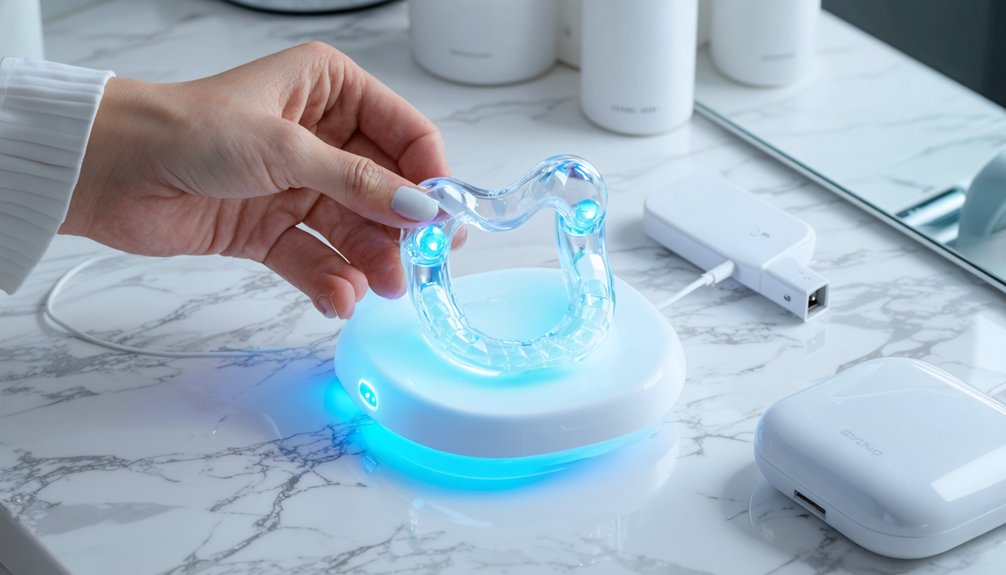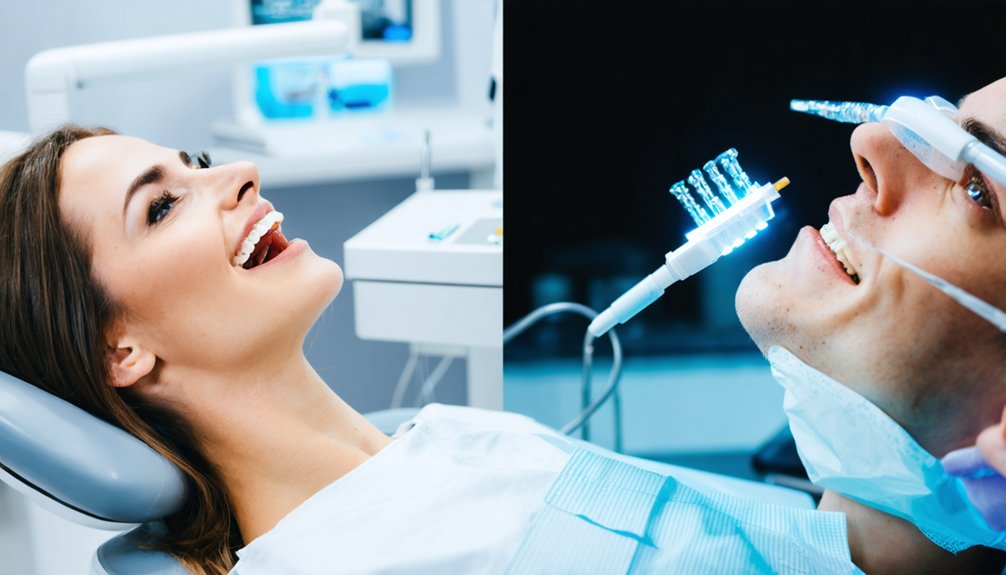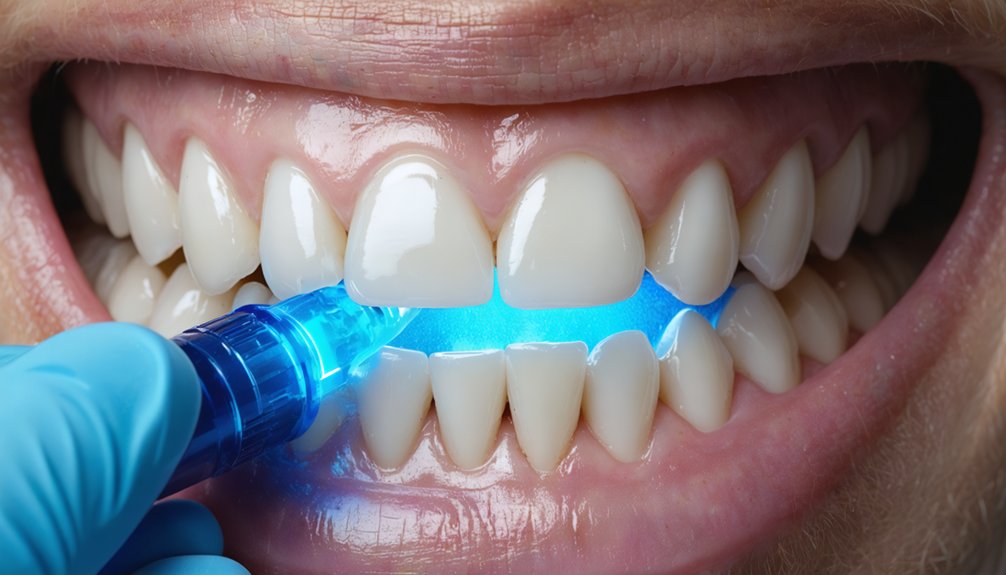
For teeth whitening, you’ll get the best results using blue light in the 450–480 nm range. This wavelength aligns precisely with the absorption peaks of peroxide-based photosensitizers, triggering reactive oxygen species that oxidize and break down enamel stains. It’s clinically validated to improve whitening effectiveness by up to 50% compared to peroxide alone, while minimizing post-operative sensitivity. Understanding exactly how wavelength variables interact with your specific gel formulation can sharpen your results even further.
Key Takeaways
- Blue light at 450–480 nm is the optimal wavelength range for teeth whitening, aligning with photosensitizer absorption peaks in peroxide-based gels.
- Hydrogen peroxide activates best between 450–460 nm, while carbamide peroxide responds most effectively near 465 nm.
- Blue light can achieve up to six shades of improvement in just 15 minutes of treatment.
- Violet light (405–410 nm) carries higher photon energy, increasing temperature risk and post-operative sensitivity compared to blue light.
- UV light is excluded from modern whitening protocols entirely due to risks of tissue damage.
How Blue Light Actually Whitens Your Teeth
Blue light doesn’t bleach your teeth directly — instead, it accelerates the chemical breakdown of hydrogen peroxide in the whitening gel.
When you apply blue light within the 450–480 nm range, the photons trigger photolysis, converting hydrogen peroxide into reactive oxygen species (ROS). These ROS oxidize chromogens embedded within your enamel, targeting the stained particles responsible for discoloration.
Light absorption by the gel’s photosensitizers is what drives this reaction. Without light, peroxide works slowly through chemical diffusion alone.
With precise wavelength activation, you’re initiating a faster, more controlled oxidation process. This mechanism directly improves whitening effectiveness by up to 50% compared to peroxide-only treatments.
You’re not relying on heat or abrasion — you’re leveraging photochemical precision to achieve measurable, accelerated shade improvement.
The Blue Light Sweet Spot: 450 Nm to 480 Nm
The 450–480 nm range represents the ideal activation window for teeth whitening, where photon energy aligns precisely with the absorption peaks of peroxide-based gel photosensitizers.
The 450–480 nm window targets peroxide photosensitizer absorption peaks with precision, maximizing whitening activation efficiency.
Within this band, blue light benefits become measurable—photons carry sufficient energy to accelerate hydrogen peroxide photolysis without generating excessive thermal output.
You’re targeting a reaction window where carbamide and hydrogen peroxide break down into reactive oxygen species at maximum efficiency.
Wavelengths near 465 nm demonstrate particularly strong alignment with photosensitizer absorption curves, directly increasing whitening efficacy compared to broader or less targeted spectrums.
Devices operating outside this range sacrifice activation precision, reducing clinical outcomes.
When you select a system calibrated to 450–480 nm, you’re optimizing the photochemical process at its most controllable and effective point.
How Do Blue and Violet Wavelengths Compare for Whitening?
When comparing blue and violet wavelengths for teeth whitening, you’re evaluating two distinct photochemical mechanisms operating at different energy levels.
In the blue light versus violet light effectiveness comparison, each wavelength delivers measurable but differentiated outcomes:
- Activation mechanism — Blue light (450–480 nm) accelerates hydrogen peroxide decomposition into reactive oxygen species, targeting chemical oxidation.
- Energy density — Violet light (405–410 nm) carries higher photon energy, facilitating physical chromophore disintegration.
- Post-operative sensitivity — Violet light protocols report reduced patient discomfort compared to blue light applications.
- Treatment efficiency — Blue light achieves up to six shades improvement in 15 minutes; violet light produces comparable results with faster molecular breakdown.
Your best choice depends on gel formulation, patient sensitivity thresholds, and device wavelength specifications.
Which Wavelength Produces the Fastest Results?
When selecting a whitening light, you’ll find that shorter wavelengths within the blue spectrum carry higher photon energy, accelerating hydrogen peroxide breakdown into reactive oxygen species more rapidly.
The 450 nm to 460 nm range delivers the most efficient carbamide peroxide activation, matching the absorption peaks of common photosensitizers in professional-grade gels.
Shorter Wavelengths React Faster
Among the wavelengths used in photochemical teeth whitening, shorter ones within the blue and violet spectrum consistently produce faster bleaching results. Higher photon energy at lower wavelengths accelerates the breakdown of whitening agents into reactive oxygen species, directly improving treatment effectiveness and color change.
Here’s why shorter wavelengths optimize your results:
- Photon energy increases as wavelength decreases, speeding stain removal at the molecular level.
- Whitening agents activate faster when light technology aligns with their peak absorption range.
- Color change occurs more rapidly, reducing total chair time without compromising dental health.
- Patient comfort improves through shorter exposure durations, minimizing pulp temperature elevation.
Wavelengths between 405 nm and 460 nm deliver the most clinically efficient activation, giving you measurable whitening outcomes with precision-controlled light application.
Optimal Activation Wavelength Range
Identifying the exact wavelength that produces the fastest whitening results narrows the focus to a precise sub-range within the broader blue and violet spectrum.
For wavelength enhancement, you’ll want to target 450 nm to 480 nm, where blue light aligns most effectively with peroxide absorption peaks. Within this band, wavelengths near 465 nm deliver ideal carbamide peroxide breakdown, accelerating reactive oxygen species generation with precision.
Light intensity compounds this effect—higher output within the validated range drives faster photolysis without exceeding thermal safety thresholds.
Violet light at 405 nm to 410 nm offers an alternative sub-range, providing higher photon energy for physical chromophore degradation.
Matching your device’s specific wavelength output to your gel formulation guarantees you’re extracting maximum reaction speed from every session.
Light Reduces Treatment Time
Matching your device’s wavelength to your gel’s absorption peak doesn’t just optimize chemistry—it directly cuts the time you spend in the chair.
Proper wavelength alignment maximizes treatment efficiency by accelerating peroxide photolysis at the molecular level.
Here’s what optimized whitening technology delivers:
- A single 15-minute in-office session can produce up to six shades of improvement.
- Wavelengths between 450 nm and 460 nm activate carbamide peroxide faster than broader-spectrum alternatives.
- Light-assisted protocols reduce total treatment time by up to 30% compared to peroxide alone.
- Fractionated light application maintains reaction speed while controlling thermal exposure.
You’re not waiting longer for better results—you’re engineering the reaction to perform faster by selecting the precise wavelength your gel requires.
Does Wavelength Affect Sensitivity and Safety?
When selecting a whitening light, you’ll find that wavelength directly influences both your pain response and overall tissue safety.
Blue light in the 450–490 nm range minimizes post-operative sensitivity, while violet light at 405–410 nm carries higher photon energy that can increase pulp and buccal surface temperatures if applied continuously.
You can reduce thermal risk across both spectrums by using fractionated light protocols, which maintain efficacy while protecting enamel and pulp integrity.
Wavelength and Pain Response
The wavelength you choose for teeth whitening doesn’t just affect speed and efficacy—it directly influences post-operative sensitivity and thermal safety. Understanding how wavelength sensitivity correlates with pain perception gives you precise control over your treatment outcome.
- Blue light (450–480 nm) minimizes thermal spikes, reducing pulp irritation during activation.
- Violet light (405–410 nm) carries higher photon energy, increasing temperature elevation risk without proper fractionation.
- Fractionated application of either wavelength considerably lowers pain perception compared to continuous exposure.
- UV wavelengths are clinically avoided due to documented tissue damage and elevated sensitivity responses.
Selecting the correct wavelength and application protocol lets you balance whitening speed against thermal tolerance—keeping treatment effective, controlled, and tissue-safe.
Safety Across Light Spectrums
Wavelength selection directly determines how safely your tissues respond throughout the bleaching process.
Blue light between 400 nm and 500 nm operates within established therapeutic limits, minimizing pulp temperature spikes and reducing post-operative sensitivity.
Shorter wavelengths, particularly violet at 405–410 nm, carry higher photon energy, which intensifies wavelength effects on both stain degradation and thermal output. You must account for this tradeoff when selecting a protocol.
Fractionated application remains one of the most effective safety measures across both blue and violet spectrums, as it prevents continuous heat accumulation against dental tissues.
UV light carries unacceptable tissue damage risks and is excluded from modern protocols entirely.
Matching your chosen wavelength to a clinically validated device guarantees you maximize bleaching efficacy while keeping pulp and enamel exposure within safe thermal thresholds.
How to Match Your Wavelength to Your Whitening Gel
Matching your light source to your whitening gel’s formulation is essential for maximizing photochemical activation. Gel compatibility directly determines which wavelength selection produces ideal reactive oxygen species output.
Follow these four criteria:
- Identify your gel’s active agent — hydrogen peroxide activates best between 450–460 nm; carbamide peroxide responds most effectively near 465 nm.
- Confirm photosensitizer presence — gels containing photosensitizers require precise wavelength alignment with their absorption peaks.
- Match device specifications to manufacturer recommendations — use only clinically validated devices specifying wavelengths within 400–490 nm.
- Adjust for treatment setting — in-office gels support higher-concentration activation; at-home formulations require lower-intensity, longer-duration light exposure.
You control outcomes by treating wavelength selection as a technical variable, not an afterthought.
What to Look for in a Wavelength-Validated Whitening Device
Selecting a wavelength-validated whitening device requires you to evaluate specific technical criteria before committing to any system. Confirm the manufacturer specifies an emission range between 400 nm and 490 nm, with wavelength calibration documented through clinical validation.
Vague claims without spectral data indicate unreliable device features. Prioritize units that disclose exact nanometer output, LED power density, and gel compatibility data.
Dual-wavelength systems offering blue for peroxide activation and red for enamel support provide measurable multi-functional value. You’ll also want fractionated light modes available, as continuous application increases pulp temperature risk.
Cross-reference the device’s wavelength output against your gel’s photosensitizer absorption peak. Devices lacking published validation studies or precise wavelength calibration specifications shouldn’t be trusted for consistent, controlled whitening outcomes.
Frequently Asked Questions
Can Wavelength Affect How Long Teeth Whitening Results Actually Last?
Wavelength doesn’t directly determine whitening duration, but your light exposure intensity and chosen wavelength optimize gel activation depth, influencing how long whitening duration persists by thoroughly oxidizing chromogens within enamel for more stable, lasting results.
Are Certain Tooth Shades or Stain Types More Responsive to Specific Wavelengths?
Yes, your tooth color responsiveness and stain type variation directly influence wavelength effectiveness. Violet light targets chromophore-based stains more precisely, while blue wavelengths better address surface discoloration, letting you optimize treatment selection based on your specific stain composition.
Does Enamel Thickness Influence How Effectively Light Wavelengths Penetrate During Whitening?
Yes, enamel thickness does influence penetration—thicker enamel affects light absorption and slows wavelength reach. Your enamel composition determines how efficiently blue light activates the whitening gel beneath the surface during treatment.
Can At-Home Devices Replicate the Wavelength Precision of Professional Dental Equipment?
At-home devices can’t fully replicate professional wavelength precision, but quality kits validated within the 400–490 nm range maintain acceptable light safety and device efficiency, giving you reliable blue LED activation for effective peroxide-based whitening results.
Do Different Wavelengths Affect Crowns, Veneers, or Bonding Differently Than Natural Teeth?
Yes, wavelengths affect restorations completely differently than natural teeth. Crown materials, veneer sensitivity, and bonding durability don’t respond to the whitening process—only your natural tooth enamel reacts to light-activated peroxide oxidation.
References
- https://www.powsmart.com/invest-how-wavelength-impacts-whitening-results/
- https://www.powsmart.com/wavelength-of-blue-light-teeth-whitening-device/
- https://www.double-white.com/best-teeth-whitening-light-complete-guide-to-safe-effective-whitening.html
- https://www.cdhp.org/why-is-blue-light-used-for-teeth-whitening/
- https://www.pioon.com/en/events/blogs/laser-light-teeth-whitening-difference-between-diode-laser-and-led.html
- https://iosrjournals.org/iosr-jdms/papers/Vol23-issue4/Ser-4/L2304044451.pdf
- https://pmc.ncbi.nlm.nih.gov/articles/PMC3466022/
- https://www.powsmart.com/led-light-source-for-dental-whitening-device/
- https://pmc.ncbi.nlm.nih.gov/articles/PMC12788505/
- https://www.atmbio.com/blog/best-teeth-whitening-light-options-today/